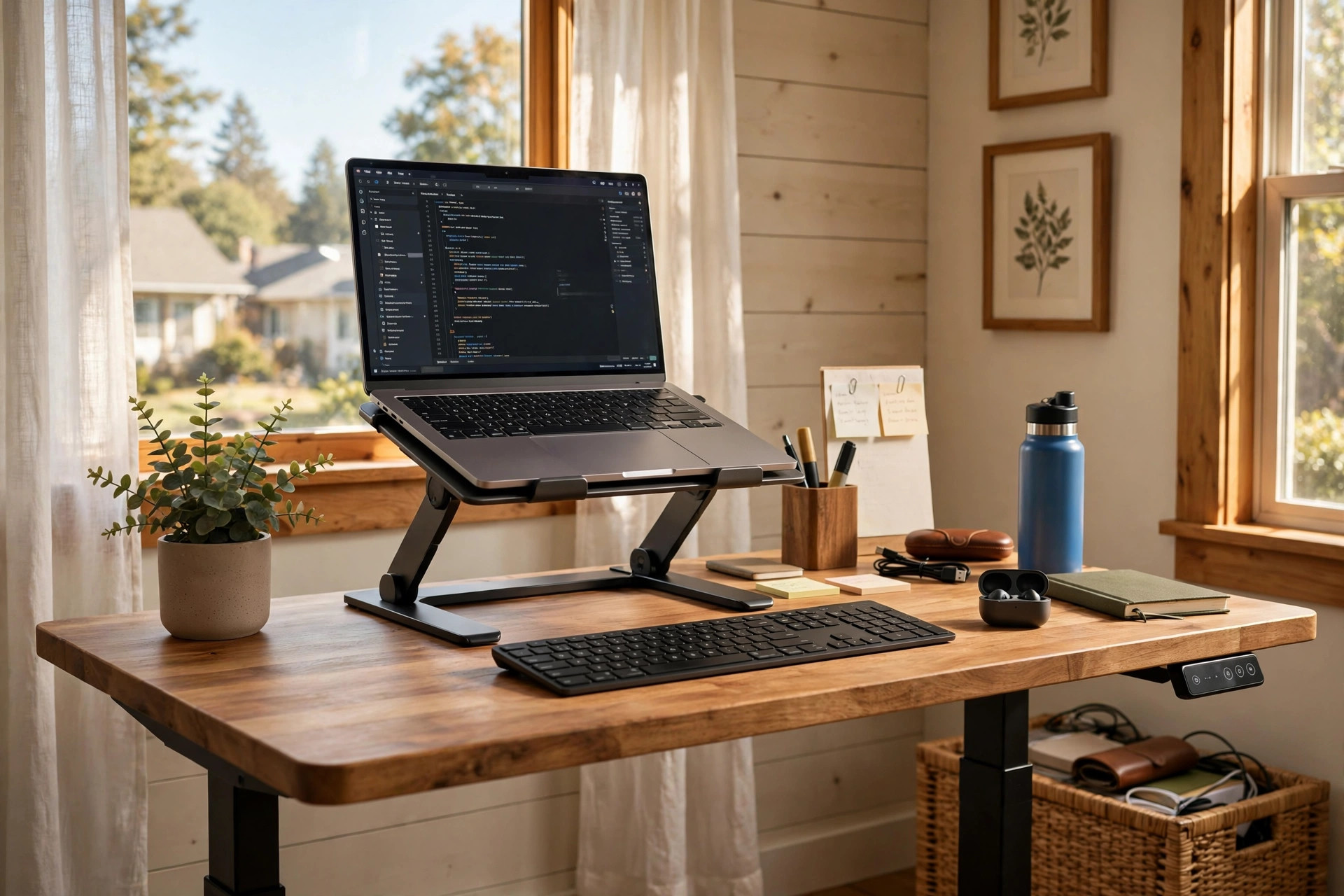

Many people now work from home at height-adjustable desks. They stand for part of the day and sit for the rest. When they stand, one problem appears right away. The laptop screen sits too low. The head tilts down. The neck bends forward. The shoulders round. An ergonomic laptop riser for standing desk height solves this problem. It lifts the laptop several inches above the desk surface. The screen rises to eye level. The head stays straight. The shoulders stay back. This simple piece of equipment can change how the whole workday feels.
Why It Matters
The human neck is built to hold the head in a neutral position. In that position, the ears sit above the shoulders. The eyes look straight ahead. A laptop on a bare desk breaks this position. The screen is too low. The user looks down at it. For every inch the head leans forward, the neck muscles carry more load. Over a full workday, this adds up to real pain. People report stiff necks, sore shoulders, and headaches.
Standing does not fix this by itself. When a person stands at a standing desk, the desk surface rises to elbow height. That is correct for typing. But the laptop screen stays at desk height. The eyes still look down. The neck still bends. An ergonomic laptop riser for standing desk height closes this gap. It raises the screen while the keyboard position stays where it should be. The eyes meet the screen at a natural level.
Workplace ergonomics researchers have long said that the top of the screen should sit at or just below eye level. When the user stands, eye level moves up by several inches compared to sitting. A riser built for standing height must reach higher than a riser built only for sitting. That is the key point of this whole buying guide.
Better posture also helps the work itself. When the neck and back are comfortable, the mind can focus. Many home workers say they stand longer and take fewer breaks once their screen is at the right height. The desk becomes a place they enjoy using instead of a place that hurts them.
What to Look For When You Buy One: Ergonomic Laptop Riser for Standing Desk Height
Not all laptop risers reach true standing height. Many are built for sitting. They add three or four inches of lift. That is enough at a sitting desk. It is not enough when the user stands. Below are the points that matter most.
Height Range
Check the maximum height first. A riser for sitting may lift the laptop base by four inches. A true ergonomic laptop riser for standing desk height should lift it six to nine inches or more. The right number depends on the person. Taller people need more lift. The goal is simple. The top of the screen should land at eye level while standing. Measure your standing eye height if you can. Then compare it with the riser’s lift range. Ergonomic furniture makers publish detailed height charts that show how to measure this at home.
Stability
A riser holds a laptop worth many hundreds of dollars. It must not wobble. Look for a wide base and solid joints. Metal frames beat plastic ones for steadiness. If the riser shakes when you type, the screen will shake too. That strains the eyes. Many buyers read independent product testers before they choose, because stability reports are hard to judge from photos alone.
Airflow and Cooling
Laptops get hot. A solid flat riser can trap heat under the machine. The best risers use open frames or vented plates. Air flows under the laptop. The fans can breathe. Some risers add built-in cooling fans. Those help but they are not a must. An open metal design is often enough for a normal office workload.
Weight Limit
Check the maximum weight the riser supports. Most thin laptops weigh three to four pounds. Large gaming laptops can weigh seven pounds or more. The riser should support your machine with margin to spare. A riser rated for ten pounds or more handles nearly every office laptop with ease.
Fit With Your Desk Setup
Think about the whole desk. A riser takes up desk space. It should leave room for a mouse, a notebook, and a cup of coffee. If you use an external keyboard and mouse, the riser only needs to hold the screen. If you type on the laptop keyboard itself, the riser tilts the keyboard toward you. That is workable for short periods. For long days, an external keyboard is the better choice. It lets the screen stay high while the hands stay at elbow height. A full ergonomic standing desk for small home office pairs well with this kind of riser.
Types and Options
Risers come in several designs. Each suits a different kind of worker.
Folding Portable Risers
These are light and thin. They fold flat. You can carry one in a laptop bag. They lift the laptop about five to seven inches. They suit people who move between home and office. They cost the least. But they may wobble under heavy laptops. They also take time to fold and unfold each day.
Scissor-Lift Risers
These use a crossing-arm frame, like a pair of scissors. You squeeze or turn a handle to change the height. They reach true standing height. Many rise eight inches or more. They are the most direct answer to the standing problem. They are heavier than folding risers. Once set, most people leave them on the desk. Home office guides often rank this style highly for daily standing use.
Desk Converter Risers
These are large platforms that hold a laptop, a monitor, or both. They sit on top of a normal desk. They rise on their own frame. They cost more. They suit workers who do not have a height-adjustable desk yet. They turn a fixed desk into a stand-up station. They take up a lot of desk space. Measure your desk before you buy one.
Wall-Mounted Shelves
A shelf on the wall can hold a laptop at standing eye level. This is a fixed solution. It cannot move up and down. It suits a dedicated standing spot, such as a room corner where you stand for calls. Furniture retailers and flat-pack shops carry simple wall shelf kits that work for this purpose. The install takes basic tools and a free afternoon.
Which One Suits a Standing Desk
If you already own a standing desk, the scissor-lift riser is usually the best match. The desk handles the sitting-to-standing change. The riser handles the extra screen lift. The two move together. Together they form a complete best laptop stand for standing desk posture setup. Folding risers are a fine second choice for travel days.
Cost and Price
Prices vary widely. A simple folding riser costs between fifteen and forty dollars. It uses light aluminum. It does the job for basic needs. A quality scissor-lift riser costs between fifty and one hundred twenty dollars. Metal frames, smooth height locks, and vented plates push the price up. Desk converter platforms run from one hundred fifty to four hundred dollars. Large models with dual tiers cost the most.
Think about the value, not just the price. A sixty-dollar riser that removes daily neck pain is cheap. A twenty-dollar riser that wobbles and slides is dear at any price. Buyers who compare flat-pack desk parts prices with stand-alone risers sometimes find that a simple shelf bracket and a sturdy shelf cost less than a branded riser. That can work, but it gives up easy height adjustment.
Also consider what else the setup may need. An external keyboard costs twenty to sixty dollars. A wireless mouse costs about the same. A small ergonomic footrest for under desk at home can make standing sessions more comfortable. The full kit still costs less than one visit to a back specialist.
Care and Upkeep
A laptop riser needs little care. Wipe it down once a month with a damp cloth. Dust collects under the frame. Dust holds heat. A clean riser keeps the laptop cooler. Check the screws and joints twice a year. Tighten anything that has loosened. A loose joint is the first sign of wobble.
Keep liquids away. Coffee and water can damage the laptop long before they hurt the riser. A spill that runs under the riser is hard to clean. Many workers keep drinks on a side table instead of the desk. That simple habit protects the whole setup.
If your riser has moving parts, a drop of machine oil on the hinges once a year keeps them smooth. Do not use cooking oil. It turns sticky over time. Do not force a stuck joint. Find the locking pin or release lever first. Forcing parts shortens the life of the riser.
Store a folding riser flat when you travel. Do not stack heavy books on it in your bag. The frame can bend. A bent frame never sits level again.
Safety
Risers are simple, but a few safety rules matter. Place the riser on a flat, stable desk surface. Push it back from the desk edge. At least two inches of desk should sit in front of the riser base. A laptop that tips off a riser can fall to the floor and break.
Do not stack risers. One riser on top of another is unstable. If one riser does not reach high enough, buy a taller model. Do not improvise with books or boxes under the riser. They shift over time.
Cables deserve attention. A charging cable that hangs from a raised laptop can catch on a chair arm. Route cables behind the desk. Cable clips cost a few dollars and prevent snags. Office furniture research labs have noted that cable management is one of the most overlooked parts of a safe desk setup.
Check the heat. Feel the bottom of your laptop after an hour of work on the riser. Warm is normal. Very hot is not. If the laptop runs hot, improve the airflow. Use a vented riser. Lift the back edge slightly. Keep the fan vents clear of dust.
Children and pets add risk. A curious child can pull a cable and drag the laptop down. A cat can knock a wobbly riser off the desk. If children or pets share the room, choose the heaviest, most stable riser you can find. Tech reviewers sometimes test stability under bumps and shakes, which is useful data for family homes.
Frequently Asked Questions
How high should a laptop riser be for a standing desk? It depends on your height. The rule is simple. The top of the screen should sit at or just below your eye level when you stand straight. Most adults need six to nine inches of lift above the desk surface. Taller people may need ten inches or more. Measure your standing eye height, then check the riser’s maximum lift before you buy.
Can I use a regular laptop stand at a standing desk? Many regular stands are built for sitting. They lift the screen only three or four inches. That leaves the screen too low when you stand. Look for a riser that states its maximum height clearly. If it cannot reach at least six inches above the desk, it is not a true standing-height riser.
Do I need an external keyboard with a riser? For short sessions, the laptop keyboard is fine. For full workdays, an external keyboard is better. It lets your hands rest at elbow height while the screen stays at eye level. This is the classic ergonomic setup. The riser handles the screen. The keyboard handles the hands. Neither one has to do both jobs.
Will a riser fit my 17-inch laptop? Check two numbers. First, the weight limit. Second, the platform width. A 17-inch laptop is wider than most 13-inch models. The riser platform should be at least as wide as your laptop. A riser that is too narrow lets the laptop rock side to side. That is annoying and unsafe.
Is a standing desk riser worth it if I only stand for one hour a day? Yes. Even one hour with the head bent forward can cause neck pain. The riser makes that hour comfortable. It also invites you to stand longer. Many people find that once the screen is at the right height, they choose to stand more often without thinking about it.
Can a laptop riser damage my laptop? A good riser will not harm a laptop. It spreads the weight across the base. It allows air to flow underneath. Avoid risers with sharp metal edges that press into the laptop shell. Avoid models that block the fan vents. If the laptop runs hot on the riser, change to a more open design.
A Final Word
An ergonomic laptop riser for standing desk height is a small buy with a large effect. It fixes the one flaw of the standing laptop setup. The screen moves up to eye level. The neck straightens. The shoulders drop. The workday feels lighter. Choose a model that reaches true standing height. Check its stability and weight limit. Pair it with an external keyboard for full days. Then enjoy standing work the way it was meant to feel.
References
Herman Miller. (n.d.). Office furniture and ergonomic seating. https://www.hermanmiller.com IKEA. (n.d.). Home furnishings. https://www.ikea.com PCMag. (n.d.). Technology product reviews. https://www.pcmag.com Steelcase. (n.d.). Office furniture and workplace research. https://www.steelcase.com The Spruce. (n.d.). Home and garden advice. https://www.thespruce.com UPLIFT Desk. (n.d.). Standing desks and ergonomic office furniture. https://www.uplift-desk.com Wayfair. (n.d.). Furniture and home goods. https://www.wayfair.com Wirecutter. (n.d.). Product reviews from The New York Times. https://www.nytimes.com/wirecutter
Was this guide helpful?

About Robert Taylor
The My Garden US editorial team writes practical, in-depth home and garden guides for American homeowners — tested advice, no fluff.
You May Also Like
Ergonomic Wrist Rest for Keyboard and Mouse: A Practical Guide
August 24, 2026 0 views
Adjustable Desk Lamp with Dimmer for Eye Strain: A Plain Guide to Gentler Desk Light
February 20, 2026 0 views
The Best Printer Stand With Storage for Home Office
January 10, 2026 0 views