
Florida homes get more sun than almost any other home in the country. That bright light is a gift, but it can also wash out a room, fade furniture, and leave windows looking bare. Luxury sheer voile panels for Florida homes solve this problem in a simple way. They soften the sunlight, keep the view of the yard or the water, and give a room a light, airy feel. This guide explains what these panels are, why they suit Florida living, how to choose them, what they cost, and how to keep them looking their best.
Why Sheer Voile Panels Matter in Florida
Florida rooms are bright by nature. Tall windows, glass doors, and lanais bring the outdoors in. Without any covering, that light can be harsh at midday. It can also make a home feel exposed. Neighbors, walkers, and cars may look straight in during the day. Sheer voile panels strike a balance. They let light pass through but break up the view from outside. You keep the glow and gain a sense of cover.
Heat is another factor. Florida summers are long, and sunlight through glass adds warmth to a room. A voile panel will not block heat the way a thick curtain will, but it does take the edge off direct sun. It spreads the light across the room instead of letting it fall in a hard band across the floor. Furniture, rugs, and floors fade more slowly when harsh rays are softened. That protection alone can save a homeowner hundreds of dollars in wear over the years.
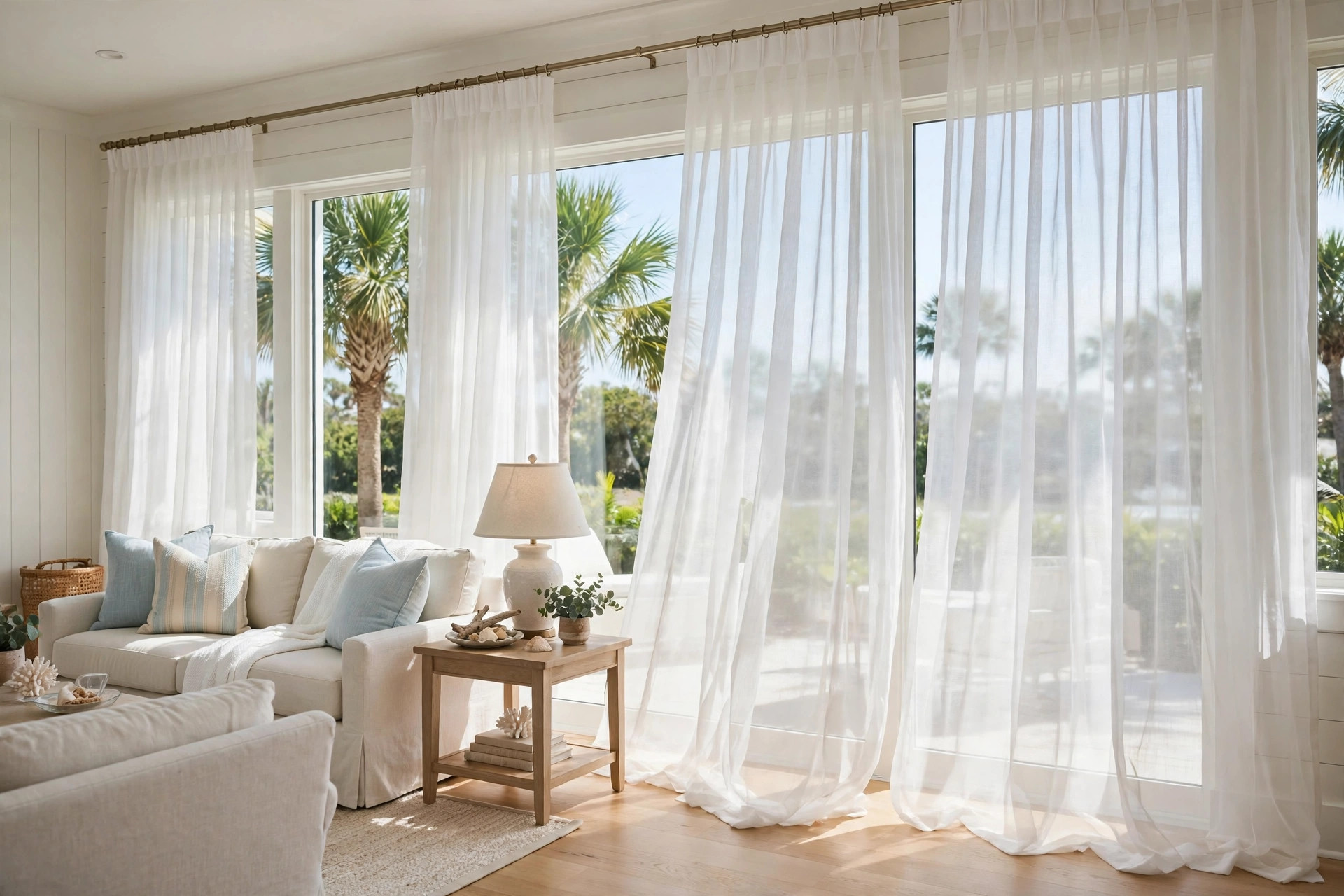
There is also the question of style. Florida homes often lean toward coastal, airy, and open designs. Heavy drapes can feel out of place in that setting. Sheer voile panels for coastal homes feel right at home. They move gently in the air from a fan or an open slider, and they give tall windows a finished look without making the room feel closed in.
What to Look For When You Shop: Luxury Sheer Voile Panels for Florida Homes
Fabric Quality
Voile is a light, plain-weave fabric. Most luxury voile panels are made from polyester, a blend of polyester and cotton, or a fine silk-like weave. For Florida, polyester is often the best pick. It stands up to sun better than cotton, and it does not stretch or sag in humid air. High-end panels use a fine, even weave with no thick spots or thin spots. Hold the panel up to the light before you buy if you can. The weave should look smooth and even.
Weight and Drape
A good voile panel falls in soft folds. It should not look stiff, and it should not cling. Luxury panels are usually cut full and wide so they hang in gentle waves. A common rule is to use a panel width that is two to three times the width of the window. This fullness is what gives voile its soft, flowing look.
Light and Privacy Balance
Sheers come in different levels of openness. Some are nearly clear. Others are dense enough to hide what is behind them. For a street-facing window, choose a denser voile. For a window that looks out on a private yard or water, a lighter weave is fine. Remember that sheers give daytime privacy only. At night, when the lights are on inside, people outside can see in.
Heading and Hardware
The top of the panel, called the heading, decides how it hangs. Rod pockets give a gathered look and are easy to hang. Back tabs give a cleaner line with soft folds. Grommets give a modern look with wide, even waves. In Florida, where homes often have sliding glass doors, many people use a traverse rod or a wide decorative rod that spans the whole door. Make sure the rod is strong enough. Wide spans of voile can get heavy, especially when doubled for fullness.
Size and Length
Measure before you buy. For a soft look, panels should just touch the floor or break slightly on it. For a clean look, they should end about half an inch above the floor. Tall Florida windows, often eight feet or more, need long panels. Many budget panels are cut short. Luxury lines offer extra-long lengths, which suit the high ceilings found in many Florida homes.
Types and Options
Single Panels Versus Sets
Voile panels are sold as single panels or in sets of two. For one narrow window, a single wide panel may be enough. For a pair of windows or a wide slider, buy sets or two singles. Always check the listed width. It is the flat width, not the gathered width. A panel listed as fifty inches wide will cover about twenty-five inches when gathered on a rod.
Plain Versus Textured Voile
Plain voile is smooth and simple. It fits modern and coastal rooms well. Textured voile has a slight crinkle, a stripe, or a woven pattern. A fine stripe or a tone-on-tone stripe can add interest without blocking light. Linen-look voile has a bit more body and a natural slub. It pairs well with rustic or farmhouse styles. Embroidered voile has stitched patterns, often along the bottom edge. It looks dressy and works well in formal living rooms and dining rooms.
Colors and Tints
White and ivory are the most common colors. They suit almost every room. For a warm room with wood floors and warm walls, ivory is softer than pure white. For a cool, modern room, pure white looks crisp. Pale gray, sand, and champagne tones work well in coastal homes. Avoid dark colors in Florida sun. Dark fabric absorbs more heat and fades faster.
Lined and Unlined
Most voile panels are unlined. That is what makes them sheer. Some luxury panels have a light lining along the edges or a band at the bottom to help them hang straight. A full lining would defeat the purpose of a sheer, so true voile panels are never fully lined. If you need both sheers and full light control, hang the voile on a double rod with a heavier curtain behind or in front of it.
Ready-Made Versus Custom
Ready-made panels are cheaper and faster. Custom panels are cut to your exact window size and offer more fabric choices. For odd sizes, such as very tall windows or wide sliders, custom may be worth the extra cost. Many Florida homes have these sizes, so custom is more common there than in other parts of the country.
Cost and Price
Prices for sheer voile panels cover a wide range. A basic ready-made panel from a large store may cost fifteen to thirty dollars. A mid-range panel with a nicer weave and a better heading may cost forty to eighty dollars. Luxury sheer voile panels for Florida homes, with fine weaves, full cuts, and extra lengths, often run eighty to two hundred dollars per panel. Custom panels can cost two hundred dollars or more per window, before hardware.
Hardware adds to the total. A basic rod may cost twenty dollars. A wide decorative rod for a slider may cost eighty to two hundred dollars. Rods that span more than eight feet need a center support bracket, which may be sold separately. If you hire a professional to measure and install, expect to pay fifty to one hundred fifty dollars per window for labor.
To keep costs down, watch for sales at large home stores. Many offer deep discounts on window treatments a few times a year. Buying all the panels for a room at once can also bring the price down, since many sellers offer volume discounts. If you want to compare styles before you buy, the large retailers are a good place to start. You can browse rods and panels at the Home Depot window treatment section and compare prices at Lowe’s curtains and drapes page before you decide.
Care and Upkeep
Voile panels collect dust, especially in Florida, where windows stay open often and sea air carries salt and fine grit. The good news is that most polyester voile panels are easy to care for.
Wash them every three to six months, or more often if you live near the beach. Use a gentle cycle with cool water and a mild detergent. Do not use bleach. It can yellow white voile and weaken the fibers. Wash panels alone or with like colors so they do not pick up lint or dye from other laundry.
Do not wring them. After the wash, shake them out and hang them back on the rod while they are still damp. They will dry smooth on their own, and the weight of the damp fabric pulls out most wrinkles. This trick saves time and avoids the need for an iron. If a wrinkle will not fall out, use a steamer on a low setting. Hold it a few inches from the fabric. A hot iron can melt polyester, so avoid direct heat.
Sun is the main cause of wear. Even polyester voile will weaken after years of strong sun. If a panel starts to feel thin or tears easily, it is time to replace it. Keep the rod brackets tight. Florida homes can face strong storms, and a loose rod can fall and tear a panel.
Safety
Sheer voile panels are light, but safety still matters. Cords are the main concern. Many older blinds and shades have looped cords, which are a strangulation risk for small children and pets. If you hang voile over existing blinds, make sure any cords are out of reach or replaced with cordless options. The U.S. Consumer Product Safety Commission offers clear guidance on window covering cord safety, and it is worth a read if you have young children.
Keep panels away from heat sources. Do not let a long panel rest against a space heater, a radiator, or an open flame such as a candle. Polyester melts and can burn. In a kitchen, keep sheers well away from the stove. Tie-backs can hold panels back from heat and from doors that swing, but use them with care around children.
For sliding glass doors, make sure the panels do not drag on the track. Fabric caught in a door track can jam the door and tear the panel. Panels for sliders should end just above the floor or be tied back during the day when the door is in use.
Frequently Asked Questions
Do sheer voile panels give privacy at night?
No. Sheers give daytime privacy only. During the day, the bright light outside makes it hard to see in. At night, indoor lights reverse the effect, and people outside can see in. For night privacy, add blinds, shades, or heavier drapes behind the voile. A double rod makes it easy to open and close both layers.
Will voile panels keep my room cooler?
They help a little. Voile softens direct sun, which cuts some of the heat that comes through glass. But a sheer will not block heat the way a lined drape or a reflective shade will. If cooling is your main goal, use the voile for looks and add a shade or a tinted film for heat control. You can read more about added privacy options in our window film privacy tint reviews and buying guide.
How wide should my panels be?
Plan on two to three times the width of your window or door. For a sixty-inch slider, use two panels that are each at least one hundred inches wide flat, or one very wide panel. Fullness is what makes voile look rich. Skimpy panels look thin and unfinished.
Can I use voile panels on sliding glass doors?
Yes. They are one of the best choices for sliders. Use a wide rod that extends past the door frame on both sides so the panels can stack off the glass when open. A traverse rod with a cord or a wand lets you draw the panels without touching the fabric, which keeps them cleaner. For a full door makeover, see our guide to top rated shutter installation services for homeowners for a layered option.
How often should I wash them?
Every three to six months is a good rule. Wash more often near the coast, where salt air leaves a film on fabric. If the panels look gray or feel gritty, they are past due. Regular washing keeps them bright and extends their life.
Do luxury voile panels fade in strong sun?
All fabric fades in time, but good polyester voile holds color well. White and ivory panels may yellow slightly after years of sun. Rotating panels and washing them on schedule slows this down. When the fabric feels thin or looks dull, replace it. For more ideas on dressing bright rooms, read our best modern geometric curtains for first time homeowners.
A Final Word
Luxury sheer voile panels for Florida homes are a small change that makes a big difference. They tame the bright sun, guard your privacy by day, and give your rooms a light, finished look that fits the Florida way of living. Choose a fine, even weave, buy enough width for full folds, and measure with care. Wash them on a regular schedule and keep cords and heat sources in mind. Do that, and your panels will serve you well for years. For fabric and craft supplies to pair with your new panels, browse JOANN’s fabric department, and for room styling ideas, the editors at The Spruce and HGTV offer plenty of bright-room inspiration. If you are starting from scratch, affordable basics at IKEA and Wayfair can help you test the look before you invest in luxury panels from a Blinds.com specialist.
References
Blinds.com. (n.d.). Window blinds, shades, and shutters. https://www.blinds.com HGTV. (n.d.). Home and garden ideas. https://www.hgtv.com IKEA. (n.d.). Home furnishings. https://www.ikea.com JOANN. (n.d.). Fabric and craft supplies. https://www.joann.com Lowe’s. (n.d.). Home improvement products. https://www.lowes.com The Home Depot. (n.d.). Home improvement products. https://www.homedepot.com The Spruce. (n.d.). Home and garden advice. https://www.thespruce.com U.S. Consumer Product Safety Commission. (n.d.). Product safety information. https://www.cpsc.gov Wayfair. (n.d.). Furniture and home goods. https://www.wayfair.com
Was this guide helpful?

About James Carter
The My Garden US editorial team writes practical, in-depth home and garden guides for American homeowners — tested advice, no fluff.
You May Also Like

Affordable Stained Glass Window Film for Southern States: A Practical Guide
June 16, 2026 0 views
How to Buy Farmhouse Style Curtains Online in Florida
May 28, 2026 0 views
Luxury Blackout Curtains for Bedrooms: A Complete Buying Guide
February 19, 2026 0 views