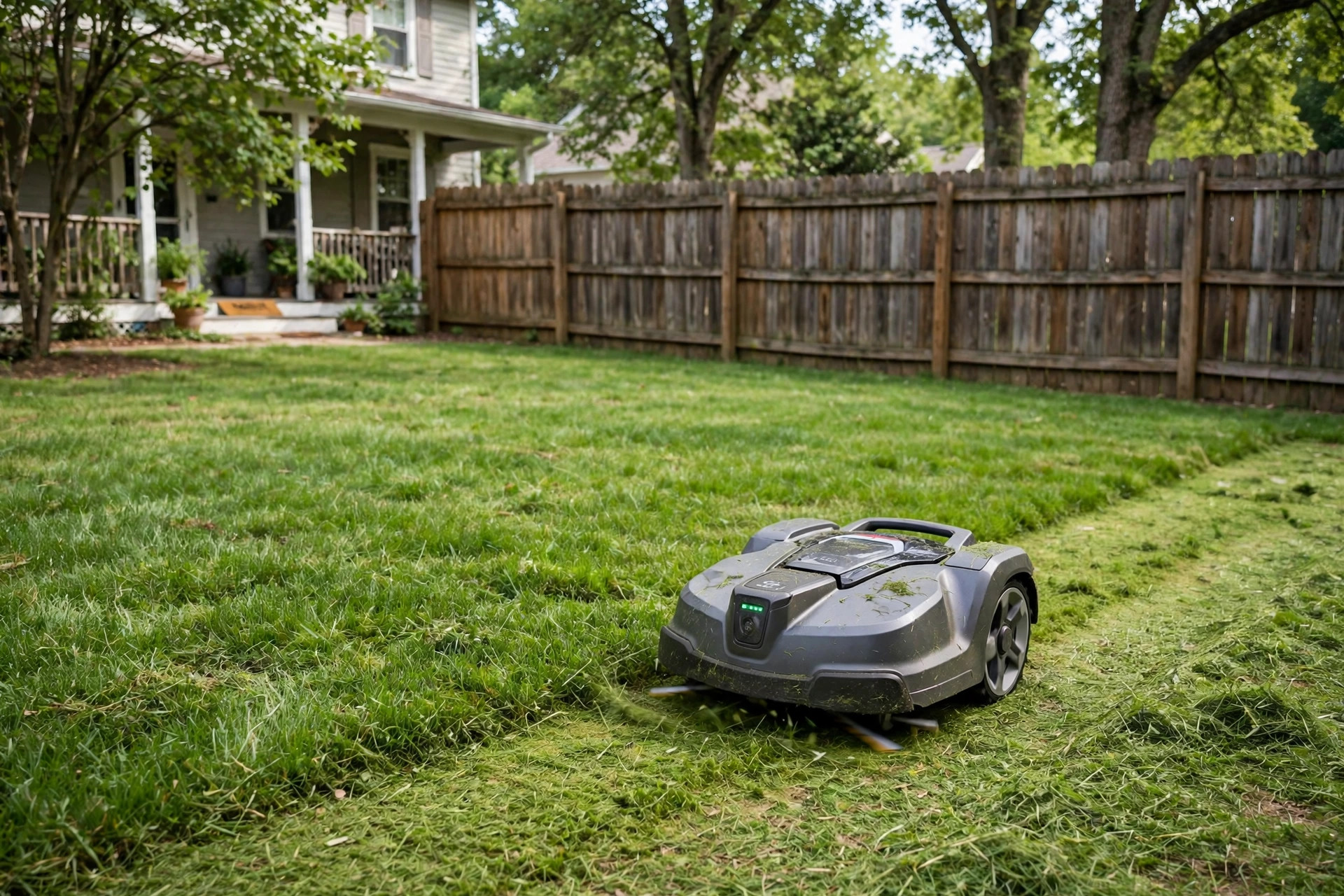

A robot lawn mower is a small machine that cuts your grass on its own. You set it up once. It leaves its charging dock on a schedule. It mows the yard while you do other things. This guide collects what robot lawn mower reviews for usa yards actually say about these machines. It covers American lawns, American weather, and real prices. It does not repeat sales talk. It tells you what owners like and what they complain about.
Many American homes have yards of a quarter acre or less. A robot mower fits these yards well. Larger yards need bigger models with stronger batteries. Reviews from across the United States agree on one point. The right machine saves hours of work each month. Independent tests from outlets such as CNET and PCMag put the leading models through weeks of real mowing each spring, and their findings line up well with owner reports. The wrong machine causes headaches and missed strips of grass.
Why It Matters
Lawn care takes time. The average American homeowner spends hours each month on the lawn during the growing season. Pushing a mower in July heat is hard work. It is harder for older people and for those with bad backs. A robot mower removes this chore. It also cuts more often than most people would. A lawn cut a little each day grows thicker and healthier. Weeds get less chance to spread.
There is a noise benefit too. Robot mowers run much quieter than gas mowers. Most make about as much noise as a quiet conversation. You can run one early in the morning or late in the evening without bothering neighbors. This matters in neighborhoods with noise rules.
Some cities and states now limit gas-powered yard tools. Battery and electric machines avoid these limits. A robot mower is fully electric. It charges from a wall outlet. Owners report lower running costs than gas mowers over time. There is no fuel to buy and no oil to change.
What to Look For: Robot Lawn Mower Reviews for Usa Yards
Reviews point to a few features that matter more than the rest. Start with yard size. Then look at how the machine finds its way around. Then check battery life and cutting height.
Yard Size and Battery
Every robot mower lists a maximum yard size. Common ratings are quarter acre, half acre, and one acre. Pick a model rated for more than your actual yard. A machine rated for half an acre works best on a yard of a third of an acre or less. Slopes and odd shapes make the mower work harder. If your yard has hills, choose a model that lists slope support. Many reviews mention that machines struggle on steep banks. Check the grade rating before you buy.
Battery life decides how much the mower cuts per trip. Small models run 60 to 90 minutes. Larger models run up to 3 hours or more. When the battery runs low, the mower returns to its dock. It charges and goes back out. A big yard may need several trips per day. This is normal. The mower handles it on its own.
Navigation: Wire or No Wire
Older designs use a boundary wire. You bury a thin wire around the edge of the lawn. The mower senses the wire and stays inside it. Wire systems are cheap and reliable. They take a few hours to install. Some owners find the wire breaks over time. Repair means finding the break and splicing it.
Newer models use GPS, cameras, or radar. These wire-free systems map the yard themselves. Setup takes minutes in an app. You draw a zone on a map of your yard. The mower follows that zone. Reviews say wire-free models are easier to start with. They cost more. They can also struggle under heavy tree cover, where GPS signals weaken. Some models combine GPS with cameras to stay accurate.
Cutting Height and Blades
Robot mowers use small razor blades. They trim a little grass each pass. This is called mulching. The fine clippings fall back into the lawn and feed it. There is nothing to bag and nothing to haul away.
Check the cutting height range. Most models adjust from about 1 inch to 4 inches. Tall fescue and other cool-season grasses do best at 3 inches or more. Bermuda and zoysia can go lower. Make sure the range fits your grass type. Blade changes are cheap and take minutes. Plan to swap blades two or three times per season.
Types and Options
Robot mowers for American yards fall into three groups. Each suits a different kind of home.
Wire-guided models. These are the classic type. They have been sold in Europe for years and are now common in the United States. They suit small to medium yards with clear edges. Prices are the lowest of the three groups. Installation takes an afternoon. Brands in this group have long track records and many parts available.
GPS and camera models. These are the newest group. They need no boundary wire. They suit renters and people who dislike digging in a wire. They also suit yards with islands, such as flower beds and trees, because zones are easy to draw in the app. Reviews note they work best with an open sky. Thick tree cover can confuse them.
Ride-on style robot tractors. These are large machines for yards of an acre or more. They cost far more than the other groups. They handle rough ground and steep slopes. Few suburban homes need them. They suit rural properties and small farms. Reviews of these models praise their power but note the high price.
Cost and Price
Prices for robot lawn mower reviews for usa yards fall into clear bands. Basic wire-guided models start near 600 dollars. Mid-range models with more features cost 1,000 to 1,800 dollars. Top wire-free models with GPS and cameras run 2,000 to 3,500 dollars. Large models for big properties can pass 5,000 dollars.
What drives the price up? Larger cutting decks cost more. GPS navigation costs more. All-wheel drive for slopes costs more. Longer battery life costs more. Smart home integration adds a little. Before you pay for extras, ask what your yard needs. A flat quarter-acre yard does not need all-wheel drive.
Running costs are low. Electricity for charging costs a few dollars per month. Replacement blades cost 10 to 30 dollars per set. A set of blades lasts 2 to 3 months in normal use. Batteries last 3 to 5 years. A new battery costs 100 to 300 dollars depending on the model. Over ten years, owners often spend less than they would on a riding mower with fuel and repairs.
Installation adds cost for wire models. You can do it yourself in a day. Paid installation runs 150 to 400 dollars in most markets. Wire-free models have no installation cost beyond the app setup.
Care and Upkeep
A robot mower needs little care, but it needs some. Clean the underside once a week during heavy growth. Grass clippings build up around the blades and wheels. A stiff brush and a garden hose do the job. Unplug the mower before you clean it. Never hose the top of the machine directly. Water can reach the electronics.
Store the mower indoors in winter. Cold weather harms batteries. Clean the machine before storage. Charge the battery to about half. Keep it in a garage or shed where it will not freeze. In spring, charge it fully and place it back on the dock. Check for software updates in the app. Updates often fix bugs and improve navigation.
Watch the boundary wire if your model uses one. Lawns shift and roots grow. A wire buried two inches deep can surface over time. Walk the wire line each spring. Push exposed sections back down. Keep a repair kit on hand. A splice kit costs under 20 dollars.
Many owners pair the mower with other yard tech. A best smart floodlight for backyard setup lets a camera watch the mower at night. Some owners check the best solar security camera reviews pages to find a camera that watches the dock. Others read best outdoor security camera without wifi subscription guides so the camera works even if the home network drops. Theft is rare, but a camera adds peace of mind. Many owners mount a Ring doorbell or yard camera so they can see the dock from their phone. A GPS tracker on the mower also helps. Some brands build one in.
Safety
Robot mowers are safe when used as directed, but they are still machines with spinning blades. The U.S. Consumer Product Safety Commission sets safety expectations for outdoor power equipment, and buyers can review general guidance at CPSC. Keep children and pets away from the mower while it runs. Teach children that the mower is not a toy. Most models stop their blades when lifted or tipped. Test this feature when you set the machine up.
Remove toys, sticks, and garden tools from the lawn before a mow. The blades are small, but they can throw pebbles. Keep the mowing schedule away from times when kids play in the yard. Many owners run the mower at night or early morning for this reason. Night mowing is quiet enough for most neighborhoods.
Check local rules. Some towns limit the hours for powered yard equipment. A robot mower is quiet, but the rule may still apply. Homeowners associations sometimes restrict them too. Ask before you buy. A quick call to the association office saves trouble later.
Lightning is a real risk. Unplug the charging dock during storms. A surge can damage the dock and the mower. A simple surge protector on the outlet helps. Bring the mower inside if a severe storm is forecast.
Smart Home Integration
Many newer robot mowers connect to smart home systems. You can start or stop a mow with a voice command. You can check the mower’s status on a phone app. Some models link with Google Home, which you can explore at the Google Store. Others work with common smart home hubs.
Reviews are mixed on how useful this is. The app that comes with the mower usually does the job. Voice control is a nice extra, not a must-have. What matters more is a clear app with simple scheduling. Look for an app that shows the mower on a map of your yard. Look for rain delays and theft alerts. These features get used every week. Fancy extras often do not.
If you already run a smart home security system, check whether the mower can join it. Some platforms, reviewed on sites like SimpliSafe and ADT, treat the mower as another connected device. Others keep it separate. Either way, the mower works fine on its own.
FAQ
How long does setup take? A wire model takes 3 to 6 hours for the first setup. Most of that is laying the boundary wire. A wire-free model takes 20 to 40 minutes. You draw the mowing zone in the app and let the mower map it. Both types need the charging dock placed near an outlet with good drainage.
Will it work on my grass type? Most robot mowers handle common American grasses. Fescue, bluegrass, ryegrass, Bermuda, and zoysia all cut well. Very tall or wet grass can clog the blades. Mow often so the mower only trims a little each time. If your grass grows fast in spring, run the mower daily.
Can it handle slopes? Many models handle slopes up to 20 or 25 percent. All-wheel-drive models handle more. Check the grade rating in the specs. Walk your yard with a level app on your phone if you are unsure. Steep ditches and banks near roads may need a string trimmer instead.
What happens in the rain? Most robot mowers have rain sensors. They return to the dock when rain starts. Light rain is fine for many models, but wet grass cuts poorly and clumps. Set a rain delay in the app. The mower will wait until the grass dries. Do not run the mower in standing water.
Will it get stolen? Theft is uncommon but possible. Most models have PIN locks and GPS tracking. The mower is useless without its dock and app account. Owners in high-risk areas add a camera over the dock. Tech reviewers at The Verge and testing groups like Consumer Reports both note that tracking features are now standard on mid-range and higher models.
How long do they last? A well-kept robot mower lasts 8 to 12 years. The blades wear out in months and are cheap to replace. The battery lasts 3 to 5 years. The body and motors last the longest. Keep it clean, store it in winter, and update the software. That is most of the maintenance.
A Short Final Word
Robot lawn mower reviews for usa yards tell a steady story. These machines work. They keep lawns neat with little effort. They suit flat and gently sloped yards best. Wire models are proven and cheap. Wire-free models are easy to set up and cost more. Match the machine to your yard size, your grass, and your budget. Read real owner reviews before you buy. Then let the little mower do the weekly work while you enjoy the weekend.
References
ADT. (n.d.). Home security and automation. https://www.adt.com CNET. (n.d.). Technology news and reviews. https://www.cnet.com Consumer Reports. (n.d.). Product reviews and ratings. https://www.consumerreports.org Google Store. (n.d.). Smart home devices. https://store.google.com PCMag. (n.d.). Technology product reviews. https://www.pcmag.com Ring. (n.d.). Smart home security devices. https://www.ring.com SimpliSafe. (n.d.). Home security systems. https://www.simplisafe.com The Verge. (n.d.). Technology news and reviews. https://www.theverge.com U.S. Consumer Product Safety Commission. (n.d.). Product safety information. https://www.cpsc.gov
Was this guide helpful?

About Lisa Anderson
The My Garden US editorial team writes practical, in-depth home and garden guides for American homeowners — tested advice, no fluff.
You May Also Like
Ring vs Nest Doorbell Comparison 2026 USA: A Full Guide
January 27, 2026 0 views
Floodlight Camera Reviews Without Subscription USA: A Plain Guide to No-Fee Home Security
October 4, 2026 0 views
Cellular Security Camera No WiFi Reviews USA: A Plain Guide for Homes and Cabins
March 26, 2026 0 views