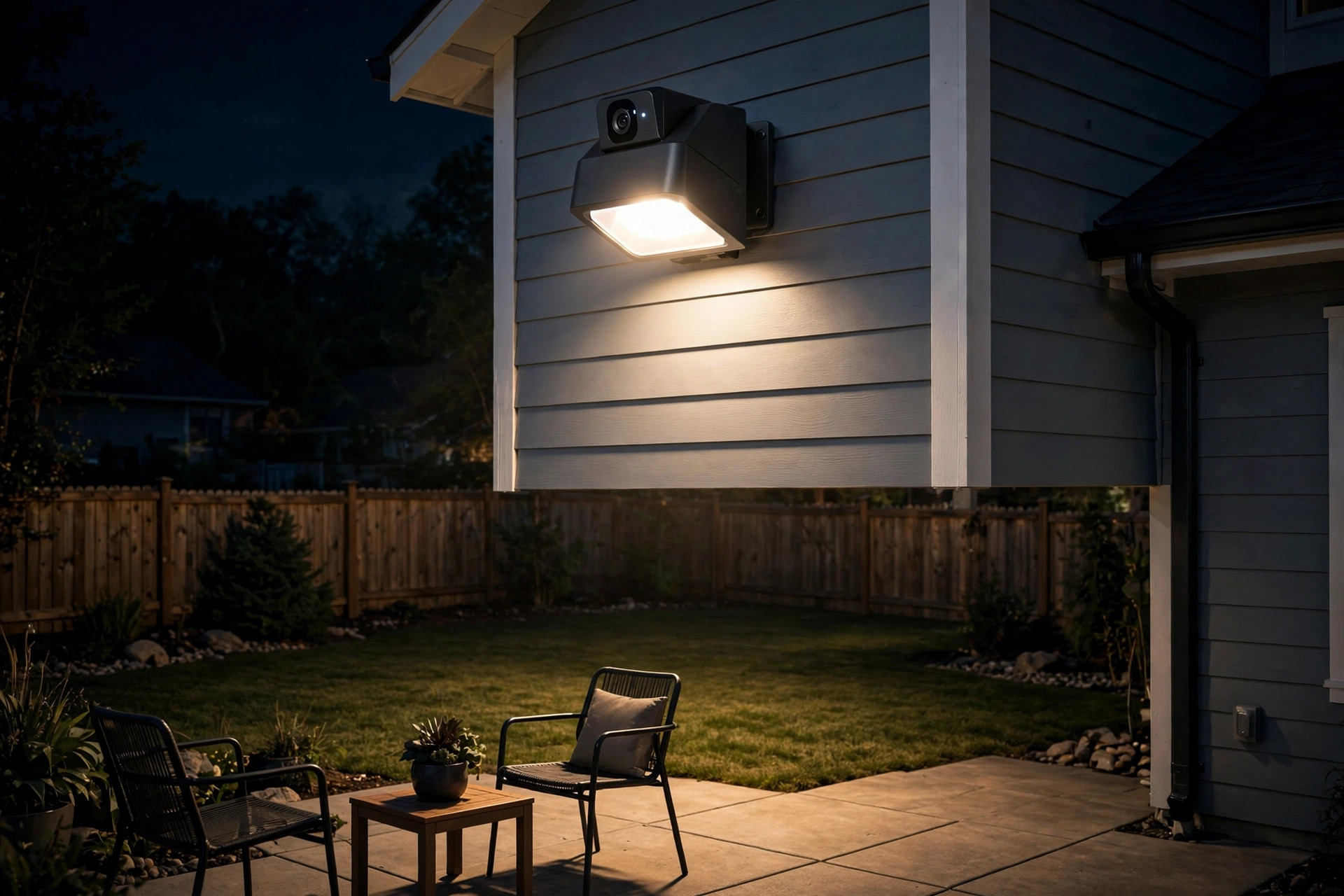

A dark backyard is easy to ignore until something goes wrong. A package left by the back gate. A noise at the fence line. A side yard where the trash cans sit. The best smart floodlight for backyard usa homes turns that darkness into a clear, well-lit space. It watches. It records. It sends an alert to the phone. This guide explains what these lights do, how to choose one, and what to expect when you put it up.
Why a Smart Floodlight Matters in the Backyard
The backyard is often the least watched part of a home. Front doors get the porch light. Driveways get the street lamps. The back sits in shadow. Studies of home crime have long shown that thieves prefer dark, hidden areas. A sudden burst of bright light removes that cover.
A smart floodlight does more than an old porch bulb. It connects to the home Wi-Fi network. When its motion sensor sees movement, the light turns on at full power. The owner gets a notice on a phone app. Many models also carry a built-in camera that starts recording at the same moment. Some add two-way talk, so the owner can speak through the light from anywhere.
For families in the United States, these lights serve many small daily uses too. They light the patio when guests stay late. They show the path when the dog needs to go out at night. They help when grilling after dark. A good unit can last ten years or more, so the choice deserves some care.
What to Look For When You Shop: Best Smart Floodlight for Backyard Usa
Brightness
Brightness is measured in lumens. Most backyard floodlights give between 1,000 and 3,000 lumens. A small patio needs about 1,000 to 1,500 lumens. A large yard with a fence line 50 feet away needs 2,000 lumens or more. More is not always better. A light that is too bright can annoy neighbors and wash out the camera picture.
Motion Detection Range and Angle
The sensor should cover the whole area you want to watch. Common ranges run 25 to 40 feet. The detection angle is often 120 to 270 degrees. Place the light where its sensor points at the approach paths, such as the back door, the gate, or the side of the garage. Some apps let the owner draw custom motion zones, so passing cars on the street do not set it off.
Camera Resolution
Many smart floodlights now include cameras. A 1080p camera gives a clear enough picture for most yards. A 2K or 4K camera shows finer detail, such as a license plate or a face across the yard. Higher resolution uses more storage and needs a stronger Wi-Fi signal. Reviews from testing groups such as Consumer Reports often compare how these cameras hold up in dark, rainy weather.
Smart Home Compatibility
Check whether the light works with the system the home already uses. Most models connect with Amazon Alexa and Google Assistant. Some work with Apple HomeKit. A few tie into full alarm systems from companies like ADT or Ring. Pick one that fits. A light that cannot talk to the rest of the house is still useful, but it loses much of the convenience.
Power Source
Hardwired floodlights connect to the home’s electrical box and stay on all the time. Solar models run on batteries charged by a small panel. Plug-in models use an outdoor outlet. Hardwired units give the brightest light and never need charging. Solar units are easy to mount where no wires reach, but they can grow dim in cloudy weeks.
Light Color Temperature
Color temperature is measured in Kelvin. Warm white, around 2700K, feels soft and welcoming on a patio. Cool white, around 5000K, looks sharper and shows more detail in camera footage. Many smart floodlights let the owner switch between warm and cool in the app. For security use, cool white is the better pick because it mimics daylight and makes faces and colors easier to see on video. For evening gatherings on the deck, warm white sets a calmer mood. Some models even dim to a low glow at dusk and jump to full power when motion starts, which saves energy and keeps the yard from looking harsh all night.
Types of Smart Floodlights
Camera Floodlights
These are the most popular. The floodlight and camera sit in one housing. When motion starts, the light turns on and the camera records video to the cloud or a local card. Two-way audio is standard. This type suits owners who want both light and video proof in one device.
Plain Motion Floodlights With Smart Controls
These have no camera. They connect to Wi-Fi and give phone control, schedules, and dimming. They cost less. They work well for lighting a garden or a path where video is not needed. They can also trigger other smart devices, such as a separate wired security camera system, when motion is sensed.
Solar Smart Floodlights
Solar models mount fast with no electrician. They suit sheds, far fences, and rental homes where drilling into wiring is not allowed. They carry smaller batteries, so their lights and recording time are shorter. For best results, mount the solar panel where it sees at least six hours of direct sun.
Dual-Head Adjustable Floodlights
Some smart models keep the classic two-head shape. Each head turns on its own. This lets the owner point one head at the patio and the other down the side yard. They are a good pick for corner mounting.
Cost and Price Ranges
Prices vary widely. Basic smart motion floodlights without cameras start around 40 to 80 dollars. Camera floodlights from well-known brands usually run 150 to 300 dollars. Premium models with 4K video and bright 3,000-lumen output can reach 400 dollars or more.
Ongoing costs matter too. Many brands charge a monthly fee for cloud video storage and smart alerts. These plans often cost 3 to 10 dollars per month. Some brands give basic recording free or allow local storage on a memory card with no fee. When comparing the best smart floodlight for backyard usa buyers, add the subscription cost to the price before choosing.
Installation adds cost if an electrician is needed. Replacing an existing wired light takes a handy owner about an hour. Running a new circuit to a spot with no wires can cost 100 to 300 dollars in labor. Retailers like Home Depot sell both the lights and the mounting boxes in one trip.
A smart way to judge value is to compare the total three-year cost. Add the purchase price, any subscription fees for 36 months, and the estimated installation cost. A 200-dollar camera floodlight with a 5-dollar monthly plan costs about 380 dollars over three years before installation. A 90-dollar smart motion light with no plan costs only 90 dollars plus mounting. The cheaper unit may be the right choice for a side gate, while the camera model earns its keep at the back door.
Installation and Care
Mounting Tips
Mount the floodlight 8 to 10 feet above the ground. Lower mounts give hot spots and blind spots. Higher mounts spread the light wider but weaken motion sensing. Aim the sensor slightly downward. Keep the camera lens away from direct rain if the model is not rated for it, though most are rated for outdoor use.
Check the Wi-Fi signal at the mounting spot before drilling. A weak signal causes late alerts and choppy video. Many homes add an outdoor Wi-Fi extender near the back wall to fix this. Pairing the light with devices from Google Store or other smart brands often requires the 2.4 GHz band, which reaches farther than 5 GHz.
Upkeep
Smart floodlights need little care. Wipe the lens and light heads with a damp cloth twice a year. Dust and spider webs can dull the light and fool the motion sensor. In fall, trim back any plants that have grown into the sensor zone. They cause false alerts on windy nights.
For solar models, clean the solar panel with water each season. A dirty panel charges slowly. For battery models, check the battery level in the app each month during winter, when cold air drains batteries faster.
Software Updates
Makers release updates that fix bugs and add features. Turn on automatic updates in the app. An old app version can miss motion events or fail to record. Guides at The Spruce and This Old House remind owners to keep smart home devices current for both function and safety.
Safety Notes
Electricity and water do not mix. If the light is hardwired, turn off the breaker before mounting or changing anything. If the wiring looks old or the box is cracked, call an electrician. Outdoor boxes must be rated for wet locations.
The U.S. Consumer Product Safety Commission, at CPSC, tracks recalls of electrical products. It is wise to check that a floodlight model has no open recall before buying. Also look for a UL or ETL mark on the box. These marks show the product passed standard safety tests in the United States.
Bright lights can disturb neighbors. Point heads down at your own yard, not at bedroom windows across the fence. Some towns have rules about light trespass. A quick check of local rules avoids trouble.
Data safety counts too. A camera floodlight records video of the yard. Use a strong password on the app and on the home Wi-Fi. Turn on two-step sign-in if the app offers it. Review who has access to the camera feed, and remove old shared users.
Energy use is another small factor. LED floodlights use far less power than old halogen models. The Department of Energy at Energy notes that LEDs last much longer and cost less to run. Most smart floodlights now use LED heads, which is good for the power bill.
Frequently Asked Questions
Do smart floodlights work without Wi-Fi?
The light will still turn on with motion without Wi-Fi, like an old motion light. But the smart parts need the network. Phone alerts, live video, cloud recording, and voice control all stop working when Wi-Fi drops. Owners who want no-Wi-Fi options should look at solar security camera reviews for models with local storage, or choose a cellular security camera that uses a mobile signal instead.
How long do the LED bulbs last?
Most LED floodlight heads are rated for 25,000 to 50,000 hours. At a few hours of use per night, that means many years. The LEDs are usually built into the unit and cannot be changed, so the whole light is replaced when they finally fail.
Will a floodlight scare off intruders?
Light alone does not stop every crime, but it removes the cover that intruders like. Combined with a camera and phone alerts, a floodlight gives the owner a chance to act. Police often advise layered protection: lights, locks, cameras, and alarms together.
Can one floodlight cover a whole backyard?
One unit covers a patio or a medium yard up to about 40 feet. A large or L-shaped yard usually needs two units, one per corner. Overlap the motion zones a little so no gap sits between them.
Are smart floodlights hard to install?
Replacing an existing wired fixture is a simple job for most handy owners. Mounting where no wires exist takes more work and may need an electrician. Solar and battery models mount with screws only and take about 20 minutes.
A Short Final Word
The best smart floodlight for backyard usa homes is the one that fits the yard, the Wi-Fi, and the budget. Bright enough to cover the space. Smart enough to send a clear alert. Tough enough for American weather, from desert heat to northern snow. Take time on the choice, mount it well, and the backyard stays bright and watched for years to come.
Related guides on this site include best video doorbell without subscription usa, ring vs nest doorbell comparison 2026 usa, and best wireless doorbell camera reviews usa.
References
ADT. (n.d.). Home security and automation. https://www.adt.com CNET. (n.d.). Technology news and reviews. https://www.cnet.com Consumer Reports. (n.d.). Product reviews and ratings. https://www.consumerreports.org Google Store. (n.d.). Smart home devices. https://store.google.com Ring. (n.d.). Smart home security devices. https://www.ring.com The Home Depot. (n.d.). Home improvement products. https://www.homedepot.com The Spruce. (n.d.). Home and garden advice. https://www.thespruce.com This Old House. (n.d.). Home renovation guidance. https://www.thisoldhouse.com U.S. Consumer Product Safety Commission. (n.d.). Product safety information. https://www.cpsc.gov U.S. Department of Energy. (n.d.). Energy efficiency and renewable energy. https://www.energy.gov
Was this guide helpful?

About James Carter
The My Garden US editorial team writes practical, in-depth home and garden guides for American homeowners — tested advice, no fluff.
You May Also Like
Best Dusk to Dawn Outdoor Light Reviews USA
May 28, 2026 0 views
Lorex vs Swann Security System Comparison USA: Which Brand Protects Your Home Best
April 1, 2026 0 views
Best Solar Path Lights Reviews 2026 USA: A Plain Guide to Bright, Safe Walkways
September 19, 2026 0 views