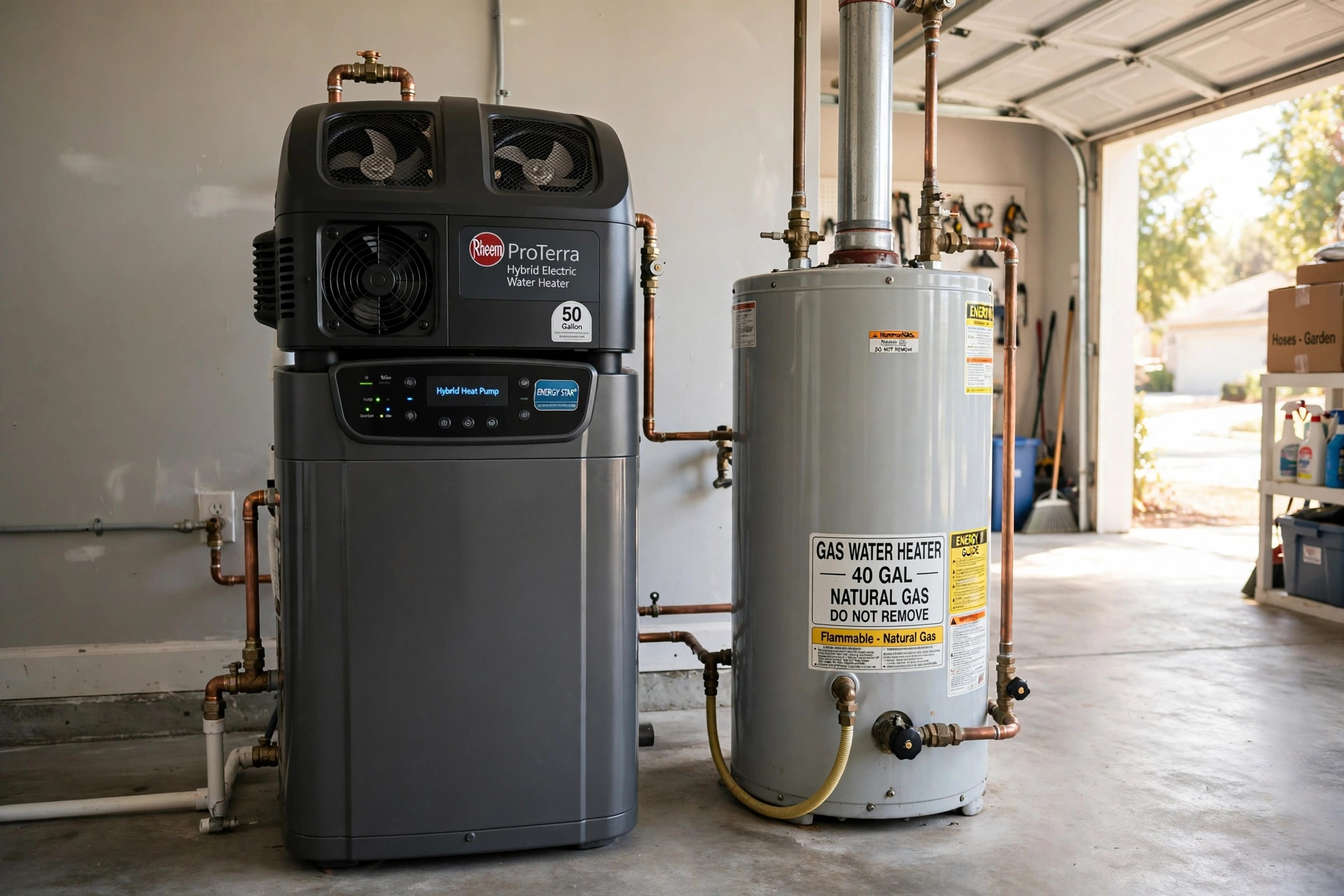

Hot water runs a modern home. Showers, dish washers, and washing machines all draw from the same tank. When an old tank fails, most buyers face one clear choice. A hybrid water heater vs gas comparison usa shoppers trust should answer three plain questions. Which one costs less to buy. Which one costs less to run. Which one lasts longer with less trouble. This guide answers all three in plain terms.
Why This Choice Matters
A water heater is one of the largest energy users in a house. The U.S. Department of Energy lists water heating among the top three uses of energy in most American homes. A poor choice can add hundreds of dollars to yearly bills for more than a decade. A good choice can pay for itself and then keep paying.
The market has changed. For years, the gas tank water heater was the default. It was cheap to buy and quick to heat water. Now the hybrid, also called the heat pump water heater, has earned its place. Major makers such as Rheem sell hybrid tanks through large stores and local dealers across the country. Buyers can compare current models and prices online before they call a plumber.
Climate rules are pushing the same way. Several states now favor electric heat pump water heating in new homes. Even where gas is still common, rising gas rates and falling heat pump prices have changed the math. A side-by-side look is worth your time before you spend.
How Each Type Works: Hybrid Water Heater vs Gas Comparison Usa
The Gas Water Heater
A gas water heater burns natural gas or propane in a burner at the bottom of the tank. The flame heats the water directly. A flue pipe carries exhaust gases up and out of the house. The tank keeps a set amount of water hot at all times, usually 40 or 50 gallons. When hot water leaves the tank, cold water enters and the burner fires to bring it back up.
Gas units heat water fast. A 50 gallon gas tank can often recover a full load in about an hour. They work in small closets and cold garages. They also work during a power outage, since the burner and basic controls need little or no electricity. For homes that already have a gas line, installation is simple and familiar.
The Hybrid Water Heater
A hybrid water heater is an electric heat pump water heater. It does not create heat with a flame or an electric element as its main source. Instead, it pulls warmth from the air around it and moves that warmth into the water tank. This is the same idea behind a refrigerator run in reverse.
Because it moves heat instead of making it, a hybrid uses far less electricity than a standard electric tank. It can cut water heating energy use by more than half in many homes. Hybrids also have backup electric elements for days when the air is very cold or when hot water demand is high. Many models can switch between heat pump only, hybrid mode, and electric only at the touch of a button.
The tank looks like a normal water heater. It stands about six feet tall and needs some air space around it to draw in room air. It works best in a basement, garage, or utility room with at least 700 cubic feet of air space.
How to Choose Between Them
Fuel Availability and Local Rates
Check what your home already has. If a gas line runs to the water heater spot, a gas unit is the easy swap. If your home is all electric, a hybrid is the natural fit. Some buyers still choose a hybrid even with gas on site, because the monthly savings can outweigh the higher price of the tank.
Local rates decide the winner. Compare the cost of one therm of gas with the cost of one kilowatt hour of electricity in your town. In areas with high gas prices and low electric rates, the hybrid wins by a wide margin. Where gas is cheap and power is dear, the gas tank stays strong. Your latest utility bills give you the numbers you need.
Household Size and Hot Water Demand
Count the people in your home. A family of five uses far more hot water than a couple. Hybrids handle large families well, but recovery is slower than gas. Many hybrids hold 50 to 80 gallons and are sized to the home. Our guide to tankless vs tank water heater cost comparison explains how tank size and recovery speed affect daily comfort.
Gas tanks recover faster, so a smaller tank can serve a busy house. A 50 gallon gas unit can match the daily output of a larger hybrid. If your home sees back to back showers and laundry at the same hour each day, that speed matters.
Space and Air Needs
A hybrid needs air. It draws warmth from the room and blows out cooler, drier air. That is a bonus in a warm garage but a drawback in a cold basement. The unit also needs headroom and clearance for the air filter on top. Measure the space before you buy.
A gas heater needs a vent. The flue must run safely to the outside, and the area must meet code for combustion air. Older venting can raise the cost of a gas swap if the liner or pipe needs repair. A look at the heat pump water heater pros and cons usa guide shows how space rules shape the choice.
Climate
Hybrids work in every state, but they are most at home in warm or mild rooms. In a garage that stays above 40 degrees, a hybrid runs with ease. In an unheated northern basement that drops near freezing, the backup elements carry more of the load and savings shrink. Gas heaters do not care about room temperature.
Types and Options
Gas Tank Models
Most gas tanks are standard atmospheric vent units. They use the natural rise of hot exhaust to vent through a chimney or flue. Power vent models use a fan to push exhaust through a side wall, which gives more choice of location. Condensing gas models catch extra heat from the exhaust and reach higher efficiency, but they cost more.
Tank sizes run from 30 to 75 gallons. For most families, 40 or 50 gallons is the sweet spot. Larger tanks cost more to buy and more to keep hot all day.
Hybrid Models
Hybrid tanks come in 40, 50, 65, and 80 gallon sizes. Most carry an Energy Star label and list a Uniform Energy Factor, or UEF, near 3.0 or higher. A UEF of 3 means the unit moves about three units of heat into the water for each unit of power it uses. A standard gas tank has a UEF near 0.6.
Many hybrids include smart controls. You can set the mode, track energy use, and find leaks early from a phone app. Some models talk to utility demand response programs, which can earn bill credits in certain regions.
Cost and Price
Purchase and Installation
A standard 50 gallon gas water heater often costs between 600 and 1,200 dollars for the tank alone. A hybrid of the same size often runs 1,500 to 2,500 dollars. Installation adds 500 to 1,500 dollars for either type, depending on the work. Gas swaps can cost more if venting or gas piping needs an upgrade. Hybrids can cost more if the electric panel needs a new 240 volt circuit.
Tax credits change the math. Federal credits have covered a share of heat pump water heater cost in recent years, and many utilities add rebates. Check the EPA and your local utility for current offers before you buy. A full breakdown of labor and parts appears in our heat pump water heater installation cost usa guide.
Running Costs
This is where the hybrid earns its price. A hybrid can use 60 percent less energy than a standard electric tank, and often less than half the fuel cost of a gas tank in areas with normal rates. For a family of four, yearly savings of 200 to 400 dollars are common. Over a 13 year tank life, the hybrid can save 2,500 to 5,000 dollars on bills.
Gas tanks cost less to run than old electric tanks, but they cannot match heat pump efficiency. They also carry a monthly gas service charge in many homes, which a full switch to electric can remove. Makers of home faucets and fixtures and water systems note that steady hot water temperature also cuts waste at the tap, which trims bills on both fuel types.
Care and Upkeep
Gas Water Heater Care
Flush the tank once a year. Sediment builds up at the bottom and makes the burner work harder. Test the pressure relief valve each year by lifting its lever and letting it snap back. Check the anode rod every two to three years and replace it when it is worn down to a thin wire. A good anode rod can add years to tank life.
Watch the flame through the sight glass. It should burn blue with small yellow tips. A mostly yellow flame or soot marks call for a service visit. Keep the area around the burner free of dust and stored items. Step by step tank flushing and anode rod tips appear in many home maintenance guides.
Hybrid Water Heater Care
Flush a hybrid tank once a year, just like a gas tank. Check the anode rod on the same schedule. The extra task is the air filter on top of the unit. Pull it out and rinse it every three to six months. A clogged filter makes the heat pump work harder and shortens its life.
Keep at least six inches of clear space around the air intake and outlet. Do not store boxes against the unit. Listen for odd sounds from the fan or compressor. Most hybrids last 13 to 15 years, about the same as a good gas tank, when the filter and anode rod get regular care.
Water Quality and Both Types
Hard water shortens the life of any tank. Scale coats the bottom of gas tanks and the elements of hybrids. If your water is hard, test it and consider treatment. A whole house water filtration system or softener can protect the tank and every fixture in the house. Fixture makers such as Moen and Kohler also link clean, balanced water to longer fixture life, and the same rule holds for tanks.
Safety
Gas water heaters need care with combustion. The burner uses room air and makes carbon monoxide, a gas you cannot see or smell. A working carbon monoxide alarm on each floor is a must in any home with gas. Never store paint, solvents, or gasoline near the heater. Flammable vapors can ignite on the burner flame.
Venting must stay clear. Check that the flue pipe is firmly joined and free of rust holes. Snow or nests can block a side wall vent on power vent models. If the pilot will not stay lit or you smell gas, leave the house and call the gas company from outside.
Hybrids are electric, so they carry no flame and make no carbon monoxide. They still need safe wiring. A 240 volt circuit must be sized right and installed to code. The pressure relief valve needs a drain line that runs to a safe spot, just as on a gas tank. Both types can scald. Set the thermostat to 120 degrees to guard against burns and to trim energy use.
FAQ
How long does each type last?
Both types last 10 to 15 years in normal use. Gas tanks average 10 to 12 years. Hybrids average 13 to 15 years with filter and anode rod care. Hard water and skipped maintenance shorten both.
Which is cheaper over its full life?
In most American homes, the hybrid is cheaper over 13 years. The higher price is often paid back in three to six years through lower bills, then the savings keep coming. Where gas is very cheap and power is very dear, the gas tank can still win on total cost.
Can a hybrid replace my gas tank in the same spot?
Often yes, if the space has enough air volume and a 240 volt circuit can be added. The hybrid is taller than many gas tanks, so check the height. It also needs a condensate drain for the water the heat pump pulls from the air. A plumber can confirm the spot in one visit.
Does a hybrid work in cold climates?
Yes. The backup electric elements cover the coldest days. Savings are smaller in a freezing basement than in a warm garage, but the unit still beats a standard electric tank by a wide margin. Duct kits on some models let the unit draw air from a warmer part of the house.
Will I run out of hot water with a hybrid?
Not if the tank is sized right. First hour ratings are printed on the yellow energy label. Match that number to your peak hour use. A 65 or 80 gallon hybrid suits a large family. Smart models can also be set to heat extra water ahead of the morning rush.
Final Word
A hybrid water heater vs gas comparison usa buyers can act on comes down to a few clear facts. Gas costs less to buy, heats water fast, and works in tight cold spaces. The hybrid costs more up front, sips energy, and often wins on lifetime cost by a wide margin. Match the tank to your fuel rates, your space, and your hot water habits. Buy the size your family needs, keep up the simple yearly care, and either choice will serve you well for a decade or more.
References
Aquasana. (n.d.). Water filtration systems. https://www.aquasana.com Delta Faucet. (n.d.). Kitchen and bathroom faucets. https://www.deltafaucet.com Family Handyman. (n.d.). DIY home repair and maintenance. https://www.familyhandyman.com Kohler. (n.d.). Bathroom and kitchen fixtures. https://www.kohler.com Moen. (n.d.). Faucets and plumbing fixtures. https://www.moen.com Rheem. (n.d.). Heating, cooling, and water heating. https://www.rheem.com The Home Depot. (n.d.). Home improvement products. https://www.homedepot.com U.S. Department of Energy. (n.d.). Energy efficiency and renewable energy. https://www.energy.gov U.S. Environmental Protection Agency. (n.d.). Protecting human health and the environment. https://www.epa.gov
Was this guide helpful?

About Lisa Anderson
The My Garden US editorial team writes practical, in-depth home and garden guides for American homeowners — tested advice, no fluff.
You May Also Like

Sewer Gas Smell in Bathroom: Proven Solutions USA Homeowners Trust
September 23, 2026 0 views
Best Water Filter for RV Full Time USA: A Plain Guide
February 10, 2026 0 views
Water Heater Maintenance Checklist for Homeowners
April 24, 2026 0 views