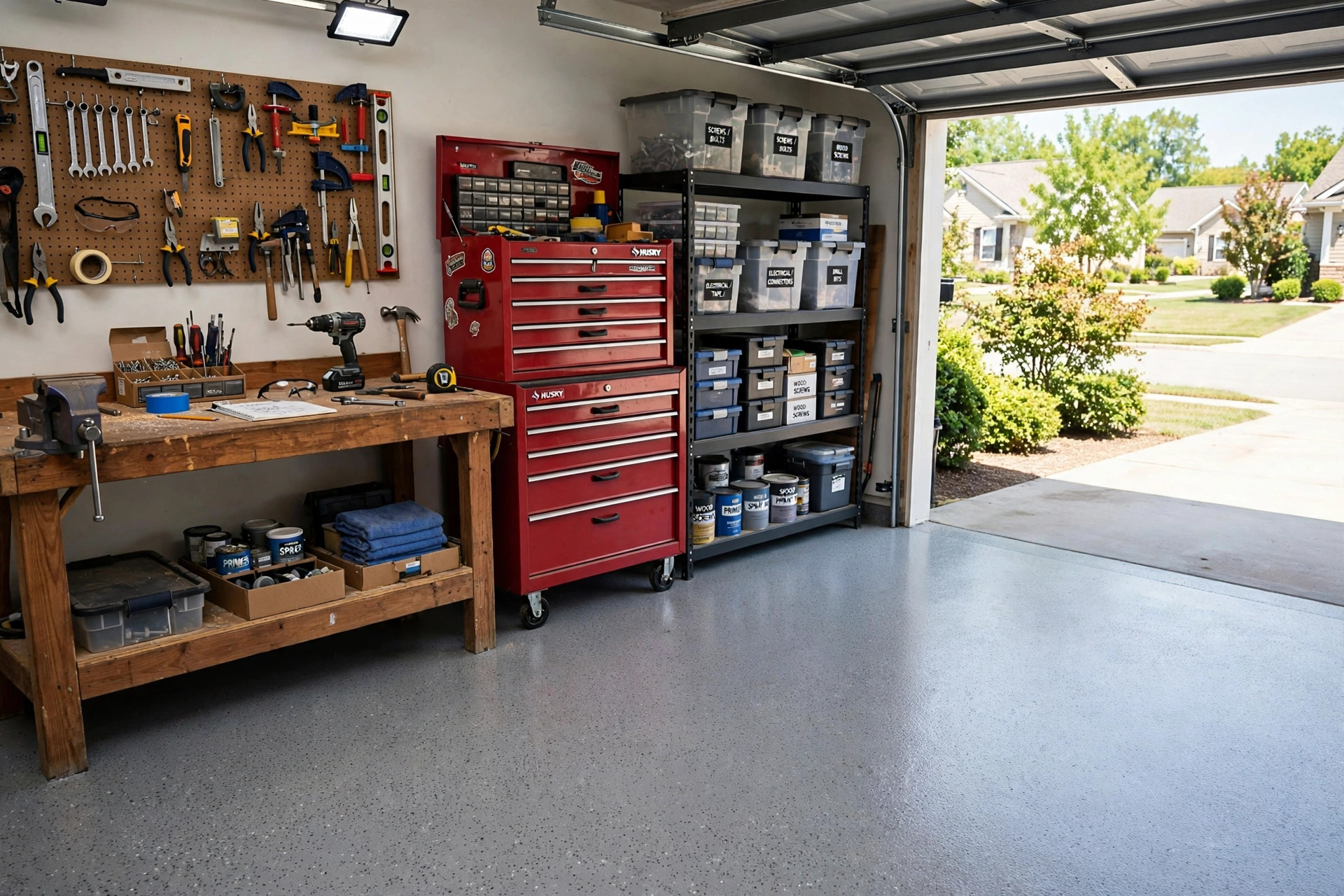

When you look at workshop flooring options for home garage spaces, you face a choice that affects your daily work. A garage floor takes abuse. Cars drip oil. Tools drop and chip. Heavy chests roll back and forth. The bare concrete slab that came with the house will crack, stain, and shed dust unless you protect it. This guide walks through the main workshop flooring options for home garage use in plain language. It covers what each type costs, how hard it is to install, and how it holds up over time. By the end, you will know which floor suits your shop.
Why Your Garage Floor Matters
A workshop is a work zone, not a showroom. Still, the floor under your feet matters more than most people think. Dust from bare concrete gets into everything: paint finishes, air tools, your lungs. Oil stains soak in and never come out. Cracks grow wider with every winter. Good workshop flooring options for home garage spaces solve these problems. They seal the concrete, resist chemicals, and give you a surface that is easy to sweep.
A finished floor also changes how the space feels. A bright epoxy or tile floor reflects light. The garage looks bigger and cleaner. That matters if you spend long hours at the bench. Homeowners who plan to sell should know that buyers notice a clean garage floor. A coated floor is a small upgrade that helps a home show well.
Main Workshop Flooring Options for Home Garage
Epoxy Coatings
Epoxy is a two-part resin that bonds to concrete and cures into a hard shell. It is the best-known of the workshop flooring options for home garage owners, and for good reason. Epoxy resists oil, gasoline, brake fluid, and most solvents. It comes in solid colors or with decorative flakes. A clear top coat adds gloss and wear protection.
Professional epoxy costs about $3 to $12 per square foot, materials and labor included. A do-it-yourself kit costs much less, but the prep work is hard. You must clean the concrete, etch or grind it, and fill cracks before the epoxy goes down. Skimp on prep and the coating will peel. With good prep, a pro epoxy floor can last 10 to 20 years. Review flooring types and their durability ratings on The Spruce before you commit.
Interlocking Floor Tiles
Interlocking tiles snap together like puzzle pieces. They are made from hard PVC or polypropylene. You lay them straight over the slab with no glue. This makes them one of the simplest workshop flooring options for home garage owners who want fast results.
Tiles cost roughly $2 to $7 per square foot. They stand up well to heavy loads and dropped tools. If one tile breaks, you pop it out and snap in a new one. Air can move under raised tile patterns, which helps with damp slabs. On the downside, seams can collect dirt, and the floor can shift under very heavy loads like a full engine block on a stand. For reviews of interlocking systems, see garage floor tiles interlocking reviews usa. Shop major retailers for selection: Home Depot and Lowe’s both carry wide tile lines.
Concrete Stain and Sealer
If your budget is tight, a concrete stain plus a clear sealer is worth a look. Acid stain soaks into the concrete and gives it rich, mottled color. A water-based stain is easier to use and comes in more colors. A concrete or acrylic sealer then locks the color in and blocks spills.
This route costs under $1 to $3 per square foot in materials. It will not hide cracks or pits, and it does not add thickness, so it feels like bare concrete under your feet. But it stops dusting and makes cleanup far easier than raw slab. Read our guide to best concrete floor stain for garage usa for product picks. The LL Flooring site also has guides on concrete finishes.
Rubber Mats and Rolls
Rubber mats come as squares or rolls, often made from recycled tires. They are soft underfoot and kind to dropped tools. Many home shops use them in front of workbenches while leaving the rest of the slab coated or bare. Horse-stall mats from a farm store are a cheap version of the same idea.
Rubber flooring runs $2 to $8 per square foot. It resists water and oil, though strong solvents can soften cheap rubber. It is easy to cut and move, which is handy if your shop layout changes. For cold garages in winter, see best garage floor mats for winter usa. Brands like Mohawk and Shaw offer rubber and vinyl work flooring lines.
Polyaspartic Coatings
Polyaspartic is a newer cousin of epoxy. Pros apply it in thin coats that cure fast, sometimes in a single day. It resists UV light better than epoxy, so it does not yellow in sunlit garages. It is also more flexible, which helps it handle the small shifts of a slab.
Polyaspartic usually costs $6 to $14 per square foot installed. It is not a common DIY job because the cure time is short and the work is tricky. But if you want a premium floor with fast turnaround, it is one of the strongest workshop flooring options for home garage owners today. This Old House has good overviews of concrete coating systems.
Porcelain and Ceramic Tile
Tile is rare in workshops, but some homeowners choose it for a clean look. Glazed porcelain resists chemicals and cleans up fast. It needs a solid, level slab and a crack-isolation membrane underneath, or the tiles will crack with the concrete. Cost runs $4 to $12 per square foot installed. Daltile carries many porcelain lines suited to hard-use rooms.
Bare Sealed Concrete
The simplest option is to leave the concrete bare but seal it. A penetrating sealer soaks in and hardens the surface. It stops dusting and blocks light stains. It will not resist oil for long, but it costs little and needs no special skill. Think of it as a stepping stone toward a full coating later.
How to Choose the Right Floor
Start with how you use the garage. If you park cars every day and do heavy mechanical work, pick a floor that resists hot tires and chemicals. Epoxy and polyaspartic win here. If you want a quick upgrade and may move later, interlocking tiles lift right out and travel with you.
Check your slab next. Look for cracks, spalling, and white mineral stains that signal moisture. Tape a two-foot square of plastic to the floor and wait 48 hours. If water beads under the plastic, your slab is damp, and coatings may not bond. Tiles or rubber mats are safer over damp slabs because air moves under them.
Think about comfort. If you stand at a bench for hours, rubber mats over a hard coating are the kindest combo. Think about cleaning too. Smooth coatings sweep fast. Textured tiles trap sawdust in the pattern but hide dirt well.
Cost and Price Breakdown
Here is a rough picture for a two-car garage of about 400 square feet:
– Concrete sealer, DIY: $100 to $400. – Concrete stain plus sealer, DIY: $200 to $600. – Interlocking tiles, DIY: $800 to $2,800. – Epoxy kit, DIY: $300 to $1,200. – Epoxy, professionally installed: $1,200 to $4,800. – Polyaspartic, professionally installed: $2,400 to $5,600.
Prices shift by region and by how much slab repair you need. Get three quotes for pro work. For DIY budgets, watch for sales at big-box stores and compare prices between Home Depot and Lowe’s.
Installation Basics
Prep is most of the job. Move everything out of the garage. Sweep, degrease, and patch cracks with a concrete repair product. For coatings, you must etch or diamond-grind the slab so the resin can grip. Read the product label twice and follow it to the letter. Most failures come from skipping steps, not from bad product.
Plan the weather. Most coatings need the slab above 50 degrees and dry for at least two days after. Keep cars off the new floor for the full cure time on the label, often a week. Good ventilation matters too, since the fumes are strong. Bob Vila and Good Housekeeping both publish solid step-by-step garage guides.
Care and Upkeep
A coated garage floor is easy to live with. Sweep it weekly. Mop with a mild detergent and warm water when it looks dull. Wipe up oil and brake fluid quickly; even tough coatings last longer when spills do not sit. Avoid harsh acids and paint strippers unless the product label says they are safe.
Interlocking tiles need a different touch. Lift a few each year and sweep the slab under them. Replace cracked tiles so they do not snag. Rubber mats can be hosed off outside and laid back down. Every year, walk the floor and note chips or lifting edges. Small repairs done early keep the floor sound.
Safety Notes
Slip resistance matters, especially with wet tires. Some glossy coatings get slick. Choose a finish with grit or flake texture in the top coat, or add an anti-slip additive. Keep a clear path to the door and the breaker panel. Do not store paint thinner or gas in open cans on any floor type. Check local fire rules for fuel storage in attached garages. This Old House publishes guidance on safe handling of household chemicals in the shop.
FAQ
What is the cheapest workshop flooring for a home garage? A penetrating concrete sealer is cheapest, under $1 per square foot in materials. It stops dust and light stains but will not hide cracks or resist oil well.
Is epoxy or polyaspartic better for a garage? Both are strong. Polyaspartic cures faster and resists UV yellowing, but it costs more and is harder to install yourself. Epoxy has more color and flake choices and a lower price.
Can I install garage floor tiles myself? Yes. Interlocking tiles need no glue and no special tools. Most homeowners finish a two-car garage in a day.
How long does garage epoxy last? With good prep, a professional epoxy floor lasts 10 to 20 years. DIY kits last less, often 3 to 7 years, since prep and materials are thinner.
Will floor coatings bond to a damp slab? Not well. Test for moisture first with the plastic-sheet test. Over a damp slab, choose raised interlocking tiles or rubber mats instead of a coating.
Does a finished garage floor add home value? A clean, coated garage floor helps a home show better and can lift buyer interest. It rarely adds a big dollar amount on its own, but it is a low-cost way to make the garage look cared for.
Final Word
There is no single best floor for every shop. Match the floor to your work, your slab, and your budget. Coatings give the toughest seal. Tiles give speed and easy repair. Stain and sealer give value. Rubber gives comfort. Pick one, prep well, and your garage will work harder for you for years.
References
Bob Vila. (n.d.). Home improvement advice. https://www.bobvila.com Daltile. (n.d.). Ceramic and porcelain tile. https://www.daltile.com Good Housekeeping. (n.d.). Product reviews and home advice. https://www.goodhousekeeping.com LL Flooring. (n.d.). Hardwood, vinyl, and tile flooring. https://www.llflooring.com Lowe’s. (n.d.). Home improvement products. https://www.lowes.com Mohawk Flooring. (n.d.). Flooring products. https://www.mohawkflooring.com Shaw Floors. (n.d.). Flooring products. https://www.shawfloors.com The Home Depot. (n.d.). Home improvement products. https://www.homedepot.com The Spruce. (n.d.). Home and garden advice. https://www.thespruce.com This Old House. (n.d.). Home renovation guidance. https://www.thisoldhouse.com
Was this guide helpful?

About Lisa Anderson
The My Garden US editorial team writes practical, in-depth home and garden guides for American homeowners — tested advice, no fluff.
You May Also Like

How to Find a Flooring Store Near Me With Installation Deals
October 1, 2026 0 views
Refinishing Hardwood Floors Cost Calculator: A Complete Guide to Prices and Planning
July 12, 2026 0 views
Fish Scale Tile Backsplash Cost in the USA: A Complete Guide to Prices, Options, and Installation
May 6, 2026 0 views