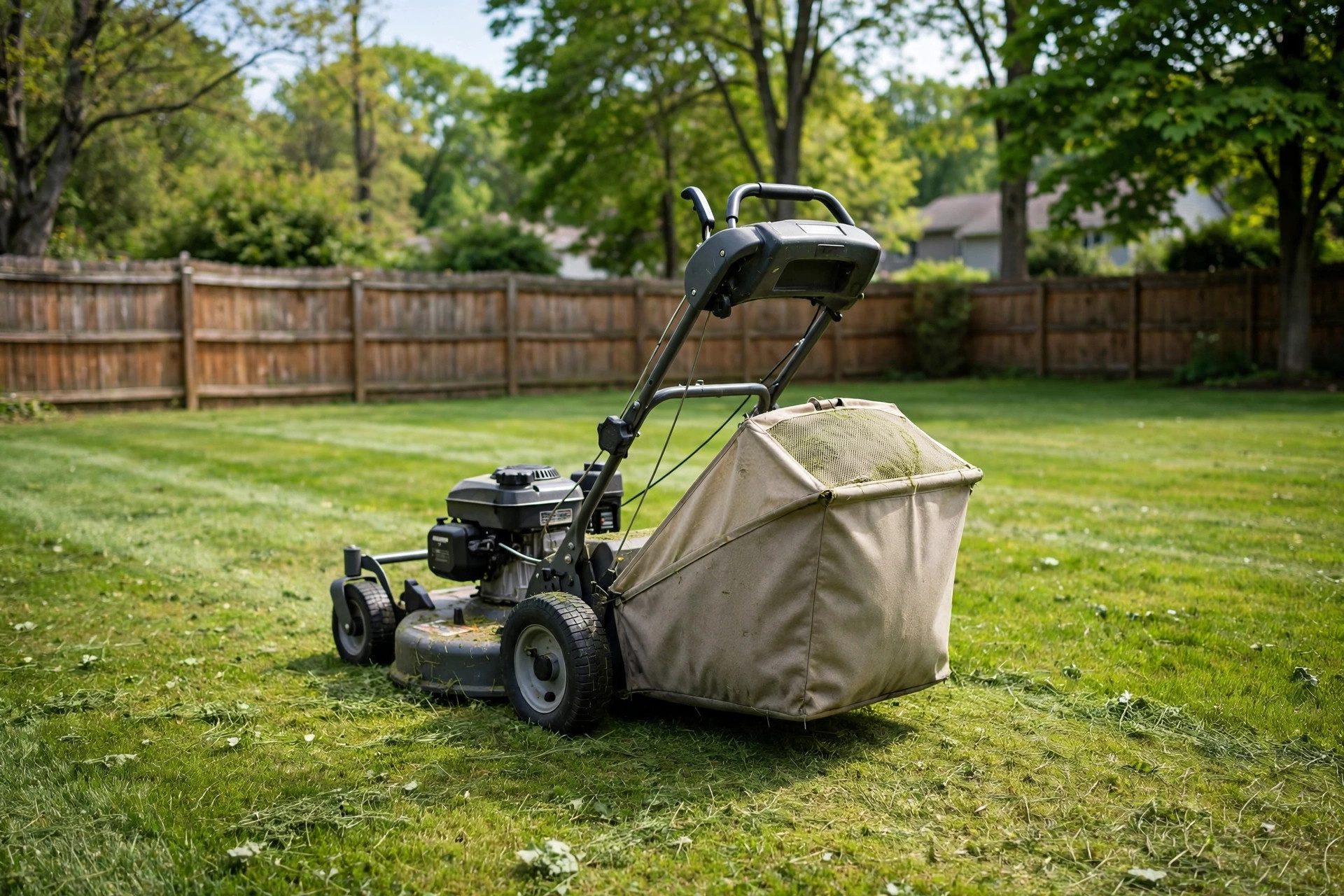

A walk behind mower with grass catcher sale is a good time to replace an old mower. The catcher is a bag or bin on the back of the mower that collects clippings as you walk. The lawn looks neat when you finish, with nothing left to rake. Sales run each spring and again in late summer, and a sale price can cut the cost by a fifth or more. But a low price means little if the mower does not fit the yard. This guide covers the main types, what to check before you buy, fair prices, care, and safety.
Why a Grass Catcher Matters
A grass catcher changes the look of a mowed lawn. Without one, clippings fall back onto the grass as mulch. That is fine for healthy grass, but thick spring growth can leave clumps that turn brown and smother the grass under them. A catcher picks up the clippings before they settle, so the yard looks clean at once.
A catcher also saves time. Raking a half-acre lawn takes an hour or more. A mower with a catcher does the same job while it cuts. The bag fills up, you dump it, and you keep walking.
There are times when a catcher helps lawn health. Weeds spread by seed. If dandelions or crabgrass have gone to seed, the catcher traps the seeds so they do not grow again. A mower with a catcher can also pick up light leaf cover in autumn, which beats raking.
The trade-off is simple. A full catcher is heavy. A large bag of damp grass can weigh twenty pounds or more. Stopping to empty the bag breaks the rhythm of the job. For small to medium yards, these are small costs. For very large yards, a rider or a robot lawn mower for half acre yards may make more sense.
How to Shop a Walk Behind Mower With Grass Catcher Sale
Timing shapes the price. The best sales run at two points in the year. Spring sales appear from March through May in most of the country. Fall clearance sales run from August through October, when dealers need shelf space before winter. A walk behind mower with grass catcher sale in fall can be the lowest price of the year, but the choice of models is smaller.
Compare the sale price to the normal price at two or three stores. A big sign that says sale does not always mean a true cut. Write down the model number and check it at another dealer. Consumer Reports tests mowers and publishes ratings that show which models hold up.
Read the sale terms. Some sales bundle extras. A bundle may add a spare blade, oil, or a larger catcher bag at no charge. That can be worth real money. Other sales are store credit card deals. The price looks low only if you open a card. Decide if that is worth it before you sign.
Check the return policy. If the mower starts poorly or vibrates badly, you want the right to bring it back. Many home stores give thirty days. Keep the box and the receipt until the mower has run a few times.
Ask about assembly and delivery. Boxed mowers need thirty to sixty minutes of setup. Some dealers assemble the mower for free during a sale. A loose handle bolt can ruin the first cut, so this is a real favor. Heavy mowers may cost extra for delivery. Factor that into the true price.
Types of Walk Behind Mowers
Walk behind mowers come in four main types. Each suits a different yard and a different owner.
Push mowers are the simplest. The engine or motor spins the blade. You supply the forward motion. They cost and weigh the least, and they suit flat yards up to about a quarter acre. The downside is sweat. A thick lawn in July heat makes a push mower feel long.
Self-propelled mowers drive the wheels for you. You walk behind and steer. Front-wheel drive suits flat yards. Rear-wheel drive climbs slopes and handles thick grass better. A self-propelled model costs about one hundred dollars more than a push model. Shoppers looking at self propelled mower deals for usa homeowners will see many choices in this group. For most homeowners with slopes or half-acre lawns, this type is the sweet spot.
Battery electric mowers run on rechargeable packs. They are quiet and start with a button. They need no oil and no gas. A single charge cuts a small to medium yard, and two batteries cover a larger one. Battery models from makers such as battery tools from RYOBI and Greenworks battery mowers have improved each year. The main limits are run time and power in very thick grass.
Gas mowers still dominate sales. A four-cycle engine from makers like engine makers like Briggs & Stratton powers most of them. Gas gives strong, steady power for thick or wet grass. The cost is noise, fumes, and upkeep. Oil must be changed, and old gas must be drained in winter. Brands like mower maker Toro and John Deere have sold gas walk behind mowers for decades.
What to Check Before You Pay
Deck size decides how much grass each pass cuts. A 21-inch deck is the standard for home mowers. It fits through gates and trims close to beds. A 22-inch deck cuts a bit more per pass but turns wider. Match the deck to the yard and the storage shed.
Look at the catcher itself. A good catcher holds at least two bushels. The bag should mount and detach with one hand. Mesh bags breathe better and fill more fully than solid bins. Check that spare bags are sold for the model. A torn bag is useless, and some odd models have no parts support.
Cutting height range matters more than people think. A mower should adjust from about one inch to four inches. Tall grass needs a high cut in summer heat. The adjustment should work with one lever, not four separate wheel pins.
Wheels tell a story about quality. Large rear wheels roll over bumps and roots with ease. Ball bearings last longer than plain plastic bushings. Thin, hard wheels slip on slopes. If the yard has a hill, large rear wheels are worth the extra cost.
Engine or motor size should fit the grass. For gas, 140 to 190 cubic centimeters suits most home lawns. Thick southern grasses like St. Augustine need the upper end. For battery, look at voltage and amp-hours. A 40-volt system with a five amp-hour battery cuts an average yard.
Weight and handle comfort decide how the mower feels after forty minutes. Lift the front of the mower in the store. Fold the handle and check the fold locks. A mower that fights you will sit in the shed.
Cost and Price
A walk behind mower with grass catcher sale usually brings prices into clear bands. Push gas mowers run from about one hundred fifty to two hundred fifty dollars on sale. Self-propelled gas models run from about two hundred fifty to four hundred fifty dollars. Battery mowers run from about two hundred fifty to five hundred dollars, with extra batteries adding fifty to one hundred dollars each.
Watch for hidden costs. A sale price may not include the catcher on some brands. The bag can cost forty to eighty dollars on its own. Check the box contents before you compare prices. Fuel, oil, and a spare blade add thirty to fifty dollars in the first year for gas mowers. Battery mowers need little beyond the charger, which is usually in the box.
Extended warranties are often offered at checkout. The standard warranty on a home mower is two to three years, and an extended plan may add little beyond that. The engine often carries its own warranty from the engine maker. Keep both papers in one folder.
Think about the cost per year. A three hundred dollar mower that lasts ten years costs thirty dollars a year before fuel. A one hundred fifty dollar mower that dies in three years costs fifty dollars a year. The better deal is often the sturdier machine at a fair sale price. Yard guides at The Spruce often compare long-term value this way.
Care and Upkeep
A mower that gets basic care lasts twice as long. The work is simple and takes less than an hour each season.
Clean the catcher after every use. Damp grass cakes inside the bag and blocks airflow. Shake the bag out, and wash it with a hose once a month. A clean bag lasts years longer.
Keep the blade sharp. A dull blade tears grass instead of cutting it. Torn tips turn brown and invite disease. Sharpen or swap the blade once or twice a season. A file and a vise do the job in twenty minutes. Those who prefer not to can search for a lawn mower blade sharpening service near me and pay a small shop fee.
For gas mowers, change the oil once a year and check the level before each use in hot months. Use fresh gas. Gas older than thirty days goes stale and gums the carburetor. At season’s end, run the tank dry or add fuel stabilizer. Store the mower in a dry shed with the plug wire off.
For battery mowers, store batteries indoors in winter. Cold drains them. Charge them to about half before long storage. Wipe the deck clean so damp clippings do not rust the steel.
Check the wheels and handle bolts each spring. Tighten what is loose. Grease wheel bearings if the manual calls for it. A mower that rolls free cuts better and lasts longer.
Feed and seed the lawn so the mower has good grass to cut. Lawn care guides from Scotts and grass seed makers at Pennington explain simple seasonal schedules. A thick lawn shades out weeds and needs fewer chemicals.
Safety
Mowers demand respect. Each year, thousands of Americans visit emergency rooms for mower injuries. Most could have been avoided.
Read the manual before the first start. Know where the blade brake and the kill switch sit. On most walk behind mowers, letting go of the handle bar stops the blade.
Wear closed shoes, long pants, and eye protection — never sandals. Pick up sticks, stones, and toys before you start. A blade can throw a stone like a bullet.
Keep children and pets inside while mowing. A child should never ride on a walk behind mower or play near one. The noise makes it hard to hear a small voice behind you. Yard care services at LawnStarter note this as the first rule of safe mowing.
Never pull a running mower backward toward your feet. If the mower clogs, shut it off and wait for the blade to stop before clearing the chute. Disconnect the plug wire or remove the battery first.
Mow slopes across the slope, not up and down, on a walk behind mower. This keeps the machine from rolling back onto you. On steep banks, use a string trimmer instead and keep the mower on flat ground.
Store gas in approved cans away from the house. Let a hot engine cool before refueling. Wipe spills before starting.
Frequently Asked Questions
Does a grass catcher work with mulching blades? It can, but the pairing is not ideal. Mulching blades chop clippings fine and drop them. A high-lift blade throws clippings up into the bag with more force. For bagging, use a high-lift or combination blade.
How often should I empty the catcher? Empty it when it is about three-quarters full. A packed bag blocks airflow and leaves trails of clippings. In thick spring grass, that may mean emptying every few passes. In dry summer grass, the bag lasts much longer.
Can I buy the catcher later and add it on? Sometimes. Many mowers ship ready for a bag, a mulch plug, or a side chute. But some sale models are bag-only or mulch-only in the box. Check the parts list before you buy. Buying the bag later often costs more than buying it in the box during a sale.
Are battery mowers strong enough to fill a catcher? For average lawns, yes. Modern battery mowers cut and bag well in normal grass. Very thick, tall, or wet grass drains the battery fast. If the lawn is often overgrown, a gas self-propelled model is the safer pick.
What size yard suits a walk behind mower with a catcher? Up to about half an acre is the practical limit. Beyond that, emptying the bag and walking the distance eats the afternoon. Larger yards suit riding mowers. Small yards under a quarter acre are easy work for any walk behind type.
Do I need to bag every time I mow? No. Many owners bag in spring when growth is fast and weeds seed, then switch to mulching in summer. Mulched clippings return nitrogen to the soil. Use the mode that fits the season.
A Final Word
A walk behind mower with grass catcher sale is worth the trip when you know what to look for. Match the mower type to the yard. Check the catcher size, the deck, and the wheels. Compare true prices, not just sale signs. Keep the blade sharp and the bag clean. The sale saves money once. The right choice saves money every year after.
References
Briggs & Stratton. (n.d.). Outdoor power equipment engines. https://www.briggsandstratton.com Scotts. (n.d.). Lawn care products and guides. https://www.scotts.com Toro. (n.d.). Lawn mowers and yard tools. https://www.toro.com Deere, J. (n.d.). Lawn care equipment. https://www.deere.com LawnStarter. (n.d.). Lawn care services. https://www.lawnstarter.com Consumer Reports. (n.d.). Product reviews and ratings. https://www.consumerreports.org RYOBI. (n.d.). Power tools and outdoor equipment. https://www.ryobitools.com The Spruce. (n.d.). Home and garden guides. https://www.thespruce.com Pennington. (n.d.). Grass seed and lawn products. https://www.pennington.com Greenworks Tools. (n.d.). Battery-powered outdoor tools. https://www.greenworkstools.com
Was this guide helpful?

About Jennifer Lee
The My Garden US editorial team writes practical, in-depth home and garden guides for American homeowners — tested advice, no fluff.
You May Also Like
Best Robotic Mower for Slopes Reviews: What to Know Before You Buy
July 20, 2026 0 views
Smart Sprinkler Timer Rebates for California Homes: A Plain Guide
August 3, 2026 0 views
Sprinkler Winterization Blowout Service Cost: A Fall Guide for Homeowners
March 24, 2026 0 views