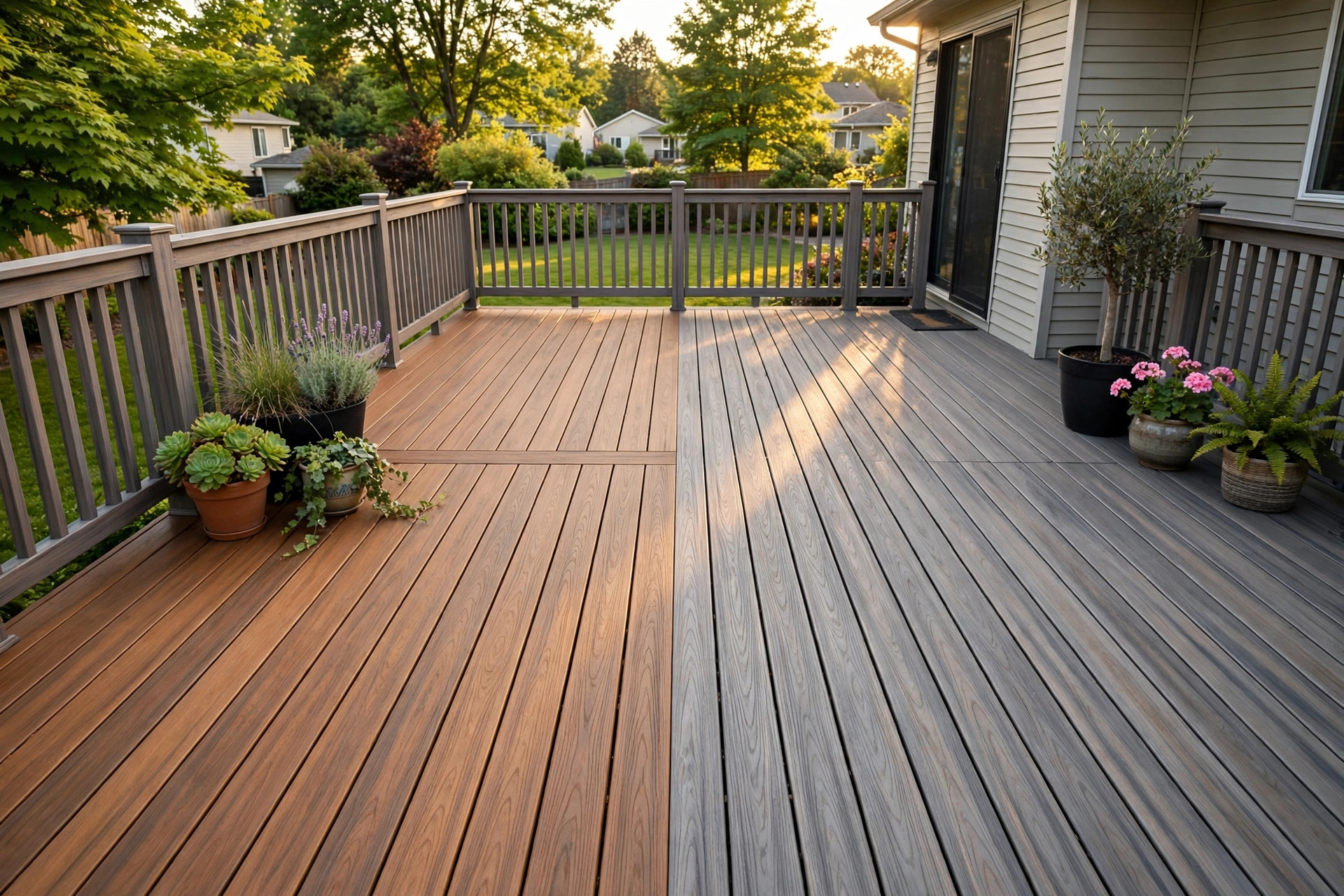

A back deck takes a beating. Sun, rain, snow, and foot traffic wear it down year after year. Wood boards split and rot. Stain fades. Nails pop up. Many USA homeowners now look at composite decking instead. Two brand names come up in almost every talk with a contractor: Trex and TimberTech. Both sell boards made of wood fibers and recycled plastic. Both promise a deck that needs no staining and lasts for decades. Still, the two brands differ in real ways. This trex vs timbertech decking comparison usa guide walks through the facts in plain terms so you can pick the right board for your home.
Why a Trex vs TimberTech Decking Comparison Matters
A deck is one of the largest purchases a homeowner makes outside the house itself. A mid-size deck can cost as much as a new car. The boards you choose will sit in the weather for 25 years or more. A poor choice shows up fast. Boards fade, warp, or feel hot under bare feet. Repair costs add up. The Trex company site and the TimberTech company site both publish product details, and reading them side by side is the smart first step.
The comparison matters because the two brands lead the market. Contractors stock both. Big stores such as Home Depot and Lowe’s sell both. That means you will hear strong views from sales staff. Your own research keeps you in charge. A careful trex vs timbertech decking comparison usa study looks at the board core, the cap layer, the color range, the warranty terms, and the real cost per foot.
What to Look for in Composite Decking: Trex vs Timbertech Decking Comparison Usa
Not all composite boards are built the same. A board has a core and a shell, called the cap. The cap is a thin plastic layer that covers the core on three or four sides. It guards against stains, scratches, and mold. Older or cheaper boards have no cap at all. They stain more and fade faster. Both Trex and TimberTech now sell capped boards as their main lines. That is good news. Still, the cap is not equal across every line. Premium lines have thicker caps and better fade guard.
Look at the warranty in years. A 25-year warranty is the floor for a good board. Read what the warranty covers. Fade and stain cover matters most. Check the slip resistance rating too. A deck near a pool or in a rainy state should grip shoes well. Color choice counts. A wide range helps you match the house siding and trim. Board width and groove style matter for the installer. Grooved boards take hidden fasteners. Square-edge boards take face screws.
Also think about heat. Dark composite boards can run hot in full sun. Southern states feel this most. Some lines carry cooling tech that keeps the surface a few degrees cooler. Ask the dealer for samples. Take them home. Lay them in the sun for an hour. Walk on them in bare feet. No brochure beats that test.
Trex Decking: Product Lines and Features
Trex is the oldest big name in composite decking. The firm started in the 1990s. Its boards mix 95 percent recycled content, mostly wood fiber and plastic film. Trex sells three main lines. The entry line is Trex Enhance. It costs the least. It comes in a small set of colors. It suits budget jobs and rental homes. The mid line is Trex Select. It adds more colors and a better cap. The top line is Trex Transcend. It has the deepest grain look and the best stain guard. A newer premium line, Trex Transcend Lineage, adds heat-mirror tech to stay cooler in the sun.
Trex boards use a wood-plastic core with a polymer cap. The cap covers three sides on most lines. Transcend boards carry a thicker shell. Trex offers a 25-year limited warranty on all lines. Fade and stain cover runs 25 years on the top lines. The firm also sells a full rail and trim system in matching colors. Nearly every lumber yard in the USA stocks it.
TimberTech Decking: Product Lines and Features
TimberTech belongs to the AZEK company. It sells two board types. The first is capped composite, sold under the TimberTech PRO and EDGE lines. The EDGE line is the value pick. The PRO line steps up in color and cap strength. The second type is capped polymer, sold as TimberTech AZEK. These boards have no wood fiber at all. They are full PVC with a polymer cap. That makes them very strong against stains, scratches, and heat. TimberTech AZEK is the premium pick and the highest priced.
TimberTech boards carry a four-sided cap on the AZEK line. That means the cap wraps the full board. The firm claims this gives better edge guard. Color lines run wide. The warranty runs 30 years on the AZEK line and 25 to 30 years on the PRO and EDGE lines. Fade and stain cover is strong on paper. TimberTech also sells matching rails, trim, and porch boards.
Head-to-Head Comparison
Durability comes first. Both brands pass the basic test. Neither rots. Neither needs stain. Insects do not eat them. The difference shows in the cap. TimberTech AZEK, with its full PVC build and four-sided cap, resists scratches and stains a bit better than Trex Transcend in lab tests cited by trade press such as This Old House. Trex Transcend still ranks high. Its thick shell handles normal home use well. For a home with large dogs or heavy patio chairs, the harder PVC surface of TimberTech AZEK has an edge.
Looks come next. Both brands print wood grain on the cap. Trex Transcend Lineage offers a soft, low-grain look in light tones. TimberTech AZEK offers deep grain in rich browns. Beauty is personal. Get full-size samples from a dealer. Lay them next to your siding. View them at noon and at dusk. The Spruce and LL Flooring guides both urge buyers to judge color in real light, not under store lamps.
Heat is a real concern in the South and West. Dark boards in full sun can top 140 degrees. TimberTech AZEK Vintage line lists cooling tech. Trex Transcend Lineage lists its own heat-mirror tech. Both help. Neither makes a dark board cool to the touch at 3 p.m. in July. Light colors stay cooler no matter the brand. If the deck faces south in Texas or Arizona, pick a light tone.
Stain and mold guard are close. Both top lines carry 25-year stain and fade cover. TimberTech AZEK edges ahead on stain tests because PVC does not absorb like wood fiber does. Trex Transcend holds its own in normal use. Spills wiped up the same day leave no mark on either. Let grease sit for a week and both may show a shadow.
Warranty terms favor TimberTech on paper. AZEK lines carry 30 years. Trex lines carry 25 years. In practice, both firms stand behind real claims when the owner keeps proof of purchase and follows the care guide. Read the fine print. Neither warranty covers damage from fire, floods, or poor install.
Install feel differs a little. Trex boards cut and fasten like dense wood. TimberTech AZEK, being full PVC, expands and contracts more with heat. Installers must leave the right end gaps. A good crew knows both systems. Ask your contractor which brand they install most. Skill with the product matters more than the brand name.
Cost and Price
Price often decides the matter. Trex Enhance runs cheapest, near the cost of pressure-treated wood. Trex Select sits in the middle. Trex Transcend costs more. TimberTech EDGE lines up with Trex Enhance on price. TimberTech PRO lines up with Trex Select. TimberTech AZEK tops them all. For a full picture of per-foot pricing, see our guide to composite decking cost per square foot usa.
Material cost per square foot runs about 5 to 8 dollars for entry lines, 8 to 12 dollars for mid lines, and 12 to 18 dollars for premium lines. Installed cost runs about 15 to 25 dollars per square foot for entry lines and 25 to 40 dollars for premium lines. Prices shift by state. Labor costs more on the coasts. A 300-square-foot deck with Trex Transcend may run 9,000 to 12,000 dollars for boards and labor. The same deck in TimberTech AZEK may run 11,000 to 14,000 dollars. Get three written bids. Make sure each bid names the exact product line, not just the brand.
Do not forget the frame. Composite boards need a strong frame. Joist spacing of 12 inches on center suits most lines. A weak frame will make any board feel bouncy. Budget for rails, stairs, and trim. Those parts can add 30 percent to the job.
Care and Upkeep
Both brands sell the same promise: no sanding, no staining, no sealing. Care is simple. Sweep the deck often. Wash it twice a year with soap and water. A soft brush lifts dirt from the grain. A garden hose rinses it clean. For tough spots, use a cleaner made for composite decking. Never use bleach in strong mix. Never use a pressure washer above 1,500 psi. Hold the tip at least 8 inches from the board. High pressure can scar the cap.
Mold can grow on pollen and leaves that sit on any deck. It does not eat the board. It feeds on the dirt. Sweep leaves in fall. Keep the gaps between boards clear so water drains. Trim plants back so air moves under the deck. Shaw Floors and Mohawk Flooring publish care notes with the same core advice for hard-surface floors: gentle soap, soft tools, and quick cleanup of spills.
Safety
A deck must be safe to walk on. Both brands make boards with slip-resistant caps. Wet boards still get slick. Add grip strips on stairs if the home has small children or older adults. Keep the surface clean. Algae on a shaded deck turns slick fast.
Heat burns bare feet. As noted, dark boards in full sun can burn skin. Light colors cut the risk. A simple outdoor rug in the main walk path helps too. Make sure the rug breathes. Solid rubber mats can trap heat and stain the cap.
Check the rail code in your town. Most USA codes call for a 36-inch rail on decks more than 30 inches off the ground. Baluster gaps must be under 4 inches. Both Trex and TimberTech sell rail kits that meet common codes. Your town may differ. Pull a permit. Get the final check. It guards your family and your resale value.
Fire needs a note. Composite decking burns. Keep grills at least 2 feet from rails. Never place a fire pit on the deck. Some towns bar grills on decks above the first floor. TimberTech AZEK, as a PVC board, has a better fire rating than wood-plastic boards. No composite board is fireproof.
FAQ
Which is cheaper, Trex or TimberTech? Entry to entry, they run close. Trex Enhance and TimberTech EDGE both sit near 5 to 8 dollars per square foot for boards. Mid lines run close too. At the top, TimberTech AZEK costs more than Trex Transcend. If budget rules, compare Trex Enhance with TimberTech EDGE and pick the color you like best.
Which lasts longer? Both carry long warranties. Trex gives 25 years. TimberTech AZEK gives 30 years. In real homes, both can pass 25 years with basic care. Sun and harsh use wear any board.
Does composite decking get hot? Yes. Dark colors get very hot in full sun. Both brands sell cooler lines now. Light colors help the most. Test samples in the sun before you buy.
Can I install it myself? A skilled DIY owner can install composite decking. The work is like wood decking, with extra care for end gaps and hidden fasteners. TimberTech AZEK needs exact gap spacing because PVC moves more with heat. Rent or buy the brand’s fastener system. Read the install guide twice. Mistakes void the warranty.
Which looks more like real wood? Both print grain on the cap. TimberTech AZEK Vintage shows deep, varied grain. Trex Transcend shows a softer grain. Ask for full boards, not small chips, and view them outside. Personal taste decides.
Should I resurface my old deck frame instead of rebuilding? If the frame is sound, new boards on the old frame can save money. A pro should check the posts, beams, and joists first. See our notes on deck resurfacing cost per square foot usa before you decide. A rotted frame needs full replacement.
Final Word
This trex vs timbertech decking comparison usa review ends with a simple take. Trex wins on price spread and dealer reach. Its three lines cover every budget. TimberTech wins on top-end strength. Its AZEK line, with full PVC build and 30-year cover, is the toughest board in this match. For most homes, either brand gives a fine deck. Pick the product line that fits your budget. Pick the color that fits your house. Hire a crew that knows the brand. Then enjoy the deck. No stain brush required.
Homeowners weighing other choices may also want our look at pvc decking pros and cons for usa homes. The Daltile site shows how tile and stone stack up against decking for patios, which helps when the project spans both a deck and a patio.
References
Daltile. (n.d.). Ceramic and porcelain tile. https://www.daltile.com LL Flooring. (n.d.). Hardwood, vinyl, and tile flooring. https://www.llflooring.com Lowe’s. (n.d.). Home improvement products. https://www.lowes.com Mohawk Flooring. (n.d.). Flooring products. https://www.mohawkflooring.com Shaw Floors. (n.d.). Flooring products. https://www.shawfloors.com The Home Depot. (n.d.). Home improvement products. https://www.homedepot.com The Spruce. (n.d.). Home and garden advice. https://www.thespruce.com This Old House. (n.d.). Home renovation guidance. https://www.thisoldhouse.com TimberTech. (n.d.). Composite and PVC decking. https://www.timbertech.com Trex. (n.d.). Composite decking and outdoor living. https://www.trex.com
Was this guide helpful?

About Robert Taylor
The My Garden US editorial team writes practical, in-depth home and garden guides for American homeowners — tested advice, no fluff.
You May Also Like
Peel and Stick Floor Tile Over Concrete USA: A Simple Guide
August 8, 2026 0 views
Lippage in Tile Floors: How to Fix It in American Homes
February 16, 2026 0 views
Wet Saw vs Snap Cutter for Tile USA: How to Choose the Right Tool
April 20, 2026 0 views