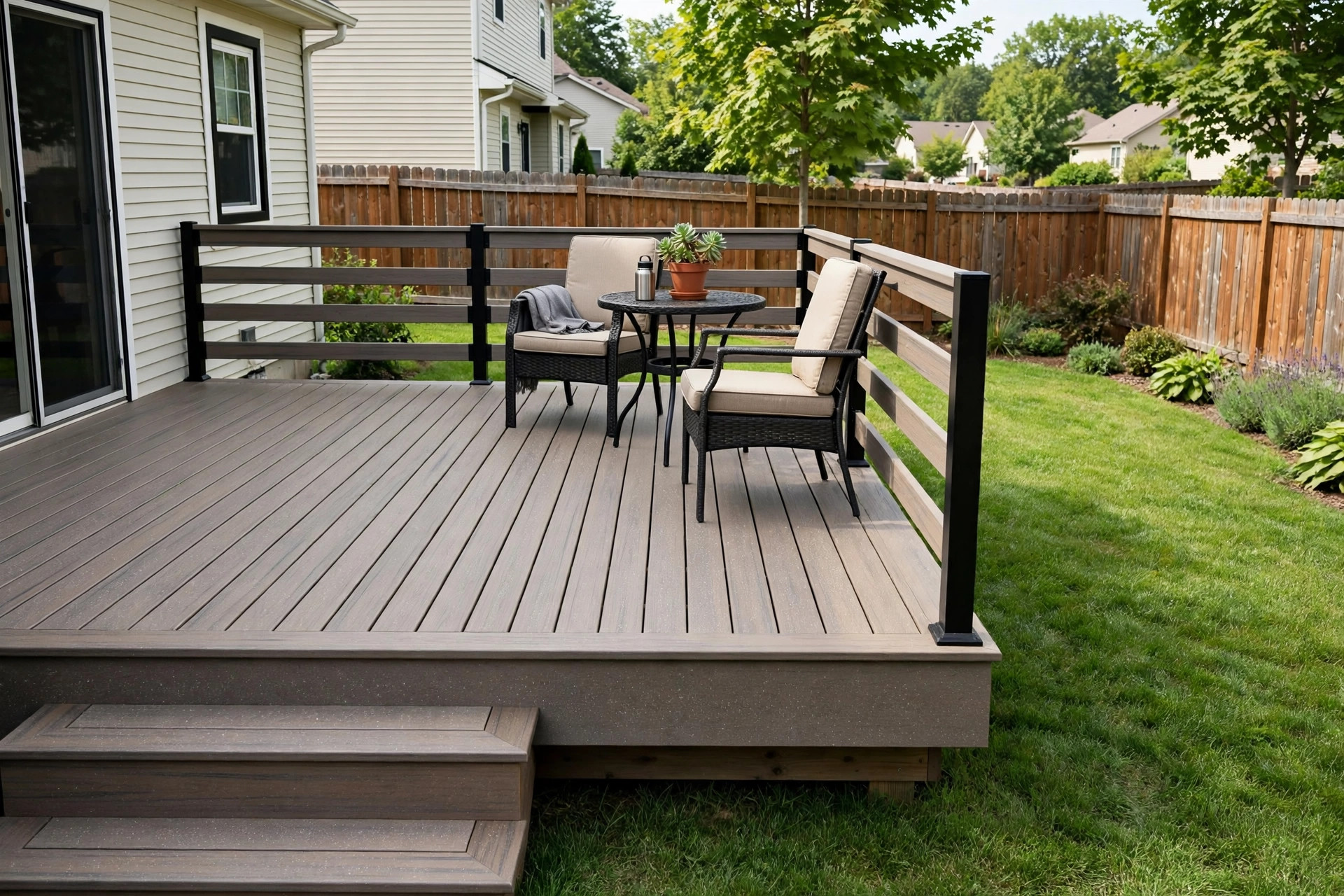

The composite decking cost per square foot in the USA is the first number most homeowners want to know before they plan a deck. A deck is a large project. The boards, the frame, the rails, and the labor all add up fast. When you know the price per square foot, you can set a real budget. You can also compare bids from different builders with a clear head.
Across the United States, composite deck boards usually cost $8 to $25 per square foot for materials alone. Once labor is added, most finished decks cost $30 to $60 per square foot. A small deck may land near $6,000. A large deck with stairs and rails can pass $20,000. The rest of this guide breaks the numbers down in plain terms so you know where each dollar goes.
Why the Per-Square-Foot Price Matters
Builders price decks by the square foot because it is the only fair way to compare jobs. Two decks may both be 300 square feet, but one may have stairs, rails, and curves that push the price up. The per-foot number lets you see past the size and look at what you are really buying.
It also protects you from lowball bids. If one builder quotes $25 per square foot and another quotes $55, you can ask what the cheaper bid leaves out. It may leave out the rails. It may leave out the permit. It may use thin, low-grade boards. A clear per-foot price makes those gaps easy to spot.
Planning ahead matters too. Most homeowners pay for a deck from savings or a home loan. When you know the full cost per square foot, you can match the deck you want to the money you have. You can also plan for the long term, since a deck you build today will serve your home for twenty years or more.
What to Look for When You Price a Deck: Composite Decking Cost Per Square Foot Usa
The price of composite decking is not one fixed number. It moves with several factors. The ones below have the biggest effect on what you will pay.
Board Quality
Composite boards come in grades. Budget boards are hollow or uncapped. They cost less but fade faster and scratch more easily. Mid-range boards are solid through the core. Premium boards have a capped shell that resists stains, scratches, and fading. The grade you pick can move the material price by $10 or more per square foot. Guides at retailers such as Home Depot explain how board grades line up with price.
Deck Size and Shape
A simple square deck is cheap to build. The cuts are straight and the waste is low. A deck with angles, curves, or multiple levels takes more time and more boards. Each cut wastes a little material. Each angle takes more labor. A curved rail can cost twice what a straight rail costs. Keep the design simple if the budget is tight.
Labor Rates in Your State
Labor is the largest part of most deck projects. Rates vary by state and by city. In high-cost areas such as California or New York, labor alone can run $20 to $30 per square foot. In lower-cost areas such as the Midwest or the South, it may run $10 to $18. Always get at least three local bids. A builder in your town knows your soil, your frost depth, and your local code.
The Frame and Footings
Composite boards sit on a frame, usually made of pressure-treated wood or steel. The frame, the footings, and the hardware are a hidden cost that many first-time builders miss. Footings must go below the frost line in cold states, which means deeper holes and more concrete. Project planners at Lowe’s walk through the framing parts that show up on a real invoice.
Types of Composite Decking and Their Price Ranges
Not all composite boards are the same. The three groups below cover nearly everything sold in the United States. Prices are for materials only, per square foot.
Budget Hollow Boards: $8 to $12
These are the entry-level boards. They are hollow in the middle or made from a simple mix of wood fiber and plastic. They look fine from a distance. Up close, they can fade in strong sun and show scratches. They work well for rental cabins or for a deck you plan to replace in ten years. If you manage rental units, our guide to durable flooring for rental properties covers how to pick surfaces that hold up under tenants.
Mid-Range Solid Boards: $12 to $18
These boards are solid through the core. They feel sturdier underfoot. They hold their color longer than budget boards. Most American homeowners pick this grade. It gives the best mix of price and life span. Many boards in this range carry 25-year fade and stain warranties.
Premium Capped Boards: $18 to $25
Premium boards have a tough polymer shell, called a cap, around the core. The cap resists stains from food, wine, and grease. It also resists fading, mold, and scratches. Colors and wood-grain patterns look closest to real wood. If you want a deck that still looks new after fifteen years, this is the grade to buy. Product research at Shaw Floors and buying guides at Mohawk Flooring show how capped surfaces compare with other outdoor and indoor materials.
Full Cost Breakdown: Materials, Labor, and Extras
A finished deck price has three parts. Materials usually take 30 to 40 percent of the budget. Labor takes 40 to 50 percent. Permits, rails, stairs, and extras take the rest. Here is how it looks on a typical 300-square-foot deck at mid-range grade.
Deck boards at $15 per square foot come to $4,500. The frame, footings, and hardware add about $2,000 to $3,000. Labor at $18 per square foot adds about $5,400. Rails add $1,500 to $3,000 depending on the style. Two sets of stairs add $500 to $1,000. A building permit adds $200 to $500. The total lands between $14,000 and $17,000. That is $46 to $57 per square foot, all in.
Extras can move the number higher. Built-in benches, planter boxes, and lighting add $1,000 to $4,000. A pergola adds $3,000 to $8,000. Removing an old deck costs $500 to $2,000. If the yard needs grading or drainage work, add more. Ask each builder for a line-item bid so you can see each part.
It helps to compare surfaces across the home when you budget. Entry areas take hard wear, and our best tile for mudroom floor reviews look at tough indoor floors that pair well with a busy backyard. Price data at LL Flooring can also help you compare outdoor surface costs with indoor flooring costs per square foot.
Care and Upkeep Costs Over Time
Composite decking costs more than wood at the start. It costs less over the life of the deck. That trade is the main reason people buy it.
A wood deck needs stain or seal every two to three years. Each round costs $500 to $1,500 on a mid-size deck. Boards rot, warp, and split, so you replace boards every few years. A composite deck needs none of that. You wash it with soap and water twice a year. That is it.
Do the math over twenty years. A wood deck may cost $8,000 to build and another $8,000 to maintain. A composite deck may cost $15,000 to build and $500 to maintain. The composite deck wins on total cost, and it wins on time. You spend your weekends on the deck, not working on it.
Composite boards still need basic care. Sweep off leaves so they do not trap moisture. Clean up grease spills fast. Do not use a high-pressure washer at close range, since it can mark the surface. Deck care tips at The Spruce give simple seasonal checklists that keep a deck looking fresh.
Safety Points to Know
Composite decks are safe when they are built right. A few points deserve care.
Heat is the first one. Dark boards get hot in full sun. In hot states, bare feet can burn on a dark deck at noon. Pick lighter colors if the deck gets full afternoon sun. Some premium boards are made to stay cooler, and the grade is worth the extra cost in warm climates.
Slip is the second one. Composite boards get slick when wet, just like wood. Keep the deck clean. Algae and mildew grow in shade and make the surface slippery. A quick wash in spring and fall solves it.
Structure is the third one. The deck must meet local building codes. Rails must be tall enough. Steps must be even. Footings must be deep enough for your frost line. Never let a builder skip the permit to save money. The permit means an inspector checks the work. Deck project walkthroughs at This Old House show what a proper build looks like from footings to rails.
Fire is the fourth one. Most composite boards carry a fire rating, but they can melt in high heat. Keep grills and fire pits away from the rails and the surface. Check the board maker’s rules for grill clearance before you place one.
FAQ
What is the average composite decking cost per square foot in the USA with labor?
Most finished composite decks cost $30 to $60 per square foot with labor, rails, and permits included. The middle of the range is about $45. Small, simple decks land near the low end. Large decks with stairs, rails, and extras land near the high end.
Is composite decking cheaper than wood over twenty years?
Yes, in most cases. Wood costs less to build but needs stain, seal, and board repairs every few years. Composite costs more up front but needs only soap-and-water cleaning. Over twenty years, composite usually costs less in total and takes far less of your time.
Does composite decking fade or stain?
Early boards faded in the sun. Modern capped boards hold their color well and carry 25-year fade warranties. Stains from food and drink wipe off capped boards with soap and water. Uncapped budget boards stain more easily, so wipe spills fast.
How long does composite decking last?
Most composite decks last 25 to 30 years. Premium boards can last longer. The frame may need work before the boards do, so a strong frame matters as much as good boards. In wet climates, good drainage under the deck adds years of life.
Can I install composite decking myself to save money?
Yes, if you have solid carpentry skills. You save the labor cost, which is 40 to 50 percent of the project. But deck framing must meet code, and mistakes are costly. Most homeowners hire a builder for the frame and footings. If you go the do-it-yourself route, read step-by-step deck guides first and pull the permit before you start.
Which color shows the least dirt?
Medium tones such as gray, brown, and weathered wood hide dust and pollen best. Very light boards show dirt. Very dark boards show dust and pollen. Pick a tone close to the color of the soil in your yard.
Final Word
The composite decking cost per square foot in the USA runs about $8 to $25 for boards and $30 to $60 for a finished deck with labor. Pick the grade that fits your budget and your climate. Get three line-item bids. Spend money on a strong frame, a proper permit, and good rails. Those choices decide how the deck looks in year fifteen, not just in year one.
If you are planning indoor updates too, our guide to moroccan tile for laundry room floor covers bold tile styles for utility rooms, and design ideas at Daltile can help you match outdoor and indoor surfaces across the whole home.
References
Daltile. (n.d.). Ceramic and porcelain tile. https://www.daltile.com LL Flooring. (n.d.). Hardwood, vinyl, and tile flooring. https://www.llflooring.com Lowe’s. (n.d.). Home improvement products. https://www.lowes.com Mohawk Flooring. (n.d.). Flooring products. https://www.mohawkflooring.com Shaw Floors. (n.d.). Flooring products. https://www.shawfloors.com The Home Depot. (n.d.). Home improvement products. https://www.homedepot.com The Spruce. (n.d.). Home and garden advice. https://www.thespruce.com This Old House. (n.d.). Home renovation guidance. https://www.thisoldhouse.com
Was this guide helpful?

About David Wilson
The My Garden US editorial team writes practical, in-depth home and garden guides for American homeowners — tested advice, no fluff.
You May Also Like

Area Rug Pad for Hardwood Floors Reviews
August 2, 2026 0 views
Best Flooring for Kitchens with Dogs USA: A Practical Guide for Pet Owners
January 28, 2026 0 views
Bluestone Patio Cost Per Square Foot USA: A Plain Guide for Homeowners
July 22, 2026 0 views