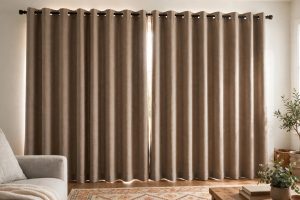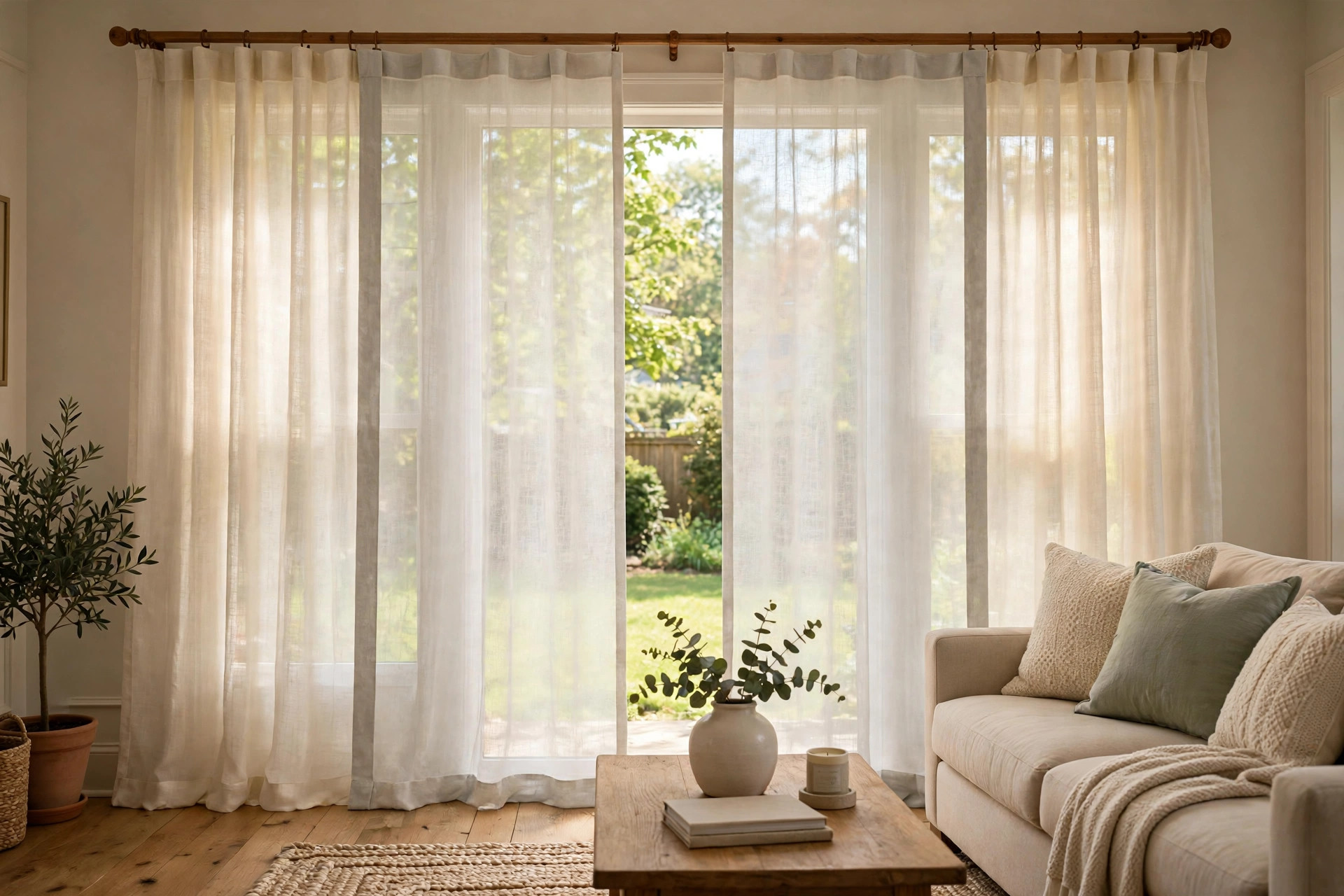

This thermal sheer linen curtains buying guide is written for the home owner who wants the best of two worlds. You want daylight. You want a soft, airy look. But you do not want the cold draft that thin curtains let through. Thermal sheer linen curtains promise both: the gentle glow of sheer fabric and a modest layer of warmth. This guide explains how they work, what to look for, what they cost, and how to keep them in good shape.
Why Sheer Linen and Warmth Can Go Together
Most people think a curtain must be heavy to block the cold. That is not quite true. Thin fabrics can still slow heat loss. What matters is the weave, the lining, and how the curtain traps a layer of still air against the glass.
Linen is made from flax. It has a loose, open weave in its sheer form, which is why light passes through it so easily. A thermal sheer linen curtain keeps that open weave on the face you see. Behind it, or within it, the maker adds a fine thermal layer. This layer is often a thin foam coat or a bonded mesh. It does not show. But it cuts drafts and slows the escape of warm air in winter and hot air in summer.
The result is not the same as a thick blackout curtain. A sheer linen curtain will never give full privacy at night with the lamps on. But it will take the edge off a cold window. Many buyers report that a room feels a degree or two warmer with lined sheers hung close to the glass. That small gain is real, and it costs far less than new windows.
Shoppers looking at other window coverings sometimes compare these with noise reducing machine washable curtains for sale for bedrooms, or with affordable waterproof outdoor shades buying guide for porches. Those serve different jobs. Thermal sheers are for rooms where you want light to stay the hero.
What to Look for When You Shop: Thermal Sheer Linen Curtains Buying Guide
A good buying trip starts with a short list of facts. Write down your window size, your rod type, and the look you want. Then judge each curtain by the points below.
Fabric weight and weave
Hold the fabric up to the light. A true sheer will let you see shapes through it. Linen sheers vary in weight from about 70 to 130 grams per square meter. Heavier sheers feel more like a real curtain. Lighter ones feel like a veil. For a thermal effect, a slightly heavier sheer works better, since it holds the lining flat and hangs in clean folds.
Look at the weave. Linen has natural slubs, which are small thick spots in the yarn. These are a sign of real linen, not a fault. A tight, even weave blocks more air movement than a loose one. Blends with polyester are common. They wrinkle less and cost less. Pure linen looks richer but needs more care.
Thermal lining and coating
Not all thermal sheers are built the same way. Some have a separate back panel of thin thermal fabric. Others have a foam or acrylic coating on the back of the sheer itself. A separate lining moves on its own and is easier to clean. A coating is cheaper and lighter, but it can peel after many washes.
Check how much warmth is claimed. Honest sellers speak in plain terms: blocks drafts, reduces heat loss, helps in summer against hot sun. Be careful with bold claims like “cuts energy bills by 40 percent.” A curtain cannot do that alone.
If you live where summers are hot, ask about heat reflection. Some thermal linings have a pale or silver face that bounces summer sun back out. This works best when the lined side faces the glass.
Size, fullness, and hanging style
Measure twice. Measure the width of the rod, not just the window. For sheers, buy panels that total one and a half to two times the rod width. This fullness is what makes sheers look soft instead of flat.
For length, decide the style. A sill-length curtain ends at the window sill. An apron-length curtain ends a few inches below. A floor-length curtain touches the floor or pools slightly. Floor length works best for the thermal job, since it stops cold air from sliding out under the hem.
Check the header style. A rod pocket slides onto the rod and gathers softly. Tab tops and back tabs look casual. Grommets make deep, even folds and slide easily. If you need premium double curtain rod brackets for sale to hang a sheer in front of a heavier drape, that layered look also boosts warmth.
Mount the rod wide and high. A rod set four to six inches wider than the window frame lets you pull the sheers fully to the side by day. A rod hung a few inches above the frame lets light flood in. Wide mounting also means the curtain covers the cold edges of the frame at night.
Color and light
White and ivory are the classic sheer colors. They glow in daylight and suit almost any room. Natural flax tones look warm and hide dust well. Dark colors give more daytime privacy but fade faster in strong sun.
Remember that a thermal lining changes the light a little. The curtain will be less see-through than an unlined sheer. In a dark room this can be a plus. In a north-facing room that needs every ray, choose the lightest lining you can find.
Types of Thermal Sheer Linen Curtains
Shops sell several forms. Each suits a different need.
Single-panel sheers with bonded coating. The lining is fused to the back. These are light, cheap, and easy to wash. They suit renters and small windows. The coating may wear after two or three years of washing.
Sheers with a separate thermal back panel. Two fabrics sewn as one panel. The back panel moves freely, so the curtain hangs well. These cost more but last longer. You can also find versions where the back panel unhooks for washing.
Layered sets. A sheer linen front panel plus a separate thermal or blackout panel on a double rod. By day you use the sheer alone. At night you draw the second panel. This gives the most warmth and the most control. Big-box stores such as Home Depot and Lowe’s stock many layered sets in standard sizes.
Cafe-length thermal sheers. Short panels that cover only the lower half of a window. They suit kitchens and bathrooms. They keep the draft off your shoulders at the table while the top half stays open to the sky.
Custom-made panels. Made to your exact width and length, in the linen you pick. Custom work costs two to four times the price of ready-made panels. It is worth it for odd windows, bay windows, or a formal living room where the fit must be perfect.
Cost and Price
Prices vary with size, fabric, and lining type. The table below is only a rough guide for standard ready-made panels in the United States.
For a single ready-made panel, 50 inches wide by 84 inches long, expect about 25 to 45 dollars for a coated sheer linen blend. A panel with a separate thermal lining runs about 40 to 70 dollars. Pure linen versions start near 60 dollars and rise past 100 for wide panels.
A pair of floor-length panels for a standard 60-inch window, with a separate thermal lining, often costs 80 to 140 dollars. Custom panels for the same window can cost 200 to 400 dollars or more.
Watch for extra costs. A new rod costs 15 to 50 dollars. Premium double curtain rod brackets for layered hanging add 10 to 25 dollars. Professional hemming runs a few dollars per panel.
Do thermal sheers save money on heat? A little. They will not replace insulation or storm windows. But a well-fitted thermal sheer on a drafty window can cut the chill you feel near the glass. Over a winter, that comfort has value even if the fuel savings are modest. Review sites such as Consumer Reports remind buyers to treat energy claims with care and to fix air leaks first, since a sealed window beats any curtain.
Measuring and Hanging, Step by Step
Good results come from careful measuring. Take these steps in order.
1. Decide the rod position. Mark a spot four to six inches above the window frame and four to six inches wider on each side. 2. Mount the rod brackets into studs or with wall anchors. Sheers are light, but a wide rod still needs firm support. 3. Measure from the top of the rod to the sill, apron, or floor, based on the length you want. Write it down. 4. Measure the rod width. Multiply by 1.5 to 2 for the total panel width you need. 5. Check the package for the finished width and length. Ready-made sizes are often given as one panel, not a pair. 6. Hang the panels. Let them hang for a day so folds settle. 7. Steam out wrinkles with a hand steamer. Linen relaxes well with steam.
For wide windows, use a center support bracket so the rod does not sag. For very tall windows, two people make hanging far easier.
Care and Upkeep
Linen is a strong fiber, but it likes gentle care. Read the label first. Most thermal sheer linen curtains wash best in cold water on a gentle cycle. Use a mild soap. Skip bleach. Bleach weakens linen and can yellow the thermal coating.
Wash panels in a mesh bag to keep the lining from catching. Do not overload the machine. Rinse well. Shake the panels out and hang them damp on the rod or a line. Linen dries fast and most wrinkles fall out as it hangs.
Coated panels need extra care. Wash them less often, perhaps twice a year. Turn them inside out so the coating faces in. Never use hot water on a coated panel, since heat can soften the bond.
For dust between washes, run a vacuum with a soft brush head over the panels once a month. In kitchens, where cooking film builds up, wash a little more often.
Sun is the slow enemy. Even good linen fades over years of direct sun. Rotate panels end to end once a year if one side gets more light. When the thermal coating starts to flake, the panel has reached the end of its useful life. Replace it rather than trying to recoat it at home.
Iron only if you must. Use a warm iron on the linen face, never on the coated back. A steamer is safer and faster.
Safety
Curtains near heat need thought. Keep all curtains, including sheers, at least three feet from space heaters, radiators, and fireplaces. Linen burns more readily than many synthetics. Never hang sheers where they can blow onto a hot surface.
Cord safety matters in homes with small children and pets. Choose cordless headings or use cord cleats to wrap cords high and tight. The Consumer Product Safety Commission offers clear guidance on window covering cord safety, and it is worth a look before you buy.
Frequently Asked Questions
Do thermal sheer linen curtains really keep a room warmer? They help a little. The thermal layer slows air movement and heat loss at the glass. You will feel less draft near the window. Do not expect them to heat a room. They work best with sealed windows and good weather stripping.
Can you see through them at night? From outside at night, with indoor lamps on, shapes and movement can show through a sheer, even a lined one. If night privacy matters, layer the sheer with a heavier panel or a blind. Sheers are a daytime privacy fabric.
Are they hard to wash? No. Most wash in cold water on gentle. The main rule is to be gentle with the thermal coating: cold water, mild soap, no bleach, and hang to dry. Separate-lining panels are the easiest to care for.
Pure linen or a linen blend: which is better? Pure linen looks and feels the best and lasts for years. A linen-polyester blend wrinkles less, costs less, and still looks good. For a busy family room, a blend is the practical pick. For a formal living room, pure linen is worth the price.
How long do thermal sheer curtains last? A well-made panel lasts five to eight years. Coated panels wear faster, often three to five years, because the coating breaks down with washing and sun. When the lining flakes or the fabric thins, replace the panel.
Where can I see more styles before I buy? Large retailers show wide ranges online. Browse IKEA for simple modern styles, Wayfair for a huge selection, Blinds.com for made-to-measure options, and Walmart for budget sets. Design ideas and room photos are easy to find at HGTV and The Spruce.
A Short Final Word
Thermal sheer linen curtains are a quiet upgrade. They do not shout. They soften hard daylight, blur the view in and out, and take the cold edge off a window. Buy the right size, hang them wide and high, and treat the lining with care. Then enjoy a room that feels a little warmer and looks a good deal softer. For a simple window treatment that works in almost any American home, they are hard to beat.
References
Blinds.com. (n.d.). Window blinds, shades, and shutters. https://www.blinds.com Consumer Reports. (n.d.). Product reviews and ratings. https://www.consumerreports.org HGTV. (n.d.). Home and garden ideas. https://www.hgtv.com IKEA. (n.d.). Home furnishings. https://www.ikea.com Lowe’s. (n.d.). Home improvement products. https://www.lowes.com The Home Depot. (n.d.). Home improvement products. https://www.homedepot.com The Spruce. (n.d.). Home and garden advice. https://www.thespruce.com U.S. Consumer Product Safety Commission. (n.d.). Product safety information. https://www.cpsc.gov Walmart. (n.d.). Everyday low prices. https://www.walmart.com Wayfair. (n.d.). Furniture and home goods. https://www.wayfair.com
Was this guide helpful?

About Michael Thompson
The My Garden US editorial team writes practical, in-depth home and garden guides for American homeowners — tested advice, no fluff.
You May Also Like

Best Outdoor Patio Curtains for Sale: A Plain Buyer’s Guide
January 2, 2026 0 views
How to Buy Custom Made Curtains Online Online in Colorado
March 9, 2026 0 views
Custom Cafe Curtains for Kitchens for Sale: A Complete Buying Guide
May 27, 2026 0 views