Many families read salt free water softener reviews for hard water before they spend money on a system. They want to know if these units really work. They want to know what they get for the price. This guide gives a clear picture of salt free systems, how they differ from true softeners, and what reviews tend to say about them.
Why Hard Water Needs Attention
Hard water is water with high levels of calcium and magnesium. These minerals leave white scale on faucets and shower heads. They clog pipes over time. They make soap hard to rinse off. Many parts of the United States have hard water, especially homes on well water.
A standard water softener uses salt and ion exchange to remove these minerals. A salt free water softener works in a different way. It does not remove the minerals at all. It changes them so they do not stick to surfaces. Because of this, many experts call these units water conditioners, not true softeners.
How Salt Free Systems Work: Salt Free Water Softener Reviews for Hard Water
The Template Assisted Crystallization Method
Most salt free systems use template assisted crystallization, often called TAC. Water flows through a tank filled with special media beads. Calcium and magnesium attach to these beads for a short time. The beads turn the minerals into tiny crystals. The crystals float away with the water. They no longer form hard scale on pipes and fixtures.
What They Do and Do Not Do
Reviews of these systems often stress one key fact. A salt free unit will not change a hardness test result. The minerals are still in the water. The water will not feel slippery the way softened water feels. Soap will not lather as easily as it does with a true softener. What the unit does is stop scale from building up. Faucets stay clean. Water heaters run better. Pipes last longer.
What Salt Free Water Softener Reviews for Hard Water Usually Report
When buyers write salt free water softener reviews for hard water, a few themes come up again and again.
First, many owners are happy with less scale. They report clean shower glass and no white crust on faucets. Second, many like the low upkeep. There is no salt to buy. There is no brine tank to clean. Third, some owners are unhappy when they learn the water is not truly soft. Their skin feels the same. Their dishes spot. They expected a full softening effect and did not get it.
Reading reviews with care helps. Look for reviews from homes with water much like yours. A home with mild hardness will see great results. A home with very hard well water may see less change. This point comes up in many buyer guides, and it matters more than brand names.
How to Choose a Salt Free System
Step One: Test Your Water
Before you buy, test your water. You can buy a simple test kit or send a sample to a lab. You need the hardness level in grains per gallon. Most salt free systems work best below 25 grains per gallon. If your water is harder than that, a true salt softener may serve you better. Homeowners who skip this step often write the most negative reviews.
Step Two: Check Your Water Chemistry
Iron and manganese can foul the media in a salt free unit. If you have well water with iron, you may need a pre filter. Many reviews note that a sediment filter for well water or an iron filter in front of the conditioner made all the difference. Know your full water profile, not just hardness.
Step Three: Size the Unit for Your Home
Sizing depends on water use and flow rate. A small home with one or two people needs a smaller unit than a large home with four bathrooms. A unit that is too small will let hard water pass through untreated during peak use. Look at the maximum flow rate in gallons per minute. Compare it with your home’s peak demand.
Step Four: Compare Media Types
TAC media is the most common and the most tested type. Some cheaper units use polyphosphate cartridges. These add a small amount of phosphate to the water to slow scale. They need cartridge changes every few months. TAC media often lasts three to five years before replacement. Reviews favor TAC for whole house use and polyphosphate for small point of use jobs.
Types of Salt Free Systems
Whole House TAC Conditioners
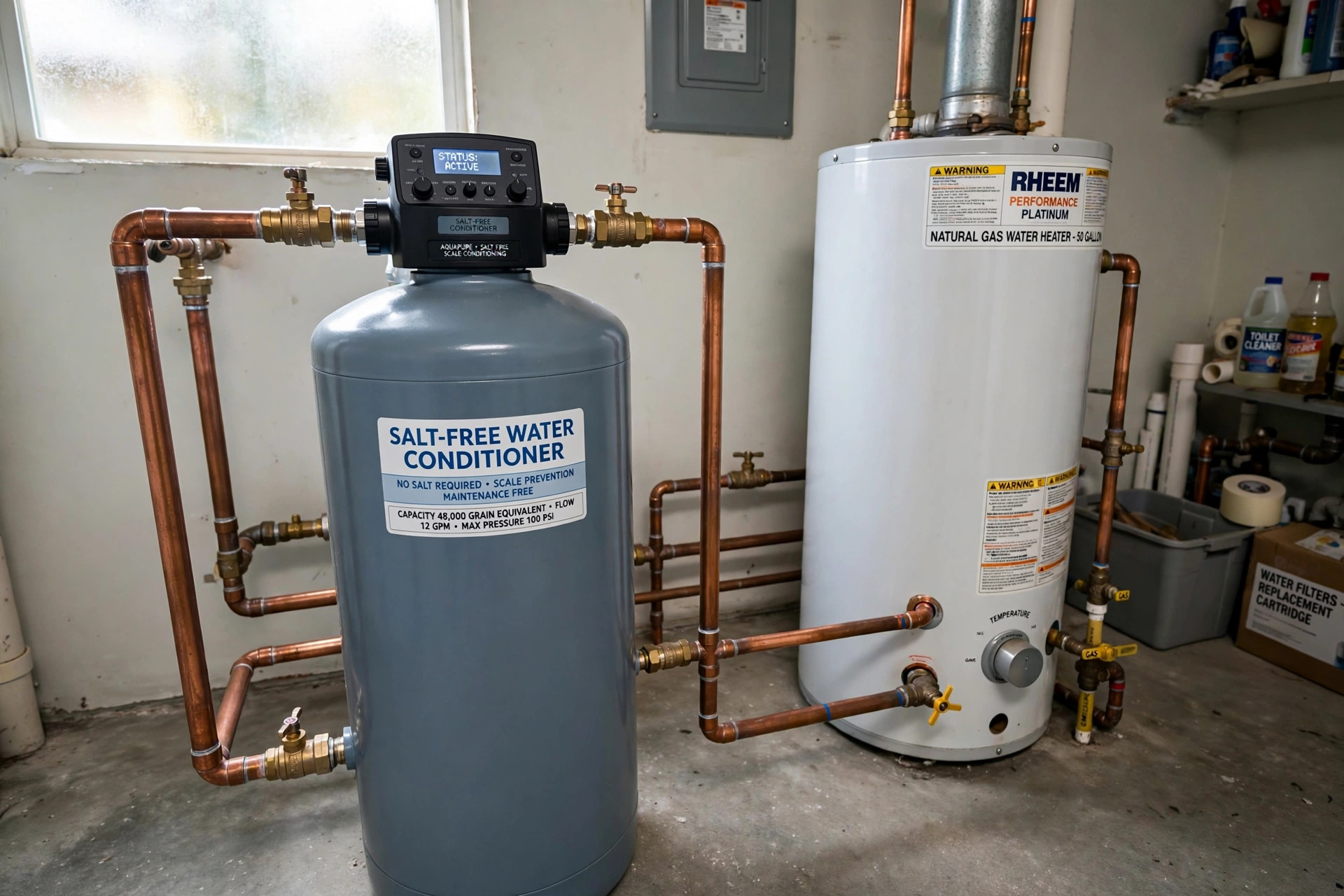
These are the main units on the market. They install at the water line where water enters the home. They treat all water in the house. Prices run from about 400 to 1,500 dollars for the unit alone. They need no drain line and no power in most cases. Installation is simpler than a salt softener.
Salt Free Cartridge Systems
These smaller units go under a sink or on a single appliance line. They use polyphosphate or similar media. They cost less, often 50 to 300 dollars. They protect one fixture or appliance. They are a good test before a whole house purchase. Cartridges need regular changes.
Combination Systems
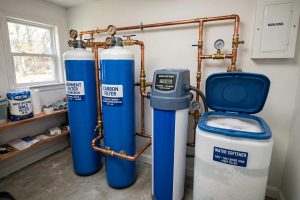
Some homes pair a salt free conditioner with other treatment. A common setup is a sediment pre filter, then the conditioner, then a drinking water filter at the kitchen sink. Reviews of combination setups are often the most positive, since each stage handles one problem. Many owners also add a shower filter for hard water to protect skin and hair at the shower.
Salt Free vs Salt Based: A Simple Comparison
Many buyers weigh a salt free conditioner against a classic salt based softener. Each has clear strengths. Each has clear limits.
A salt based softener removes calcium and magnesium from the water through ion exchange. The water tests soft. Soap lathers well. Skin feels slick after washing. These are the signs most people link with soft water. The trade offs are real. The owner must buy salt often. The unit uses extra water to clean its resin bed. The discharge contains chloride, and some towns limit or ban it. The unit needs a drain line and a power outlet.
A salt free conditioner takes the simpler path. It leaves the minerals in the water but changes them so they cannot form hard scale. There is no salt to buy. There is no extra water use. Installation is easier. Upkeep is close to zero. The trade off is that the water never feels soft. Test strips will still show hard water. Dishes may still spot.
Reviews suggest a rule of thumb. Choose salt based softening when hardness is high, above 25 grains per gallon, or when the soft feel of the water matters most to the family. Choose salt free when hardness is mild to moderate, when low upkeep matters, or when salt discharge is a concern in the area. Some homes use both: a salt softener for the main line and a salt free cartridge on a line that feeds a garden or a fish tank, where sodium from a softener would cause harm.
Cost over ten years often ends up close between the two. Salt systems cost less up front in some cases but need salt and water year after year. Salt free systems cost more up front in some cases but need only a media change every few years. Running the numbers for your own home, with your own hardness level, gives the honest answer.
Cost and Price
The unit is only part of the cost. A whole house salt free conditioner runs 400 to 1,500 dollars. Professional installation adds 200 to 800 dollars, depending on the job. Some handy owners install the unit themselves with basic plumbing skills.
Running costs are low. There is no salt to buy. There is no extra water use, since there is no backwash cycle. The main running cost is media replacement every few years, which can run 100 to 400 dollars. Compare this with a salt softener, which needs 50 to 100 dollars of salt per year plus water for regeneration. For a clear picture of salt based options, many buyers read a water softener versus conditioner comparison before they decide.
Care and Upkeep
Salt free systems need little care. That is their main selling point. Even so, a few tasks keep them working well.
– Check the pre filter every few months and change it when dirty. – Watch for scale return. If scale appears on fixtures, the media may be spent. – Replace the TAC media on schedule, usually every three to five years. – Keep iron out of the unit. If iron levels rise, add or service an iron filter first. – Test your water once a year to confirm hardness has not changed.
Owners who follow this simple routine report steady results for years. Owners who ignore the pre filter often see performance drop within months.
Safety and Health Notes
Salt free systems add nothing to the water in most cases. TAC media changes the shape of minerals but adds no chemical. This appeals to people who watch their sodium intake, since salt softeners add sodium to the water. The United States Environmental Protection Agency provides general guidance on home water treatment and drinking water quality.
One point deserves care. A salt free conditioner does not make water safe to drink. It does not remove lead, bacteria, or chemicals. If you worry about drinking water safety, add a certified drinking water filter. Product listings at major retailers such as The Home Depot and Lowe’s show which filters carry independent certifications.
Common Problems Found in Reviews
No product is perfect. Reviews point to a few repeat problems.
High hardness overwhelms the unit. Above 25 grains per gallon, results drop fast. Test first.
Iron ruins the media. Even low iron levels can coat TAC beads. Use a pre filter.
Spotting on dishes remains. The minerals are still in the water. Glassware may still spot. A rinse aid in the dishwasher helps.
No slippery feel. Some buyers miss the soft feel of true softened water. This is normal for conditioners.
Undersized units fail at peak flow. A unit rated for 8 gallons per minute will not treat a home that draws 15. Size up, not down.
Reading about these issues in advance keeps expectations fair. Most one star reviews come from a mismatch between the home’s water and the unit’s limits, not from a broken product.
Frequently Asked Questions
Do salt free water softeners really work?
They work for their stated purpose, which is scale prevention. They do not soften water in the true sense. Reviews are positive when buyers understand this limit before purchase.
Will a salt free system help my skin and hair?
Results vary. Some owners report less dryness because soap rinses cleaner without heavy scale. Others notice little change. A point of use shower filter may help more for skin and hair.
How long does the media last?
TAC media usually lasts three to five years. Polyphosphate cartridges last three to six months. Actual life depends on water use and water chemistry.
Do I still need salt for anything?
No. That is the main draw. There is no brine tank and no salt bags. This also means no salty discharge water, which some towns restrict.
Can I install it myself?
Many owners do. The unit connects to the main water line with basic fittings. If you are not sure about plumbing, hire a professional. Poor installation voids many warranties.
Is it worth the money for city water?
For city water with moderate hardness, reviews are often good. Scale drops, appliances last longer, and upkeep is near zero. For very hard well water, a salt softener may be the better buy.
A Short Final Word
Salt free water softener reviews for hard water tell a steady story. These units are simple, low care tools for scale control. They are not true softeners. Buyers who test their water first, size the unit right, and keep iron out of it tend to be satisfied. Buyers who expect soft, slippery water tend to be let down. Know what the unit does, and it can serve your home well for years.
Homeowners who want deeper background can turn to trusted guides from This Old House, Family Handyman, and Aquasana for water treatment basics. Fixture makers such as Moen, Kohler, and Delta Faucet also publish useful care guides for homes with hard water.
References
Aquasana. (n.d.). Water filtration systems. https://www.aquasana.com Delta Faucet. (n.d.). Kitchen and bathroom faucets. https://www.deltafaucet.com Family Handyman. (n.d.). DIY home repair and maintenance. https://www.familyhandyman.com Kohler. (n.d.). Bathroom and kitchen fixtures. https://www.kohler.com Lowe’s. (n.d.). Home improvement products. https://www.lowes.com Moen. (n.d.). Faucets and plumbing fixtures. https://www.moen.com The Home Depot. (n.d.). Home improvement products. https://www.homedepot.com This Old House. (n.d.). Home renovation guidance. https://www.thisoldhouse.com U.S. Environmental Protection Agency. (n.d.). Protecting human health and the environment. https://www.epa.gov
Was this guide helpful?

About Emily Rodriguez
The My Garden US editorial team writes practical, in-depth home and garden guides for American homeowners — tested advice, no fluff.