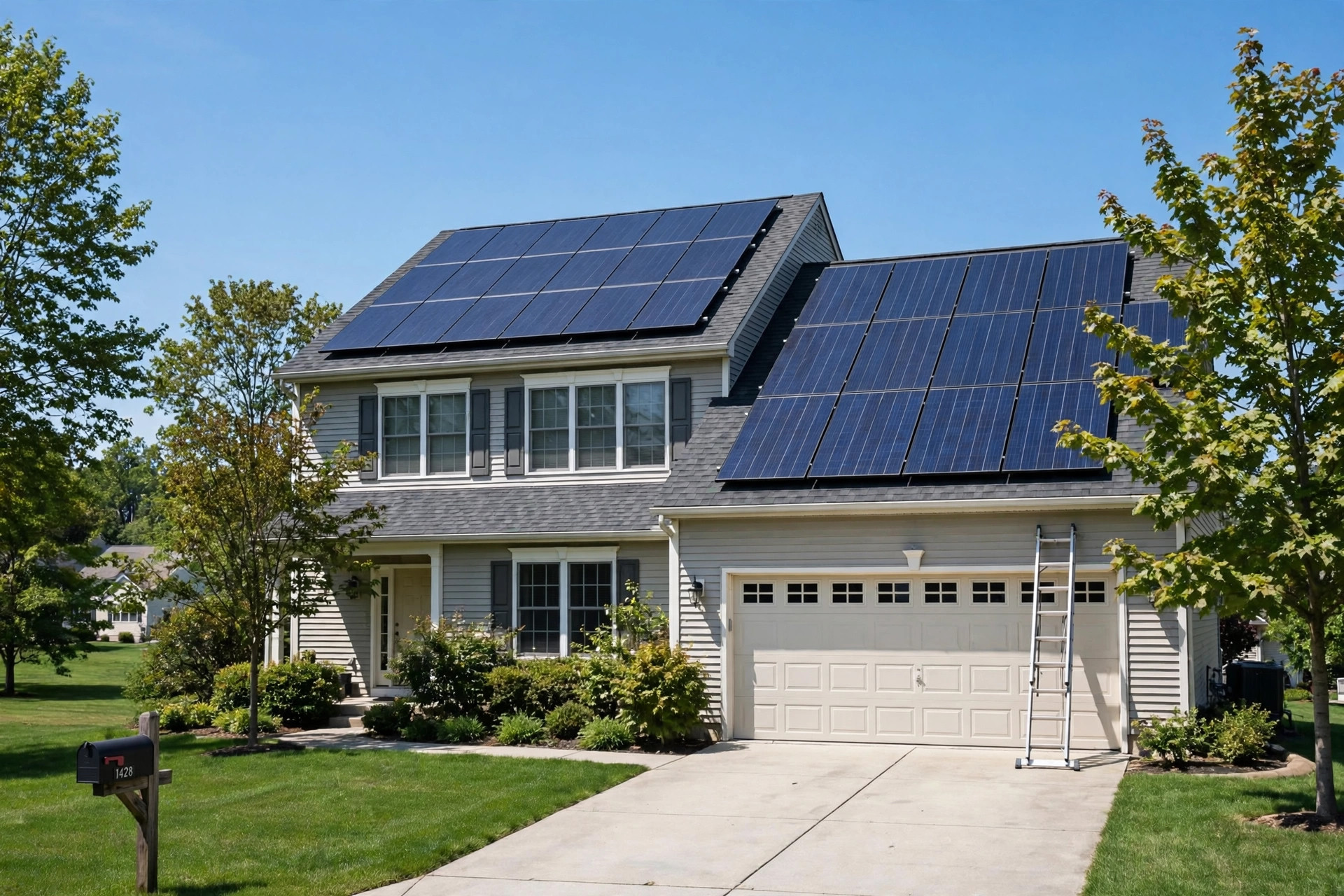

More American homeowners are asking what residential solar cost per watt 2026 usa means for their own roofs. Prices have moved. Equipment has changed. Tax credits have changed. The cost per watt is the figure that brings all of this down to one simple number: how many dollars you pay for each watt of power the system can make. If you can read that number, you can read almost any solar quote.
The number is not fixed. It shifts with the state you live in, the shape of your roof, and the equipment on the bid. But once you know the fair range and what sits behind it, you can judge whether a proposal is fair or inflated.
Why the Cost Per Watt Matters
A solar quote can run to many pages. It lists panels, inverters, rails, permits, and labor. One homeowner may see a total of 18,000 dollars. Another may see 24,000. Totals alone do not tell you which deal is better, because the systems may be different sizes.
The cost per watt solves this. You take the gross price before tax credits and divide it by the system size in watts. An 8,000-watt system that costs 22,400 dollars works out to 2.80 dollars per watt. Now you can place any two bids side by side.
Industry groups and government analysts use the same measure. The Energy Department publishes research on solar costs, and ENERGY STAR offers guidance on home energy upgrades. When a reviewer at Consumer Reports tests home products, readers get a neutral view they can trust.
Think of the figure as a thermometer for the market. If three installers quote 2.60, 2.75, and 3.40 dollars per watt for similar equipment, the third bid stands out. Something in it costs more. Maybe it is a premium panel. Maybe it is overhead. You can ask, and the answer will tell you a lot.
What to Look For in a Solar Quote: Residential Solar Cost Per Watt 2026 Usa
A fair quote shows the system size in kilowatts, the panel brand and model, and the inverter type. It shows the gross price, the federal tax credit, and any state or local incentives. It names the installer and the warranty terms.
Read the panel wattage. Panels sold in 2026 often rate 400 to 470 watts each. A system with 20 panels at 430 watts is 8,600 watts, or 8.6 kilowatts. Divide the gross price by 8,600 and you have your number.
Look at the inverter. String inverters are simpler and cheaper. Microinverters sit on each panel and add cost but can help shaded roofs. The choice moves the cost per watt by a real amount.
Check the roof work. A plain asphalt roof with a simple shape is fast to work on. Tile roofs, steep pitches, and odd angles add labor. Labor is one reason the national number spreads as wide as it does.
Ask about monitoring and maintenance. Some bids include an app that tracks each panel. Others leave that out. A clear quote names what is in and what is out.
Types and Options for Residential Solar
Home solar comes in a few forms. Each form has its own cost per watt.
Rooftop Panels
This is the common case. Panels bolt to rails on the roof. For most homes in 2026, this runs about 2.50 to 3.50 dollars per watt before tax credits. The This Old House site covers roof projects in plain detail, and Home Depot carries many of the parts and tools used on a job.
Ground Mounts
Some homes have room for panels on the ground. Racks and trenches add material and labor. Cost per watt usually runs higher than a rooftop job, though the panels can face the sun at a better angle.
Solar Shingles and Building Tiles
These look like a normal roof. They cost far more per watt than panels and suit owners who prize looks above payback. Most buyers skip them.
Battery Storage
A battery stores daytime power for night use. It adds a large sum to the bid but does not add watts. If you divide the full price by system watts, a bid with a battery will show a higher cost per watt. Many buyers compare the solar and the battery as two lines.
Tech reviewers at CNET and PCMag follow smart home gear, and solar pairs well with other connected devices. A solar security camera for the driveway needs no grid power, and Ring sells solar chargers that keep such cameras running outdoors, a sign of how far small solar gear has come in the home.
Cost and Price Breakdown
Here is a rough map of where the money goes on a typical 8-kilowatt home system priced near 2.80 dollars per watt, or about 22,400 dollars gross.
– Panels: about 30 percent. The modules themselves, often 400 to 470 watts each. – Inverter: about 10 percent. String or microinverter electronics that turn direct current into home current. – Racking and wiring: about 10 percent. Rails, clamps, cable, and disconnect boxes. – Labor: about 20 percent. The crew, the electrician, and the project lead. – Permits, inspection, and design: about 10 percent. Plans, utility paperwork, and the city visit. – Installer overhead and margin: about 20 percent. Office, trucks, insurance, and profit.
Prices vary by state. The West and the Northeast often quote higher, near 3.00 to 3.50 dollars per watt, because labor and permits cost more. The South and the Midwest often land lower, near 2.50 to 3.00. Local supply and the number of competing installers matter.
Tax credits change the real cost. The federal credit has been a large share of many deals. State programs add rebates, tax breaks, or net metering rules that change the payback. Because tax law moves, confirm the current credit with a tax adviser before you sign. A credit does not change the quoted cost per watt, but it changes what leaves your pocket.
Cash buyers pay the quoted price. Loan buyers pay the quoted price plus interest. A loan at a high rate can add a dollar per watt or more to the true lifetime cost. Read the loan terms as closely as the equipment terms.
Leases and power purchase agreements are a third path. You pay little or nothing up front, then buy the power at a set rate. There is no cost per watt to quote here, because you do not own the system. Compare the rate to your utility bill instead.
Care and Upkeep
Solar panels need little care. Rain washes off most dust. In dry regions, a rinse once or twice a year helps. Do not walk on the panels, and do not use harsh cleaners.
Trim trees that shade the array. Shade is the quiet thief of solar output. A small branch across one panel can drag a whole string down unless each panel has its own microinverter or optimizer.
Watch the monitoring app. If one panel drops while the rest hold steady, call the installer. Many faults show up in the data long before the electric bill would reveal them.
Check the roof hardware every few years. Look for loose bolts, chewed cable, or rust on the rails. A visual check from a ladder is often enough. Keep the attic clear of stored boxes under the array so heat can escape.
Inverters age before panels. A string inverter may last 10 to 15 years. Microinverters tend to last longer. Panel warranties often run 25 years. Know these dates, and plan the budget for a future inverter swap.
Snow is a short problem in most regions. Panels face the sky and shed snow on their own once the sun hits them. Do not scrape them with metal tools. In hot regions, leave air space under the array so the panels can cool. Heat lowers output a little, but good airflow keeps the loss small.
Keep the paperwork in one folder. Store the contract, the panel model numbers, the warranty cards, and the installer phone number together. Years from now, a repair will go much faster when you can name the parts.
Safety
Work on a roof is risky. Falls are the main danger. Only licensed crews should mount panels, and they should use proper anchors and harnesses.
Electrical work carries shock and fire risk. The system must be installed to code and inspected. The Consumer Product Safety Commission tracks home product hazards, and its guidance on electrical safety is worth a read before any major project.
Some states require a licensed electrician for the final tie-in to the breaker panel. Do not skip this. An unpermitted system can void a roof warranty and cause trouble with the utility or the insurer.
After storms, look at the array from the ground. If a panel is cracked or shifted, call the installer. Do not climb up to fix it yourself.
If you add a battery, place it where the manual allows, usually in a garage or utility area, away from heat and moisture. Keep the area clear.
Solar owners often add other connected gear as part of a smart home plan. A smart doorbell with clear installation costs and a smart water leak detector are common add-ons, and a Bob Vila guide can help you plan the wiring and placement for any of these devices.
FAQ
What is a good residential solar cost per watt in 2026?
For a standard rooftop system in the United States, 2.50 to 3.00 dollars per watt before tax credits is a fair range in most markets. Quotes near 2.50 are strong. Quotes above 3.50 deserve a second look and a clear reason for the premium.
Does the cost per watt include the battery?
Usually not in a clean comparison. A battery adds dollars but not watts, so it raises the figure. Ask the installer to show the solar price per watt and the battery price as separate lines.
How big a system does my home need?
Look at your last 12 electric bills. Add the kilowatt-hours for the full year. In most of the country, one kilowatt of panels makes about 1,200 to 1,500 kilowatt-hours per year. Divide your yearly use by that range to size the array. A typical home needs 6 to 10 kilowatts.
How long until solar pays for itself?
Payback often falls between 6 and 12 years, depending on the local utility rate, the tax credits, and the bid. High-rate states pay back faster. Cheap power and shaded roofs stretch the timeline.
Should I get microinverters or a string inverter?
Shaded or odd-shaped roofs favor microinverters, since each panel works on its own. Simple, sunny roofs do well with a string inverter at lower cost. The choice moves the cost per watt by roughly 0.15 to 0.30 dollars.
Can I install solar myself?
The parts are sold to the public, but the permit, the electrical tie-in, and the roof work make this a hard do-it-yourself job. Most states want licensed hands on the final connections. A bad mount can leak, and a bad wire can start a fire. Hire a pro for the roof and the electric work.
A Short Final Word
The residential solar cost per watt 2026 usa figure is the single most useful number in any solar conversation. Learn to compute it, and the whole market becomes legible. Get three or four bids. Ask each bidder the same questions. Then choose the installer you trust at a price per watt you can defend. The panels will sit on your roof for a quarter century, so the extra week of homework pays well.
References
Bob Vila. (n.d.). Home improvement advice. https://www.bobvila.com CNET. (n.d.). Technology news and reviews. https://www.cnet.com Consumer Reports. (n.d.). Product reviews and ratings. https://www.consumerreports.org ENERGY STAR. (n.d.). Energy efficient products. https://www.energystar.gov PCMag. (n.d.). Technology product reviews. https://www.pcmag.com Ring. (n.d.). Smart home security devices. https://www.ring.com The Home Depot. (n.d.). Home improvement products. https://www.homedepot.com This Old House. (n.d.). Home renovation guidance. https://www.thisoldhouse.com U.S. Consumer Product Safety Commission. (n.d.). Product safety information. https://www.cpsc.gov U.S. Department of Energy. (n.d.). Energy efficiency and renewable energy. https://www.energy.gov
Was this guide helpful?

About James Carter
The My Garden US editorial team writes practical, in-depth home and garden guides for American homeowners — tested advice, no fluff.
You May Also Like

Elderly Monitoring Camera for Home Reviews USA
February 28, 2026 0 views
Best Home Safe for Documents Reviews USA
February 5, 2026 0 views
Smart CO Detector with App Alerts USA: A Guide for Every Home
April 22, 2026 0 views