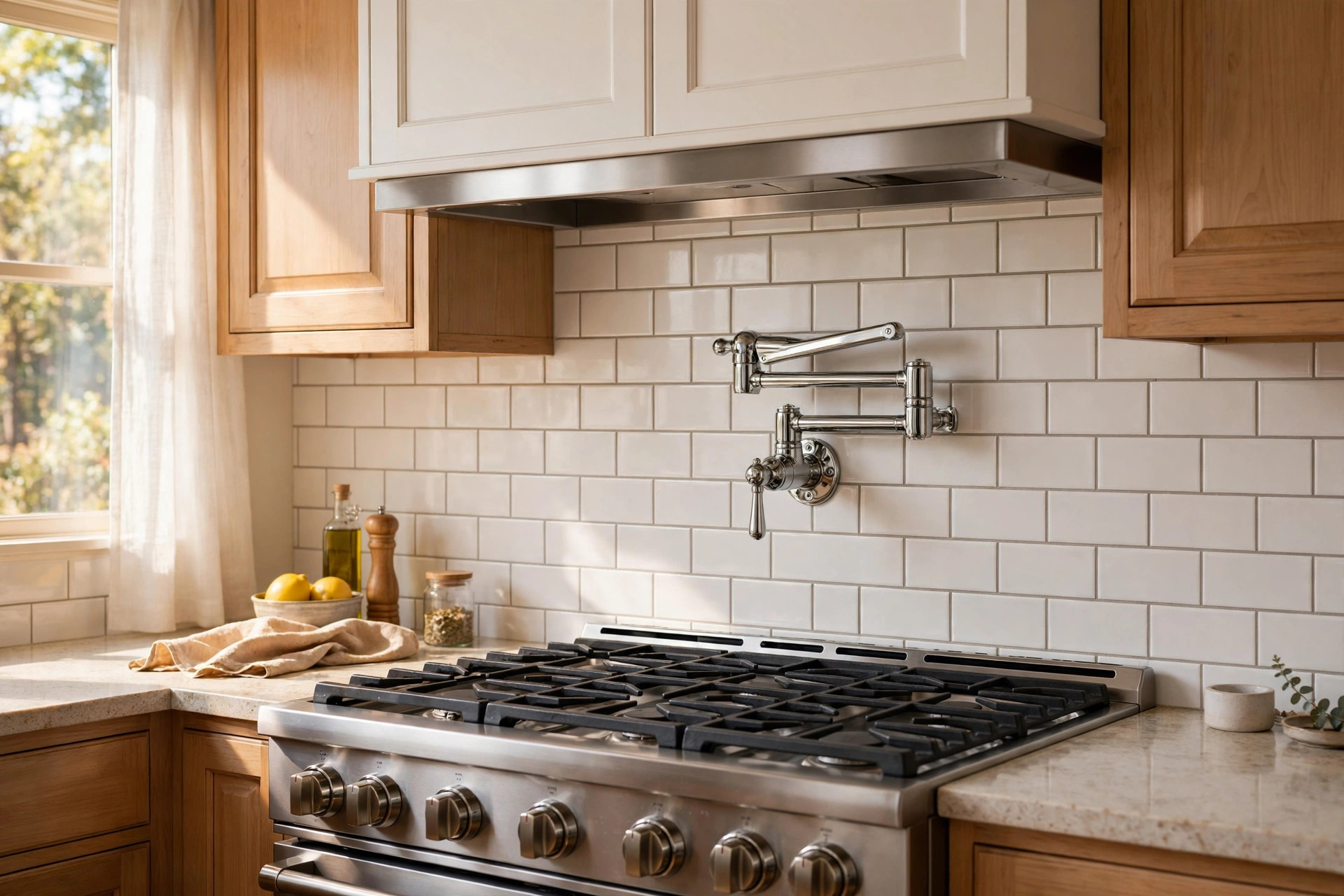
Anyone who has carried a heavy pot of water from the sink to the stove has felt the strain in the arms and the worry of a spill. A pot filler is a small faucet mounted on the wall above the stove. It swings out so you can fill pots right where they cook. No carrying. No drips across the floor. In this pot filler faucet pros and cons review for the USA, we look at what these faucets do well, what they do badly, what they cost, and what owners wish they had known before they bought one.
Why a Pot Filler Matters in a Busy Kitchen
A pot filler serves one job. It delivers cold water directly to pots sitting on the stove or cooktop. Cooks who make pasta, stock, canning batches, or large pots of soup fill heavy vessels again and again. A gallon of water weighs about eight pounds. A six-gallon stockpot can weigh fifty pounds when full. Moving that much weight from sink to stove is tiring and risky.
The pot filler was once common in the kitchens of fine restaurants and old European homes. Today it has become a popular feature in American kitchen remodels. Designers like the look. Serious cooks like the ease. In this article we review the honest strengths and weaknesses so you can decide if one belongs in your kitchen.
How a Pot Filler Works: Pot Filler Faucet Pros and Cons Reviews Usa
A pot filler mounts on the wall behind the range, about twenty inches above the cooking surface. It connects to the cold water line inside the wall. Most models have two arms that fold back against the wall when not in use. They swing out to reach the front burners. A handle or two handles control the flow. There is no hot water supply. There is no drain under the faucet. That missing drain is the root of most complaints, which we will cover below.
The faucet only dispenses water when you turn it on. When folded back, it sits close to the wall. The design keeps it out of the way of tall pots and out of the way of steam.
The Pros: Why Owners Love Pot Fillers
Less Carrying and Less Strain
The main benefit is simple. You do not carry heavy pots of water across the kitchen. For older cooks and anyone with back or shoulder trouble, this is a real gain. Reviews from American owners say again and again that this one change made daily cooking easier.
Speed and Ease
A pot filler usually delivers water faster than a kitchen sink faucet. It can have a higher flow rate because it does not face the same flow limits as some sink faucets. Filling a large canning pot takes less time. When you add water to a pot that is already hot on the burner, you do not have to move it.
A High-End Look
Many buyers choose a pot filler for the style. It signals a serious kitchen. It pairs well with a range cooker, a tile backsplash, and a professional hood. Models come in chrome, brushed nickel, matte black, and brass tones. The faucet can match the rest of the kitchen fixtures.
Easy Refills During Cooking
When a pot boils down, you can add water without lifting it. Pasta water, rice water, and stock can be topped off right on the burner. This is the small daily joy that owners mention most.
The Cons: The Honest Drawbacks
No Drain Under the Faucet
This is the biggest con. A pot filler sits over the stove. There is no sink below it. If you overfill a pot, the water lands on the stove, on the counter, or on the floor. Owners warn that you must watch the pot while it fills. Children should not use it alone.
Leak Risk Inside the Wall
A pot filler adds a water line and joints inside the wall. Every joint is a place where a leak could start. If a joint fails, water can drip inside the wall before you notice. Good installation lowers this risk. Cheap valves raise it. Some owners add a shutoff valve in the cabinet below so they can cut the water to the filler when they leave the house for a long time.
Installation Cost and Complexity
Adding a pot filler to an existing kitchen is not a small job. The wall must be opened to run a water line. That means tile work and patching. If the wall is brick or concrete, the job is harder still. In a new build or full remodel, the cost is modest. In a finished kitchen, it can run to several hundred dollars for the plumber alone, plus the price of the faucet and the repair work.
You Still Need the Sink
A pot filler does not replace the kitchen faucet. You cannot wash food or hands at it. You cannot rinse anything. Some buyers imagine they will use it for everything near the stove. In practice it is a one-job tool. It earns its place only if you often fill large pots.
Extra Joint to Maintain
Every faucet needs care. The swing arms of a pot filler have seals that wear with time. The spring in the handle can loosen. The wall mount can work loose if the arms are pulled hard. Reviews note that owners should check the joints now and then and tighten what is loose.
Types and Options
Single-Arm and Double-Arm Models
Most pot fillers have two jointed arms that fold flat against the wall. A few have one long arm. The double-arm style reaches further and folds neatly. It costs more.
Handle Styles
Many models use a lever handle that stays open until you close it. Some use a spring-loaded handle that shuts off when you let go. The spring style is safer against overflows. Cooks who fill huge pots for canning often prefer the lever because they do not have to hold it open.
Finish Choices
Chrome and stainless match most appliances. Brushed nickel is common. Matte black and brass are popular in styled kitchens. Pick a finish that matches your other faucets. Reviews note that cheap finishes can peel in the steam above a stove. This is a place to avoid the cheapest models.
Mount Height
Install the faucet high enough that tall stockpots fit under it. Twenty inches above the burner grates is a common guide. Too low and the spout hits the pot. Too high and the splash from the falling water is worse.
Cost and Price in the USA
A basic pot filler costs from about forty to one hundred dollars. Mid-range models from known brands run from one hundred fifty to four hundred dollars. Designer models in brass or copper tones can pass six hundred dollars. The faucet price is only part of the bill. Installation in a new kitchen adds one to three hours of plumber time. In an existing kitchen with a tiled backsplash, the total with repairs can reach five hundred to one thousand dollars.
Compare that cost to how often you will use it. If you fill large pots most days, the price feels fair. If you cook small meals and rarely fill a pot larger than two quarts, the money is better spent on a better pull down kitchen faucet at the sink. Reading reviews from American owners helps here: the happiest buyers are the ones who cook in volume.
What to Look for When You Buy
Build Quality
Choose a solid brass body rather than thin plated plastic. Heavy joints last longer. Read reviews and look for notes about the finish holding up in steam. Brands like Moen and Delta sell pot fillers that match their main faucet lines, which makes the finish and parts easier to trust.
Flow Rate
Look for a flow rate near or above four gallons per minute. That fills a pot fast. Some models reach five or six gallons per minute. A slow filler takes away the whole point.
Reach and Swing
Measure your range. The arms must reach your front burners when extended and fold back clear of the wall when closed. Check the published reach in inches against your stove depth.
Valve Type
Ceramic disc valves last longer than rubber washers. They turn smoothly and seal well. They also make drip repairs less common.
Matching Faucet Lines
If your kitchen has a touchless kitchen faucet or a commercial style kitchen faucet, choose a pot filler from the same maker when you can. The finish will match and you will know where to get parts.
Care and Upkeep
A pot filler needs little care, but it needs some. Wipe the arms and spout each week to keep grease from building up. Do not use harsh cleaners on the finish. Once a year, check the wall mount and the arm joints for looseness. Turn the handle on and off and look for drips at the joints.
If the flow slows down, the aerator may be blocked by sediment. Unscrew it, rinse it, and put it back. If a joint drips, the seal inside may need replacing. Keep the model name and number in a file so you can order the right part.
When you go away for more than a day or two, close the shutoff valve if one was fitted. This is a simple habit that removes the leak risk while the house is empty.
Safety Notes
Never leave a filling pot unattended. There is no overflow drain. A pot left under an open pot filler will spill onto a hot stove. That can crack a glass cooktop or send water into the burners.
Teach children that the pot filler is not a toy and not a drinking fountain. The spout sits over a hot cooking surface, and the area around it is not a safe place to play.
Make sure the faucet was installed with a proper water line and a shutoff. Have a licensed plumber do the work. A do-it-yourself install inside a finished wall is a job where a small mistake can cause a large water loss.
Check local rules. Some areas ask for a vacuum breaker or a backflow device on a pot filler line. Your plumber will know what the local code wants.
Reviews: What American Owners Say
Reviews from the USA tell a steady story. Owners who cook big meals love the filler. They use it for pasta, canning, stock, and lobster pots. They say it is one of the best features in their kitchen.
Owners who rarely fill large pots report that it gets little use. A few say it was a design choice rather than a cooking choice, and they admit it mostly sits folded against the wall.
Common complaints in reviews are drips from the arm joints, finishes that spot in steam, and the shock of the installation bill in an old kitchen. Common praise is the speed of the fill, the ease on the back, and the look over the range.
Frequently Asked Questions
Is a pot filler worth it?
It is worth it if you often fill pots larger than four quarts. Pasta makers, canners, and big-family cooks get the most value. If your largest pot is small and your sink is steps from the stove, you can skip it.
Do pot fillers leak?
Any faucet can leak. The risk with a pot filler is that a leak inside the wall goes unseen. Choose a quality valve, have a licensed plumber install it, and check the joints each year. A shutoff valve in the line adds peace of mind.
Can I add a pot filler to an existing kitchen?
Yes, but the wall must be opened to run the water line. In a kitchen with a tile backsplash this means cutting and replacing tile. The work costs more than in a new build. Get a quote from a plumber before you buy the faucet.
Hot or cold water?
Pot fillers supply cold water only. The code in most areas does not allow a hot line to a filler over the stove. You heat the water in the pot.
How high should a pot filler be mounted?
About twenty inches above the burner grates is a common height. It must clear your tallest pot with room to spare. Measure before the plumber opens the wall.
Do I need a permit to install one?
Rules differ by town. Many areas count it as a plumbing change that needs a permit and an inspection. Ask your plumber or the local building office before work starts.
A Short Final Word
A pot filler is a simple tool that does one job well. It fills pots on the stove without carrying. The pros are comfort, speed, and looks. The cons are the missing drain, the leak risk in the wall, and the cost of adding a water line. Read the reviews, measure your stove, and be honest about how you cook. If your kitchen sees big pots most weeks, a pot filler may be the small luxury you use every day. If not, the money serves you better elsewhere in the kitchen.
For more background, see Family Handyman, U.S. Environmental Protection Agency, and The Home Depot. For more background, see Lowe’s, Delta Faucet, and Kohler. See Aquasana for more detail.
References
Aquasana. (n.d.). Water filtration systems. https://www.aquasana.com Delta Faucet. (n.d.). Kitchen and bathroom faucets. https://www.deltafaucet.com Family Handyman. (n.d.). DIY home repair and maintenance. https://www.familyhandyman.com Kohler. (n.d.). Bathroom and kitchen fixtures. https://www.kohler.com Lowe’s. (n.d.). Home improvement products. https://www.lowes.com Moen. (n.d.). Faucets and plumbing fixtures. https://www.moen.com The Home Depot. (n.d.). Home improvement products. https://www.homedepot.com U.S. Environmental Protection Agency. (n.d.). Protecting human health and the environment. https://www.epa.gov
Was this guide helpful?

About David Wilson
The My Garden US editorial team writes practical, in-depth home and garden guides for American homeowners — tested advice, no fluff.