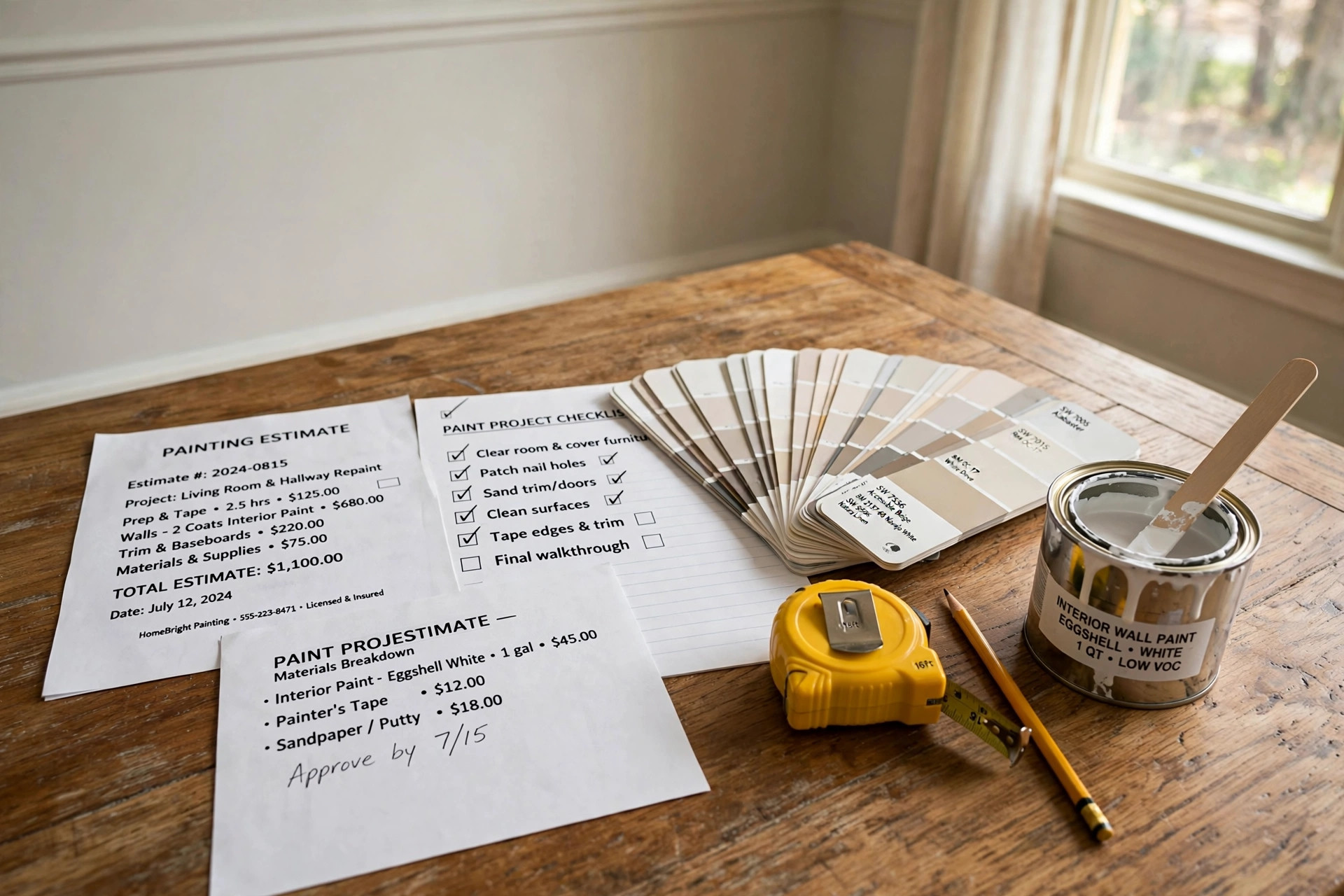

A painting quote comparison checklist for homeowners is the most useful tool you can bring to a painting project. Most owners call three painters and get three bids that look nothing alike. One is a single page with a price. Another is four pages of detail. The third was given over the phone. A checklist lets you put them side by side and see what each painter really plans to do. This guide shows you how to build that checklist, what every line should say, and how to choose the bid that gives you the best work for a fair price.
Why Comparing Quotes Matters
A fresh coat of paint changes a home. It can raise value, protect wood, and make old rooms feel new. But a bad job costs far more than a good one. Paint that peels in a year means you pay twice. Painters who skip prep work often win on price and lose on results.
Two bids can differ by hundreds or even thousands of dollars. The difference is rarely luck. It is scope. One painter may plan to prime, caulk, sand, and apply two coats. Another may plan to spray one coat and leave. Without a checklist, you cannot see this. You only see the price. That is how owners end up with the wrong crew.
A checklist also keeps you honest with the painters. When every bidder answers the same questions, no one can hide weak spots in vague words. You learn which firms are careful and which rush. Many homeowners who read paint product reviews before a project also find that comparing the actual bids is what saves them money in the end.
What to Look for in Every Painting Quote: Painting Quote Comparison Checklist for Homeowners
Every quote should answer the same basic questions. If one does not, call the painter and ask before you judge the price. Your painting quote comparison checklist for homeowners should include the items below.
Scope of Work
The bid should state every surface to be painted. It should name each room, each wall, each ceiling, each trim piece. For exterior work, it should name siding, eaves, fascia, doors, shutters, and garage. Vague words like “paint the house” are not enough. You want a list.
Surface Preparation
Prep work decides how long paint lasts. Ask what the painter will do before the first coat. Good prep may include washing, scraping loose paint, sanding, filling holes, caulking gaps, and priming bare spots. The bid should say which of these are included. A bid that skips prep will cost you more later. Guides on proper surface preparation steps explain why this part of the job takes time.
Paint Brand and Product Line
The quote should name the brand and the exact product line, not just “premium paint.” Sherwin-Williams, Behr, and Benjamin Moore each make many lines at different prices and quality levels. A good bid names the line and the sheen for each surface. You can check the named products on the maker sites, such as Sherwin-Williams paint products, Behr products, or Benjamin Moore colors, to see where they sit in quality.
Number of Coats
Most jobs need two coats over primer. One coat rarely covers well or lasts long. The bid should state how many coats go on each surface and whether primer counts as a coat. If a bid says “two coats” but uses primer as one of them, you are really getting one finish coat. Ask for clarity.
Materials and Supplies
The quote should say who supplies the paint, primer, caulk, tape, and drop cloths. Most painters buy materials and bill you for them. The bid should list an allowance or a fixed material price. This keeps the painter from charging twice for the same gallon.
Labor and Crew
Ask how many workers will come and how many days the job should take. A one-man crew at a low price may take three weeks and live in your house the whole time. A crew of four may finish in three days. Both can be fine, but you should know which you are buying.
Repairs Beyond Painting
Many jobs need small repairs first. Rot in trim, cracked drywall, peeling stucco, or loose siding must be fixed before paint goes on. The bid should say whether such repairs are included and what they cost. Some painters include minor carpentry. Others stop at paint. Put it on the checklist.
Start Date and Finish Date
The bid should give a real schedule. “As soon as possible” is not a date. Ask when the crew will start and how many work days the job should last. Weather can shift exterior dates, but the painter should still give a plan.
Payment Terms
Never pay the full price up front. A fair plan is a small deposit, payments as work is done, and a final payment only after you approve the finished job. The bid should state the deposit, the schedule, and the final payment. If a painter demands most of the money before work starts, walk away.
Warranty
A good painter stands behind the work. Ask what the warranty covers and how long it lasts. One year is common. Two years is better. The bid should state the warranty in writing, not just in talk. You can find plain advice on what a painting warranty should cover to compare against.
Types of Painting Quotes You Will See
Not every quote looks the same. It helps to know the common types so you can compare them fairly.
Lump Sum Quotes
This is one price for the whole job. It is simple and common. The risk is hidden detail. A lump sum bid with no breakdown makes it hard to see what is included. Ask the painter to add the checklist items above to the lump sum.
Itemized Quotes
These break the job into parts: prep, paint, labor, materials, repairs. Itemized quotes are the easiest to compare. You can line up each part across bids and see where they differ. When a painter gives you a lump sum, ask for an itemized version.
Time and Materials Quotes
Here you pay for hours worked plus the cost of materials. This type is fair for jobs with unknown problems, such as a very old house with hidden rot. The risk is that hours can grow. Ask for a written cap or a range so the price cannot run wild.
Verbal Quotes
A price given by phone or at the door with nothing in writing is not a quote. It is a guess. Never compare a verbal quote with a written one. Ask the painter to put it in writing with the checklist items before you judge it. Homeowners who read home improvement guides often learn this lesson the hard way.
Cost and Price: Reading the Numbers
Painting prices in the United States vary by region, size, and surface. Interior work often runs by the square foot of wall or by the room. Exterior work often runs by the square foot of siding. A small bedroom may cost a few hundred dollars. A full exterior on a two story house can run several thousand.
Do not pick the lowest price without checking the checklist. A low bid may leave out prep, primer, or a second coat. When you add those back in, the low bid may be the most expensive. A high bid may include better paint, full prep, and a strong warranty. The painting quote comparison checklist for homeowners exists to make these trade offs clear.
Watch for prices that are far below the others. A bid that is half the price of the rest is a warning sign. The painter may plan to cut corners, use cheap paint, or may not carry insurance. Ask what was left out. If the answer is vague, move on.
Material costs are easy to check. Paint runs from about thirty dollars a gallon for basic lines to eighty or more for top lines. A gallon covers about three hundred and fifty square feet in one coat. You can look up retail prices at stores such as Home Depot paint supplies or Lowe’s paint department to see if the bid’s material price is fair. Retail design shows on sites like HGTV can also give you a feel for what finished work should look like.
Related reading on costs may help. If you plan exterior work, see our guide on the best exterior house painting cost estimator usa. If you are looking at interior rooms, our post on interior house painters near me reviews can help you find firms. For brick homes, read about exterior brick painting service near me cost.
Care and Upkeep After the Job
A good paint job needs simple care to last. Wash exterior siding once a year with a garden hose and a soft brush. Touch up small chips before bare wood shows. Keep sprinklers from hitting painted walls every day, since constant water shortens paint life.
Inside the home, wipe walls with a damp cloth instead of strong cleaners. Keep the extra paint the painter leaves you. Label each can with the room and the date. When a scuff appears, you can touch it up in minutes instead of calling the painter back.
Ask the painter what the paint needs to cure. Most latex paint feels dry in hours but takes about two to four weeks to cure fully. During that time, avoid hanging heavy items or scrubbing the new surface.
Safety and Insurance Checks
Before any painter climbs a ladder on your property, check two papers: a license where your state requires one, and proof of insurance. The painter should carry general liability insurance and workers compensation. Ask for a certificate and call the insurer to confirm it is current.
If a worker falls from your roof and the firm has no insurance, you may be held liable. This risk is real. Do not skip this step on the checklist. It takes ten minutes and can save you a fortune.
For homes built before 1978, ask about lead paint. Federal law requires painters to be certified in lead safe work when they disturb paint in older homes. The bid should state how the crew will handle lead paint if they find it. This is not a detail to leave out.
Ventilation matters for interior work. Make sure the painter plans to ventilate rooms while painting and while the paint dries. Low odor paints help, but fresh air is still wise.
How to Use Your Checklist Step by Step
Follow these steps with each bid you receive.
1. Read the full bid once before you judge the price. 2. Write the price on your checklist next to the painter’s name. 3. Go through each checklist item and mark it as included, extra, or missing. 4. Call the painter about every missing item. Write down the answers. 5. Ask each painter the same three questions: what paint line will you use, how many coats, and what is the warranty. 6. Check licenses and insurance for the top two bids. 7. Call two past customers of each finalist. Ask if the crew was clean, on time, and if the paint still looks good. 8. Pick the bid with the best mix of scope, quality, and price, not the lowest price alone.
Keep all bids and your checklist in one folder. If a dispute comes up later, these papers are your proof of what was promised.
Frequently Asked Questions
How many quotes should I get?
Three is a good number. Two can work if both are detailed. More than four makes the comparison slow and confusing. Three detailed bids give you a fair range of price and quality.
Should I tell each painter the other bids?
You can say you are getting three bids. That is fair. Do not share the exact prices. If you show a low price to a good painter, some will match it by cutting scope. You want each bid to stand on its own merits.
What if one quote is much higher than the others?
Ask why. The painter may plan more prep, better paint, or include repairs the others left out. Sometimes the high bid is the honest one. Compare the checklist line by line before you judge.
Is the cheapest quote ever the right choice?
It can be, but only if the checklist shows it includes the same scope, paint, prep, and warranty as the others. A cheap bid that matches the full scope is a good deal. A cheap bid with a thin scope is a trap.
Should materials be included in the quote?
Yes. The bid should include paint, primer, and supplies as a stated price. This stops the painter from billing you twice and lets you check that the paint named matches what is actually used.
Do I need a written contract?
Yes. The accepted quote becomes the contract when both sides sign it. It should restate the scope, schedule, payment terms, and warranty. Never start work on a handshake alone.
A Short Final Word
A painting quote comparison checklist for homeowners takes an hour to build and use. It can save you thousands of dollars and weeks of regret. Line up each bid, check the scope, the prep, the paint, the price, and the papers. Choose the painter who gives you the most complete job for a fair price. The paint on your walls will thank you for years.
References
Behr. (n.d.). Paints, primers, and stains. https://www.behr.com Benjamin Moore. (n.d.). Paints and stains. https://www.benjaminmoore.com Bob Vila. (n.d.). Home improvement advice. https://www.bobvila.com HGTV. (n.d.). Home and garden ideas. https://www.hgtv.com Lowe’s. (n.d.). Home improvement products. https://www.lowes.com Sherwin-Williams. (n.d.). Paints and coatings. https://www.sherwin-williams.com The Home Depot. (n.d.). Home improvement products. https://www.homedepot.com The Spruce. (n.d.). Home and garden advice. https://www.thespruce.com This Old House. (n.d.). Home renovation guidance. https://www.thisoldhouse.com
Was this guide helpful?

About Robert Taylor
The My Garden US editorial team writes practical, in-depth home and garden guides for American homeowners — tested advice, no fluff.
You May Also Like

Limewash Brick Fireplace Kit Reviews USA: What Homeowners Should Know
June 23, 2026 0 views
Wall Molding Kits for Dining Room Use in American Homes
August 10, 2026 0 views
Best Paint Sprayer for Home Use Reviews
January 24, 2026 0 views