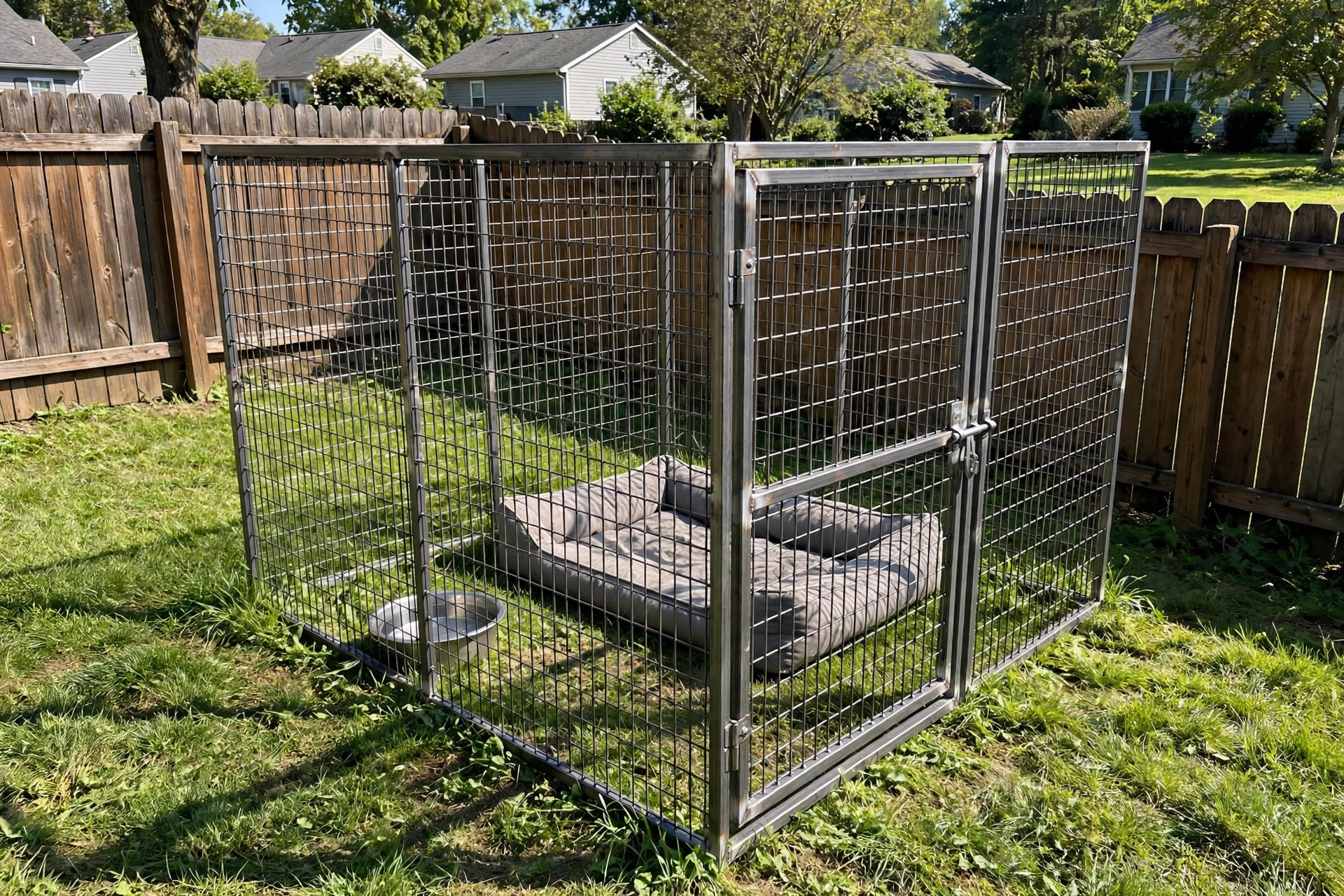

A dog that spends time outdoors needs a place that is safe, strong, and comfortable. An outdoor dog kennel with welded wire panels gives your dog a secure spot to enjoy fresh air when you cannot watch every minute. These kennels use steel panels in which the wire mesh is welded at each joint. The result is a fence that keeps its shape and resists chewing, digging, and hard pushing far better than ordinary chain link. In this guide you will learn how welded wire kennels work, what to look for when you buy one, how much they cost, and how to keep one safe and clean for years.
Why a Welded Wire Kennel Matters
Many dogs do best when they can move between the house and the yard. Yet an open yard is not always safe. A dog may dig under a fence, chew through a weak barrier, or run into the street. A welded wire kennel solves this problem by giving the dog a fixed space with solid walls.
Welded wire is made by crossing steel wires and fusing them at every crossing point. This makes each panel stiff and hard to bend. A dog that pushes or jumps against the wall will find little give. This strength also helps the kennel stand up to wind and snow without sagging.
A kennel also helps with training. Puppies and young dogs learn quickly that the kennel is their place to rest and play. It keeps them out of garden beds, trash cans, and tools stored in the yard. For owners who rent a home, a free-standing kennel is useful because it can be taken apart and moved without damage to the property.
Owners of large or strong breeds gain the most. A determined dog can climb or break light fencing. A large breed kennel built with welded wire panels stands a much better chance of holding the animal safely.
How to Choose the Right Kennel: Outdoor Dog Kennel with Welded Wire Panels
Before you buy, measure your yard and think about your dog. The right size depends on the breed, the energy level of the dog, and the hours the dog will spend inside.
Size and Height
The kennel must be large enough for the dog to stand, turn, stretch out, and play. A good rule is to allow at least four times the floor area of the dog’s crate indoors. For a small dog, a kennel of six feet by six feet is often enough. For a large dog, look for eight feet by ten feet or more. Long runs of ten or twelve feet give an active dog room to move.
Height matters too. The walls should be taller than the dog when it stands on its hind legs. For most medium and large dogs, a wall height of six feet is wise. Jumpers and climbers need the full six feet, and sometimes more. A gate should be wide enough for you to walk through with the dog on a leash.
Wire Gauge and Frame Quality
Wire gauge tells you how thick the steel wire is. Lower numbers mean thicker wire. For most dogs, 8 gauge or 9 gauge wire is strong enough. Very strong dogs and large breeds do better with 6 gauge. Thin 11 gauge wire may bend under pressure and is best left for small, calm dogs.
Look at the frame as well. Panels should have a steel tube frame around the edges. Round or square tubing of one inch or more gives the panel real strength. The welding points should be smooth and even, with no sharp tips that could cut a dog’s nose or paw.
Galvanized steel is the best choice for outdoor use. The zinc coating keeps rust away for many years. Some panels are coated with vinyl or powder paint over galvanized steel. This adds color and extra protection. Avoid painted panels that are not galvanized underneath, because the paint will chip and rust will follow.
Types and Options
Kennels come in several forms, and each suits a different need.
Panel kits. These are sets of pre-made panels that bolt or clamp together. You can buy a standard square or add extra panels to make a long run. Panel kits are easy to expand. You can also change the shape to fit a corner of the yard.
Kits with a roof. A roofed dog run keeps sun, rain, and snow off the dog. Roof frames usually hold a canvas tarp or a metal panel. In hot climates a roof is almost a must, because it keeps the kennel floor cool.
Open-top kennels. These have no roof. They cost less and give full sky above the dog. They work for calm dogs that do not climb. If you choose an open top, plan shade another way, such as a tree or a shade sail.
Anchor systems. Some kennels sit on the ground with legs or feet. Others use ground anchors or stakes that hold the frame down. Anchors are smart in windy areas. They also stop a strong dog from lifting the panel edge.
Doors and latches. A good gate has a latch that a dog cannot open with its nose or paw. Look for a latch that locks with a carabiner or padlock. Sliding bolt latches are common and work well. Make sure the gate opens inward or outward without hitting trees or walls.
Cost and Price
Prices for a welded wire dog kennel depend on size, wire gauge, and brand. Small kits for one small dog often sell for about one hundred to two hundred dollars. Mid-size kennels for medium dogs usually cost between two hundred and four hundred dollars. Large kennels for big breeds, especially those with a roof, often run from four hundred to eight hundred dollars. Very large runs and heavy duty commercial models can pass one thousand dollars.
Thicker wire costs more. Galvanized panels cost more than plain painted steel. Roofs, sun shades, and floor mats add to the bill. Delivery fees can add a lot for heavy kits, so check the shipping cost before you order from pet supply retailers like Chewy or big stores like Home Depot.
Used kennels can save money. Check local listings and farm sales. Inspect used panels for rust, bent frames, and broken welds before you pay. Replacing a few damaged panels is cheap, but a rusted frame is not worth buying.
Budget for extras. You will likely want a water bowl that clamps to the wire, a shade cover if the kennel has no roof, and anchors for the frame. An elevated dog bed keeps the dog off cold or wet ground and is a wise addition in damp climates.
Care and Upkeep
A welded wire kennel needs little care, but regular checks keep it safe.
Walk the fence line once a month. Look for loose clamps, bent panels, and rust spots. Tighten bolts that have worked loose. A can of cold galvanizing spray can touch up small rust spots before they spread.
Clean the kennel floor often. Remove waste every day to keep flies away and to keep the dog healthy. Hose down the panels and floor every week or two. Pet health sites such as PetMD remind owners that clean quarters lower the risk of skin and paw problems.
Check the gate latch each time you use it. A worn latch can fail at the worst moment. Replace plastic clips with metal ones when they crack.
In winter, clear snow from the panels and roof so the weight does not bend the frame. In summer, make sure shade covers part of the kennel at all hours. The American Kennel Club advises that dogs always have fresh water and a shaded resting place when outdoors.
Every spring, give the whole kennel a close look. Replace any panel with broken welds. A single loose wire can injure a paw or snag a collar.
Safety
A kennel is only safe when it is set up and used with care.
Place the kennel on level ground away from roads and driveways. Keep it clear of fences the dog could use as a ladder. Leave a gap between the kennel and any structure so the dog cannot climb out.
Never use the kennel as a full-time home. Dogs need human company, walks, and indoor rest. A kennel is a safe yard within a yard, not a substitute for care. Animal welfare guidance from the ASPCA stresses that dogs left alone outside for long hours can suffer from heat, cold, boredom, and loneliness.
Watch the weather. Bring the dog inside during storms, extreme heat, and bitter cold. Welded wire stops the dog from leaving, but it does not protect against lightning, falling branches, or freezing rain.
Make the kennel escape-proof. Sink the bottom edge a few inches into the soil, or lay wire mesh flat on the ground around the base to stop digging. Check for gaps under the gate. A small dog can squeeze through a gap of only a few inches.
Keep collars snug and remove choke chains before the dog enters the kennel. A loose collar can catch on wire mesh. Tags should be flat or slide-on so they do not hook on the wire.
Frequently Asked Questions
What is the difference between welded wire and chain link?
Welded wire is stiff because every wire crossing is fused. Chain link is woven and flexes when pushed. A welded wire dog kennel keeps its shape better, resists chewing at the edges, and is harder for a dog to climb. Chain link costs less but stretches and sags over time.
How big should the kennel be?
The kennel should give the dog room to walk, stretch, and lie down fully. As a rough guide, allow at least twenty-five square feet for a small dog, fifty square feet for a medium dog, and eighty square feet or more for a large dog. Bigger is always better when you have the space.
Can a strong dog break out of a welded wire kennel?
A well-built kennel with thick gauge wire, a steel tube frame, and a locking gate will hold almost any dog. Escapes usually come from weak points: a loose latch, a gap under the gate, or panels that were never anchored. Choose 8 gauge or thicker wire for strong breeds and check the hardware often.
How do I stop my dog from digging out?
Lay welded wire mesh or concrete pavers on the ground inside the kennel along the edges. Bury the bottom of the panels a few inches deep. Give the dog toys and exercise so boredom does not drive digging. A tired dog digs far less than a restless one.
How long will a welded wire kennel last?
A galvanized steel kennel kept clean and touched up at rust spots can last ten to fifteen years or more. Cheap painted panels may rust in three to five years in wet climates. Storage of the kennel under a roof when not in use adds years to its life.
A Short Final Word
An outdoor dog kennel with welded wire panels is one of the most practical buys a dog owner can make. It keeps the dog secure, protects the yard, and gives the animal a place of its own in the open air. Choose thick wire, a strong frame, and a size that fits your dog. Set it on level ground, add shade and water, and check it often. Do this, and the kennel will serve your dog well for many seasons. ## References
Chewy. (n.d.). Pet supplies and pet care. Chewy
ASPCA. (n.d.). Animal welfare and pet care resources. ASPCA
PetMD. (n.d.). Pet health information. PetMD
American Kennel Club. (n.d.). Dog care and training resources. American Kennel Club
The Spruce Pets. (n.d.). Pet care advice and guides. The Spruce Pets
Home Depot. (n.d.). Home improvement products. The Home Depot
Lowe’s. (n.d.). Home improvement products. Lowe’s
Walmart. (n.d.). Everyday products for home and pet. Walmart
Petco. (n.d.). Pet supplies and services. Petco
References
American Kennel Club. (n.d.). Dog care and training resources. https://www.akc.org ASPCA. (n.d.). Pet care and animal welfare resources. https://www.aspca.org Chewy. (n.d.). Pet supplies. https://www.chewy.com Lowe’s. (n.d.). Home improvement products. https://www.lowes.com Petco. (n.d.). Pet supplies and services. https://www.petco.com PetMD. (n.d.). Pet health information. https://www.petmd.com The Home Depot. (n.d.). Home improvement products. https://www.homedepot.com The Spruce Pets. (n.d.). Pet care guides and product reviews. https://www.thesprucepets.com Walmart. (n.d.). Everyday low prices. https://www.walmart.com
Was this guide helpful?

About Michael Thompson
The My Garden US editorial team writes practical, in-depth home and garden guides for American homeowners — tested advice, no fluff.
You May Also Like

Best Automatic Feeder for Two Cats Portion Control
June 26, 2026 0 views
Dog Crate Furniture End Table for Living Room: A Practical Guide
August 14, 2026 0 views
Best Pet Water Bottle for Hiking With Dogs: A Complete Guide
February 13, 2026 0 views