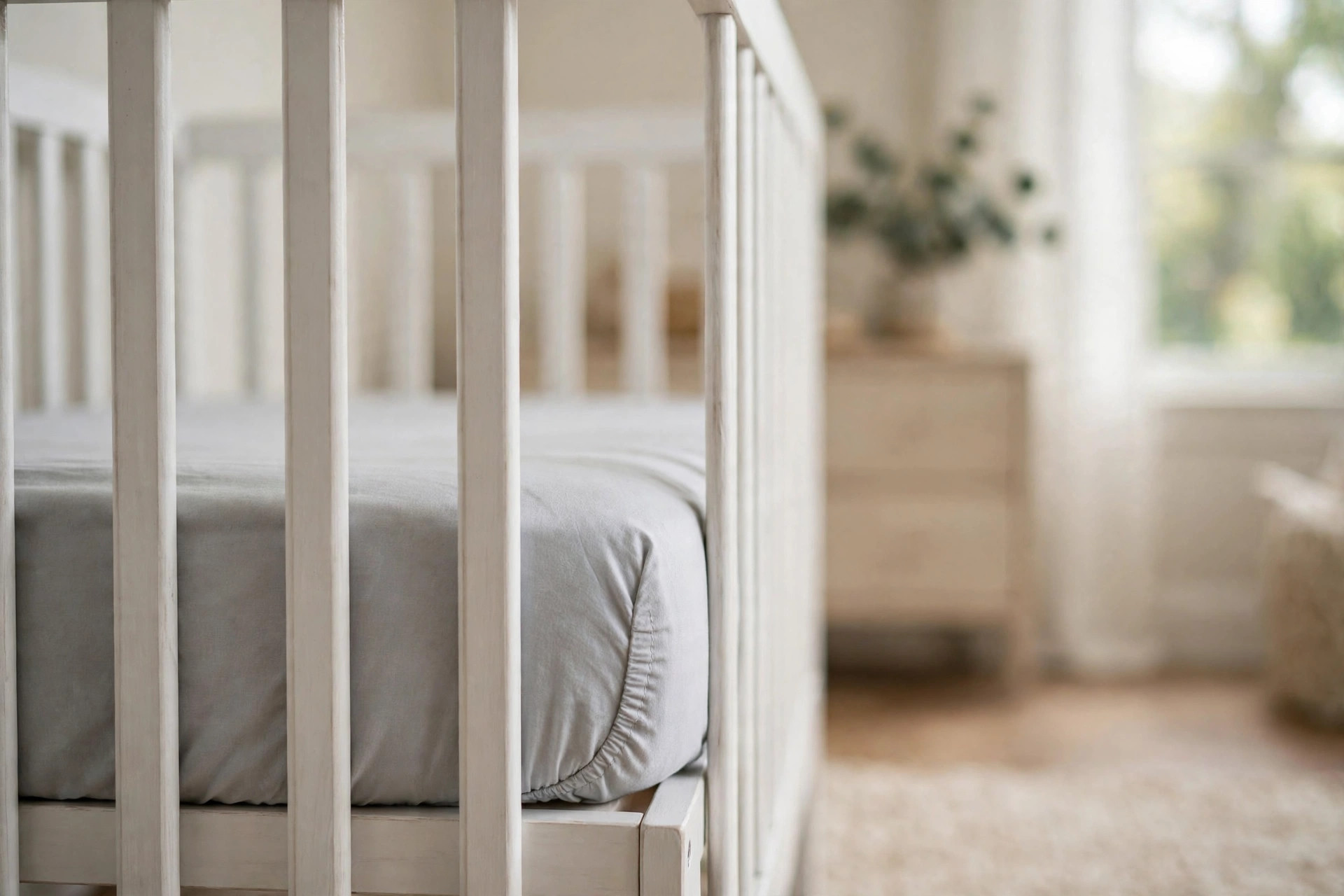

The search for nursery crib sheets fitted for standard crib size starts the same way in most homes. A crib goes up in the nursery. A mattress slides into the frame. Then comes the question of what to lay the baby on. A fitted crib sheet sounds like a small detail. It is not. The baby will sleep on it for thousands of hours in the first year of life. Fit, fabric, and safety all matter more than pattern or price.
A standard crib in the United States measures about 28 inches wide and 52 inches long, with a mattress usually around 5 to 6 inches thick. A fitted sheet made for that size has elastic all around the edge, pulling the sheet tight under the mattress corners. When the fit is right, the sheet stays flat and smooth through the night. When the fit is wrong, it bunches, pops loose, or leaves folds. Folds in a sleeping surface are a safety problem for an infant.
This guide explains what to look for in nursery crib sheets fitted for standard crib mattresses, how many to buy, how to wash them, and which safety rules apply. It is written in plain terms. No special knowledge is needed to follow it.
Why the Right Sheet Matters
A crib sheet does three jobs. First, it covers the mattress and keeps it clean. Second, it gives the baby a soft, even surface to sleep on. Third, it keeps the sleep space safe. All three jobs depend on fit and fabric.
The fit matters because of the way cribs are built. A standard crib mattress must fit the crib frame with no gaps wider than two adult fingers at the sides. The sheet must fit the mattress the same way. A loose sheet can ride up and form pockets of fabric. The U.S. Consumer Product Safety Commission sets the safety rules for cribs and crib mattresses in the United States. A tight-fitting sheet is part of those expectations. A sheet that will not stay in place is not a good sheet, no matter how fine the cotton.
The fabric matters because a newborn’s skin is thin and sensitive. Rough fabric can irritate it. Fabric that traps heat can make the baby too warm. The American Academy of Pediatrics gives safe sleep guidance through its parent site, and keeping the sleep surface firm and free of extra bedding is a central point. The sheet should feel smooth to the cheek and breathe well.
The cleanliness matters because babies leak. Milk comes up. Diapers leak. A sheet will be changed in the night more than once. A good sheet comes off fast, survives hundreds of washings, and goes back on without a fight.
How to Choose Nursery Crib Sheets Fitted for Standard Crib Mattresses
Buying a fitted crib sheet is a small purchase, but a few checks keep it from becoming a waste of money.
Check the Measurements
The label should say the sheet fits a standard crib mattress, about 28 by 52 inches. Many sheets also list a depth range, such as up to 8 inches of mattress thickness. Match that range to your mattress. A sheet made for a thin mattress will not stay on a thick one. A sheet made for a very thick mattress will be baggy on a thin one. If you already own a waterproof organic crib mattress for a newborn, measure its thickness before you shop. The depth number matters as much as the length and width.
Look at the Elastic
Elastic is what keeps the sheet on the mattress. The best sheets have elastic all the way around, not just at the corners. Full elastic pulls evenly from every side. Corner-only elastic tends to pop loose when the mattress is lifted or when a restless baby pushes against the rail. Turn the sheet over in the store or zoom in on the product photo online. A wide, sturdy elastic band is a good sign. A thin cord of elastic is a weak one.
Feel the Fabric
Cotton is the most common choice, and for good reason. It is soft, breathable, and easy to wash. Muslin cotton is lighter and airier, good for warm rooms. Flannel cotton is heavier, good for cold nights. Bamboo blends are soft and smooth. Jersey knit feels like a soft T-shirt and stretches a little, which helps it hug the mattress.
Whatever the fabric, run it against your cheek. If it feels scratchy to you, it will feel scratchy to the baby. Wash the sheet once before the first use. Washing softens most fabrics and removes the sizing and dust from the factory.
Count the Sheets You Need
Most parents need three sheets at minimum. One is on the crib. One is in the wash. One is in the drawer, ready for the next change. In truth, four or five is better for the first months, when night changes are frequent. Sheets are cheap enough that running short is a false economy. A parent changing a sheet at 3 a.m. should not be hunting for a clean one.
Think About the Nursery Around It
The sheet is one part of the sleep setting. A nursery that stays dark helps the baby sleep longer, which is why many parents pair good sheets with blackout curtains for nursery windows. Soft light for night feedings also helps, and a night light with a dimmer lets a parent check the baby without waking the house. Each piece is small. Together they make the night easier.
Types and Fabric Options
Sheets for a standard crib come in a few main fabric types. Each has strengths and each has a season.
Plain weave cotton. The standard choice. Durable, breathable, and widely sold. A mid-weight cotton sheet suits most homes and most climates. It washes well and wears for a long time.
Cotton muslin. A loose, open weave. Very breathable. Muslin softens with every wash. It suits warm nurseries and summer babies.
Flannel. Brushed cotton with a soft nap. Warm to the touch. Good for winter and for cold rooms. Flannel pills a little with washing, which is normal and harmless.
Jersey knit. A stretchy knit like a T-shirt. It fits the mattress snugly because the fabric itself gives a little. Soft and comfortable. Some parents find it less crisp than woven cotton, but babies do not mind.
Bamboo or bamboo blends. Smooth, silky, and breathable. It usually costs more than cotton. Try one sheet before buying a set.
Waterproof sheets. These have a waterproof layer built in, usually between two fabric layers. They protect the mattress and cut down on extra changes. They feel a little less breathable than plain cotton, so many parents use them as backup sheets rather than everyday sheets.
Thread count, the number so often printed on adult sheets, matters little in crib sheets. A count between 200 and 400 in cotton is fine. Softness comes more from the type of cotton and the weave than from the count.
Cost and Price
Fitted crib sheets are among the least expensive items in a nursery. In most American stores, a single cotton sheet costs between about 10 and 25 dollars. A two-pack often costs 20 to 40 dollars. Organic cotton sheets cost a bit more, often 25 to 40 dollars each. Bamboo sheets sit in a similar range.
A sensible budget for sheets is 60 to 100 dollars for a set of four. It is worth paying a little more for full elastic and a fabric that washes well. The cheap sheet that pops off every night is the expensive one, measured in lost sleep.
Big retailers discount crib bedding during baby events in spring and fall. Buying a two-pack instead of singles usually saves a few dollars. Large family stores such as Target and Walmart carry standard crib sheets at low prices all year. Nursery specialists like Pottery Barn Kids sell them at higher prices with finer fabrics. Home goods retailers such as IKEA and Wayfair stock a wide range in between.
Price tells you something about fabric, but it tells you nothing about fit. A twenty-dollar sheet that fits your mattress is better than a forty-dollar sheet that does not. Always check the measurements first.
Care and Upkeep
Crib sheets live a hard life. Good care keeps them soft and safe.
Wash before first use. Wash every new sheet once in warm water with a mild, fragrance-free detergent. This removes factory chemicals, softens the fabric, and shrinks the sheet to its true size.
Wash often. Change the sheet at least once a week, and right away after any leak, spit-up, or blowout. Babies are messy. A clean sheet is part of a healthy sleep space.
Use warm water and mild detergent. Hot water wears fabric faster and can shrink cotton more. Fragrance-free detergent leaves nothing on the fabric to irritate the baby’s skin. Skip fabric softener. It coats the fibers and makes them less absorbent, and the scent can bother a baby.
Dry on medium heat or hang dry. High heat weakens elastic over time. When the elastic goes, the sheet is done. Medium heat, or line drying in the sun, keeps the elastic working longer.
Inspect the elastic. Every month or two, stretch the elastic edge and look at it. If it is loose, wavy, or cracked, the sheet no longer fits safely. Retire it. A sheet that will not stay tight on the mattress is a hazard, not a saving.
Keep the rotation going. Rotate through your sheets evenly so one does not wear out while the others stay new. When a sheet shows thin spots, holes, or failing elastic, replace it.
Parenting guides at What to Expect and The Spruce both keep updated nursery checklists, and crib sheets appear on all of them as a basic, non-optional item. That is how ordinary this purchase is, and how important.
Safety
Safety is the part of this guide that matters most. Read it carefully.
Nothing loose in the crib. The sheet must fit tightly. If you can pinch more than a small fold of fabric on the mattress surface, the sheet is too big. Loose fabric near a sleeping infant is a danger. This rule comes first, before comfort, before pattern, before price.
Bare is best. A fitted sheet on a firm mattress is all the bedding a baby needs. No blankets, no pillows, no bumpers, no stuffed animals in the crib. The safe sleep guidance from pediatric sources is clear on this point. If the room is cold, dress the baby in a wearable blanket or a warm sleeper instead of adding loose bedding.
Check the fit after every wash. Sheets shrink. A sheet that fit perfectly new may fit less well after ten washings. Pull it over the mattress and check the corners. If it fights you or sits baggy, replace it.
No ties or straps. Some sheets come with ties or straps meant to hold them on. Do not use them. Ties near a sleeping baby are a strangulation risk. A well-fitted sheet with good elastic needs no ties.
Watch for recalls. Crib bedding is sometimes recalled for safety reasons. Before buying, and once a year after, check the U.S. Consumer Product Safety Commission recall listings. It takes five minutes. It is worth the habit.
Buy sheets made for standard cribs. Mini cribs, portable cribs, and play yards use different mattress sizes. A sheet made for one size does not safely fit another. Match the sheet to the mattress you own. If you are unsure of your mattress size, measure it with a tape measure. Length, width, and thickness, all three.
Frequently Asked Questions
How many fitted crib sheets do I need? Three is the minimum: one on the crib, one in the laundry, one ready in the drawer. Four or five is more comfortable in the first months, when sheets are changed often in the night.
What size sheet fits a standard crib? A standard American crib mattress is about 28 inches wide, 52 inches long, and 4 to 6 inches thick. Buy a fitted sheet labeled for a standard crib mattress, and check that its depth range covers your mattress thickness. Measure the mattress if you are unsure.
Are organic crib sheets worth the extra cost? Organic cotton is grown without certain pesticides, and some parents prefer it for that reason. The fabric itself is much like ordinary cotton. If the price fits your budget, it is a fine choice. A well-fitting ordinary cotton sheet is just as safe.
Can I use a regular twin sheet on a crib mattress? No. A twin sheet is far too large. The extra fabric bunches and folds, and loose fabric in a crib is dangerous.
How often should I wash crib sheets? Once a week at minimum, and right away after spit-up, leaks, or illness.
When should I replace a crib sheet? Replace it when the elastic weakens and the sheet no longer lies flat and tight, or when the fabric thins or tears. Most sheets last through one baby’s crib years with normal rotation.
A Final Word
Nursery crib sheets fitted for standard crib mattresses are a small purchase with an outsized role. The baby sleeps on the sheet every night for the first year and more. Buy the right size. Choose a soft, breathable fabric. Make sure the elastic is strong and full. Keep three or four on hand. Wash them often, check the fit, and replace them when they wear out.
The nursery can hold many fine things: soft rugs, gentle light, dark curtains, and pictures on the wall. But the sheet is what touches the baby. Get that right, and the rest of the room is decoration.
References
American Academy of Pediatrics. (n.d.). HealthyChildren.org. https://www.healthychildren.org IKEA. (n.d.). Home furnishings. https://www.ikea.com Pottery Barn Kids. (n.d.). Kids furniture and decor. https://www.potterybarnkids.com Target. (n.d.). Retail store. https://www.target.com The Spruce. (n.d.). Home and garden advice. https://www.thespruce.com U.S. Consumer Product Safety Commission. (n.d.). Product safety information. https://www.cpsc.gov Walmart. (n.d.). Everyday low prices. https://www.walmart.com Wayfair. (n.d.). Furniture and home goods. https://www.wayfair.com What to Expect. (n.d.). Pregnancy and parenting guidance. https://www.whattoexpect.com
Was this guide helpful?

About Emily Rodriguez
The My Garden US editorial team writes practical, in-depth home and garden guides for American homeowners — tested advice, no fluff.
You May Also Like

Best Blackout Curtains for Nursery Windows USA
March 17, 2026 0 views
Best Nursery Rug Soft for Crawling Babies: A Parent’s Guide
March 31, 2026 0 views
A Kids Bedroom Fan with Light for the Ceiling: A Plain Buying Guide
March 28, 2026 0 views