
Morning glories are among the fastest and most rewarding vines a home gardener can grow. This morning glory seeds buying guide usa walks you through every step of choosing seed packets that will give you strong germination and weeks of bright summer blooms. A single packet costs little, yet it can cover a whole fence or trellis with color from July to frost. Whether you shop at a local garden center or order from a seed company online, the rules are much the same. Fresh seed, the right variety, and a sound sowing plan are what matter most. Many growers also shop for other easy seeds in the same season. If you want a fuller seed rack, see our heirloom vegetable seeds buying guide, our organic herb seeds buying guide, or our wildflower seed mixes buying guide.
Why Morning Glories Deserve a Place in Your Garden
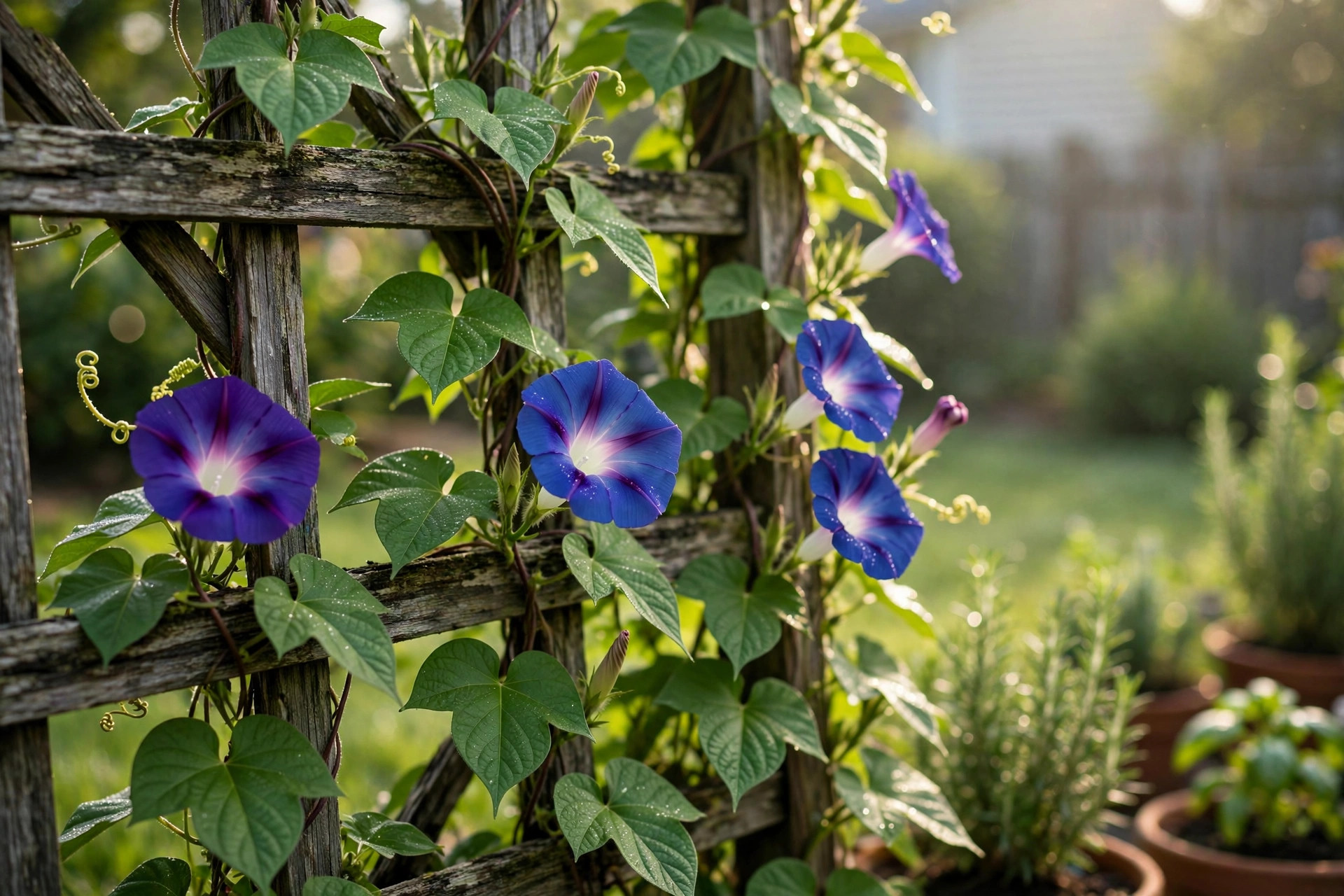
Morning glories (Ipomoea purpurea and close kin) are annual climbing vines that grow from seed to ten or more feet tall in a single season. Their funnel-shaped flowers open in the early morning and close by afternoon, and each plant produces dozens of blooms over the summer. Gardeners value them for several plain reasons.
First, they are fast. Few plants give such height and coverage for so little money. A five-foot trellis can be filled in six to eight weeks from sowing. Second, they are forgiving. Morning glories accept ordinary garden soil and need no special fertilizer. Third, they serve a practical purpose. Trained over a fence, an arbor, or a mailbox post, they give quick summer privacy and shade. Many homeowners plant them along chain-link fences to soften a harsh view.
There is one caution that belongs up front. Morning glories self-sow freely. In warm regions they can spread beyond the bed where you planted them. Check local guidance before planting near wild areas, and remove seed pods if you do not want volunteers next year.
What to Look for When You Buy Morning Glory Seeds: Morning Glory Seeds Buying Guide Usa
Seed packets look alike on the shelf, but a few details separate good seed from old or weak stock. Read the packet before you pay.
Pack date and sell-by date. Seeds are living things, and germination falls as they age. Morning glory seed keeps well for about three to four years when stored cool and dry, but seed packed for the current year gives the strongest start. The packet should show a packed-for year or a sell-by date. Skip packets that show neither.
Seed count. Morning glory packets in the United States usually hold from ten to over one hundred seeds, depending on the seller and the variety. Compare price per seed rather than price per packet when sizes differ. A larger packet at a fair price is often the better buy because you will want extra seeds for filling gaps.
Variety name. Do not buy seed labeled only as “morning glory mix” unless you truly do not care what grows. Named varieties such as Heavenly Blue, Grandpa Otts, or Scarlet O’Hara give you known color and bloom habit. A packet with a clear variety name tells you the seller knows the stock. Burpee lists named morning glory varieties with plain descriptions of color and vine length, which is a useful standard to compare against.
Source reputation. Established seed houses test germination and keep seed lots fresh. Long-running American suppliers such as Park Seed and Gurney’s have sold garden seed for generations and stand behind their packets. Buying from such firms reduces the risk of stale or mislabeled seed.
Packet information. A good packet gives sowing depth, spacing, days to bloom, and vine height. If the packet gives no growing directions, the seed inside was packed with little care.
Types and Options on the Market
Morning glory seed comes in several forms. Each suits a different kind of gardener.
Named flower varieties. Heavenly Blue is the classic, with large sky-blue blooms and white throats. Grandpa Otts gives deep purple flowers with a red star. Scarlet O’Hara bears red blooms. Moonflower (Ipomoea alba) is a close relative with large white flowers that open at night. White Flower Farm’s catalog pages show how breeders group these vines by color and bloom time, which can help you plan a planting.
Mixed packets. Seed mixes give a blend of colors in one sowing. They suit a first-time grower or a fence where variety matters more than pattern. Expect blues, purples, pinks, and whites. Proven Winners and Monrovia both note how mixed plantings read from a distance, and their plant descriptions can guide your expectations for a blended sowing.
Organic seed. Some sellers offer morning glory seed grown without synthetic pesticides or fertilizers. Organic packets cost a little more. They suit gardeners who run a fully organic bed. The difference in growing results is small, since morning glories are easy plants either way.
Bulk seed. For long fences or community plots, bulk packets of a quarter pound or more cut the cost per seed sharply. Buy bulk only from a seller who states the germination rate. Bulk seed left in a hot warehouse can be weak, so buy from a source that turns stock quickly.
Treated versus untreated seed. Some commercial seed carries a fungicide coating, dyed pink or blue so it can be seen. Home gardeners should choose untreated seed. Morning glories germinate well without treatment, and untreated seed is safer around children and pets.
Cost and Price: What a Packet Should Cost
Morning glory seed is one of the cheapest ways to fill a garden. Knowing fair prices keeps you from overpaying.
A standard packet at a garden center or hardware store usually sells for between two and five dollars. Packets hold roughly fifteen to fifty seeds. Online seed houses sell similar packets for about the same price, though shipping may add to a small order. Bulk packets for large plantings run from about eight to twenty dollars per quarter pound, depending on variety.
Price per seed is the honest measure. At four dollars for thirty seeds, each seed costs about thirteen cents. At nine dollars for a quarter pound, roughly two hundred seeds, each seed costs under five cents. Because morning glories germinate well when fresh, cheap seed is often the smart buy. Pay more only when you want a named variety that is hard to find, or certified organic stock.
A small packet sows a long row. One seed every six inches along a fence line plants about thirty feet of fence with room to spare. Thin the seedlings to one strong plant per foot after they come up.
Planting and Care Through the Season
Morning glories are sown directly outdoors. They dislike transplanting, and indoor starts rarely pay. Follow these steps for a strong stand.
Timing. Wait until after the last frost and until the soil feels warm to the hand, usually late spring in most of the United States. The Old Farmer’s Almanac frost-date charts give a good guide for your zip code. Sowing into cold soil gives slow, patchy germination.
Scarification. Morning glory seeds have a hard coat. Nick each seed lightly with a nail file or soak them in warm water for twenty-four hours before planting. Soaking softens the coat and can cut germination time in half. Gardening Know How describes this simple soaking method in plain terms, and it is worth doing for every sowing.
Sowing. Plant seeds half an inch deep in soil that has been loosened and cleared of weeds. Water the row gently and keep it moist until seedlings appear, usually in five to ten days. Once seedlings show two sets of true leaves, thin to one plant every twelve inches. Crowded plants give thin vines and few flowers.
Support. Give vines something to climb at sowing time. Trellises, fences, strings, and poles all work. Morning glories twine by touch and find the support on their own once they are a few inches tall. A fence needs no added help.
Water and feed. Morning glories need steady moisture in the first month. After they are climbing, they tolerate short dry spells. Water deeply once a week if rain does not come. Go easy on fertilizer. Rich soil and heavy feeding give long vines with few flowers. Lean soil gives more blooms. A thin layer of compost at planting is all most vines need.
Deadheading and cleanup. Pick off spent flowers if you want to slow self-sowing. In fall, pull the vines down after frost kills them and compost or discard the stems. If you want volunteers next spring, leave some seed pods to drop. The extension pages at NIFA explain how garden plants naturalize, and morning glories are a good example of a plant that needs watching for that reason.
Safety Notes for Homes with Children and Pets
Morning glory seeds contain compounds that are toxic if eaten in quantity. The vines and flowers are only mildly irritating, but the seeds are the part to guard. Keep seed packets stored high, out of reach of small children, and put leftover seed away after planting day. If a child eats a handful of seeds, call your local poison control center at once. Teach children that garden seeds are not candy.
For pets, the risk is lower because most animals ignore the hard seeds, but dogs that chew plants should be watched. The ASPCA-style plant lists at The Spruce include morning glory among plants that deserve caution around pets. Fences that carry the vines should keep seed pods above the reach of curious mouths where that is practical.
These points should not frighten anyone away from a fine garden plant. Common sense storage and a little supervision cover the whole risk.
Frequently Asked Questions
How long do morning glory seeds take to sprout? With soaking, most seeds sprout in five to ten days in warm soil. Without soaking, allow two to three weeks. Cool soil slows everything down.
Can I start morning glory seeds indoors? You can, but it is rarely worth the trouble. The vines dislike having their roots disturbed, and direct sowing outdoors catches up quickly once the soil is warm.
How many seeds should I plant per spot? Sow two or three seeds per spot and thin to the strongest seedling. This covers you if one seed fails. Thin early so the kept plant does not fight for light.
Will morning glories come back next year? They are annuals and die with hard frost. In warm zones they often self-sow so thickly that they seem to return. In cold zones, save a few dried seed pods and sow fresh seed in spring.
Why are my vines all leaves and no flowers? The usual cause is too much nitrogen fertilizer or soil that is too rich. Morning glories bloom best on lean ground. Cut back feeding, and make sure the plants get full sun for at least six hours a day.
Are morning glories invasive? In some warm states they reseed so freely that gardeners treat them as a nuisance. They are not banned in most places, but check your state or county noxious weed list if you garden near natural areas. Removing spent flowers before pods form keeps them in bounds.
A Short Final Word
A morning glory planting asks little and returns much. Buy fresh seed of a named variety from a seller you trust. Sow after the frost, soak the seed, give the vines a fence or trellis, and let them climb. By midsummer you will have a wall of green topped with fresh blue trumpets every morning. Few garden projects give such a return for a few dollars and an afternoon of work. Keep this morning glory seeds buying guide usa with your seed order, and you will start the season with the odds firmly in your favor.
References
Burpee. (n.d.). Seeds, plants, and gardening supplies. https://www.burpee.com Gardening Know How. (n.d.). Gardening guides and plant care. https://www.gardeningknowhow.com Gurney’s Seed & Nursery Co. (n.d.). Seeds, plants, and garden supplies. https://www.gurneys.com Monrovia. (n.d.). Plants for home gardens. https://www.monrovia.com National Institute of Food and Agriculture. (n.d.). Agricultural research and extension. https://www.nifa.usda.gov Park Seed. (n.d.). Seeds, plants, and gardening supplies. https://www.parkseed.com Proven Winners. (n.d.). Plants and gardening inspiration. https://www.provenwinners.com The Old Farmer’s Almanac. (n.d.). Gardening calendars and advice. https://www.almanac.com The Spruce. (n.d.). Home and garden advice. https://www.thespruce.com White Flower Farm. (n.d.). Plants, bulbs, and garden supplies. https://www.whiteflowerfarm.com
Was this guide helpful?

About Jennifer Lee
The My Garden US editorial team writes practical, in-depth home and garden guides for American homeowners — tested advice, no fluff.
You May Also Like
Heirloom Vegetable Seeds for California Homes: A Plain Growing Guide
June 16, 2026 0 views
Native Grass Seed for Florida Homes: A Plain Guide to a Strong Local Lawn
October 5, 2026 0 views
Sunflower Seed Packs for Texas Homes USA
May 17, 2026 0 views