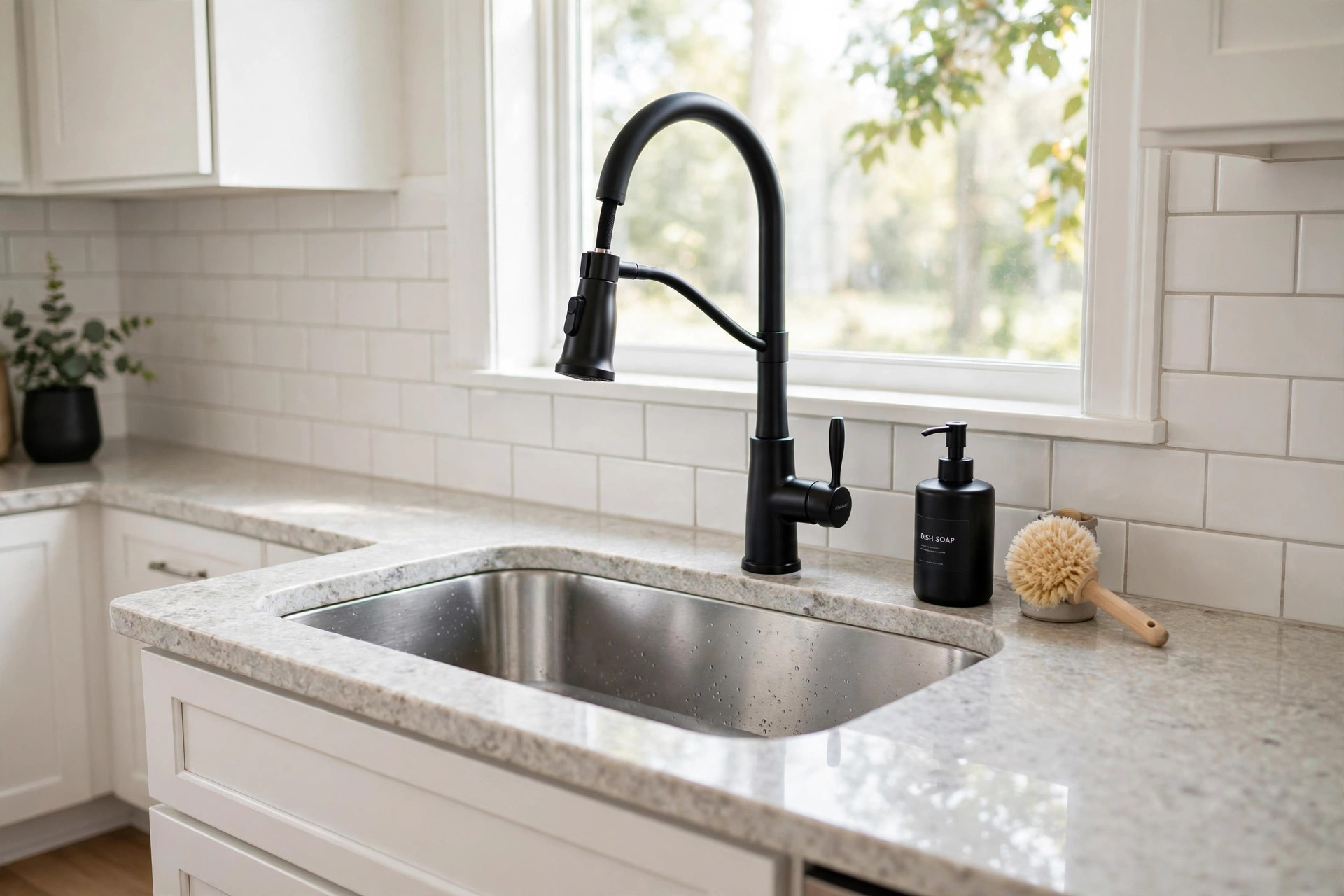

The matte black kitchen faucet has become one of the most talked-about fixtures in home remodeling. Ten years ago, chrome and brushed nickel ruled the sink. Today, black fixtures show up in model homes, kitchen showrooms, and television makeovers across the United States. The look is bold, modern, and hard to miss. But a faucet is not a throw pillow. It is a working tool that you touch many times a day, and it must last for years in hard water and steam.
This guide lays out the matte black kitchen faucet pros and cons in plain terms. You will find how the finish is made, what it costs, how it wears, and what daily care it takes. By the end, you will know whether matte black belongs in your kitchen or whether a classic finish serves you better.
Why the Finish Matters More Than the Shape
Shoppers often pick a faucet by its shape: high arc, pull-down spray, touchless sensor. Shape matters, but finish decides how the faucet looks after two years of use. A chrome faucet shows water spots but hides scratches. A brushed finish hides spots but may show wear at the handle. Matte black shows almost no water spots, yet it can reveal scratches and grease marks that chrome would hide.
The finish also sets the tone of the room. Black is a strong neutral. It can ground a white kitchen, match dark appliances, and tie together cabinet pulls and light fixtures. At the same time, it is a fashion choice. Trends in kitchen design change every decade. A finish that feels fresh today may feel dated later, and a faucet is harder to swap than a lamp shade.
That is why the matte black kitchen faucet pros cons usa discussion keeps growing. American buyers want honest answers about wear, repair, and resale before they drill holes in a new sink.
How Matte Black Faucets Are Made: Matte Black Kitchen Faucet Pros Cons Usa
To judge the pros and cons, it helps to know what matte black really is. The black color is a coating over a brass or stainless steel body. Most makers use one of two methods. The first is physical vapor deposition, often called PVD. In this process, the faucet parts sit in a vacuum chamber while a thin metal film bonds to the surface. PVD finishes tend to be hard and even. The second method is powder coating or epoxy paint. Powder coating can look rich and deep, but it may chip more easily at the edges.
Not all black finishes are equal. A low-price faucet may use a simple painted finish that wears off at the spout and handle within a few years. A well-made model from an established maker often uses PVD or a baked enamel that resists peeling. When you shop, the maker matters more than the color name on the box. Well-known fixture makers such as Moen and Kohler publish finish warranties, which is a good sign. Delta Faucet also offers black finishes across its lines with clear care guides.
This matters for one simple reason: the pros of matte black hold only when the finish itself is sound. A cheap coating turns every pro into a con within two years.
The Pros of a Matte Black Kitchen Faucet
A Bold, Modern Look
The clearest pro is style. Matte black reads as modern, confident, and clean. It works with white shaker cabinets, gray stone, butcher block, and dark soapstone alike. Designers call black a “grounding” color. In a kitchen with many light surfaces, one dark fixture gives the eye a place to rest. If your cabinets, pulls, and pendant lights already lean dark, a black faucet completes the picture without a remodel.
Hides Water Spots and Fingerprints
Hard water leaves white spots on chrome within hours. Matte black hides those spots far better. In homes with well water or mineral-heavy city water, this is a real daily win. Many owners report that the faucet looks clean between weekly wipe-downs, while their old chrome model needed daily polishing. For a deeper fix to mineral-heavy water, some homeowners add filtration; a guide to the best sediment filter for well water explains that route.
Pairs With Many Hardware Choices
Black cabinet pulls, black window frames, and black appliances are easy to find in 2026. A matte black faucet ties these pieces together. You do not need to match it to the sink. Black looks fine over stainless, white, granite composite, and fireclay sinks. This freedom makes it a safe pick in mixed-metal kitchens, where chrome faucets can clash with brass pendants.
Resists a “Dated” Look, for Now
Black fixtures have stayed in style longer than many predicted. They entered kitchens in the mid-2010s and still sell well a decade later. While no trend lasts forever, matte black has shown more staying power than the copper and bronze waves of the past. Retailers such as Home Depot and Lowes carry deep stock of black faucets, which signals steady demand rather than a passing fad.
The Cons of a Matte Black Kitchen Faucet
Shows Scratches and Grease
Every finish has a weak point. For matte black, it is surface marks. The dark, flat surface shows light scratches, soap scum buildup, and greasy fingerprints more than brushed nickel does. If you scrub with a rough pad, you can cut through the coating to the metal below, and that mark is nearly impossible to hide. Households with heavy cooking, kids, or hard scrubbing habits will notice this first.
The Finish Can Wear or Chip
As noted above, cheap coatings fail. Even good ones wear faster at high-touch points: the handle edge, the spray head button, the tip of the spout. Once the coating chips, water can reach the base metal and cause corrosion. Owners in coastal areas, where salt air speeds corrosion, should choose PVD finishes and rinse the faucet now and then. When finish wear is a concern, reading a broad buying guide on faucet quality helps; This Old House covers fixture longevity in plain terms.
Hard Water Stains Still Happen
Matte black hides spots better than chrome, but it does not defeat hard water. In very hard water areas, mineral scale builds up as a white crust around the base and the spray face. If left for months, the crust can etch the finish. Regular wiping prevents this, but the faucet still asks for steady care. Homes with mineral-rich well water often pair the faucet with whole-house treatment; see our notes on the best sediment filter for well water for context.
Touch-Up and Repair Are Hard
A scratched chrome faucet can be polished. A worn matte black faucet usually cannot. Touch-up paints exist, but they rarely match the flat black tone and often peel again. In most cases, a damaged finish means replacing the whole faucet. That makes the initial quality of the coating the most important buying decision.
Trend Risk at Resale
Most buyers today like matte black. But tastes shift, and a black faucet is a statement. In a home you plan to sell within five years, a safe classic finish may appeal to more buyers. Real estate agents often advise neutral, timeless fixtures for resale. If you love the look and plan to stay, this con does not apply to you.
Types and Options to Know
Pull-Down vs. Pull-Out
Pull-down faucets have a high arc and a spray head that pulls straight down. They suit deep single-basin sinks. Pull-out models have a lower profile and a head that pulls toward you. They suit smaller sinks and tight spaces. Both come in matte black from every major maker.
Single Handle vs. Two Handle
Single-handle models mix hot and cold with one lever. They are the common choice in modern kitchens. Two-handle bridge faucets fit farmhouse styles. Matte black works in both, though single-handle high-arc models dominate the black finish market.
Touchless and Smart Models
Touchless faucets turn on with a wave of the hand. They cost more and need batteries or a power outlet. The matte black finish pairs well with the high-tech look. Before you buy, check the sensor warranty and how the finish holds up around the sensor window, since that area gets wiped often. If you are comparing moisture and plumbing projects around the home, our notes on the best basement dehumidifier with pump cover a different kind of water control.
Bar and Prep Faucets
Small matte black bar faucets can echo the main faucet at a prep sink or wet bar. Matching the finish across both sinks gives a planned, finished look that designers favor.
Cost and Price in the USA
Matte black kitchen faucets span a wide price range. Budget models sell for under one hundred dollars. Mid-range models from known brands run from about one hundred fifty to four hundred dollars. High-end and designer models can pass six hundred dollars. The finish itself usually adds a small premium over chrome from the same maker, often twenty to fifty dollars.
Price predicts finish quality more than any other factor. Below one hundred dollars, you are likely getting a painted finish with a short warranty. In the mid-range, PVD and baked finishes with lifetime finish warranties become common. Read the warranty card before you buy. A “lifetime finish warranty” is worth real money on a black faucet. Retailers like Home Depot list warranty terms on the product page, so compare before you order.
Installation adds cost if you hire a plumber. A straight swap of one faucet for another is a simple job in most kitchens. If you are changing from a three-hole to a one-hole setup, you may need a deck plate or new sink, which adds parts and labor. For general guidance on home water projects, Family Handyman offers clear how-to articles aimed at careful do-it-yourselfers.
Care and Upkeep
Daily care decides how long matte black looks good. The rules are simple and worth following.
– Wipe the faucet dry after heavy use, or at least once a day. A soft cloth is enough. – Clean with mild soap and warm water. Avoid bleach, ammonia, and harsh bathroom cleaners. – Never use abrasive pads, steel wool, or scouring powder. They cut the finish. – For hard water crust, soak a cloth in white vinegar, lay it on the spot for ten minutes, then rinse and dry. Do not leave vinegar sitting for an hour; long acid soaks can dull the finish. – Dry the base and handle joint. Standing water is the enemy of every finish.
One habit saves more finishes than any product: drying. A ten-second wipe after dinner keeps spots, scale, and soap film from building up. Owners who dry the faucet report that it looks new for years. Owners who let water sit report crust and dull patches within months.
For drinking-water quality questions that go beyond the faucet, Aquasana publishes plain-language guides on home filtration, and the EPA sets the federal drinking-water standards worth knowing.
Safety and Water Quality Notes
A faucet finish is safe when it comes from a reputable maker. In the United States, kitchen faucets must meet federal rules for lead content in wetted parts. Look for NSF/ANSI 61 certification on the box or product page. This standard limits lead and other harmful substances that can leach into drinking water. Do not buy no-name faucets that skip this marking. The savings are not worth the risk.
Hot water safety matters with any faucet. Set your water heater to 120 degrees Fahrenheit. That temperature is hot enough for dishes and hand washing but low enough to prevent scalds, especially for children and older adults. If your heater needs service, our guide to the best anode rod for water heater explains a common maintenance part.
Frequently Asked Questions
Does matte black fade in sunlight?
Indoor kitchen faucets get little direct sun, so fading is rare. If your sink sits under a large south-facing window, strong sun can warm the finish over years, but this is uncommon. PVD finishes resist fading better than painted ones.
Can I use hard water with a matte black faucet?
Yes, with steady care. Wipe the faucet dry often and remove scale before it builds up. In very hard water areas, consider softening or filtration to protect all your fixtures, not just the faucet.
Will matte black match my stainless steel appliances?
Yes. Black and stainless are a classic pair in modern kitchens. Many designers mix black faucets with stainless appliances on purpose. The contrast looks planned rather than mismatched.
Is matte black harder to keep clean than chrome?
It depends on what bothers you. Matte black hides water spots better than chrome but shows scratches and grease more. If you cook with a lot of oil and wipe down often, chrome may be easier. If hard water spots are your main complaint, matte black is easier.
Can a scratched matte black faucet be fixed?
Small marks can sometimes be hidden with a careful touch-up, but results are mixed. Deep scratches through the coating usually cannot be repaired to look new. Prevention through gentle cleaning is the real answer.
How long should a good matte black faucet last?
A quality faucet with a PVD or baked finish should give ten to fifteen years of good service with normal care. Budget painted models may show wear in two to five years. The warranty length is a fair guide to expected life.
A Short Final Word
The matte black kitchen faucet earns its place on style and spot-hiding alone. It is modern, forgiving of hard water marks, and easy to pair with other hardware. Its costs are honest ones: a higher price for a good coating, gentle daily care, and the knowledge that deep scratches cannot be undone.
Buy the best finish you can afford from a maker with a real warranty. Wipe it dry. Skip the harsh cleaners. Do those three things, and the pros of matte black will outweigh the cons for many years in your kitchen.
References
Aquasana. (n.d.). Water filtration systems. https://www.aquasana.com Delta Faucet. (n.d.). Kitchen and bathroom faucets. https://www.deltafaucet.com Family Handyman. (n.d.). DIY home repair and maintenance. https://www.familyhandyman.com Kohler. (n.d.). Bathroom and kitchen fixtures. https://www.kohler.com Lowe’s. (n.d.). Home improvement products. https://www.lowes.com Moen. (n.d.). Faucets and plumbing fixtures. https://www.moen.com The Home Depot. (n.d.). Home improvement products. https://www.homedepot.com This Old House. (n.d.). Home renovation guidance. https://www.thisoldhouse.com U.S. Environmental Protection Agency. (n.d.). Protecting human health and the environment. https://www.epa.gov
Was this guide helpful?

About Robert Taylor
The My Garden US editorial team writes practical, in-depth home and garden guides for American homeowners — tested advice, no fluff.
You May Also Like

Best Filter for Lead Removal Reviews USA: A Plain Guide for Homeowners
June 24, 2026 0 views
SharkBite vs Soldered Copper: A Plain Comparison for American Homes
August 29, 2026 0 views
Best Dishwasher for Hard Water Reviews USA
March 23, 2026 0 views