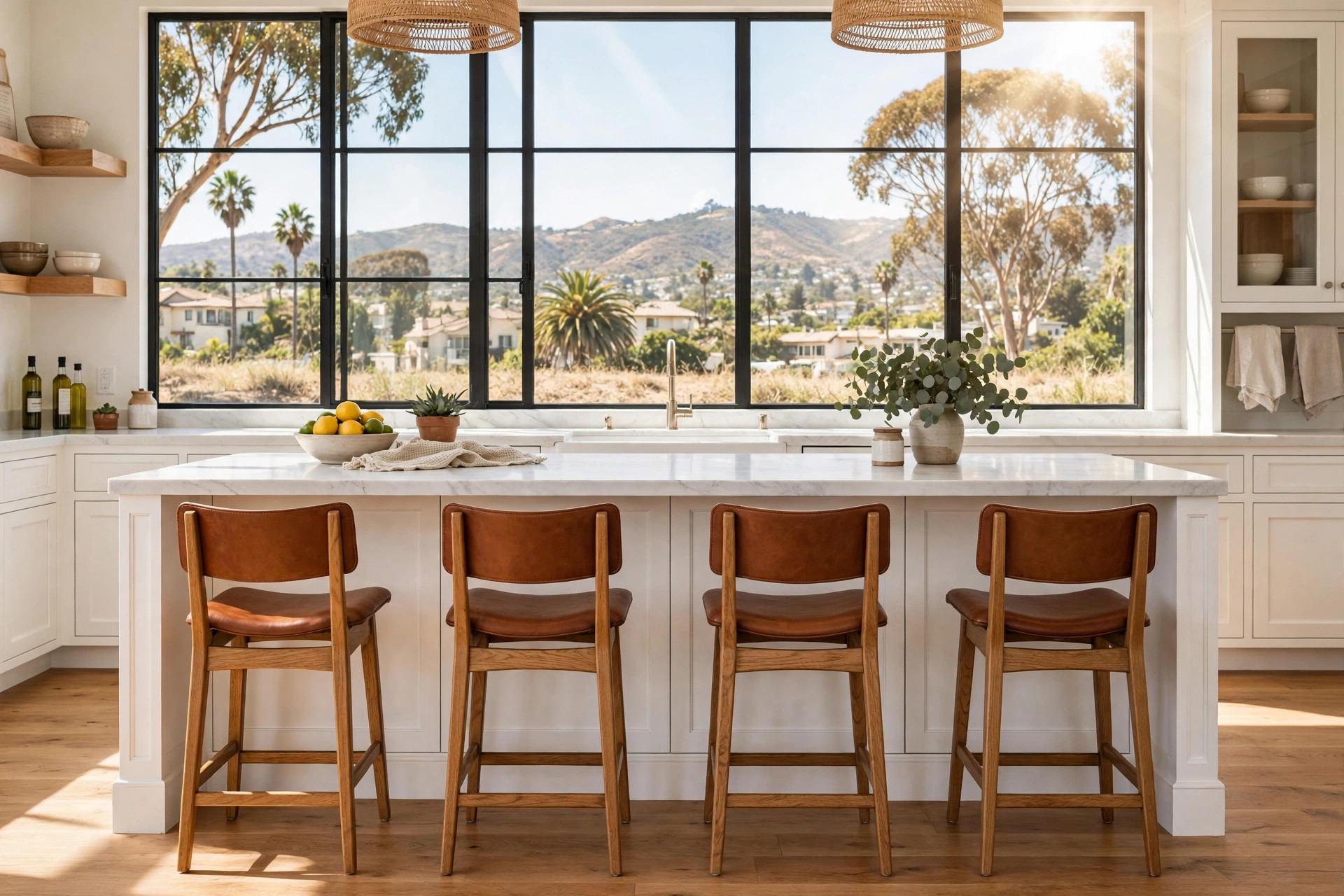

The search for kitchen island stools california homes usa begins in thousands of households each year. California kitchens are famous for their islands. Large islands. Long islands. Islands that serve as a cooking station in the morning and a homework desk in the evening. The right stools turn that island into the busiest seat in the house. The wrong stools gather dust in a corner.
This guide explains what to look for, what to avoid, and how much to spend. It covers seat height, frame style, materials, cost, care, and safety. It was written for the way California homes are actually built and used: open floor plans, indoor-outdoor living, and families who eat in the kitchen more than the dining room.
Why Kitchen Island Stools Matter in California Homes
The kitchen island is the center of the modern California home. In many new builds across the state, the island is nine or ten feet long. Builders design it that way on purpose. It gives the household a place to gather that is not the living room and not the dining room.
Stools decide how that space gets used. Comfortable stools invite people to sit down. Uncomfortable stools keep the island empty. When grandparents visit, they sit at the island. When children do homework, they sit at the island. When neighbors stop by for coffee, they sit at the island. The stools are the difference between a showpiece and a meeting place.
California style adds its own demands. Many homes mix indoor and outdoor living. Sliding glass doors open wide. Sunlight pours in for most of the year. Fabrics fade faster here. Wood dries out faster here. Buyers in the state therefore think harder about material and finish than buyers in milder climates. The goal is a set of stools that looks good on day one and still looks good in year five.
There is also the question of how people live now. Remote work has pushed the kitchen island into service as a second office. A stool that felt fine for a twenty-minute breakfast may feel very different after three hours of laptop work. Back support, footrests, and seat padding matter more than they did a generation ago. Shoppers comparing kitchen island stools for sale in the USA often notice that the models with full backs and footrests sell out first.
How to Choose the Right Stools: Kitchen Island Stools California Homes Usa
Choosing stools is a practical job. It starts with a tape measure and ends with a test sit. The steps below take the guesswork out of the process.
Measure the Seat Height First
This is the step people skip, and it is the one that matters most. The rule is simple. Measure from the floor to the underside of the island countertop. Then subtract ten to twelve inches. That number is the seat height you need.
Most kitchen islands in California homes are built at counter height, which is 36 inches. That calls for a stool with a seat height of 24 to 26 inches. Bar-height islands are 42 inches high and need stools of 28 to 30 inches. Many older homes, and many renovated ones, have a mix: one side at counter height, a raised side at bar height. Measure both sides before you buy.
Write the numbers down. Take them to the store or keep them beside the computer when you shop online. A stool that is two inches too tall will push your legs into the counter. A stool that is two inches too short will leave you reaching up for your plate. Neither feels right for long.
Count the Seats and Plan the Spacing
A common mistake is buying too many stools. People see a long island and assume it holds six. In practice, each person needs 24 to 28 inches of width. A nine-foot island fits four stools with elbow room. Squeeze in five and everyone eats with their shoulders hunched.
Check that the stools can slide fully under the counter when not in use. In smaller California kitchens, backless stools save space because they tuck away cleanly.
Match the Style of the Home
California homes run from Spanish colonial to mid-century modern to new farmhouse builds. The stool should speak the same language as the room. A dark leather stool with brass legs suits a modern kitchen. A painted wood stool suits a farmhouse kitchen. A woven rattan stool suits a coastal kitchen.
You do not need a perfect match. You need harmony. Pick up one color from the kitchen and repeat it in the stool. That can be the cabinet paint, the hardware finish, or the floor tone. When in doubt, black frames and natural wood seats go with almost anything.
For readers comparing styles across the country, our guide for American homes covers the main regional looks.
Types and Options
Stools come in more forms than most buyers expect. The three big choices are height, back style, and material. Each has trade-offs worth knowing.
Counter Height Versus Bar Height
Counter-height stools suit the standard 36-inch island. They are easier to get on and off. Children and older adults find them more comfortable. Bar-height stools suit raised breakfast bars. They give a better view over the kitchen and feel more like a pub seat. If your island has a raised eating ledge, you likely need bar height on that side.
Adjustable-height stools can be useful in homes with more than one counter height. Gas-lift models move between 24 and 33 inches. For a fixed island, fixed-height stools last longer and look cleaner.
Backless, Low-Back, and Full-Back Styles
Backless stools slide under the counter and keep sightlines open. They are the best pick for small kitchens and for homes where the island faces the living room. The trade-off is comfort. Sitting longer than an hour gets tiring without a back.
Low-back stools give a small curve of support at the lower back. They still tuck under most counters. Many California buyers choose this middle ground. It keeps the open look but adds real comfort.
Full-back stools feel most like a chair. They are the best choice when the island doubles as an office or a homework station. They take up more room and cost more. Measure carefully, because the back adds six to eight inches of height above the seat.
Materials: Wood, Metal, and Upholstered
Solid wood stools age well in California homes. Oak, ash, and walnut handle the dry air better than soft pine. Wood feels warm to the touch and fits traditional and farmhouse styles. It needs occasional oiling or waxing to prevent drying.
Metal stools bring an industrial look and strong frames. Steel and aluminum do not warp. Powder-coated finishes resist chips. Metal seats can feel cold in winter mornings, though California winters are mild enough that this bothers few people.
Upholstered stools are the most comfortable. Seats covered in leather, performance fabric, or vinyl invite long sits. In sunny kitchens, pick fade-resistant fabrics. Performance fabrics made for outdoor use hold color well near glass doors. Real leather develops a rich patina but needs conditioning twice a year in dry climates.
Many of the best-selling designs mix materials. A wood seat on a black metal frame. A leather seat on a brass base. These hybrids give the comfort of one material and the strength of another. Retailers such as IKEA and Wayfair carry wide ranges, which makes side-by-side comparison easy.
Cost and Price
Prices for kitchen island stools span a wide range. At the low end, simple backless wood or metal stools sell for 40 to 80 dollars each. These work fine for guest seating or for households on a tight budget. Mid-range stools, from 120 to 250 dollars each, add better joinery, nicer fabrics, and stronger frames. This is where most California buyers land.
Designer stools run 300 to 700 dollars each. Brands such as Article, West Elm, CB2, and Crate and Barrel sell in this range. The extra money buys solid hardwood frames, premium leather, and designs that hold their value. A set of four at this level is a serious purchase, often 1,200 to 2,800 dollars for the set.
Watch for the hidden costs. Shipping for heavy stools can add 50 to 150 dollars. Some stools arrive unassembled and take twenty minutes each to build.
Sales follow the furniture calendar. January clearance, Memorial Day, and Labor Day bring the deepest discounts. Buying during these windows can cut 20 to 40 percent off the price. Readers in other states may also like our look at kitchen island stools for Texas homes, where the same seasonal patterns apply.
A note on value: the cheapest stool is not always the cheapest choice. A 50-dollar stool that wobbles after a year costs more in the long run than a 180-dollar stool that lasts ten. Check the weight rating before you buy. A rating of 250 pounds or more signals a sturdy frame.
Care and Upkeep
Good care keeps stools looking new for years. The routine is simple and takes only a few minutes a month.
For wood frames, dust with a soft cloth weekly. Every six months, apply a light coat of furniture oil or paste wax. This matters in California, where low humidity can dry out wood and open small cracks. Keep wood stools away from direct afternoon sun when possible. A window film or a sheer curtain slows fading.
For metal frames, wipe with a damp cloth and dry at once. Check the foot pads every few months. Worn pads scratch tile and hardwood floors. Replacement pads cost a few dollars.
For upholstered seats, vacuum the fabric monthly with a brush attachment. Blot spills at once with a clean cloth. Do not rub, because rubbing pushes the stain deeper. Performance fabrics can often be cleaned with mild soap and water. Leather seats need a leather conditioner every six to twelve months. In dry inland areas of California, condition leather more often.
Tighten bolts and screws twice a year. Stools loosen with daily use. A quick turn of a wrench prevents wobble and keeps joints strong. If a stool has a swivel mechanism, add a drop of lubricant to the moving parts once a year. Guides from The Spruce and Apartment Therapy offer useful step-by-step cleaning advice for different materials.
Safety in the Home
Stools are safe furniture, but a few checks protect children and older adults.
Stability comes first. A good stool has a wide base. Five-legged or four-legged designs resist tipping better than single-pedestal models. Before buying, read the weight rating and the tip-over notes. Avoid stools with a narrow base and a tall back in homes with small children who climb.
Swivel stools are popular, but they can spin a child off balance. If young children use the island, choose fixed stools or models with a swivel lock. Footrests should be smooth and rounded. Sharp edges on metal footrests can scrape shins.
Check for pinch points on folding or adjustable stools. Keep the adjustment lever out of reach of toddlers. For homes with older adults, stools with arms give a handhold when sitting down and standing up. A seat height at the lower end of the right range makes standing easier on the knees.
Place a rug or felt pads under the stools if you have hardwood or tile floors. This stops sliding and protects the finish. In earthquake country, which includes most of California, heavy stools are less likely to walk across the floor during a tremor than light ones. It is a small point, but worth a thought.
Frequently Asked Questions
How many stools fit on a standard California kitchen island?
A standard island is about eight to nine feet long. Allow 24 to 28 inches per person. That means three to four stools on a typical island. Measure your own island and divide by 26 inches to get a safe number.
What seat height do I need for a 36-inch island?
Buy stools with a seat height of 24 to 26 inches. The rule is to subtract ten to twelve inches from the counter height. For a 36-inch counter, that gives 24 to 26 inches of seat height.
Are backless stools comfortable enough for daily use?
Backless stools suit short meals and quick coffee. For daily use longer than an hour, a low-back or full-back stool is more comfortable. Many households mix the two: backless stools for guests and backed stools for the main seats.
What is the best material for sunny California kitchens?
Performance fabric and solid hardwood handle sun well. Performance fabrics resist fading near glass doors. Hardwood can be oiled to fight dryness. Avoid dark vinyl in direct sun, because it gets hot to sit on.
How much should I budget for four good stools?
Plan on 500 to 1,000 dollars for four mid-range stools. This buys solid construction and decent comfort. Designer sets of four run 1,200 to 2,800 dollars. Watch for holiday sales to save 20 to 40 percent.
Where can I see stools in person before buying?
Furniture showrooms and home stores let you test sit, which matters more than photos. Houzz and HGTV also publish room photos that show how different stool styles look in real kitchens, which helps narrow the list before you visit a store.
Final Word
The right kitchen island stools change how a California home feels. They turn the island from a work surface into a gathering place. Measure your counter, count your seats, and pick materials that suit the sun and the dry air. Spend a little time on the choice now, and the stools will serve the household for a decade.
Start with the height. Get that right and everything else follows. Then choose a style that fits the room, a material that fits the climate, and a price that fits the budget. Sit in the stool before you buy if you can.
References
Apartment Therapy. (n.d.). Home design ideas and inspiration. https://www.apartmenttherapy.com Article. (n.d.). Modern furniture. https://www.article.com CB2. (n.d.). Modern furniture and decor. https://www.cb2.com Crate and Barrel. (n.d.). Furniture and home decor. https://www.crateandbarrel.com HGTV. (n.d.). Home and garden ideas. https://www.hgtv.com Houzz. (n.d.). Home design and remodeling. https://www.houzz.com IKEA. (n.d.). Home furnishings. https://www.ikea.com The Spruce. (n.d.). Home and garden advice. https://www.thespruce.com Wayfair. (n.d.). Furniture and home goods. https://www.wayfair.com West Elm. (n.d.). Modern furniture and home decor. https://www.westelm.com
Was this guide helpful?

About Emily Rodriguez
The My Garden US editorial team writes practical, in-depth home and garden guides for American homeowners — tested advice, no fluff.
You May Also Like

Bedroom Side Tables for Florida Homes: A Practical Guide
July 30, 2026 0 views
Entryway Decorative Mirrors: USA Online Deals and Buying Guide
September 9, 2026 0 views
Living Room Wall Art Reviews and Buying Guide for USA Homes
February 21, 2026 0 views