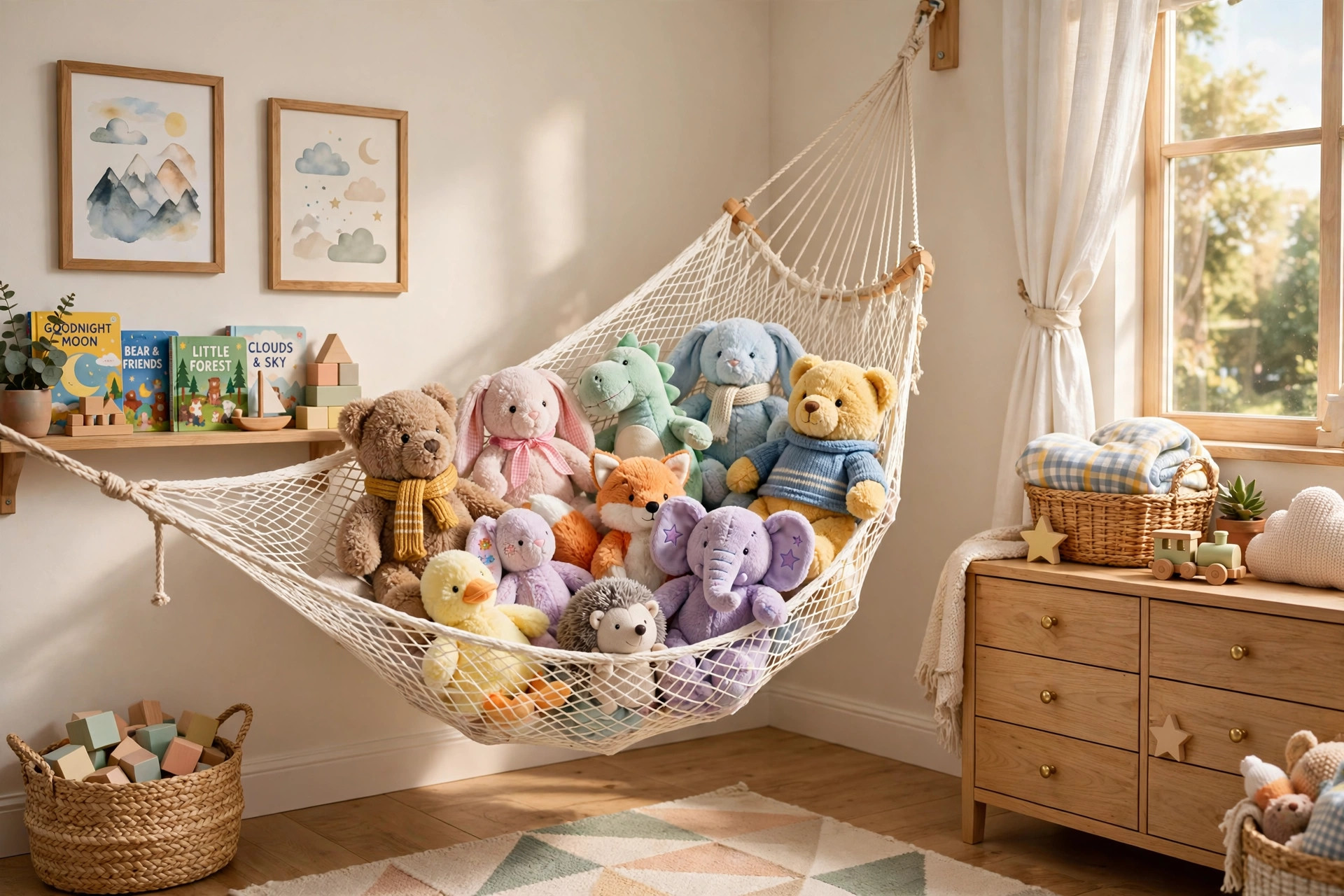

A kids toy storage hammock for stuffed animals is one of the simplest ways to bring order to a child’s room. It is a mesh net that hangs in the corner of a wall, near the ceiling, and holds plush toys the way a fruit hammock holds fruit in a kitchen. Stuffed animals pile up fast. A single birthday can add five new ones. A hammock gathers them in one place, keeps them off the floor, and turns clutter into a soft display.
Parents like these nets because they use dead space. The upper corner of a bedroom is almost never used. A hammock puts that space to work. Children like them because their toys stay in sight and in reach. They can pull down a bear, play with it, and toss it back up when they are done.
This guide explains why the hammock works so well, what to look for when you buy one, the main types, what they cost, how to keep them clean, and how to hang them with safety in mind.
Why It Matters
Floor space is the most scarce thing in a child’s room. A twin bed, a dresser, and a small table can fill the whole floor. Stuffed animals that rest on the floor take space away from play. They also collect dust, and they get stepped on. A hammock lifts them up and out of the way.
A net hammock also teaches a child to put things back. A toy box is deep and dark. A child cannot see what is inside, so toys that go in are forgotten. A hammock is open. Every toy shows. A child can point to the one they want and place it back on top of the pile. The routine is simple enough for a three-year-old to learn.
There is a visual benefit as well. A wall of color from the net looks warm and cheerful. Many parents match the net color to the room. White and cream nets fit most nurseries. Bright nets add life to a playroom. The CPSC offers general guidance on keeping children’s rooms safe, and a tidy room with clear floors is part of that picture. Fewer things on the floor means fewer trips and falls during night wake-ups.
Finally, a hammock saves money. A large toy box or a tall shelf can cost a great deal. A net hammock costs very little and holds just as many plush toys as a small bookcase. When you compare it to other options like a kids bookshelf with bins for toy storage, the hammock is often the cheaper first step.
What to Look For: Kids Toy Storage Hammock for Stuffed Animals
Not all nets are alike. The points below will help you judge quality before you buy.
Mesh strength. Hold the net and pull it gently between your hands. The mesh should feel firm and spring back. Weak mesh sags after a few months and lets small toys slip through. Look for nets described as double-stitched or reinforced at the edges.
Hole size. The holes must be smaller than the toys you plan to store. Small plush toys and beanie-style animals can drop through wide mesh. A hole size near one inch or less is a safe choice for most collections.
Size and capacity. Nets are sold in small, medium, and large or jumbo. A small net may hold ten to fifteen toys. A jumbo net can hold thirty or more. Measure your corner before you buy. A net that is too small for the corner looks lost. A net that is too large will hang low and drape over furniture.
Hooks and hardware. Most nets come with three or four hooks or brackets. Check that the hooks feel solid and can bear weight. Cheap plastic hooks can pull out of drywall. Many parents prefer to buy separate screw-in hooks that grip a wall stud. The Healthychildren.org site from the American Academy of Pediatrics covers nursery safety in detail and is a good place to review before you mount anything on a wall.
Fabric and color. Cotton nets feel soft and natural. Polyester nets are stronger and resist stretching. White goes with everything. Pastel pink, blue, and green suit many rooms. Bright rainbow nets are popular in playrooms. Some parents like the decor advice on The Spruce when they plan the room around the hammock.
Ease of cleaning. The net will catch dust. A net that can go in a washing machine on a gentle cycle will save you time. Check the label before you buy.
Types and Options
Corner triangle nets
The classic shape is a triangle that fits into the corner where two walls meet the ceiling. Three corners of the net hook to three points on the walls. This is the most common type, and it suits most bedrooms. It holds a good pile of toys and takes no floor space at all.
Flat wall nets
A flat net hangs against a single wall rather than across a corner. It looks more like a storage rack than a hammock. It suits narrow walls and spaces between windows. Flat nets often have pockets as well as a main pouch, which is handy for small toys that would fall through a loose mesh.
Multi-tier hanging nets
These look like three or four nets stacked in a column. They hang from the ceiling or from a tall hook. Each tier holds its own group of toys. They suit a child who likes to sort toys by type or size. They need more headroom than a corner net, so check your ceiling height.
Combination systems
Some families pair a hammock with other storage. The hammock holds the daily favorites. A nursery closet organizer for baby clothes holds the rest. Retailers like Target and Amazon carry both nets and closet organizers, so you can plan the whole system at once.
Cost and Price
A kids toy storage hammock for stuffed animals is one of the least costly storage items you can buy.
Small nets sell for about five to ten dollars. They hold a modest group of toys and suit a small nursery corner. Medium nets sell for about ten to fifteen dollars. They suit most children’s bedrooms. Large and jumbo nets sell for about fifteen to twenty-five dollars. They hold large collections and suit shared rooms or playrooms.
Premium sets with extra-strong mesh, metal hooks, and matching decor can reach thirty dollars. Even at that level, the hammock costs less than most toy boxes. IKEA and Wayfair carry nets across this price range, and Pottery Barn Kids sells higher-priced versions that match their room collections.
Watch for hidden costs. You may need to buy separate wall anchors or stud-finding tools if the included hooks are weak. That can add five to ten dollars. Still, the total stays far below the price of a bookshelf or a toy chest.
Prices change with sales and seasons. Nets often drop in price during back-to-school sales and after the holidays, when toy storage is in high demand.
Care and Upkeep
A net hammock needs little care, but it does need some.
Take the toys down every two or three months and wash the net. Most nets can go in a washing machine on a gentle cycle with cold water. Use a mild soap. Let the net air dry. Heat from a dryer can weaken elastic edges and shrink the mesh.
While the net is down, wash or wipe the toys themselves. Stuffed animals collect dust and allergens. Many can be washed in a mesh laundry bag. Check each toy’s label first.
Inspect the hooks once a month. Make sure they are still tight in the wall. The weight of a full net can loosen drywall anchors over time. If a hook feels loose, move it to a wall stud or replace the anchor with a stronger one.
Check the mesh for holes. A small tear can be sewn shut with a needle and thread. A large tear means it is time for a new net. A torn net can drop a heavy toy on a child’s head, so do not ignore damage.
Rotate the toys now and then. Children forget toys they cannot see under a pile. A quick rotation keeps old favorites in use and slows the growth of the collection.
Safety
Safety comes first with anything that hangs on a wall in a child’s room.
Mount it high enough. Hang the net well above a small child’s head so it cannot be pulled down onto them. The net is for storage, not for swinging. Teach children early that it is not a toy.
Use proper anchors. A full net of plush toys is heavier than it looks. Twenty or thirty stuffed animals can weigh several pounds. Use anchors rated for the weight, and set them into wall studs when you can. Drywall anchors of the toggle type hold better than simple plastic sleeves.
Keep cords and strings away. Do not use a net with long loose cords near a crib or a toddler bed. Long cords can pose a strangulation risk. If your net has long hanging strings, tie them up short or trim them. The CPSC publishes cord-safety rules for children’s rooms, and the advice on What to Expect also covers safe nursery setups.
Check for small parts. Some nets come with beads, clips, or plastic toggles as decoration. Remove anything small enough to fit through a toilet-paper tube. Small parts are a choking hazard for children under three.
Inspect often. A net that is full, heavy, and old can fail at the hooks. A quick monthly check takes a minute and prevents a fall.
When the hammock shares the room with other wall items, plan the layout as a whole. Removable kids bedroom wall decals are a safe way to decorate the wall under a hammock without adding hardware.
FAQ
How many stuffed animals can a hammock hold?
It depends on the size of the net and the size of the toys. A small corner net holds about ten to fifteen medium plush toys. A jumbo net can hold thirty or more. Large plush toys take up much more room than small ones, so a collection of big bears will fill a net faster than a collection of small figures.
What is the best height to hang it?
Hang the top hooks six to twelve inches below the ceiling. The bottom edge of the filled net should rest above the child’s head when they stand under it. In most rooms this means the lowest point of the net sits about five feet from the floor. Younger children can still reach the lower toys with a small step stool under adult supervision.
Will it damage my walls?
Three small hook holes are all it leaves behind. They can be filled with spackle and painted over in minutes when you move the net or move out. This makes the hammock a good choice for renters. Use the least invasive hook that still holds the weight safely.
Can I use it in a corner that has a window?
You can, but a window changes things. Sunlight can fade both the net and the toys over time. Blinds or curtains can catch on the net when they open. If the corner has a window, pick the next corner instead, or keep the net clear of the window trim.
What if my child’s collection keeps growing?
A second net in another corner is the simple answer. Two medium nets often work better than one jumbo net because they spread the weight and suit two spots in the room. You can also thin the collection. Box up toys the child no longer plays with and store the box in a closet.
Is a hammock better than a toy box for stuffed animals?
For stuffed animals, yes, in most cases. A toy box hides toys at the bottom where they are forgotten. A hammock shows every toy and takes no floor space. A toy box suits hard toys and blocks better. Many families use both: a hammock for plush toys and a box for the rest.
A Short Final Word
A kids toy storage hammock for stuffed animals solves a common problem with a simple tool. It uses empty corner space, keeps toys in sight, and teaches children to put things back. It costs little, installs in minutes, and lasts for years with light care.
Choose a net with strong mesh and small holes. Hang it with anchors that suit the weight. Keep it clean and check it now and then. Do those simple things, and the pile of stuffed animals on the floor will become a neat, colorful display on the wall. For a child, that is more than storage. It is a home for the toys they love.
References
Amazon. (n.d.). Online shopping. https://www.amazon.com American Academy of Pediatrics. (n.d.). HealthyChildren.org. https://www.healthychildren.org IKEA. (n.d.). Home furnishings. https://www.ikea.com Pottery Barn Kids. (n.d.). Kids furniture and decor. https://www.potterybarnkids.com Target. (n.d.). Retail store. https://www.target.com The Spruce. (n.d.). Home and garden advice. https://www.thespruce.com U.S. Consumer Product Safety Commission. (n.d.). Product safety information. https://www.cpsc.gov Wayfair. (n.d.). Furniture and home goods. https://www.wayfair.com What to Expect. (n.d.). Pregnancy and parenting guidance. https://www.whattoexpect.com
Was this guide helpful?

About James Carter
The My Garden US editorial team writes practical, in-depth home and garden guides for American homeowners — tested advice, no fluff.
You May Also Like

Crib Mattress Protector Waterproof Breathable: The Complete Parent Guide
September 28, 2026 0 views
Nursery Glider with Nursing Pillow Set: Comfort for New Parents
June 20, 2026 0 views
Kids Teepee Tent for Indoor Playroom Decor: A Simple Buying Guide
May 31, 2026 0 views