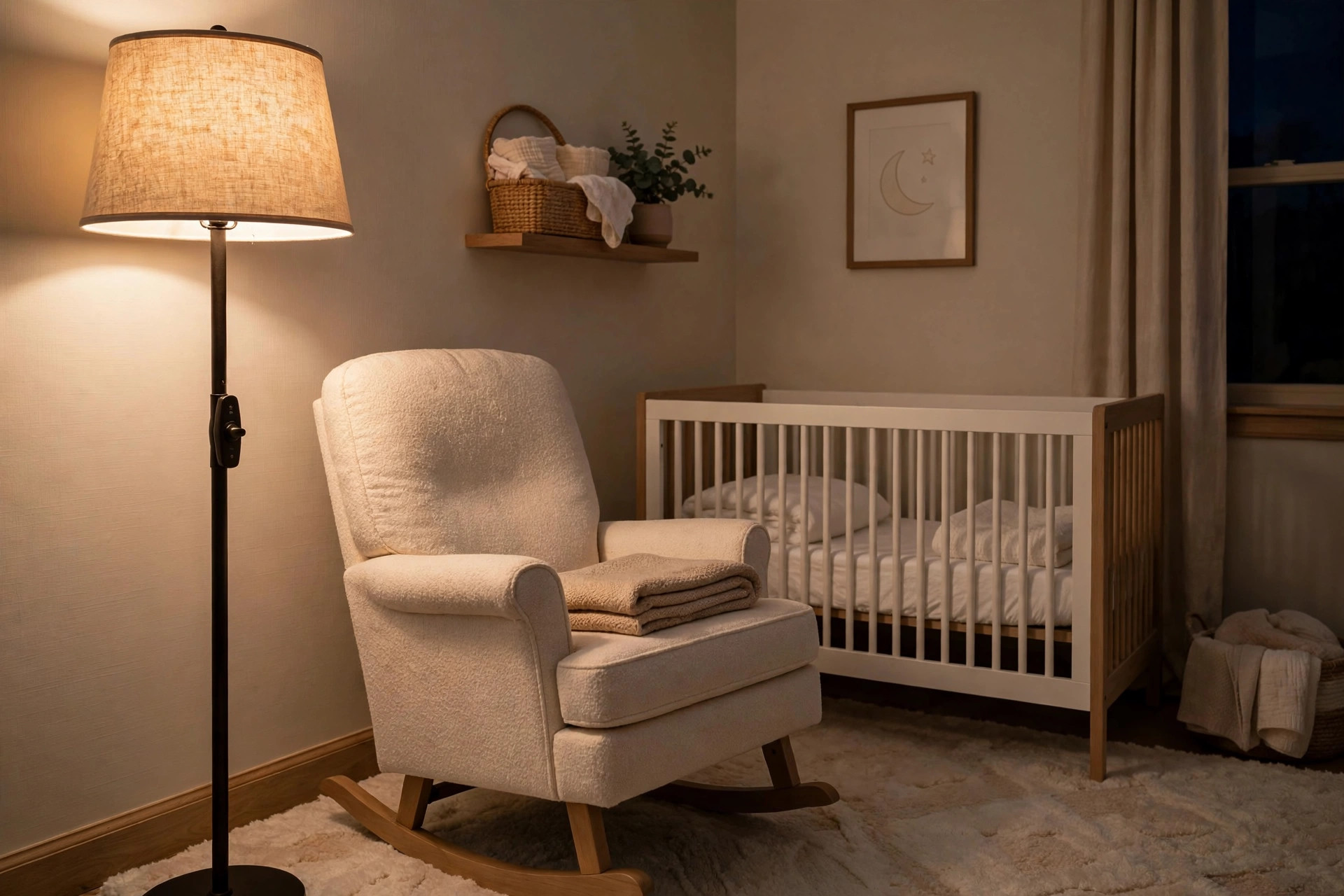

A nursery floor lamp with dimmer for nursing is one of the most useful things a parent can buy for a baby’s room. The idea is simple. A baby needs to eat many times at night. Bright light wakes the baby up. It also wakes the parent up too much. A dim floor lamp gives just enough light to see. The parent can feed the baby. Then the baby can fall back asleep. The dimmer lets the light go up or down. Low light keeps the room calm.
Many parents learn this in the first week at home. They use the overhead light at first. The baby cries under the bright light. The parent feels tired and tense. Then they try a dim lamp. Nights get easier. That is why this one small item gets so much praise from new parents.
Why It Matters
A newborn eats every two to three hours. This goes on for weeks, and often for months. Night feedings are a fact of life. The light in the room matters more than most parents expect. Strong light tells the brain that it is day. It stops the release of sleep hormones. This is true for adults. It is also true for babies.
A floor lamp with a dimmer solves the problem. It stands beside the nursing chair. The light points up or down, not at the baby. The parent can turn it low. The room stays dark enough for sleep. The parent can still see the baby latch. The parent can check a diaper. The parent can find the pacifier that fell on the floor.
A floor lamp has another good point. It is not tied to one spot on the wall. It can move. Put it beside the glider today. Move it beside the crib tomorrow. When the nursing days end, it can move to a corner. It becomes a reading lamp for a toddler. Good things last.
A floor lamp also keeps cords away from the baby. A table lamp needs a table. The cord runs across the room. A floor lamp sits in one corner. The cord goes straight to the wall. This is safer. It also looks cleaner.
Many parents pair a dim floor lamp with a night light for middle of the night feedings. A night light gives a small glow. A floor lamp gives more light when it is needed. The two work well together.
What to Look for and How to Choose: Nursery Floor Lamp with Dimmer for Nursing
Brightness and the Dimmer
The dimmer is the heart of this lamp. Look for one that goes very low. Some dimmers only go down to half power. That is still too bright for a night feeding. A good dimmer can take the light down to a soft glow.
There are two kinds of dimmers. Some lamps have a built-in dimmer. It may be a knob on the pole. It may be a touch pad on the shade. Other lamps use a separate dimmer plug. The plug goes into the wall outlet. The lamp plugs into it. Both work. A built-in dimmer is simpler. Nothing extra to buy.
Touch dimmers are nice at night. A parent holding a baby cannot reach far. A touch on the pole is easy. A knob is also easy. Foot switches are easy too. Pick what feels right.
Shade Shape
The shade shapes the light. A drum shade spreads light up and down. It gives a soft, even glow. A cone shade points light one way. It is good for reading. For nursing, a drum shade or a globe shade is best. They do not throw hard light in any one spot.
Light color matters too. Bulbs come in warm and cool tones. Warm light feels like a candle. It is calm. Cool light feels like day. It wakes the mind. For a nursery, choose warm light. Look for bulbs marked 2700K or lower. Many baby and parenting guides at What to Expect note that a calm sleep setting helps babies learn night from day.
Height
A floor lamp should be tall enough to light the chair, but not so tall that it shines in eyes. Most floor lamps are 55 to 65 inches tall. That is a good range. The shade should sit above the parent’s head when seated. The light should fall on the lap and the floor, not on the baby’s face.
Base and Stability
A nursery lamp must stand firm. Toddlers pull up on things. They grab poles. A heavy base keeps the lamp from tipping. Look for a wide, flat base. Some lamps weigh over ten pounds. That is a good sign.
Place the lamp where it cannot fall on the crib. Keep it behind the chair, not beside the crib. As the child grows and starts to walk, watch how the lamp is used. The lamp should be a tool, not a toy.
Bulb Type
LED bulbs are the best choice. They run cool. An old-style bulb gets hot. A hot bulb near fabric is a risk. LED bulbs also last for years. They use little power. Many LED bulbs now work with dimmers. Check the box. It should say “dimmable.” Not all LED bulbs dim well. A non-dimmable bulb on a dimmer may flicker. Flicker hurts the eyes.
Types and Options
Arc Floor Lamps
An arc lamp curves over the chair. The light hangs above the parent. This gives great light for feeding. The base stays off to the side. This keeps the floor near the chair clear. Arc lamps cost more. They also take more space. In a small room, they can feel big.
Torchiere Lamps
A torchiere points light up at the ceiling. The ceiling bounces it down. The room fills with soft light. There are no hard shadows. Many torchieres now come with dimmers. They are simple and cheap. They fit in small rooms.
Tripod Floor Lamps
A tripod lamp has three legs. It looks modern. It is stable. The light sits in the middle of the legs. It gives a wide pool of light. The wide stance takes floor space. In a tiny nursery, it may crowd the room.
Pharmacy and Reading Lamps
These lamps have an adjustable arm. The head moves. The light can point right at a book or at the baby. They are great for parents who read during feedings. They give focused light. The focused light stays off the baby’s eyes if the head is aimed well.
Smart Lamps
Some lamps connect to a phone or a voice speaker. A parent can say “dim the light.” This is handy with full hands. Smart lamps cost more. They need a wireless network. For some parents, the ease is worth it. For others, a simple knob is enough.
A floor lamp is only one part of a calm nursery. Dark windows help too. Many parents add blackout curtains for nursery windows to keep street light out. Soft light and dark windows make a good pair.
Cost and Price
A nursery floor lamp with a dimmer does not need to cost much. Prices run in clear bands.
A basic torchiere with a dimmer costs about 30 to 60 dollars. It does the job. It is light and simple. It may not last as long as a dearer lamp.
A mid-range lamp costs about 60 to 130 dollars. This is where most parents shop. The build is better. The dimmer is smoother. The shade looks nicer. Retailers like IKEA and Target carry many lamps in this range.
A high-end lamp costs 130 to 300 dollars or more. These lamps have solid metal parts. They have better dimmers. They look like fine furniture. Stores like Pottery Barn Kids sell nursery lamps that match other nursery pieces.
Do not forget the bulb. A dimmable LED bulb costs about 5 to 12 dollars. Buy a warm one. Keep a spare in the drawer. A bulb will fail at 2 a.m. sooner or later.
Big home stores carry floor lamps in every band. Browsing the lighting aisles at Home Depot or the nursery section at Wayfair helps a parent compare looks and prices side by side. Reading lamp reviews on The Spruce can also help narrow the choice.
A floor lamp pairs well with the right chair. A rocking chair for small nursery spaces and a dim floor lamp make the feeding corner complete. Budget for both at once if the room is still empty.
Care and Upkeep
A floor lamp needs little care. Dust the shade once a month. A drum shade collects dust on top. A damp cloth takes it off. Do not soak the shade. Paper and fabric shades do not like water.
Check the cord twice a year. Look for cracks or frays. A damaged cord is a fire risk. If the cord is bad, stop using the lamp. Replace the cord or the lamp. Do not tape a bad cord and keep using it.
Keep the area around the lamp clear. Blankets, toys, and clothes should not touch the shade. LED bulbs run cool, but the rule still holds. Heat builds up when air cannot move.
Tighten the pole joints once in a while. Lamps loosen with time. A wobbly lamp tips more easily. A firm twist keeps it steady.
When the child starts to climb, rethink the lamp spot. Move it behind heavy furniture. Or move it out of the room for a time. A toddler can pull a lamp down. Safety comes first.
Safety
Safety is the most important part of any nursery item. Lamps are no different. The federal safety agency, the Consumer Product Safety Commission, sets rules for nursery products. Lamps must meet electrical safety standards. Buy from known stores. Look for a UL or ETL mark on the lamp or the box. That mark means the lamp passed safety tests.
Keep cords out of reach. Run the cord along the wall. Use cord covers if needed. Never run a cord under a rug where a foot can catch it. A tripping parent holding a baby is a danger to both.
Use the right bulb wattage. The lamp socket states a max wattage. Never go above it. With LED bulbs this is rarely a problem. An LED that gives the light of a 60-watt bulb uses only about 9 watts. Still, check the number.
Keep the lamp away from the crib. A lamp should never hang over or lean toward the crib. Hot bulbs and small hands do not mix. Put the lamp by the chair. Keep the crib clear.
Turn the lamp off when leaving the room for a long time. This saves power. It also cuts risk. A simple habit keeps the nursery safe.
Think about the baby’s sleep too. The pediatric guidance at HealthyChildren.org stresses a safe, calm sleep setting. Soft light, a firm flat mattress, and nothing loose in the crib form the base of safe sleep. A dim lamp supports that setting. It never replaces it.
Frequently Asked Questions
Is a floor lamp better than a table lamp for nursing?
A floor lamp is often better. It stands on its own. It needs no table. The cord runs straight to the wall. It moves from room to room. A table lamp works too, but it needs a side table. In a small nursery, floor space may be easier to spare than table space.
What wattage should the bulb be?
For night nursing, a dim warm bulb is best. A 40 to 60 watt equivalent LED is plenty. The key is the dimmer. With a good dimmer, the parent can take the light down to a faint glow. Brighter is not better at night.
Can any LED bulb be used with a dimmer?
No. The bulb must say “dimmable” on the box. A non-dimmable LED on a dimmer may flicker or buzz. It may also fail early. Always match a dimmable bulb to a dimmer lamp. The lamp manual lists which bulbs fit.
Where should the lamp stand in the nursery?
Put the lamp beside or behind the nursing chair. The light should fall on the parent’s lap, not on the baby’s face. Keep it away from the crib. Keep the cord against the wall. Do not put the lamp where a toddler can grab and pull it.
Is warm or cool light better for night feedings?
Warm light is better. Warm light calms. It does not fight the body’s sleep signals. Cool light feels like daylight. It can wake the baby more and make it harder for the parent to fall back asleep. Choose bulbs marked 2700K or lower.
When should the lamp be replaced?
Replace the lamp when the cord frays, the pole wobbles and will not tighten, or the dimmer flickers and will not stop. LED bulbs last for years, so a failing lamp is usually a wiring or switch problem. Do not keep using a lamp that sparks or smells hot. Buy a new one.
A Short Final Word
A nursery floor lamp with dimmer for nursing is a small buy with a big return. It makes night feedings calmer. It keeps the baby drowsy. It lets the parent see without waking the house. Choose a stable lamp with a true low dimmer. Pick a warm, dimmable LED bulb. Keep the cord safe and the lamp away from the crib. Do that, and the long nights will feel a little shorter.
References
American Academy of Pediatrics. (n.d.). HealthyChildren.org. https://www.healthychildren.org IKEA. (n.d.). Home furnishings. https://www.ikea.com Pottery Barn Kids. (n.d.). Kids furniture and decor. https://www.potterybarnkids.com Target. (n.d.). Retail store. https://www.target.com The Home Depot. (n.d.). Home improvement products. https://www.homedepot.com The Spruce. (n.d.). Home and garden advice. https://www.thespruce.com U.S. Consumer Product Safety Commission. (n.d.). Product safety information. https://www.cpsc.gov Wayfair. (n.d.). Furniture and home goods. https://www.wayfair.com What to Expect. (n.d.). Pregnancy and parenting guidance. https://www.whattoexpect.com
Was this guide helpful?

About Emily Rodriguez
The My Garden US editorial team writes practical, in-depth home and garden guides for American homeowners — tested advice, no fluff.
You May Also Like

Toddler Duvet Cover Set for First Big Bed: A Simple Guide for Parents
April 7, 2026 0 views
Kids Loft Bed With Slide for Fun Bedroom: A Parent’s Guide
August 3, 2026 0 views
A Parent’s Guide to the Kids Room Rug Round for Play Area Use
February 6, 2026 0 views