
A gazebo is a fine place to sit on a warm evening. It gives shade at noon and shelter when rain comes. But a gazebo that is not tied down can turn into a hazard. One strong gust of wind can lift it, drag it, or flip it over. That can harm the frame, the patio, and anyone close by. So every owner should learn how to anchor gazebo to patio before the first storm of the season.
This guide explains the task in plain steps. It covers why anchoring matters, which methods fit which patios, what tools you need, what the work costs, and how to keep the anchors sound year after year. The methods below suit most metal and wood gazebos on concrete, stone, or paver patios. With a few hours and basic tools, you can make your gazebo as steady as the house beside it.
Why Anchoring Matters
A gazebo is light for its size. The roof acts like a sail. When wind blows under the canopy, it pushes the whole frame upward and sideways. A ten-by-twelve gazebo can catch hundreds of pounds of force in a heavy storm. If the legs are only resting on the patio, the frame can slide, tip, or go airborne.
Anchoring does two things. First, it holds the frame down against lift. Second, it stops the legs from walking across the patio in high wind. A firm anchor lets you enjoy the gazebo in all weather, and it keeps your neighbors and your property safe. Many local rules now require fixed structures to be secured. A loose gazebo can also void its warranty, since makers expect the frame to be tied down per their manual.
You do not need to anchor only in storm country. Even a calm suburb can get a sudden squall. Anchoring is cheap insurance, and it costs far less than a bent frame or a broken fence.
What to Look for Before You Start: How to Anchor Gazebo to Patio
Know Your Patio Surface
Patios are not all the same. The right anchor depends on what lies under the gazebo legs.
– Poured concrete slab. The best case. You can drill and set wedge or sleeve anchors straight into the slab. – Stone or concrete pavers. These sit on sand or gravel. You can drill through a paver and set an anchor into the base below, or you can lift a paver and pour a small concrete footing under it. – Brick patios. Like pavers. Drilling is fine, but the mortar joints are weak, so aim for the middle of each brick. – Tile over concrete. You can drill through the tile into the concrete beneath. Work slowly so the tile does not crack.
Walk the patio and check its condition. Old slabs with wide cracks or loose pavers are poor anchors. Fix or replace damaged spots before you drill.
Check the Gazebo Legs
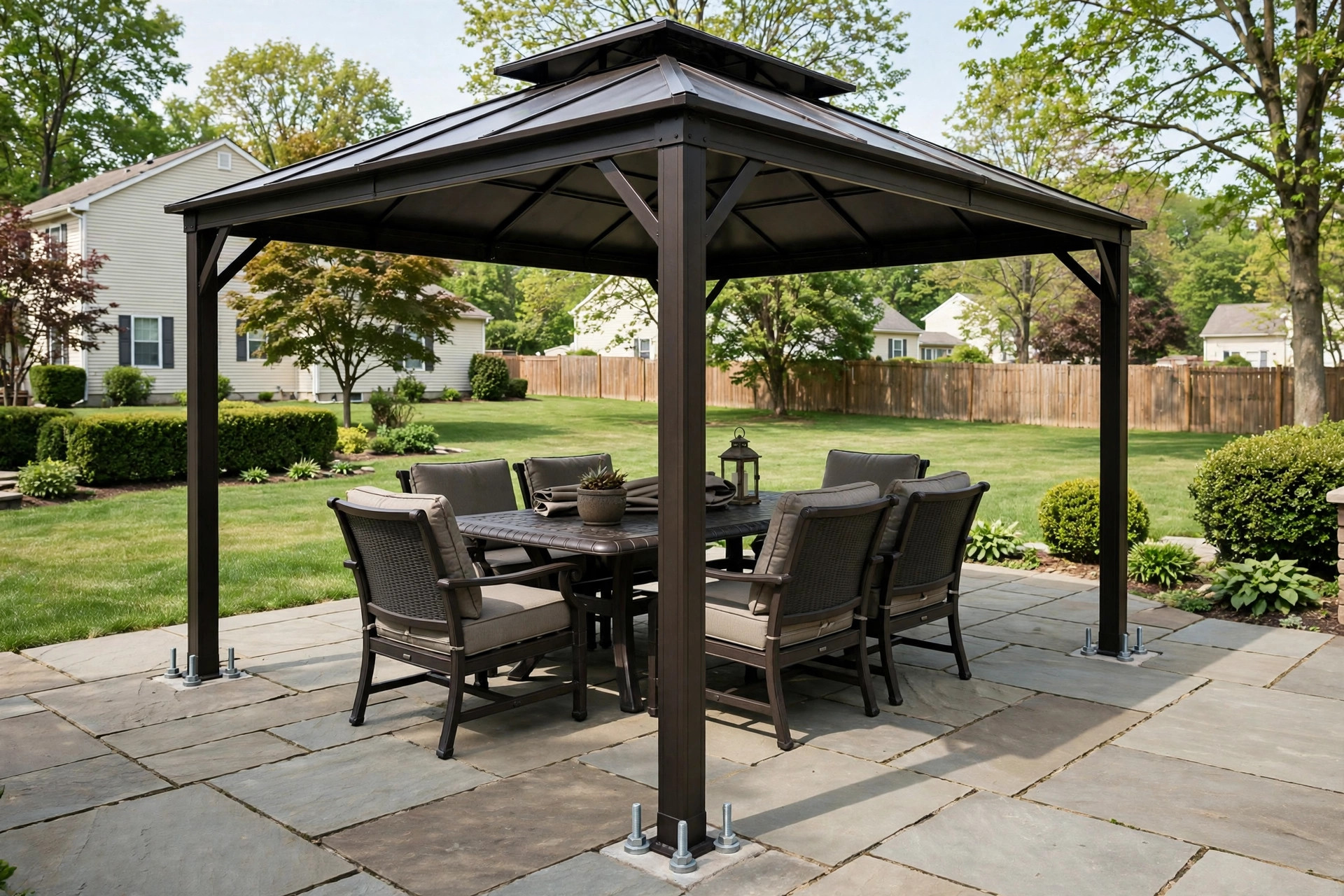
Look at the feet of your gazebo. Most metal frames have flat foot plates with holes for bolts. Wood gazebos often have posts that sit in metal post bases. If your frame has no bolt holes, you can use straps, brackets, or weight plates instead. Measure the plate size and hole diameter so you buy anchors that fit.
If the manual is lost, the product pages at stores like IKEA or Wayfair often show the foot design for similar gazebo models.
Wind and Ground Rules in Your Area
Learn what wind your area sees. Most gazebo anchors suit winds up to about sixty miles per hour. If your town gets hurricanes or strong winter storms, you may want heavier anchors or extra straps. A quick check of local building rules will tell you if a permit is needed for a fixed gazebo.
How to Choose Your Anchoring Method
There are four common ways to hold a gazebo to a patio. Pick the one that fits your surface and your frame.
Concrete Wedge or Sleeve Anchors
This is the strongest choice for a poured slab. You drill a hole into the concrete, drop in the anchor, and tighten a nut. The anchor wedges tight against the hole walls. A half-inch sleeve anchor in solid concrete can hold several thousand pounds of pull. Use four anchors, one per leg, at minimum.
Pros: very strong, neat, hidden under the foot plate. Cons: you need a hammer drill and masonry bit, and the holes are permanent.
Tapcon Screws
Tapcon screws are heavy masonry screws that thread straight into drilled concrete or stone. They are easy to set with a standard drill and a masonry bit. They hold well for small to mid-size gazebos. Use screws at least three inches long in solid concrete.
Pros: quick, easy, cheap. Cons: less hold than wedge anchors, and they can loosen if the concrete is old or soft.
Concrete or Steel Weight Plates
If you cannot drill, weights work. Flat steel plates or concrete blocks sit on the foot plates and add downward force. Sand-filled weight bags do the same job. This method suits renters or new patios where drilling is not wanted.
Pros: no holes, fully removable. Cons: heavy to move, and high wind can still tip a light frame, so pair weights with straps for safety.
Tie-Down Straps and Ground Anchors
Some owners run straps from the frame to anchors set in soil around the patio edge. This works when the patio is too thin or too decorative to drill. Drive spiral ground anchors into the soil at each corner, then run ratchet straps over or through the frame.
Pros: strong in soil, no damage to the patio. Cons: straps show, and soft or wet soil can let anchors pull out.
For most owners, drilled concrete anchors are the best answer to how to anchor gazebo to patio. They are cheap, strong, and nearly invisible. If drilling is not an option, combine weight plates with straps for the next best hold.
Types of Gazebos and What They Need
Metal Frame Gazebos
These are the most common patio models. They are light, so they need all four legs bolted down. Foot plates make this simple. If you are still shopping, reviews of the best metal gazebo for backyard reviews can help you pick a frame with solid foot plates and thick posts.
Wood Gazebos
Wood posts are heavy, which helps in wind, but the wood must stay off wet concrete or it will rot. Use metal post bases bolted to the slab, with the post bolted to the base. Anchor the bases with wedge anchors.
Pop-Up Canopy Gazebos
These are tents, not fixed structures. Never try to bolt one to a patio as if it were permanent. Use weight bags on the legs and tie straps to firm points. Take the canopy top off when wind rises.
Step-by-Step: How to Anchor Gazebo to Patio
Here is the full method for a poured concrete patio using sleeve anchors. Most other methods follow a similar pattern.
Step 1: Gather Your Tools
You will need:
– A hammer drill and a masonry bit that matches your anchor size – Four or more sleeve or wedge anchors (half inch by four inches is common) – A wrench or socket set – A tape measure and a pencil – A shop vacuum or small brush – Safety glasses and work gloves – A level
Buy one or two extra anchors in case a hole strips out.
Step 2: Place and Level the Gazebo
Set the frame where you want it. Keep each foot at least six inches from the patio edge so the concrete has enough meat around the hole. Check with a level that the frame stands square. Mark the bolt holes on the concrete with a pencil. Move the gazebo aside so you can drill freely.
Step 3: Drill the Holes
Put on your safety glasses. Drill each hole straight down to the depth the anchor needs, usually a little deeper than the anchor length. Drill slowly and let the bit do the work. Pull the bit out now and then to clear dust. Vacuum the dust out of each hole when done. Dust left in the hole will weaken the grip.
Step 4: Set the Anchors
Slide the frame back into place over the holes. Drop a sleeve anchor through each foot plate hole and into the concrete. Tap it gently with a hammer until it sits flat. Thread the nut on and tighten with a wrench. Tighten in a crisscross order, like lugs on a car wheel, so the frame does not twist.
Step 5: Check and Test
Push each leg by hand. Nothing should move. If a plate rocks, loosen the nut, pack a thin shim under the plate, and tighten again. Try to lift each leg slightly. The anchor should hold firm. Stand back and look at the frame from all sides to confirm it is square and level.
Step 6: Seal Around the Holes
Run a thin bead of outdoor silicone around each foot plate. This keeps water out of the drilled holes and stops freeze damage in cold climates. Wipe off the extra with a damp cloth.
The whole job takes about two hours for a standard four-leg frame. If you are unsure about any step, product review sites such as Consumer Reports publish test results on patio structures and hardware.
Cost and Price
Anchoring is one of the cheapest safety jobs in the home. Here is what to expect:
– Sleeve or wedge anchors: ten to twenty dollars for a pack of four. – Tapcon screws: eight to fifteen dollars for a box. – Weight plates or sandbags: thirty to eighty dollars for a set of four. – Spiral ground anchors and straps: twenty to forty dollars per corner. – Hammer drill rental: about forty dollars a day if you do not own one.
Most owners spend under fifty dollars in materials. A hired handyman may charge one hundred to two hundred dollars for the whole job. Compared with the cost of a gazebo, which runs several hundred to a few thousand dollars, this is a small sum.
Care and Upkeep
Anchors need little care, but a quick check twice a year keeps them sound. Look at each foot plate in spring and fall. Tighten any nut that has worked loose. Watch for rust on the plates and bolts, and brush on outdoor paint or rust spray if spots appear. For more ideas on protecting outdoor metal, see metal patio furniture rust prevention tips.
If you sealed the plate edges with silicone, check the seal after winter. Frost can lift it. Reapply a fresh bead where it has cracked. For weight bags, check for tears and refill sand that has leaked out. If you move the gazebo, fill the old holes with concrete patch.
Safety
Take these cautions to heart.
– Never drill into a thin patio. If your slab is less than three inches thick, anchors can crack it. Use weights instead, or pour a footing. – Watch for utilities. Do not drill deep near the house wall without knowing what lies under the slab. Call your local utility line service before any deep digging around the patio edge. – Take the canopy down in severe weather. Anchors handle normal storms. In a hurricane warning, remove fabric panels and the roof canopy if your model allows it. A bare frame catches far less wind. – Keep children clear. Do not let kids hang from the frame or climb the posts. Anchors hold the frame to the ground; they do not make it a playground. – Check after every big storm. Even good anchors can loosen after a hard blow. A five-minute check after each storm catches problems early. – Use gloves and glasses. Concrete dust is harsh on eyes and lungs. Wear a mask when drilling in a closed or dusty space.
Frequently Asked Questions
Can I anchor a gazebo to pavers instead of concrete?
Yes. Drill through the paver into the compacted base below and set a sleeve anchor. For the best hold, lift the paver and pour a small concrete footing, then reset the paver and bolt through it. This spreads the load and stops the paver from lifting.
How many anchors does a gazebo need?
At least one per leg. A four-leg gazebo needs four anchors, and a six-leg model needs six. Some owners add extra straps at the corners for wind country. More is always better than less.
Will drilling hurt my patio?
The holes are small, usually half an inch wide. Under the foot plates they are invisible. If you ever remove the gazebo, a bit of concrete patch fills them flush. The risk of cracking is low if you drill slowly and keep the holes away from the slab edge.
Can I use sandbags instead of bolts?
Sandbags and weight plates work for light frames and calm areas. They are a fair choice if you rent your home. But they do not grip the patio, so in strong wind a light frame can still shift. Pair weights with tie-down straps for a surer hold.
Do I need to anchor a gazebo on a deck?
Yes, and the method differs. On a wood deck, lag bolts go through the foot plates into the deck joists, not just the deck boards. Find the joists first with a stud finder. Never trust the boards alone, since they can pull up under load.
What about wind protection for the rest of my patio?
The same wind that threatens a gazebo can toss a patio umbrella. Umbrella guides such as best patio umbrella for wind reviews and the cantilever umbrella base weight guide show how to weigh down shade gear the same way you secure a gazebo.
A Short Final Word
Knowing how to anchor gazebo to patio is a small skill with a large payoff. A few anchors, a couple of hours, and a bit of care keep your gazebo standing firm through wind and rain. Do the work once, check it twice a year, and your patio shelter will serve you for many seasons. The peace of mind is worth every penny.
References
IKEA. (n.d.). Outdoor furniture and patio. https://www.ikea.com Wayfair. (n.d.). Outdoor furniture and patio. https://www.wayfair.com Consumer Reports. (n.d.). Product reviews and ratings. https://www.consumerreports.org
Was this guide helpful?

About Sarah Mitchell
The My Garden US editorial team writes practical, in-depth home and garden guides for American homeowners — tested advice, no fluff.
You May Also Like
How to Assemble a Metal Gazebo Kit: A Plain Step-by-Step Guide
July 3, 2026 0 views
The Best Patio Umbrella for Small Balcony Living
February 11, 2026 0 views
Best Outdoor Rug for Screened Porch
May 31, 2026 0 views