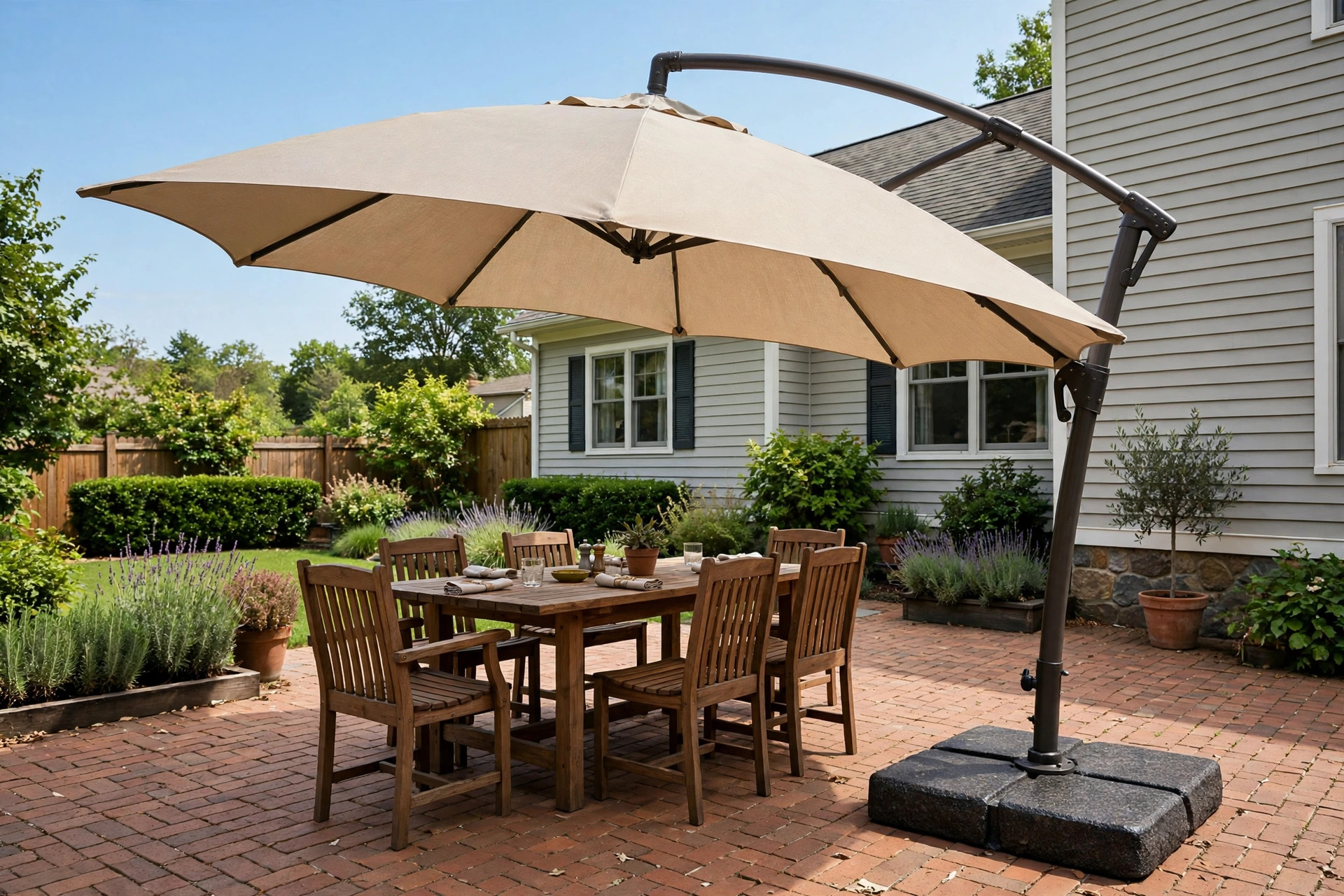

A cantilever umbrella, also called an offset umbrella, hangs its canopy off to the side of a heavy pole. It shades a dining table or a sitting area without a center pole in the way. This guide explains how much weight your base needs to keep that umbrella from tipping, sliding, or flying across the yard.
The base is the most important part of the setup. A canopy catches wind the way a sail catches wind. The pole sits off to one side, so the weight pulls sideways. That side load makes a cantilever far harder to hold down than a regular center-pole umbrella. Get the weight right, and your umbrella will sit through summer storms. Get it wrong, and you may find it in the neighbor’s fence.
Why Base Weight Matters
A cantilever umbrella works like a lever. The pole stands on one side. The canopy reaches out several feet from the pole. Wind pushes on that canopy, and the push turns into force at the base. The heavier the base, the harder it is for wind to lift the far side.
Center-pole umbrellas split the load down the middle. Cantilever umbrellas do not. The offset arm creates torque, which is a twisting force that tries to topple the pole. For this reason, a cantilever base must weigh much more than a base for a normal umbrella. Many makers say a cantilever needs three to four times the weight of a standard base.
Weight also affects daily use. A base that is too light will creep across the deck on windy days. It will tilt the canopy at an angle. In strong gusts, it can flip over and smash patio furniture, break the canopy ribs, or hit a person. Outdoor safety groups often warn that falling patio furniture is a real cause of injury. A heavy, well-chosen base is cheap insurance against all of that.
There is another reason to follow this cantilever umbrella base weight guide. Most umbrella warranties require the right base. If your umbrella breaks in the wind and the maker finds that the base was too light, the warranty may be void. Keep your receipt and follow the maker rules.
How to Choose the Right Weight: Cantilever Umbrella Base Weight Guide
Match the Weight to the Canopy Size
Canopy size is the first factor. A larger canopy catches more wind. Most makers print a minimum base weight in the manual or on the product page. As a rule of thumb:
– A canopy up to 9 feet across needs at least 150 to 200 pounds of base weight. – A canopy of 10 to 11 feet needs 200 to 260 pounds. – A canopy of 12 to 13 feet needs 260 to 350 pounds.
These numbers are only a starting point. Some 10-foot models ask for as little as 180 pounds. Some 11-foot models ask for 300 pounds. Always read the manual first. The maker tested your model, and its number beats any general chart. If the manual is lost, search for the model name online or ask the store. Many patio furniture retailers list base requirements on the product page.
When you compare models, look at the best patio umbrella for wind ratings as well. A heavier base often pairs with a stronger frame, and that combination handles gusts far better than weight alone.
Think About Your Location
Wind changes from place to place. A patio in a quiet suburb faces less wind than a deck on a hill or a yard near the coast. Open ground lets wind build speed. Tall fences and walls block it.
If your yard is open or you live in a windy region, go above the minimum. Add 20 to 50 pounds over the maker’s number. If you are in a sheltered courtyard with high walls, the minimum is usually enough. But never go below it.
Watch your yard through one windy season before you decide. Note which way the wind blows and how hard it hits the umbrella corner. Many owners find that one corner of the deck takes the worst of it, and they move the umbrella to a safer spot.
Pick the Fill Material
Most cantilever bases are not one solid block. Many are hollow plastic shells that you fill at home with water or sand. Water is easy. You can fill the shell with a garden hose and empty it before winter so it does not crack in the frost. But water weighs about 8 pounds per gallon. Sand weighs about 13 pounds per gallon, so sand gives you far more weight in the same shell.
Wet sand weighs even more, close to 15 pounds per gallon. For that reason, sand is the better fill for cantilever umbrellas in windy spots. The trade is weight when you need to move the base. A sand-filled shell is hard to drag across a deck. Some owners use a mix of sand and water, or they fill half with sand and top up with water. This works, but pure sand holds better.
Solid bases use cast iron, steel, granite, or concrete. They arrive at full weight and never need filling. They look nicer and sit lower, which helps them resist tipping. The trade is cost and the hard work of moving them. A 200-pound iron base stays where you put it. Make sure you like the spot.
Types of Cantilever Bases
Water and Sand Fill Shells
These are the most common and the least costly. The shell is tough resin or plastic. It holds 15 to 25 gallons. Fill it with water for light duty or sand for heavy duty. Many shells come in two or four stackable parts so you can build up the weight in steps. Look for a drain plug for winter emptying.
Cross Bases
A cross base is a flat steel or iron frame shaped like a plus sign or an X. It bolts to the umbrella pole. By itself it is light, so you add weight by setting pavers, sandbags, or iron plates on top. Cross bases are popular on rooftops and wood decks, where the flat shape spreads the load and avoids scratching. When you use pavers, strap them down so they do not slide.
Solid Iron and Steel Bases
These are single heavy pieces, often 150 to 300 pounds. They look best on a fine patio. Many have a powder-coat finish that resists rust. Some are shaped to slide partway under the pole for a neat fit. You pay more, but you never think about filling or emptying.
Granite and Concrete Bases
Stone and concrete bases weigh 200 to 350 pounds and look natural with garden furniture. They are the most stable choice in high wind. The trade is size. They are bulky, and moving one takes two people and a hand truck. Set them on level ground and they will not budge.
In-Ground Mounts
The strongest option is no base at all. An in-ground mount is a steel sleeve set in a concrete footing in the earth. You drop the pole in and pin it. Wind cannot move it because the ground holds it. This is the best choice for yards with soft soil and strong winds. The trade is that the umbrella can never move. Dig below the frost line and check local rules before you pour concrete.
For a regular table umbrella, the setup is different. A rectangular patio umbrella for a table drops through the middle of the table, and the table itself adds stability. Cantilever models do not have that help, which is why their bases must be so much heavier.
Cost and Price
Price follows weight and material. A fillable resin shell of 100 to 150 pounds capacity costs about 40 to 90 dollars. Sand to fill it adds a small cost from a home store.
A cross base with plates or pavers runs 80 to 200 dollars, depending on how much iron you add. Solid iron bases of 200 to 300 pounds run 150 to 400 dollars. Granite and concrete bases run 150 to 350 dollars. In-ground mount kits are cheap, often 30 to 60 dollars, but you must add concrete and labor.
Do not buy on price alone. A cheap base that is too light will cost you a new umbrella after the first storm. Match the weight to the canopy first, then shop for the best value at that weight. Watch for sales at large home stores and outdoor furniture sellers. Spring clearance often cuts prices by a third.
Care and Upkeep
A base needs little care, but neglect shortens its life. Check the pole bolt and the crank handle twice a season. Bolts loosen with wind rocking. Tighten them by hand, then give a quarter turn with a wrench.
Wash the base with soap and water once a year. Sand-filled shells grow algae on damp spots. Iron bases can rust where the coating chips. Touch up chips with rust-resistant paint made for metal. Keep drain holes clear so water does not pool.
Before winter, empty water-filled shells or bring them under cover. Frozen water cracks plastic. Sand can stay, but cover the shell so it does not hold ice. Store the canopy closed and tied. A closed canopy takes far less wind load than an open one. Many owners also buy a cover for the whole umbrella. If you are shopping for covers, it helps to read reviews of a side table with an umbrella hole setup too, since matching furniture keeps the whole patio safe.
Check the base level each spring. Frost and rain shift patios. A base that tilts even a little is easier for wind to push. Shim it with rubber pads if needed.
Safety
Close the umbrella when the wind picks up. Most makers say to close it when gusts pass 25 to 35 miles per hour. A closed umbrella sheds wind. An open one fights it. Make closing part of your routine, like locking the door.
Never leave a cantilever umbrella open overnight in a storm zone. A sudden night gust can topple it while you sleep. Tie the canopy with its strap so it cannot catch wind when closed.
Keep children and pets away from the umbrella in wind. A falling base can break a foot or a toe. Warn guests not to hang on the canopy arm. It is not built to hold body weight, and extra weight on the arm changes the balance.
Place the umbrella away from grills and fire pits. Hot embers burn canopy fabric, and a melted canopy changes how wind loads it. Keep at least 10 feet between the canopy edge and open flame.
Anchor loose pavers and sandbags on cross bases. In a hard gust, unstrapped pavers become flying objects. Use straps or bolts made for the job.
Frequently Asked Questions
How heavy should a cantilever umbrella base be?
Follow the maker number first. If you cannot find it, use the general rule from this cantilever umbrella base weight guide: 150 to 200 pounds for a 9-foot canopy, 200 to 260 pounds for a 10 to 11-foot canopy, and 260 to 350 pounds for a 12 to 13-foot canopy. Add more if your yard is open or windy.
Is sand or water better for an umbrella base?
Sand is better for holding power. It weighs about 13 pounds per gallon, while water weighs about 8 pounds per gallon. Use sand in windy spots. Use water if you need to move the base often or if you must empty it before winter. Never let a water-filled shell freeze full.
Can I use a cantilever umbrella without a base?
No. Never use a cantilever umbrella with no base or with a base that is too light. The offset design makes it topple easily. Even on a calm day, a bump or a sudden gust can knock it over. Use at least the minimum weight, or mount it in the ground.
How do I stop my cantilever umbrella from blowing over?
Use the right base weight. Close the umbrella in strong wind. Set the base on level ground. Point the canopy downwind when a storm comes. Keep the canopy closed and strapped at night. Check the bolts twice a season. These steps together stop most blow-overs.
Can I put my cantilever base on a wood deck?
Yes, but take care. Heavy iron bases can dent soft wood. Set the base on a rubber mat or a paver. Spread the load with a cross base if the deck is older. Check the deck boards each year, because a 250-pound base sitting in one spot can wear the wood.
What is the best base for a windy coastal area?
For coastal wind, use a solid iron or granite base at the top of the weight range, or mount the pole in the ground with concrete. Fillable shells can work if you fill them with sand and go well above the minimum. Consumer testing sites such as Consumer Reports often test patio umbrellas in wind, and their results can help you pick a strong frame to pair with a heavy base.
A Short Final Word
A cantilever umbrella gives you shade where you want it, with no pole in the middle. That freedom comes at a price, and the price is weight. Read the maker number, match the base to the canopy, add extra for wind, and fill with sand when in doubt. Check the bolts, close the canopy in storms, and your umbrella will give you years of cool summer shade.
References
Wayfair. (n.d.). Outdoor furniture and patio umbrellas. https://www.wayfair.com IKEA. (n.d.). Outdoor furniture and patio. https://www.ikea.com Consumer Reports. (n.d.). Patio umbrella buying guide and ratings. https://www.consumerreports.org
Was this guide helpful?

About Michael Thompson
The My Garden US editorial team writes practical, in-depth home and garden guides for American homeowners — tested advice, no fluff.
You May Also Like
Outdoor Dining Chairs with Arms: A Complete Guide to a Set of Four
January 19, 2026 0 views
How to Assemble a Metal Gazebo Kit: A Plain Step-by-Step Guide
July 3, 2026 0 views
Patio Furniture for Narrow Balcony Ideas That Work in Small Spaces
June 4, 2026 0 views