
If you own an older home, the gas boiler installation cost for old house projects is one of the biggest questions you will face. The old boiler may be thirty years old. It may rattle, run all winter, and cost a fortune in gas. At some point you must decide whether to repair it or replace it. This guide gives you the plain facts. You will learn what a gas boiler installation in an older house usually costs in the United States in 2026, what drives the price up or down, how to choose the right unit, and how to keep it running safely for years.
Why a New Boiler Matters in an Older Home
Older houses were built for a different age of heating. Many homes built before 1960 have cast iron radiators, no ductwork, and thin walls. Their boilers often date from the 1970s or 1980s. Those old units run at sixty to seventy percent efficiency. That means up to forty cents of every dollar of gas goes straight up the chimney.
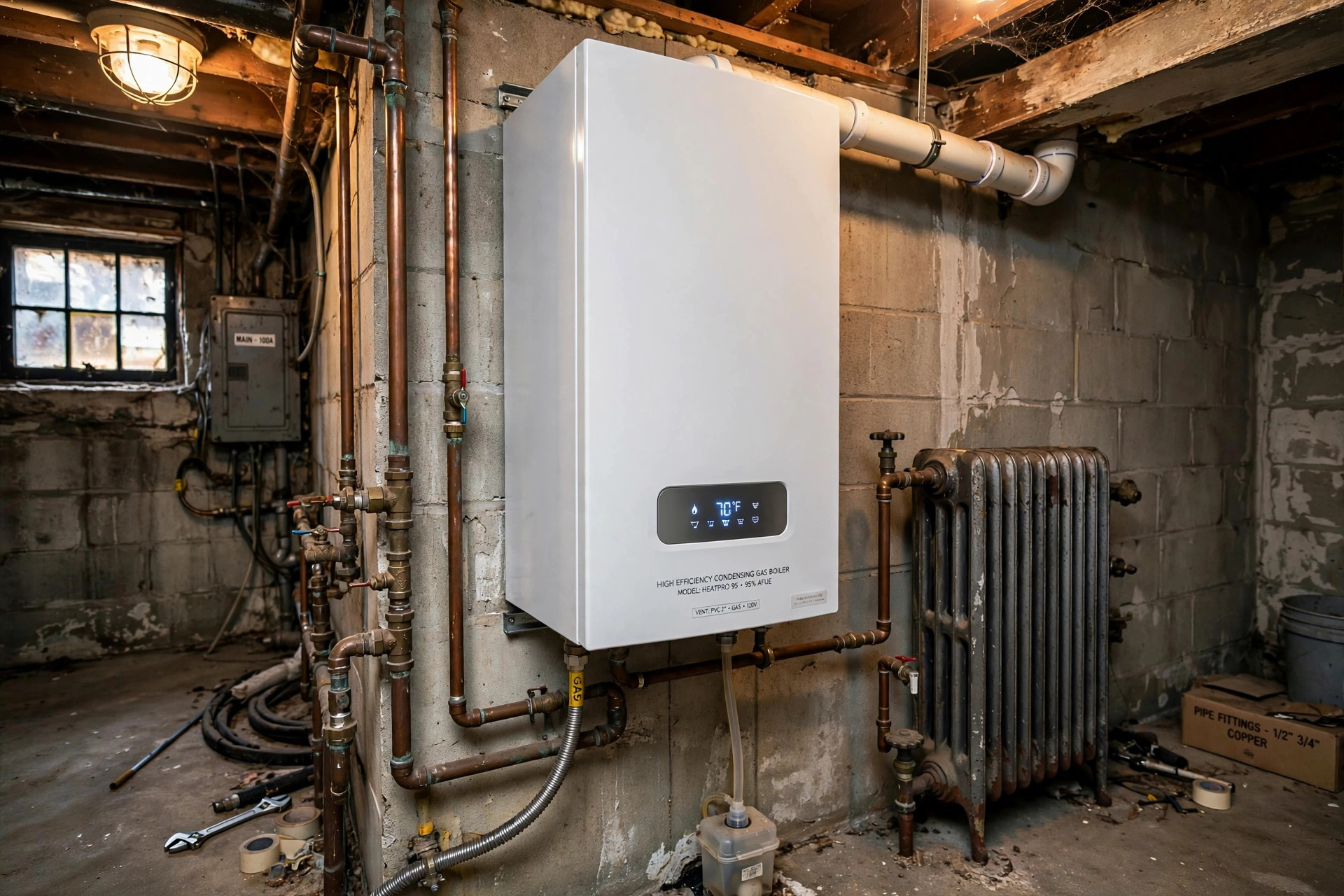
A modern gas boiler changes that picture. New condensing models reach ninety to ninety-eight percent efficiency. In a drafty old house, that difference can cut heating bills by hundreds of dollars a year. The new unit also runs quieter, takes up less space, and needs fewer repairs.
There is a safety reason too. Old boilers can develop cracked heat exchangers. That can let carbon monoxide into the home. A new unit, installed to current code, removes that risk. For these reasons, many owners of older homes find that the gas boiler installation cost for old house work pays for itself in fuel savings and peace of mind. Useful background on boiler brands and options appears on Rheem and Trane.
How to Choose the Right Boiler: Gas Boiler Installation Cost for Old House
Get the Size Right
Sizing is the most important decision. An oversized boiler wastes fuel. It turns on and off in short bursts, which wears parts out. An undersized boiler cannot keep the house warm on the coldest nights.
Do not simply match the old unit. Old boilers were often oversized on purpose. A good contractor performs a heat-loss calculation, often called a Manual J calculation. This measures the size of each room, the windows, the insulation, and the local winter temperatures. It gives the true heating load of the house. For most older homes between 1,500 and 2,500 square feet, a boiler of 80,000 to 150,000 BTU is common.
Pick the Efficiency Level
Boilers carry an AFUE rating, which stands for Annual Fuel Utilization Efficiency. It tells you how much of the gas becomes heat. Standard boilers run around eighty percent AFUE. Condensing boilers run at ninety percent or more.
Condensing units cost more up front. They also save more on fuel each year. In cold states with long winters, the savings often pay back the extra cost in five to eight years. If you plan to stay in the house for a decade or more, the high-efficiency unit is usually the better buy. Federal guidance on efficient heating is published by ENERGY STAR.
Check the Venting
Old boilers vented through a brick chimney. New condensing boilers often vent through a plastic pipe out a side wall. This is called direct venting. It is safer and more efficient. But it changes the job. The contractor must run new vent pipes and a condensate drain. That adds to the cost, especially if the boiler sits in a basement far from an outside wall.
Some older homes have chimneys in poor shape. In that case, a chimney liner may be required if the new boiler uses the chimney. A steel liner typically adds several hundred dollars. Your installer should inspect the chimney before giving a final price. Practical guidance for owners of old houses is available at This Old House.
Types of Gas Boilers for Old Houses
Conventional Boilers
A conventional boiler, also called a heat-only boiler, heats water for radiators and sends hot water to a separate storage tank. This design fits old homes well. Many old houses already have radiators and a tank. The installation is simple. The boiler itself is usually the cheapest type. The trade-off is size: you need room for the tank.
System Boilers
A system boiler has the pump and expansion vessel built into the unit. It still needs a hot water tank, but the system is more compact and simpler to install. It suits homes with more than one bathroom. It costs more than a conventional boiler but less than a combi.
Combi Boilers
A combi boiler provides heat and hot water from one unit with no tank at all. It saves a great deal of space. This is a big plus in older homes where the basement is tight. But a combi can only serve so much hot water at once. In a house with two bathrooms used at the same time, the shower may run lukewarm. For smaller old homes, a combi often works well. For larger ones, a system boiler is safer. A side-by-side comparison of options can be found in the guide on combi boiler vs tankless comparison usa.
Condensing vs. Non-Condensing
Almost all new boilers sold today are condensing models. They capture heat from the exhaust gases that older designs wasted. The law in many states now pushes toward condensing units. They cost more but run far cheaper. For an old house with high heating demand, condensing is almost always worth it.
Gas Boiler Installation Cost for Old House: Real Numbers
Now the heart of the question. The gas boiler installation cost for old house work in the United States in 2026 usually falls between $6,000 and $15,000. That covers the boiler, the labor, and the basic materials.
Here is how the range breaks down:
– Basic replacement, same location, conventional boiler: $6,000 to $9,000. This is the cheapest case. The old boiler comes out and the new one goes in its place. The pipes, vents, and gas line need little change. – Mid-range, condensing boiler with new venting: $9,000 to $12,000. Most old-house jobs land here. The crew installs a high-efficiency unit, runs new PVC vent pipes, adds a condensate drain, and updates the thermostat. – Complex job in a very old house: $12,000 to $15,000 or more. This happens when the chimney needs a liner, the gas line must be upsized, the radiators need new valves, or the boiler must move to a new spot.
Several things push the price up in old houses. Asbestos is one. Some old boiler insulation contains asbestos, and safe removal costs extra. Lead paint on old pipes can add work. Old electrical panels may need an upgrade to serve the new controls. Plaster-and-lath walls make running new pipe runs slow and costly.
Getting three written quotes is the best defense against overpaying. Each quote should list the boiler make and model, the AFUE rating, and exactly what work is included. Be wary of a quote far below the others. It may skip the chimney liner or the permit. Related price guides include boiler replacement cost near me 2026 and oil to gas boiler conversion cost usa.
What Affects the Price Most
Labor in your area. Installation labor varies widely by region. Work in the Northeast and on the West Coast costs more than in the Midwest or South. Expect labor to be about half the total bill.
The gas line. Old homes often have a small gas line sized for the old boiler. A new high-input boiler may need a larger line. Running a new gas line can add $500 to $1,500.
Radiator work. New boilers work best with modern thermostatic radiator valves. Replacing the old valves on each radiator adds $100 to $250 per radiator. It is money well spent, because it lets you control the heat room by room.
Permits and inspections. Most cities require a permit for a boiler swap. The fee is usually a few hundred dollars. A good contractor pulls the permit for you. Never skip it. The inspector checks the gas connections and venting, which protects your family.
Rebates and tax credits. Check current federal and state programs before you buy. High-efficiency boilers sometimes qualify for tax credits or utility rebates worth hundreds or even thousands of dollars. Details on qualifying equipment are listed by ENERGY STAR, and the U.S. Department of Energy explains home energy incentives at Energy.gov.
Care and Upkeep After Installation
A new boiler needs little care, but it does need some. Have it serviced once a year by a licensed technician. The tech cleans the burner, checks the vent, tests the safety controls, and checks the water pressure. Annual service costs about $150 to $300.
Between visits, keep an eye on the pressure gauge. Most systems run between twelve and fifteen psi when cold. If the pressure keeps dropping, there may be a leak. Bleed the radiators at the start of each heating season. Air trapped inside makes the top of the radiator cold while the bottom stays hot.
Condensing boilers produce acidic condensate that drains away through a small pipe. Make sure that drain stays clear. In very cold weather, an outside condensate pipe can freeze. Ask the installer to run it inside the house or insulate it well. Home repair guidance for this task is covered by the Family Handyman.
Water quality matters too. Old pipes carry rust and sludge. A magnetic filter on the return pipe catches that debris and protects the new boiler. Many installers now fit one as standard.
Safety Rules for Old Houses
Gas boilers are safe when installed and maintained well. But old houses need extra care.
First, install carbon monoxide detectors on every floor and near the bedrooms. Test them monthly. Carbon monoxide has no smell and no color. A detector is your only warning. The Carrier and Lennox sites both stress detector use in their heating safety guidance.
Second, never block the vents or the combustion air supply. Do not store paint cans, boxes, or old furniture against the boiler. It needs air to burn safely and room to cool.
Third, watch for the signs of trouble. A yellow or flickering burner flame, soot marks on the boiler case, or a strange smell can signal incomplete combustion. Turn the boiler off and call a technician at once.
Fourth, if your old boiler has asbestos insulation, do not touch it. Have it tested by a certified inspector. Asbestos removal must be done by licensed workers with proper gear.
Frequently Asked Questions
How long does a gas boiler installation take in an old house?
A simple swap takes one to two days. A complex job with new venting, a gas line upgrade, and chimney work can take three to five days. The contractor should give you a schedule in writing before work starts.
Can I install a gas boiler myself to save money?
No. Gas work requires a licensed professional in almost every state. A mistake with a gas line can cause a fire or an explosion. The permit, the inspection, and the warranty all depend on professional installation. The Goodman and Rheem warranty terms, for example, require licensed installation.
Should I repair my old boiler instead of replacing it?
If the boiler is under fifteen years old and the repair costs less than a third of a new unit, repair may make sense. If the boiler is over twenty years old, needs frequent fixes, or has a cracked heat exchanger, replacement is the wiser choice. An honest technician will tell you which applies.
Will a new boiler work with my old radiators?
Yes. Modern boilers work fine with cast iron radiators. In fact, radiators are ideal for condensing boilers because they run at lower water temperatures, which lets the boiler condense more and save more fuel. You do not need to replace the radiators.
Does a new boiler add value to an old house?
It usually does. Buyers of older homes worry about heating costs. A new high-efficiency boiler with a warranty is a strong selling point. It may not add the full installation cost to the sale price, but it helps the home sell faster and avoids price cuts for an old heating system.
How much can I save on fuel with a new boiler?
Moving from a sixty-five percent efficient boiler to a ninety-five percent efficient model can cut fuel use by roughly a third. In a cold climate with $2,000 annual gas bills, that means about $600 to $700 saved each year. The exact figure depends on fuel prices and the winter.
A Short Final Word
The gas boiler installation cost for old house projects is higher than a simple swap in a new home. Old houses ask for extra care: the chimney, the gas line, the radiators, and the permits. But the payoff is real. You get a warm house, lower bills, and a safe system built to modern codes. Get three quotes, choose the right size, and pick a licensed contractor with old-house experience. Your home has lasted a hundred years. Give it a heating system that will carry it through the next thirty.
References
Carrier. (n.d.). Heating and cooling systems. https://www.carrier.com ENERGY STAR. (n.d.). Energy efficient products. https://www.energystar.gov Family Handyman. (n.d.). DIY home repair and maintenance. https://www.familyhandyman.com Goodman. (n.d.). Heating and cooling equipment. https://www.goodmanmfg.com Lennox. (n.d.). Heating and cooling systems. https://www.lennox.com Rheem. (n.d.). Heating, cooling, and water heating. https://www.rheem.com This Old House. (n.d.). Home renovation guidance. https://www.thisoldhouse.com Trane. (n.d.). Heating and air conditioning. https://www.trane.com U.S. Department of Energy. (n.d.). Energy efficiency and renewable energy. https://www.energy.gov
Was this guide helpful?

About James Carter
The My Garden US editorial team writes practical, in-depth home and garden guides for American homeowners — tested advice, no fluff.
You May Also Like

Smokeless Fire Pit Reviews 2026 USA: What the Reviews Say and How to Choose
April 28, 2026 0 views
Best Portable Humidifier for Bedroom USA: A Simple Buying Guide
August 19, 2026 0 views
Garage Insulation Kit for Metal Doors USA: A Plain Guide for Homeowners
January 3, 2026 0 views