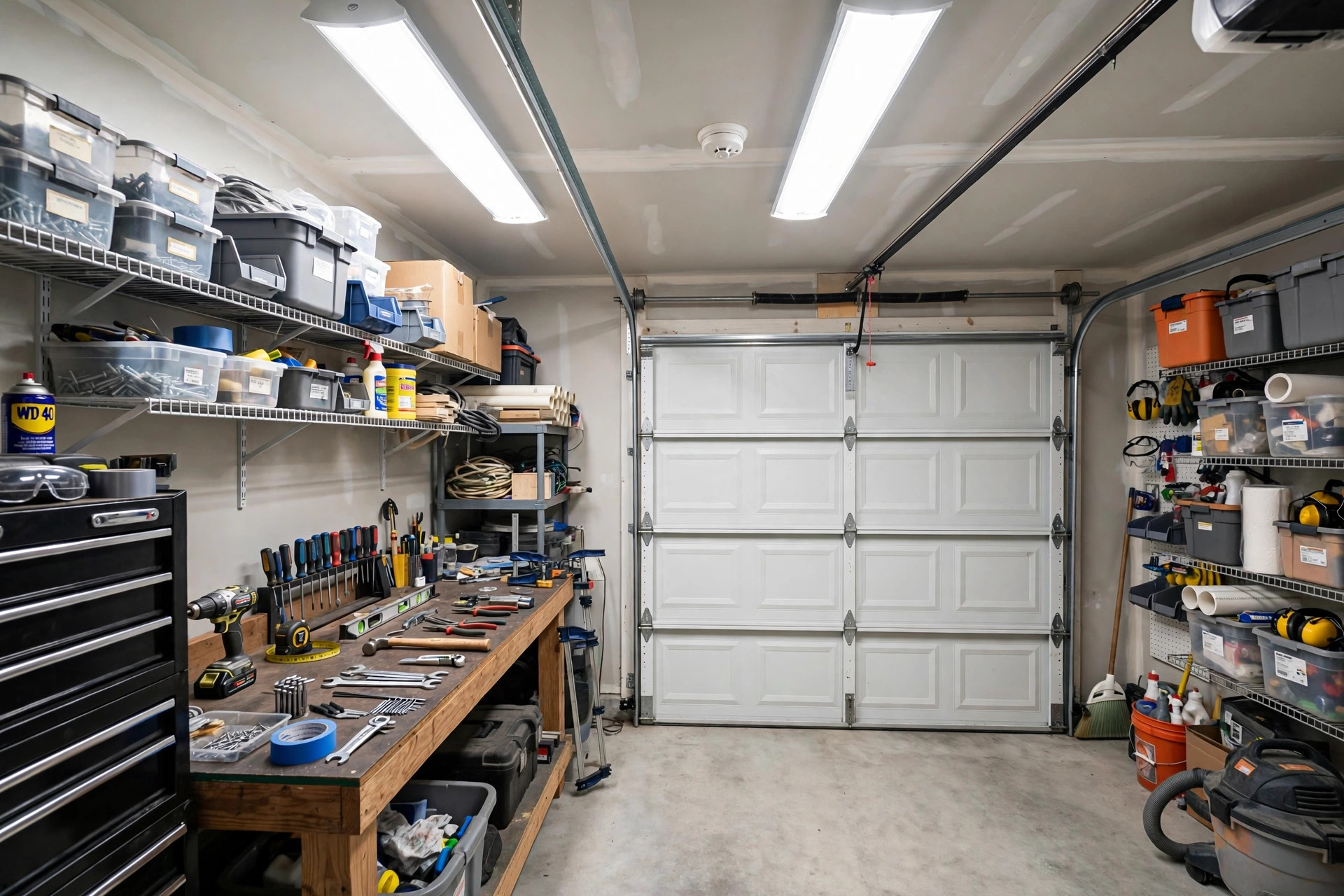

This garage shop lights reviews buying guide usa will help you pick the right lights for a garage or home workshop. Good light makes work easier. It also makes a garage safer. This guide explains what matters most when you read reviews and shop for fixtures. It covers brightness, color, types, cost, care, and safety. By the end, you will know how to choose with confidence.
Why Good Garage Lighting Matters
Most garages start with one bare bulb. That bulb hangs from the ceiling. It throws hard shadows. Corners stay dark. The work bench looks dim. This is not good enough for real work.
Good shop lights change the whole space. A garage becomes a place where you can see fine detail. You can read small print on parts. You can spot a leak or a crack. You can work after dark without strain on your eyes.
There is also a safety side. Dark corners hide tripping hazards. A cord on the floor can cause a fall. Sharp tools are harder to handle in poor light. Bright, even light lowers the risk of accidents. Families with kids gain from this too. Children play in garages and driveways. Good light helps everyone see where they walk.
Reviews help because shoppers share real results. They tell how bright a light felt in a real garage. They note if the light buzzed or flickered. They report how long the install took. A buying guide collects these facts in one place. It saves hours of research.
How to Choose the Right Shop Light: Garage Shop Lights Reviews Buying Guide Usa
The best light for your garage depends on size, use, and wiring. Think first about how you use the space. A parking garage needs less light than a full workshop. A wood shop needs bright light at bench height. Read on for the main points to check.
Lumens and Brightness
Lumens measure how much light a fixture gives off. More lumens means more light. A basic two-car garage often needs about 8,000 to 15,000 lumens in total. A working shop may need 20,000 or more.
Reviews are useful here. Shoppers often say if a light felt bright enough. They may say a four-foot LED fixture lit a whole bay. Trust these real reports more than claims on a box. Check the rated lumens too. The number is printed on the package. Compare it with other models at a similar price.
Note that lumens alone do not tell the full story. A fixture with good lens design spreads light wide. A poor lens makes hot spots and dark zones. This is another point where user reviews help. Look for words like “even coverage” in reviews.
Color Temperature
Color temperature is measured in Kelvins. It tells whether light looks warm or cool. For garages and shops, most buyers pick 4,000K to 5,000K. This range looks like daylight. It makes colors look true. Paint, wood grain, and wires are easy to tell apart.
Warm light around 3,000K feels cozy. It suits living rooms. In a workshop it can feel dull. Very cool light above 6,000K can look harsh. Many reviewers warn against it for long work sessions. It can tire the eyes.
Pick 4,000K for a mix of work and storage. Pick 5,000K for a pure workshop. This choice is common in buyer guides across the country.
Fixture Types and Mounting
Shop lights come in several shapes. The most common is the four-foot or eight-foot tube style. It mounts to the ceiling or hangs on chains. Many new models use built-in LED boards instead of replaceable tubes. They are thin and light.
High bay fixtures suit tall garages. They hang from a cord and give strong light in a wide circle. Wraparound fixtures have a plastic cover that softens the light. Flush mount panels give a clean look for finished garages.
Check how a light mounts before you buy. Chain mounts fit open ceilings with joists. Surface mounts fit drywall ceilings. Some lights plug into a standard outlet. Others must be hard wired to a switch. If you are not sure about wiring, pick a plug-in model. You can find clear wiring help from guides at Family Handyman and Bob Vila.
Types of Garage Shop Lights
LED Shop Lights
LED shop lights are the top pick in most reviews. They use far less power than old fluorescent tubes. They turn on at full brightness right away. They do not flicker in the cold. Cold garages are common in northern states. Fluorescent tubes struggle there. LEDs do not.
LED fixtures last a long time. Many are rated for 30,000 to 50,000 hours. That can mean ten years or more of normal use. They also run cool. This is safer near wood dust and paint fumes.
Fluorescent Shop Lights
Fluorescent tubes were the standard for decades. They are cheap to buy. They give decent light. But they have clear weak points. They use more power than LEDs. They fade over time. They hum and flicker as they age. The bulbs contain mercury, so old tubes need special disposal.
Some shoppers still buy them for very low upfront cost. Over time, LED models win on power bills. Most new reviews point buyers toward LED.
High Bay and Wraparound Fixtures
High bay lights fit garages with ceilings above ten feet. They push light down in a wide cone. Reviews praise them for big open shops and barns.
Wraparound fixtures give soft, even light. The plastic lens hides the bright boards inside. This cuts glare. They are a good pick for garages that double as hobby rooms. You can read model specs and compare shapes at Lumens or Lamps Plus.
Linkable and Motion Sensor Models
Linkable shop lights connect in a row with short cords. One outlet can feed several lights. This is handy for long garages. Reviews often praise this feature for easy setup.
Motion sensor models turn on when you enter. They turn off after a set time. They save power and add safety at night. Some models add a battery backup. They stay on during a power cut. That feature gets high marks in reviews.
Cost and Price Guide
Prices vary by size, brand, and features. A basic four-foot LED shop light often costs between 25 and 50 dollars. A linkable pair or a high bay model can cost 60 to 120 dollars. Prices change with sales, so check current listings at The Home Depot and Lowe’s.
Look at cost per year, not just the price tag. An LED fixture uses far less power than an old fluorescent. Over five years, the savings on your power bill can top the extra cost. Reviews often mention this. Shoppers like the low running cost.
Do not judge by price alone. A very cheap light may flicker or fail early. Read the one-star and three-star reviews. They reveal real problems. Look for patterns. If many buyers report dead units in six months, skip that model. Guides like The Spruce and Consumer Reports also test lighting and share findings.
Plan the number of fixtures too. Two lights can serve a one-car garage. A two-car shop may need four to six. More fixtures at lower power beat one harsh light. The cost adds up, so budget before you shop.
Care and Upkeep
LED shop lights need little care. The boards do not need bulb changes. But dust still matters. A dusty lens blocks light. Wipe fixtures with a soft dry cloth once or twice a year. Cut power first for safety.
Check the mounts now and then. Chain hooks can loosen. Hanging fixtures should not sway much. Tighten screws once a year. Look at cords for wear. A cracked cord should be replaced. LED fixtures also benefit from clean power. Surges can shorten their life. A surge guard on the panel helps. If lights flicker when a tool starts, the circuit may be weak. An electrician can check this.
Outdoor rated fixtures need more care. Check seals for cracks. Water can shorten the life of a fixture. For general upkeep ideas, Philips and Energy.gov publish lighting care tips worth reading.
Keep a note of model numbers and purchase dates. If a unit fails under warranty, you will need proof of purchase. Most brands offer two to five years of coverage. Reviews often say how easy a brand made a warranty claim. That detail is worth noting.
Safety First
Electricity demands respect. Turn off the breaker before you wire any fixture. Test with a voltage tester. If you are not sure, hire an electrician. A bad wire job can start a fire.
Mind the heat rating of old fixtures. Some old shop lights run hot. Keep them clear of stored boxes and paint cans. LED models run cooler, but they still need air flow. Do not cover a fixture with cloth or boxes.
Check the rating for damp places. Garages can be damp. Look for a UL or ETL mark on the label. That mark shows the fixture met safety tests. Energy Star lists certified lighting products that meet set standards.
Mount lights so they do not glare into the street. A light aimed at a road can blind drivers. Aim fixtures down and in. This is good for neighbors and for safety.
If you plan to add lights to a full shop, review your circuit load. Too many lights on one circuit can trip the breaker. Spread fixtures across circuits when you can. Simple planning now avoids trouble later.
Frequently Asked Questions
How many lumens do I need for a two-car garage?
Most buyers find 10,000 to 20,000 total lumens work well. That is about four four-foot LED fixtures at 4,000 to 5,000 lumens each. Add more if you do fine work like wood or auto repair. Reviews often confirm these numbers for real garages.
Are LED shop lights better than fluorescent?
Yes, for most uses. LEDs use less power. They start at full brightness in the cold. They last longer and run cooler. Fluorescents cost less upfront, but LEDs win over time on power and life.
What color temperature is best for a garage shop?
Most reviewers pick 4,000K to 5,000K. This daylight look shows true colors. It suits bench work, tools, and paint matching. Avoid very warm or very cool light for long work sessions.
Can I install shop lights myself?
Plug-in models are simple for most adults. You mount the fixture and plug it in. Hard wired models need basic wiring skill. If you doubt your skill, call an electrician. Safety comes first.
Do shop lights work in cold garages?
LED shop lights work well in the cold. They reach full brightness at once. Old fluorescent tubes dim and flicker in cold air. This is one reason buyers switch to LED. Check the rating on the box for cold use.
How long do LED shop lights last?
Many are rated for 30,000 to 50,000 hours. With a few hours of use per day, that is many years. Real life varies with brand, heat, and power quality. Read warranty terms before you buy.
A Short Final Word
The right garage shop lights make work brighter and safer. Start with your garage size. Pick the lumens and color you need. Read real reviews with care. Compare a few models on price and warranty. Install with safety in mind. Do this, and your garage will serve you well for years.
If you are updating other rooms too, see our guides on kitchen track lighting reviews buying guide, sensor porch lights reviews buying guide, and motion flood lights reviews buying guide for more lighting help.
References
Bob Vila. (n.d.). Home improvement advice. https://www.bobvila.com Consumer Reports. (n.d.). Product reviews and ratings. https://www.consumerreports.org ENERGY STAR. (n.d.). Energy efficient products. https://www.energystar.gov Family Handyman. (n.d.). DIY home repair and maintenance. https://www.familyhandyman.com Lamps Plus. (n.d.). Lighting and home decor. https://www.lampsplus.com Lowe’s. (n.d.). Home improvement products. https://www.lowes.com Lumens. (n.d.). Lighting and ceiling fans. https://www.lumens.com Philips. (n.d.). Lighting products. https://www.philips.com The Home Depot. (n.d.). Home improvement products. https://www.homedepot.com The Spruce. (n.d.). Home and garden advice. https://www.thespruce.com U.S. Department of Energy. (n.d.). Energy efficiency and renewable energy. https://www.energy.gov
Was this guide helpful?

About Lisa Anderson
The My Garden US editorial team writes practical, in-depth home and garden guides for American homeowners — tested advice, no fluff.
You May Also Like
Kitchen Track Lighting: How to Find the Best USA Online Deals
July 9, 2026 0 views
Kitchen Island Pendants California Homes USA
July 21, 2026 0 views
Deck Cap Lights for California Homes in the USA
August 23, 2026 0 views