
A good yard does not go dark when the sun goes down. This guide to landscape spot lights texas homes usa explains how homeowners in the Lone Star State can light their yards with spot lights. It covers types, costs, placement, and safety. The aim is simple: help a homeowner make a sound choice.
Why Outdoor Lighting Matters for Texas Homes
Texas evenings are warm for much of the year. Families eat outside, sit on porches, and walk through gardens late into the night. A dark yard wastes all of that space. Light brings it back into use.
Spot lights also add safety. A lit walkway shows steps and edges. A lit driveway shows where cars and people are. Thieves prefer dark houses. Light makes a home a poor target.
Curb appeal matters too. A home that glows softly at night looks cared for. In Texas towns where home values rest on first impressions, night looks count. Spot lights can lift the whole face of a house.
There is a comfort angle as well. A yard that stays usable after dark extends the living space of the home. Children can play in the yard while parents watch from the porch. Guests feel welcome when the path to the door is clear. These small daily gains add up over years of living in the house.
Light also helps with security cameras. Most home cameras record better with some light in the scene. Spot lights aimed at key areas give cameras the detail they need. A camera that sees a face clearly is worth more than one that records shadows.
Finally, lighting sets mood. A few warm beams on trees and stone turn an ordinary yard into a place people want to linger. That feeling is hard to put a price on, but homeowners notice it every night.
What Landscape Spot Lights Do: Landscape Spot Lights Texas Homes Usa
A spot light sends a narrow beam of light in one direction. It points up at a tree, a wall, or a statue. It does not wash a wide area like a flood light. It picks out one thing and shows it off.
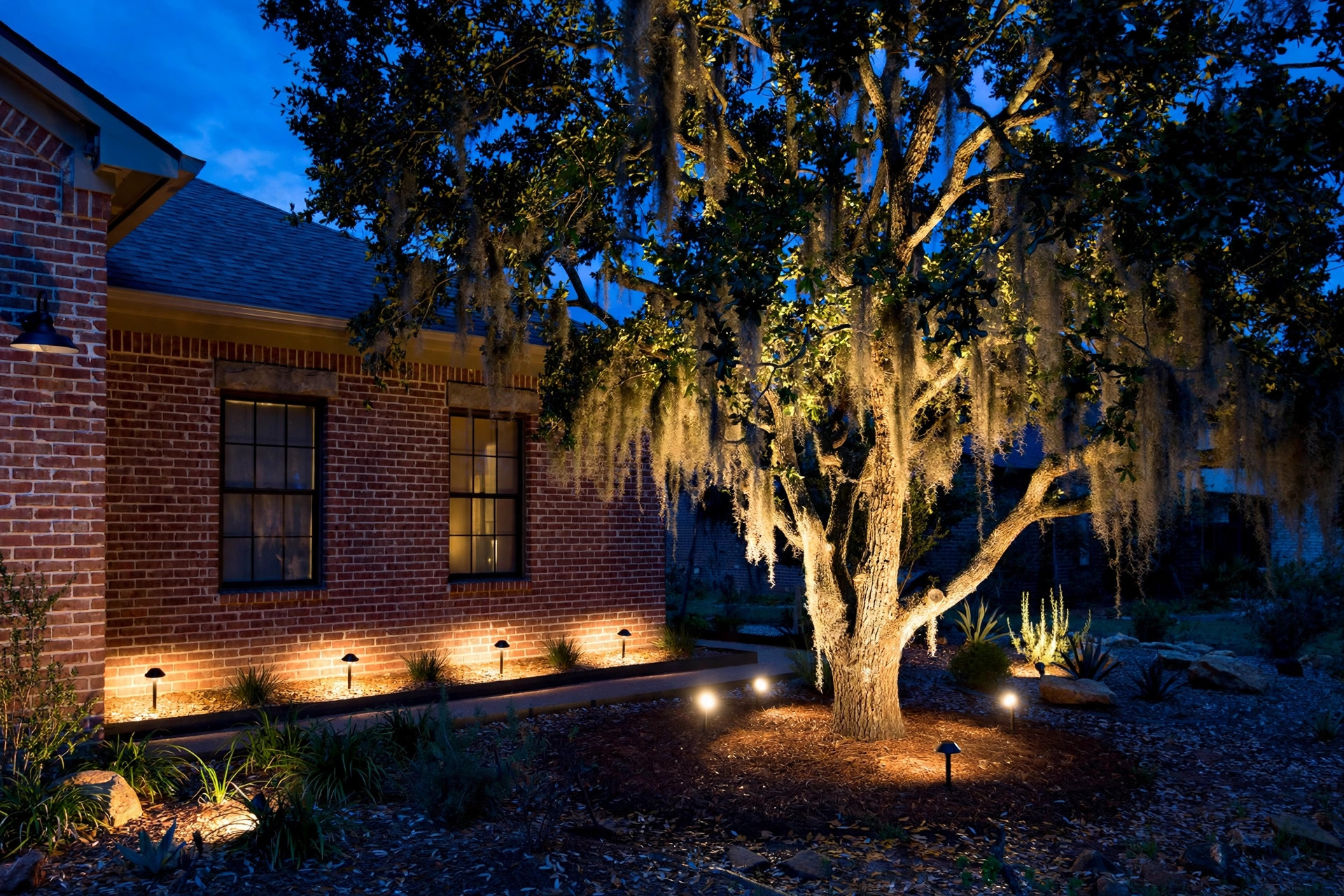
Most spot lights sit low in the ground or on a short stake. The light rises from below. This uplighting gives trees and columns a tall, proud look. It is the most common trick in landscape lighting.
How to Choose the Right Spot Lights
Brightness and Color
Brightness is measured in lumens. For most yards, 200 to 600 lumens per spot light is enough. A small bush needs less. A tall oak needs more.
Color temperature is measured in kelvin. Warm white, around 2700 to 3000 kelvin, looks best on brick, stone, and wood. It suits Texas homes. Cool white can look harsh and cold. Guides from ENERGY STAR explain how warm tones also use less energy than older bulbs.
Power Source
Wired low-voltage systems run on 12 volts. They are safe, steady, and bright. A transformer plugs into an outdoor outlet and feeds the lights. This is the most popular choice.
Solar spot lights need no wire at all. They charge by day and shine by night. They cost less to install. They are dimmer, and cloudy days cut their run time. They suit small jobs far from the house.
Build Quality
Texas weather is hard on outdoor gear. Summer heat bakes plastic. Storms bring hail. Look for metal housings, glass lenses, and sealed joints. A good fixture should last many years. Reviews and buying advice on Consumer Reports style sites can help, but for lighting, product pages at Lumens and Lamps Plus show build details worth comparing.
Types of Landscape Spot Lights
Wired Low-Voltage Spot Lights
These are the workhorses. A cable runs from the transformer to each light. The cable can sit just under mulch or soil. Voltage is low, so the work is safe for most handy homeowners. Output is strong and even.
Solar Spot Lights
These stake into the ground anywhere the sun reaches. No trench, no wire. They are the fastest way to add light. Their limits are brightness and run time. After a gray winter day, they may fade by midnight.
Line-Voltage Spot Lights
These use full household current. They are very bright and suit large estates. They need conduit, permits, and an electrician. Most homeowners in Texas never need this level.
Placement Ideas for Texas Yards
Start with the front of the house. Two or three spot lights aimed at the facade give it depth. Keep them a few feet from the wall so the beam spreads.
Trees are the next prize. One uplight at the base of a live oak turns it into a sculpture. Aim the beam up the trunk so it spreads into the canopy.
Texas yards often have native stone, stucco, or cedar fences. Grazing light across a stone wall shows its texture. Place the light close to the wall and aim it up at a sharp angle.
Do not light every plant. Restraint looks better. Pick three or four features and light them well. The eye needs dark spots to rest on.
Think about sight lines from inside the house. The views from the kitchen window and the living room matter most. A tree lit for the street is nice, but a garden bed lit for the breakfast table is used every day. Walk through the house at night and note what each window faces.
Layer the heights. A low uplight on a shrub, a mid-level light on a small tree, and a tall beam on an oak give the yard depth. Flat lighting, all at one height, looks dull. Vary the angles as well. Cross-lighting from two sides shows texture better than one beam head on.
Front yards and back yards play different roles. The front is for the street and for welcome. Keep it tidy and even. The back is for living. There you can be bolder, with light on a patio, a fountain, or a favorite tree.
Paths and steps need their own care. Spot lights are for showing things off, not for walking light. Pair them with a solar path lights buying guide plan or low bollard lights along walks so no one trips in the dark.
Cost and Price Range
A single solar spot light costs about five to twenty dollars. A single low-voltage LED spot light costs about twenty to eighty dollars. Brass and copper fixtures cost more but last longer.
A full low-voltage kit with six lights and a transformer often runs from one hundred to four hundred dollars. Shoppers at The Home Depot and Lowe’s can compare many such kits side by side.
Professional installation adds cost. A landscaper may charge several hundred dollars for design and wiring. Many Texas homeowners do it themselves in a weekend.
Get two or three quotes if you hire out. Prices vary widely between firms. Ask what brand of fixtures they use and how long the work is guaranteed. A one-year warranty on parts and labor is common.
Running costs are small. LEDs use little power. A dozen low-voltage LED spot lights may add only a few dollars a month to the electric bill.
Replacement parts are cheap too. A new LED bulb or a new stake costs a few dollars. Keep one spare fixture on hand so a dead light never leaves a dark gap for long.
Over ten years, a well-built system costs less than most homeowners expect. The fixtures are the main outlay. Power and upkeep are minor. Compared with other home upgrades, landscape lighting gives strong value for the money.
Installation Basics
Plan on paper first. Mark each light, each tree, and each wall. Decide where the transformer will sit. Keep it near an outdoor outlet and out of standing water.
Lay the cable on top of the soil first. Test every light at night before burying anything. Move lights until the look is right. Only then tuck the cable under mulch.
Connections matter. Use waterproof wire nuts or the connectors sold for landscape cable. A bad joint will fail in the first heavy rain. Texas storms test every weak point.
Set a timer or a dusk-to-dawn sensor. Lights that burn all night waste money and annoy neighbors. Aim for dusk until about midnight on most nights.
Care and Upkeep
Clean the lenses a few times a year. Dust and lawn clippings dim the beam. A damp cloth is enough.
Trim plants that grow into the beam. A bush that swallows a spot light wastes its output.
Check stakes after storms. High wind can knock fixtures over. Reset them and re-aim the beam.
LED bulbs last for years. When one finally dies, match the color temperature of the rest. A single cool bulb among warm ones will stand out.
Re-aim lights once a year. Soil settles and stakes shift. A beam that crept off target over months will look wrong even if the bulb is fine. Take a night walk each spring and adjust.
Check the transformer seasonally. Make sure vents are clear of leaves and nests. A transformer that runs hot will fail early. Most units sit for years with no care, but a quick look costs nothing.
After a hailstorm, inspect lenses for cracks. A cracked lens lets water in. Replace the lens or the fixture before the next rain.
Safety
Keep lights clear of dry grass and mulch in drought season. Texas summers bring fire risk. LED fixtures run cool, but keep heat away from dry fuel.
Do not aim spot lights into a neighbor’s windows or at the street. Bright beams blind drivers. Many Texas towns have rules about light trespass. Check local codes before a big install.
Call 811 before digging any trench, even a shallow one. Utility lines run closer to the surface than most people think. The call is free.
For electrical work beyond low voltage, hire a licensed electrician. Water and household current are a poor mix.
Pairing Spot Lights With Other Outdoor Lights
Spot lights do their best work as part of a team. Outdoor wall lanterns by the front door give a warm welcome. Patio string lights make a back deck feel festive. The U.S. Department of Energy’s Energy Saver pages and the outdoor guides at The Spruce both stress layering: task light where you walk, accent light where you look. Philips also publishes outdoor lighting ideas that show how uplights, path lights, and wall lights work together.
Frequently Asked Questions
How many spot lights does a Texas home need?
Most homes need six to twelve. Start with the facade, two trees, and one garden bed. Add more only if dark corners remain.
Will spot lights raise my electric bill much?
Not by much. LED spot lights use three to seven watts each. Ten of them cost about as much to run as one old porch bulb.
Do solar spot lights work in Texas heat?
Yes, and Texas sun is ideal for them. Heat itself does not stop them. Short winter days and shaded spots are the real limits.
What color light suits a brick Texas home?
Warm white at 2700 to 3000 kelvin. It flatters red brick, limestone, and stucco. It also feels welcoming.
Can I leave spot lights on all night?
You can, but a timer is wiser. Dusk to midnight covers the useful hours. All-night light wastes power and can bother wildlife.
Are landscape spot lights safe around kids and pets?
Yes. Low-voltage fixtures stay cool and carry only 12 volts. Solar lights carry even less. Keep cords buried so no one trips.
A Final Word
Landscape spot lights texas homes usa is not a hard project. Pick warm LEDs, light a few features well, and keep the wiring tidy. A weekend of work gives a yard that shines for years. Texas nights are too good to spend in the dark.
References
Consumer Reports. (n.d.). Product reviews and ratings. https://www.consumerreports.org ENERGY STAR. (n.d.). Energy efficient products. https://www.energystar.gov Lamps Plus. (n.d.). Lighting and home decor. https://www.lampsplus.com Lowe’s. (n.d.). Home improvement products. https://www.lowes.com Lumens. (n.d.). Lighting and ceiling fans. https://www.lumens.com Philips. (n.d.). Lighting products. https://www.philips.com The Home Depot. (n.d.). Home improvement products. https://www.homedepot.com The Spruce. (n.d.). Home and garden advice. https://www.thespruce.com U.S. Department of Energy. (n.d.). Energy efficiency and renewable energy. https://www.energy.gov
Was this guide helpful?

About Jennifer Lee
The My Garden US editorial team writes practical, in-depth home and garden guides for American homeowners — tested advice, no fluff.
You May Also Like
Vanity Light Bars Texas Homes USA: A Complete Buying Guide
June 16, 2026 0 views
Ceiling Fans Lights Deals Near Me: How to Find the Best Ones
August 18, 2026 0 views
Vanity Light Bars for Florida Homes USA: A Complete Guide
June 15, 2026 0 views