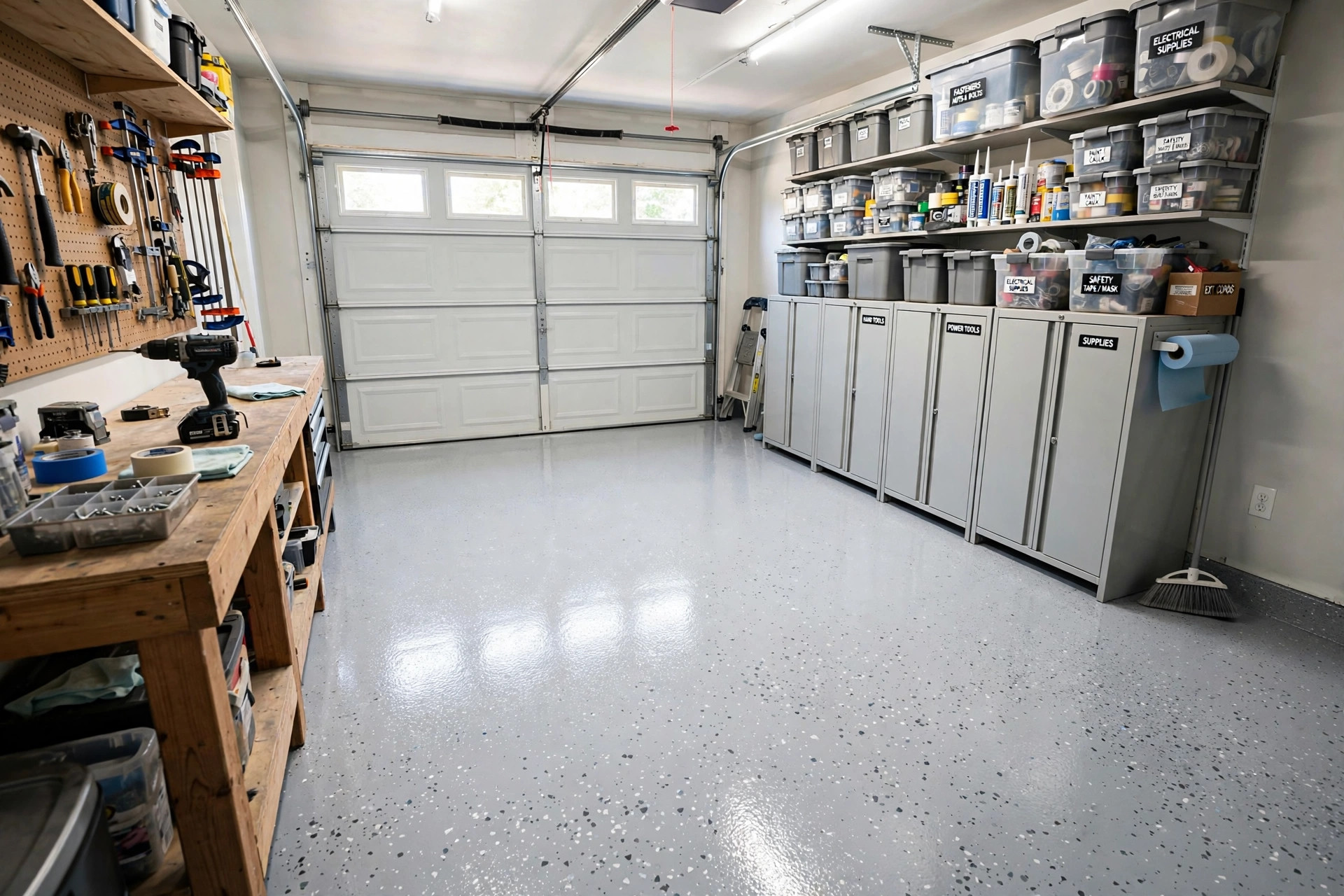

A bare concrete garage floor takes a beating every day. Hot tires roll across it. Oil drips onto it. Road salt eats into it through the winter. Over time the surface turns gray, dusty, and stained. Garage floor epoxy coating kit reviews USA homeowners read can point them toward a fix that is both tough and good looking. An epoxy kit turns a tired slab into a hard, glossy floor that wipes clean in minutes.
But not every kit performs the same. Some kits bond well and last ten years. Others peel within a year. That is why reading reviews matters. This guide walks through what reviews say, how the kits work, what to look for when you buy, what they cost, and how to apply them for a lasting result.
Why an Epoxy Coating Makes Sense
Concrete is porous. It drinks in every spill. Motor oil, brake fluid, and antifreeze sink into the surface and leave dark stains that never come out. In cold states, meltwater mixed with road salt works into tiny cracks and breaks the surface apart over time. A sealed epoxy layer blocks all of this. Liquid sits on top instead of soaking in, so a quick wipe with a paper towel handles most spills.
Reviews also praise the look. A plain gray floor becomes a smooth, even surface with a slight shine. Many kits include decorative color flakes that give the floor a speckled finish like stone. A clean floor can make the whole garage feel larger and brighter, which helps when the garage doubles as a workshop or storage space.
Durability is the other big reason. A good epoxy bond can hold up under parked cars, heavy tool chests, and rolling jacks. Reviews of two-part epoxy kits often mention that the floor still looks new after several years of daily use. That kind of record is hard to find with plain concrete paint, which tends to chip under hot tires.
If your project extends below the house, you may want to compare notes with our roundup of basement floor epoxy kits for sale as well, since many of the same rules apply underground.
What to Look for in a Kit: Garage Floor Epoxy Coating Kit Reviews Usa
Reviews agree on a few points that separate good kits from weak ones. The first is the solids content. Epoxy kits are sold as 100 percent solids, water based, or solvent based. A 100 percent solids epoxy goes on thick and builds a strong film. Water based kits are thinner, easier to apply, and smell less, but they lay down a thinner coat. Many long term reviews say the thicker products hold up better under cars.
The second point is coverage. Most one-car garage kits cover 200 to 250 square feet. A two-car garage usually needs a two-car kit or two one-car kits. Shoppers who try to stretch one kit over a larger floor often report thin spots and early wear. Measure your floor first. Buy enough to lay the film at the thickness the label calls for.
Third is the prep requirement. No epoxy sticks to dirty concrete. Reviews of failed jobs almost always trace back to poor prep. The best kits include or call for a concrete etcher or degreaser. Some reviewers suggest renting a concrete grinder for the best bond, though a thorough etch works well for most home garages. Look for a kit whose instructions are clear about prep. Confusing or thin instructions are a warning sign.
Fourth is the working time. Two-part epoxy starts to harden once you mix the resin and hardener. Many kits give 60 to 90 minutes of working time at room temperature. In a hot garage that window shrinks. Reviews often advise working with a partner so one person rolls while the other cuts in along the edges. Helpful guidance from sites like This Old House stresses the same point: plan the work before you open the cans.
Types of Garage Floor Epoxy Kits
Two-Part Water Based Epoxy
This is the most common kit on store shelves. It mixes a resin and a hardener, thins with water for easy rolling, and cleans up with soap and water. The smell is mild, which matters in an attached garage. Coverage per kit is fair. Reviews say it goes on smoothly and looks good for the first year or two. Under heavy car traffic, though, it may show wear sooner than thicker epoxies.
100 Percent Solids Epoxy
This is the professional grade choice. There is no water or solvent to evaporate, so what you roll on stays on the floor. The film builds to several times the thickness of a water based coat. Reviews from serious do-it-yourselfers say this is the closest a homeowner can get to a contractor installed floor. The trade off is a stronger odor during application and a shorter working time. It also costs more. For a garage that holds two cars and a workbench, many reviewers call it worth the price.
Epoxy with Polyaspartic Topcoat
Some kits pair an epoxy base coat with a polyaspartic clear topcoat. Polyaspartic cures fast, sometimes in a few hours, and resists yellowing in sunlight better than plain epoxy. Reviews note that this combo handles hot tire pickup very well. The catch is that the fast cure leaves little room for error. Reviewers recommend this type for experienced painters or for shoppers who have a helper.
Concrete Stain and Sealer Kits
These are not true epoxy, but they appear in the same reviews. A stain adds color to the concrete, and a sealer locks it in. The finish is thinner and less tough than epoxy. Reviews say it works fine for a garage used mainly for storage. If you plan to park cars on it daily, true epoxy gets better marks.
What the Reviews Say About Top Brands
Across retailer and review sites, a few names come up again and again. Products sold through Home Depot and Lowe’s draw the largest number of reviews, which makes patterns easier to spot. Water based kits from mainstream paint brands earn praise for easy application and clear instructions. Brands like Behr show strong ratings for color and finish, though some long term reviews note wear under heavy use.
Specialty floor coating brands sold online draw fewer but often more detailed reviews. These tend to be 100 percent solids products. Reviewers who bought them often compare them directly with the store brands they used before. The common report is a thicker film, a harder cure, and better resistance to chemicals. The common complaint is price and the need for careful mixing.
Paint makers with deep coating lines, such as Sherwin-Williams and Benjamin Moore, also sell floor systems worth a look. Their reviews tend to stress surface prep and proper application, which matches the trade advice on Bob Vila.
Decorating sites such as HGTV and The Spruce add design context, with photo galleries of finished garage floors that help shoppers picture the result. If you are also dressing up the walls, our notes on the best paint for pegboard in the garage pair well with a fresh floor.
Cost and Price Ranges
Kit prices vary widely. A basic one-car water based kit often sells for 80 to 150 dollars. A two-car kit of the same type runs 150 to 250 dollars. Move up to 100 percent solids epoxy and a two-car kit can cost 300 to 500 dollars. Kits with a polyaspartic topcoat sit at the top of the range, often 400 to 600 dollars for a two-car garage.
Those prices cover the coating only. Budget extra for prep supplies if the kit does not include them. A gallon of concrete degreaser runs 15 to 25 dollars. Etching solution costs about the same. Crack filler for damaged spots adds 10 to 20 dollars. Painter tape, rollers, and spiked shoes for walking on wet epoxy add another 30 to 50 dollars. Reviewers often say the extras are worth it, since skimping on prep is the fastest way to waste the kit.
Compared with hiring a contractor, the kits are a bargain. A professional epoxy floor install often costs 3 to 12 dollars per square foot, which puts a two-car garage at 1,200 to 4,800 dollars. A kit does the same area for a few hundred dollars plus a weekend of labor. Reviews of do-it-yourself jobs that were prepped well often say the result rivals hired work.
How to Apply a Kit Step by Step
Reviews agree that the method matters as much as the material. Here is the process that successful reviewers describe.
First, clear the garage completely. Sweep out all dirt and dust. Second, degrease the floor. Scrub oil spots with a concrete degreaser and rinse well. Third, etch the concrete. Spread the etching solution, scrub with a stiff broom, and rinse until the water runs clear. The surface should feel like fine sandpaper. Fourth, let the floor dry fully. Most labels call for 24 hours. Do not rush this step.
Fifth, fix cracks and pits with concrete patch and let it cure. Sixth, tape off the walls and the driveway edge. Seventh, mix the epoxy exactly as the label says. Measure the parts. Mix for the full time the label calls for. Eighth, cut in the edges with a brush, then roll the main area in small sections. Ninth, broadcast the color flakes while the epoxy is wet, tossing them upward so they fall evenly. Tenth, stay off the floor for the cure time on the label, often 24 hours before foot traffic and 72 hours before cars.
Temperature matters. Most kits want the floor and the air between 50 and 80 degrees. Too cold and the epoxy will not cure. Too hot and it hardens before you finish rolling. Reviewers in warm states often start early in the morning to beat the heat.
Care and Upkeep
An epoxy floor is easy to keep. Sweep or dust mop it weekly. Mop with a mild cleaner and water when it looks dull. Avoid harsh acids and strong solvents for routine cleaning, since they can dull the gloss over time.
Place a mat under a motorcycle kickstand or under jack stands to spread the load. In snowy states, rinse off road salt residue in the spring. Many reviewers report that a yearly wash keeps the floor looking close to new. If a small chip appears, most brands sell touch up kits. Fix chips early so moisture cannot get under the coating.
Safety Notes
Work with the garage door open and a fan running. Even low odor kits release fumes while curing. Wear chemical resistant gloves, eye protection, and a respirator rated for organic vapors when working with 100 percent solids or solvent based products. Keep children and pets out of the garage until the floor has fully cured.
Wet epoxy is very slippery. Wear spiked shoes made for the job rather than walking in boots. Store leftover hardener and resin out of reach of children, and never pour leftovers down a drain.
FAQ
How long does a garage floor epoxy kit last?
With good prep and normal car traffic, a quality kit lasts five to ten years. Thicker 100 percent solids epoxies tend to reach the top of that range. Thin water based coats may show wear in three to five years under heavy use. Reviews of long lasting jobs almost always mention careful prep.
Can I apply epoxy over an old painted floor?
Only if the old paint is sound and well bonded. Loose or peeling paint must come off first. Most reviewers recommend grinding or stripping a failing old coating down to bare concrete before starting. Epoxy bonds best to clean, etched concrete.
What is hot tire pickup and how do I avoid it?
Hot tire pickup is when warm tires soften a coating and lift it off the floor. It is the most common complaint in negative reviews. Thicker epoxies and polyaspartic topcoats resist it best. Full cure time matters too. Wait the full 72 hours, or longer in cool weather, before parking on the new floor.
Do I need to etch new concrete?
New concrete must cure before coating, usually 28 days. After that, even smooth new slabs need etching or grinding so the epoxy can grip. Reviewers who skipped this step on new concrete often report peeling within the first year.
Can I do this project alone?
It is possible for a one-car garage, but reviewers strongly suggest a helper for larger floors. One person can mix and cut in while the other rolls. The working time is short, and an extra set of hands keeps the wet edge moving.
How does epoxy compare with concrete paint?
Epoxy forms a chemical bond and cures into a hard plastic film. Concrete paint is a surface film that sits on top. Reviews consistently rate epoxy higher for garages that see cars, chemicals, and heavy tools. Paint costs less and works for light duty storage spaces.
A Short Final Word
Garage floor epoxy coating kit reviews USA shoppers write tell a clear story. The kits work well when the concrete is clean, dry, and etched, and when the shopper buys enough product for the space. Pick the type that fits your garage: water based for light use, 100 percent solids for daily car traffic, and a polyaspartic topcoat for the toughest duty. Read the reviews for the exact kit you plan to buy, since small differences in instructions matter. And if your research takes you to the roof next, see our look at metal roof paint coating reviews for a similar buyer guide. A weekend of careful work buys you years of a clean, hard, good looking floor.
References
Behr. (n.d.). Paints, primers, and stains. https://www.behr.com Benjamin Moore. (n.d.). Paints and stains. https://www.benjaminmoore.com Bob Vila. (n.d.). Home improvement advice. https://www.bobvila.com HGTV. (n.d.). Home and garden ideas. https://www.hgtv.com Lowe’s. (n.d.). Home improvement products. https://www.lowes.com Sherwin-Williams. (n.d.). Paints and coatings. https://www.sherwin-williams.com The Home Depot. (n.d.). Home improvement products. https://www.homedepot.com The Spruce. (n.d.). Home and garden advice. https://www.thespruce.com This Old House. (n.d.). Home renovation guidance. https://www.thisoldhouse.com
Was this guide helpful?

About James Carter
The My Garden US editorial team writes practical, in-depth home and garden guides for American homeowners — tested advice, no fluff.
You May Also Like

Limewash Brick Fireplace Kit Reviews USA: What Homeowners Should Know
June 23, 2026 0 views
Best Paint for Basement Ceiling Exposed: A Complete USA Guide
June 13, 2026 0 views
German Schmear Brick Cost Near Me: Prices, Methods, and Tips
March 31, 2026 0 views