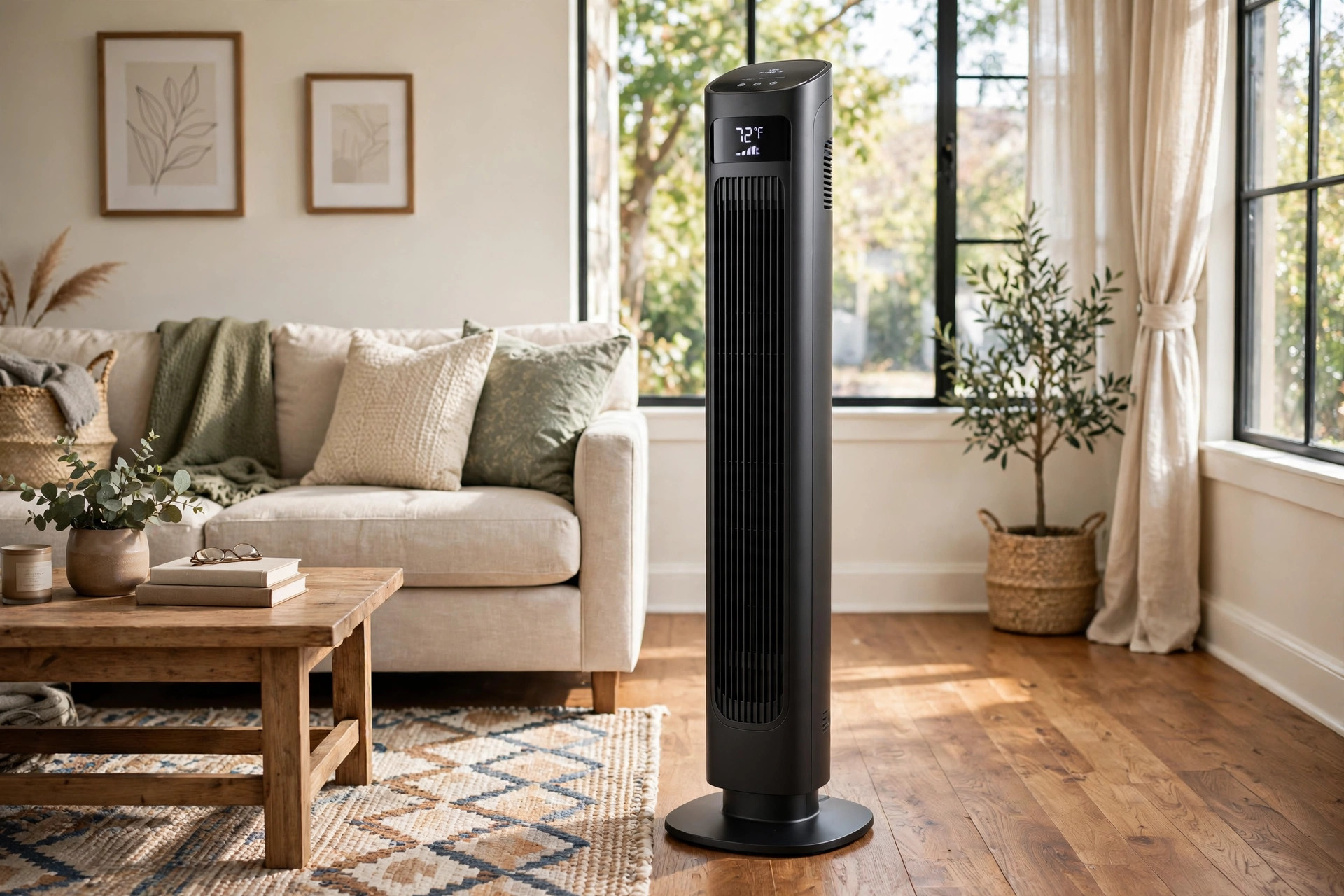

This dyson vs lasko tower fan comparison usa shoppers keep searching for is simpler than most reviews make it sound. Both brands sell well-known tower fans. Both move air across a room with a tall, narrow column that takes up little floor space. But they take different paths. Dyson is the premium maker of bladeless tower fans. Lasko is the value brand that has sold fans to American homes for more than a century. This guide puts the two side by side on design, air power, noise, safety, price, and long-term cost, so you can decide which one belongs in your home.
Why This Comparison Matters
A tower fan is a simple machine, but it runs for hundreds of hours each summer. In hot states such as Texas, Florida, and Arizona, a tower fan may run every night from May through September. A noisy fan steals sleep. A weak fan leaves a bedroom stuffy. A costly fan that adds little is money wasted. Buyers searching for a dyson vs lasko tower fan comparison usa want one honest answer: is the Dyson worth five to ten times the price of the Lasko?
The two brands serve different buyers. Dyson sells engineering and design. Its bladeless fans look like modern sculpture and carry features such as air purification and remote control. Lasko sells plain, reliable cooling at a price almost any household can afford. Neither approach is wrong. The right choice depends on your room, your budget, and what bothers you at night: heat, noise, or both.
Dyson Tower Fans: What You Get: Dyson vs Lasko Tower Fan Comparison Usa
Design and Build
Dyson tower fans are bladeless. Air passes through a hollow loop with no spinning blades on view. The body is tall and narrow, finished in clean nickel or blue tones. The build feels solid. Dyson fans often double as air purifiers with HEPA filters that trap dust and pollen. Many models include an LCD screen, a curved magnetic remote, night-time mode, and oscillation that can swing from 30 to 350 degrees.
Air Power and Noise
Dyson uses air multiplier technology. A small fan inside the base pushes air through a ring-shaped aperture, and surrounding air follows it. The result is a smooth stream of air with no choppy buffeting. The airflow feels steady rather than strong. Dyson fans are quiet on low settings. On high they still make sound, but the tone is soft and even. Owners of the best tower fan for bedroom reviews usa often list Dyson models among the quietest for sleep.
Safety
The bladeless loop is the clear safety win. There are no fast blades and no finger traps. Homes with small children or pets can place a Dyson at floor level without worry. The whole unit wipes clean with a dry cloth, since there are no grilles to trap dust.
Lasko Tower Fans: What You Get
Design and Build
Lasko tower fans look like tower fans. They are tall columns with visible grilles and spinning blades inside. Plastic bodies come in black or white. The build is light and simple. Most models include three speeds, oscillation, a timer, and a small remote. Higher models add an ionizer and a wide 60-degree oscillation. The design is not stylish, but it is honest and easy to use.
Air Power and Noise
Lasko fans push strong, direct air. For raw breeze per dollar, Lasko is hard to beat. A forty-two-inch Lasko tower can cool a medium bedroom well on its medium setting. The trade-off is noise. Lasko fans are louder than Dyson models at the same setting. On high they hum and whir. Light sleepers may find the sound keeps them awake, though some owners enjoy the steady white-noise hum.
Safety
Lasko fans have guarded blades. The grilles keep fingers out, but they are not as child-proof as a bladeless design. Cleaning takes more work. Dust gathers on the grilles and on the blades inside. Owners must take the fan apart or blow dust out with compressed air now and then.
What to Look For When You Shop
Before you pick a brand, check the basics. First, measure your room. A tower fan suits bedrooms and small living rooms up to about two hundred square feet. Bigger rooms need more than one fan or a different cooling method.
Second, check the height. Taller fans spread air over a wider area. A forty-inch tower cools a bed better than a thirty-inch model. Short towers work well on desks and side tables.
Third, think about noise ratings. Makers list noise in decibels, but the numbers are hard to trust. Read owner reviews instead. Look for words such as quiet, hum, and sleep. If reviewers argue about noise, the fan is probably loud.
Fourth, count the features you will actually use. Oscillation spreads air across the room. A timer lets the fan shut off after you fall asleep. A remote saves you from getting up at night. Night mode dims lights and lowers sound. Ionizers and purifiers help some buyers, but they add cost.
Fifth, check the warranty and the return policy. Fans are cheap to make, and a weak motor can fail in the first summer. A one-year warranty is normal. Buy from a store that takes returns, and test the fan on its first night home.
Head-to-Head: Dyson vs Lasko Tower Fan
Price and Long-Term Cost
This is where the two brands sit farthest apart. A Lasko tower fan usually costs between forty and one hundred dollars. A Dyson tower fan usually costs between four hundred fifty and seven hundred dollars. The Dyson also needs filter changes if it purifies air. Replacement filters add to the yearly cost. The Lasko has almost no upkeep cost beyond electricity.
Power use is close. Both brands draw modest power, far less than a window air conditioner. Running a tower fan instead of a room air conditioner can cut cooling costs in mild weather, a point raised by efficiency programs at ENERGY STAR and the U.S. Department of Energy. Neither fan will raise a power bill much.
Noise Levels
Dyson wins on quiet. Its bladeless flow makes a low, smooth sound. Lasko wins on nothing here except price, but its sound is steady and many sleepers mask it easily. For bedrooms and nurseries, quiet matters most. Parents often read the best bladeless fan for nursery reviews usa before they buy, because babies sleep through less than adults think.
Airflow and Coverage
Lasko moves more raw air per dollar. A mid-size Lasko can push a strong breeze across a twelve-by-twelve bedroom. Dyson airflow feels softer but reaches farther in a smooth sheet. Neither fan cools a whole house. For whole-house air movement, readers compare dedicated units in our window fan for whole house cooling reviews. A tower fan is a room fan. Put it near the person, not across the house.
Cleaning and Upkeep
Dyson is easier to clean. Wipe the loop and base with a cloth. Lasko needs grille and blade cleaning, which takes ten to fifteen minutes a few times per summer. Both brands ask owners to check the cord and plug each season. Maintenance advice from This Old House and The Family Handyman applies to any fan: keep vents clear, keep the unit level, and unplug it when you clean it.
Safety and Product Standards
Both brands sell listed, safety-tested products. Still, shoppers should check current product safety notices from the U.S. Consumer Product Safety Commission before buying any home appliance, especially if buying secondhand. Bladeless designs lower the risk for homes with toddlers and pets.
Which Should You Buy?
Buy the Lasko if you want strong cooling for little money. It cools a bedroom well, costs less than a dinner out, and lasts for years with basic care. It is the practical pick for college students, renters, guest rooms, and second bedrooms.
Buy the Dyson if quiet air, safety, and design matter to you, and the price fits your budget. It is the pick for light sleepers, homes with small children or pets, and rooms where the fan is on display all summer. The air-purifying models add real value in allergy season.
Buy neither and choose a ceiling or window fan if your main goal is whole-home air movement at the lowest cost. Independent testing summaries at Consumer Reports regularly note that fan type should match room size, not brand fame.
Care and Upkeep
Keep any tower fan clean and it will run for years. Dust the outside weekly during summer. Blow dust off blades and grilles monthly if your model has them. Change Dyson purifier filters on the maker’s schedule. Store the fan upright in a dry place for winter. Never run a fan with a frayed cord. Never block the air intake with curtains or laundry. These simple habits add years of life, a point heating and cooling makers like Carrier and Trane make about all home air equipment, not just furnaces and air conditioners.
Safety Notes
Fans are safe when used with care. Keep tower fans away from water. Do not run cords under rugs where they can overheat. Give the fan a few inches of clear space on all sides. Turn the fan off when you leave the room for long periods. Small children should not pull the fan over, so place light models against a wall. If a fan smells hot or sparks, unplug it at once and replace it. Makers such as Lennox, Goodman, and Rheem all stress yearly safety checks for home comfort gear, and a five-minute fan check each spring fits the same habit.
FAQ
Is a Dyson tower fan really worth the high price?
It is worth the price if you value quiet, bladeless safety, and modern design. It is not worth it if you only need a strong breeze in a bedroom. A forty-to-eighty-dollar Lasko cools a room nearly as well for a fraction of the cost.
Which is quieter, Dyson or Lasko?
Dyson is quieter. Its bladeless airflow makes a smooth, low sound. Lasko fans are louder, especially on high. Light sleepers usually prefer Dyson.
Do Lasko tower fans break down quickly?
No. Lasko fans are simple machines with few parts to fail. Many run for five to ten years. Clean them each summer and they last.
Do Dyson fans really purify the air?
The Dyson models with sealed HEPA filters do trap fine dust, pollen, and pet dander. Models without filters are fans only. Check the model name before you buy if purification matters to you.
Which fan is safer for homes with children?
Dyson, because of the bladeless design. A toddler cannot reach moving blades. Lasko fans are guarded and reasonably safe, but the bladeless loop is safer.
How much power does a tower fan use?
Most tower fans draw twenty to sixty watts, far less than a window air conditioner. Running one costs only a few cents per hour. If you use the fan each night all summer, the yearly power cost stays under twenty dollars either way, so electricity does not decide this race. The price gap sits entirely in the purchase price and, for Dyson purifying models, the filter cost.
Think about room count as well. One Dyson costs as much as five or six Lasko fans. A family cooling three bedrooms can outfit the whole house with Lasko towers for less than one Dyson. That math pushes most value shoppers toward Lasko, and many owners pair a Lasko tower with a box fan for strong cross-room airflow.
Final Word
This dyson vs lasko tower fan comparison usa ends where most honest comparisons end: both brands do their job, and the price gap buys quiet, safety, and style rather than more cooling. Pick Lasko for value. Pick Dyson for peace and quiet. Either way, keep the fan clean, give it clear space, and sleep cool.
References
Carrier. (n.d.). Heating and cooling systems. https://www.carrier.com Consumer Reports. (n.d.). Product reviews and ratings. https://www.consumerreports.org ENERGY STAR. (n.d.). Energy efficient products. https://www.energystar.gov Family Handyman. (n.d.). DIY home repair and maintenance. https://www.familyhandyman.com Goodman. (n.d.). Heating and cooling equipment. https://www.goodmanmfg.com Lennox. (n.d.). Heating and cooling systems. https://www.lennox.com Rheem. (n.d.). Heating, cooling, and water heating. https://www.rheem.com This Old House. (n.d.). Home renovation guidance. https://www.thisoldhouse.com Trane. (n.d.). Heating and air conditioning. https://www.trane.com U.S. Consumer Product Safety Commission. (n.d.). Product safety information. https://www.cpsc.gov U.S. Department of Energy. (n.d.). Energy efficiency and renewable energy. https://www.energy.gov
Was this guide helpful?

About Jennifer Lee
The My Garden US editorial team writes practical, in-depth home and garden guides for American homeowners — tested advice, no fluff.
You May Also Like
Variable Speed AC Pros and Cons Reviews USA: An Honest Guide for Homeowners
April 6, 2026 0 views
Ductless Mini Split Installation Cost Per Zone
March 29, 2026 0 views
HVAC Tax Credits 2026 for Homeowners USA: What You Can Claim and How
May 17, 2026 0 views