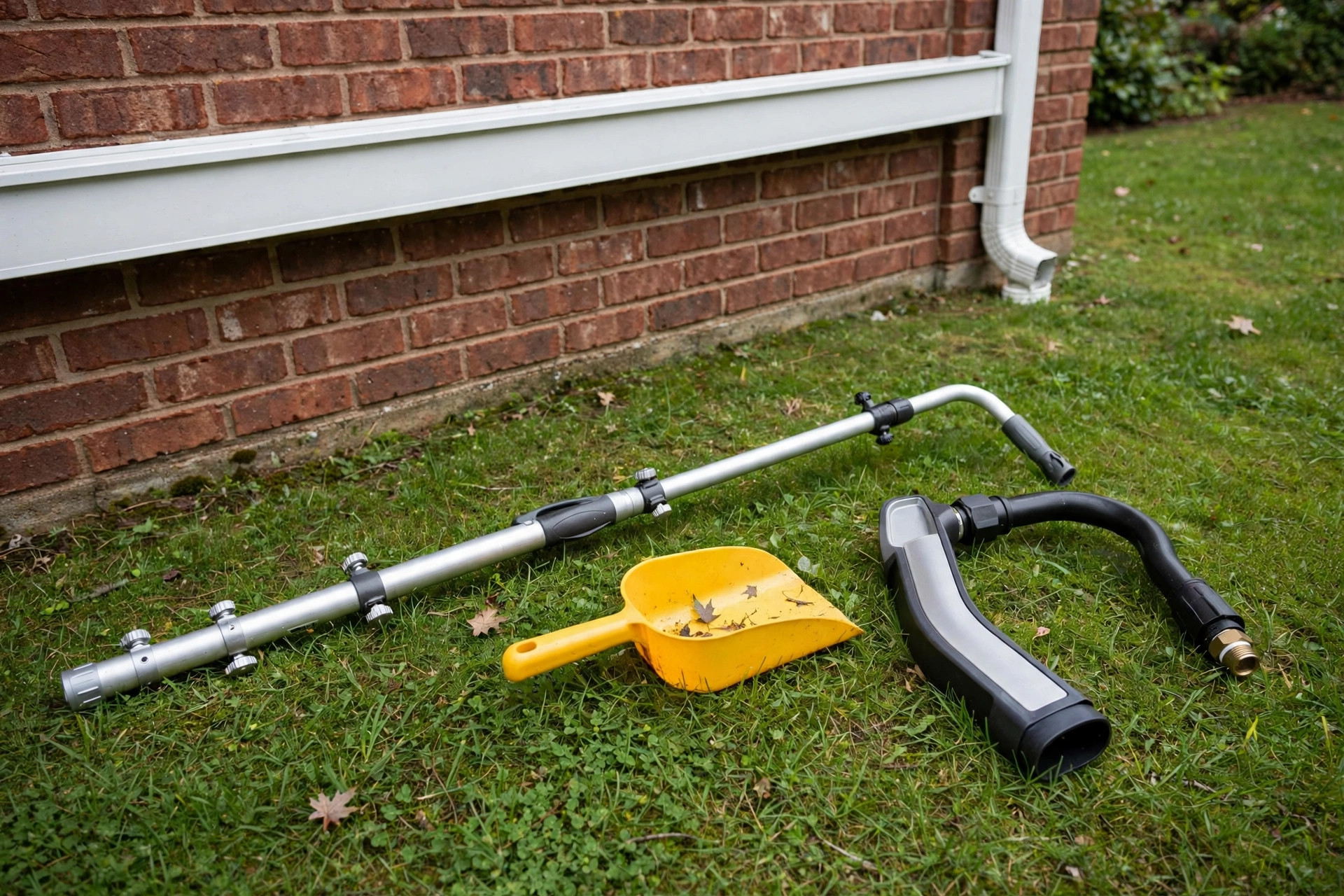

Rain gutters do quiet work on every American home. They catch water from the roof and carry it away from the walls and the foundation. The U.S. Environmental Protection Agency notes that managing this runoff also protects local streams from sediment and chemicals. When gutters fill with leaves and mud, they stop working. Water spills over the edge. It stains the siding, rots the wood trim, and soaks the ground by the foundation. That is why commercial grade gutter cleaning tools with free shipping have become so popular with homeowners. They are stronger than the cheap tools in the hardware store bargain bin, and when the shipping is free, the price is often close to what a professional visit would cost. This guide explains what these tools are, how to pick the right set, what they should cost, and how to use them safely.
Why Clean Gutters Matter
A clogged gutter is more than a small bother. In the fall, a roof can shed hundreds of pounds of leaves. Wet leaves pack down into a mat. That mat traps water. Standing water adds weight that can pull a gutter away from the house. In cold states, the same trapped water freezes into ice dams. Ice pushes up under the shingles and lets meltwater leak into the attic.
The damage from neglect adds up. Wood fascia boards rot, paint peels, basements take on water, and landscaping washes out. A Saturday of gutter cleaning costs little, while a foundation repair costs thousands. Home guides at This Old House have long listed gutter cleaning as one of the most cost-effective jobs a homeowner can do. Most homes need a cleaning twice a year, and homes under big trees may need a third in mid-autumn.
Commercial grade tools make the job go faster. They reach farther, move more debris, and hold up season after season. On a two-story house or a long roof line, the right tool can mean a one-hour job instead of a full weekend on a ladder.
How to Choose the Right Tools: Commercial Grade Gutter Cleaning Tools with Free Shipping
What “Commercial Grade” Really Means
The words “commercial grade” get printed on many boxes. They do not carry a legal definition. In practice, the term points to tools built for daily use by paid crews. The parts are thicker. The handles are longer. The fittings are metal instead of plastic. The warranty is often longer, too.
When you shop for commercial grade gutter cleaning tools with free shipping, look for details that prove the claim. Check the wall thickness of telescoping poles. Look at the locking clamps that hold each section in place. Good clamps grip tight and do not slip under load. Read the product weight. A sturdy tool feels solid in the hand. Reviews on sites like Consumer Reports can tell you which brands hold up over time and which ones crack at the joints after one season.
Match the Tool to Your Home
Start with the height of your gutters. A one-story ranch needs a pole that reaches ten to twelve feet. A two-story colonial needs sixteen to twenty feet. Measure from the ground to the gutter edge. Add four feet. That is the reach you need, because you will hold the pole at an angle.
Next, look at your trees. Pine needles call for different tools than broad oak leaves. Needles slip through wide scoops and pack into downspouts. A pressure nozzle or a vacuum kit works better on needles. Big wet leaves are easy to scoop by hand from the ladder, but a long-reach tool keeps you off the ladder entirely.
Think about water pressure as well. Pressure washer attachments are fast but need a machine with enough power. Most electric washers in the 1,800 to 2,300 PSI range work. The buying advice at Bob Vila suggests matching the attachment to the machine, not the other way around.
Finally, set a budget. You can find a professional grade gutter cleaning tools buying guide on this site that walks through price bands in more detail. As a rule, a solid starter set runs between sixty and one hundred fifty dollars. Free shipping matters most on long telescoping poles, because carriers charge extra for oversized boxes.
Types of Commercial Grade Gutter Cleaning Tools
Telescoping Wands and Poles
A telescoping pole is the backbone of most gutter cleaning kits. Sections slide out and lock at set lengths. The top end takes different heads: a curved wand that sprays water, a scoop, or a brush. Aluminum poles are light and do not rust. Fiberglass poles are stiffer and handle more force. Carbon fiber is the lightest of all, but it costs more.
Good commercial poles lock with a twist or lever clamp. Cheap poles use friction fit and slowly collapse while you work. Look for poles rated to at least eighteen feet, with a foam or rubber grip. Bare metal gets slippery when wet.
Gutter Scoops and Tongs
A scoop is a simple plastic blade shaped to fit the gutter trough. You run it along the channel and push debris toward the downspout. Commercial scoops are wider and stiffer than home-store versions. Some have a hole in the middle so the scoop can slide over gutter hangers without snagging.
Tongs are two arms on a pole that open and close to grip a wad of leaves. They shine on dry debris but struggle with wet, packed mud. Many kits pair a scoop with a tong head on the same pole, which covers most situations without a ladder.
Pressure Washer Attachments
A curved pressure wand bends at the top so the spray points down into the gutter. You stand on the ground and walk the length of the house while water blasts leaves and silt toward the downspout. These attachments clean fast but make a mess, so wear old clothes and warn anyone nearby.
Pressure attachments work best as a second pass. Scoop the heavy debris first, then wash silt out of the corners. Silt builds up where the gutter meets the downspout and hardens into a crust if skipped. Project walkthroughs at Family Handyman show how a ten-minute rinse can restore full flow to a sluggish gutter.
Gutter Vacuum Kits
A gutter vacuum kit connects to a wet-dry shop vacuum. Long tubes reach up to the gutter. A curved nozzle sucks leaves straight into the canister. There is almost no mess on the ground. The trade-off is weight and noise. A full shop vacuum is heavy to drag around the house, and the motor is loud.
Vacuum kits suit homes with light, dry debris and choke on wet mats of leaves. Empty the canister often, since a packed canister loses suction and strains the motor. If you already own a strong shop vacuum, the kit is a cheap add-on. If not, the full package can cost as much as a small pressure washer.
Gutter Guards and Screens
Guards are not cleaning tools, but they cut future cleaning. Mesh screens snap over the gutter and let water in while keeping leaves out. Foam inserts do the same at a lower price. No guard stops all debris, so budget for a light cleaning each year. Seasonal checklists at The Spruce note that guards reduce labor but do not remove the chore.
Cost and Price
Prices for commercial grade gutter cleaning tools with free shipping fall into three bands. Basic scoop-and-pole sets run twenty-five to sixty dollars. Mid-range kits with several heads and a twelve to eighteen foot pole run sixty to one hundred fifty dollars. Full systems with a vacuum kit or a pressure washer attachment run one hundred fifty to three hundred dollars.
Free shipping changes the math. A twenty-foot pole ships in an oversized box, and carriers may add fifteen to thirty dollars in surcharges. A seller that folds that cost in can be cheaper even with a higher sticker price. Big retailers such as Home Depot and Lowe’s list shipping terms on each product page, so check before you buy.
Watch for bundle deals in early fall. Sellers know that September is gutter season. Kits that pair a pole, a scoop, and a spray head often drop ten to twenty percent. Also see professional grade gutter cleaning tools with free shipping, heavy-duty kits for landlords and small crews that cost more up front but often include spare heads and longer warranties.
Care and Upkeep
Commercial tools last if you treat them well. Rinse every tool after use. Gutter sludge is acidic. It pits aluminum and stains plastic. A quick rinse with the garden hose takes two minutes and adds years to the tool’s life.
Dry telescoping poles before you collapse them. Water trapped between sections leaves mineral crust. The crust makes the pole stick the next time you extend it. Wipe the locking clamps with a rag. A drop of silicone spray on the threads keeps them smooth. Do not use oil-based sprays on plastic clamps. The oil can soften the plastic over time.
Hang poles on wall hooks instead of leaning them in a corner. A pole that leans for months can take a slight bend and wobble at full reach. Store scoops and heads in a bucket or tool bag, out of direct sun. Ultraviolet light makes plastic brittle. Care guides at Good Housekeeping note that storage habits are the main reason some tools last a decade while others fail in two seasons.
Inspect the kit each spring. Flex each pole section, check the clamps, and look for cracks at the neck of scoop heads. Replace worn parts before the fall rush. Spare heads cost little, and a broken tool in October means a trip to the store when shelves are bare.
Safety
Most gutter injuries come from ladders, not from the tools. That is the best argument for long-reach tools. Every foot of pole keeps you closer to the ground. Still, many jobs need a ladder for a close look at the downspouts. Set the ladder on firm, level ground. Keep your hips between the rails. Never reach more than an arm’s length to either side.
The Consumer Product Safety Commission publishes ladder safety rules worth reading before the season starts. The key points are simple. Inspect the ladder for cracked rungs. Keep three points of contact at all times. Do not stand on the top cap. Have someone hold the base when the ladder is tall.
Watch for power lines. Aluminum poles conduct electricity. A twenty-foot pole near a service drop is a serious hazard. Work on dry, calm days. Wind can swing a long pole into wires or branches. Wear gloves. Gutter debris hides sharp edges, old nails, and sometimes wasp nests. Safety glasses keep splashed sludge out of your eyes. If you find a nest, stop and deal with it in the evening when the insects are calm.
Be careful with pressure washers around windows and painted trim. A focused jet can strip paint and crack old caulk. Keep the nozzle moving. Never point it at people or pets. Drain and coil the hose when you finish so nobody trips.
Frequently Asked Questions
Are commercial grade gutter cleaning tools worth the extra money? For most homeowners, yes. The tools reach farther and last longer than budget sets. A one-hundred-dollar kit used twice a year for ten years costs five dollars per use. A professional visit can cost one hundred fifty dollars or more. The kit pays for itself in one season.
Can I clean gutters without a ladder? In many cases, yes. A telescoping pole with a scoop or a pressure attachment handles the main runs from the ground. You may still want a ladder to check the downspouts and the corners. Long-reach tools cut ladder time down to a few minutes per side of the house.
What is the best tool for pine needles? Pine needles are the hardest debris to remove. They mat together and clog downspouts. A pressure washer attachment or a vacuum kit works best. Scoops tend to pack needles tighter. Flush the downspouts with a garden hose after cleaning to clear lodged needles.
How often should I clean my gutters? Twice a year is the standard answer. Clean in late spring after the seeds and blossoms fall. Clean again in late fall after the leaves drop. Homes under heavy trees may need a third cleaning in midsummer. After any big storm, take a quick look. A single clogged downspout can overflow a whole run.
Is free shipping really free on oversized tools? Usually, yes. The seller pays the carrier and builds the cost into the price. Compare the delivered total with other sellers. Sometimes a lower price with a shipping fee beats a higher price with free shipping. Read the terms for items over eight feet long; some sellers exclude oversized boxes.
Should I hire a pro instead of buying tools? It depends on your house and your comfort with heights. A steep roof, a three-story home, or clogged underground drains may call for a professional. See reliable gutter cleaning service providers in florida for an example of what to look for in a service company. For a typical one- or two-story home, a good tool kit and a free Saturday are enough.
A Final Word
Gutter cleaning will never be anyone’s favorite chore. The right tools make it shorter and safer. Commercial grade gutter cleaning tools with free shipping give a homeowner professional reach without professional prices. Pick a kit that matches your gutter height and your trees. Take care of the tools and they will take care of your house. Twice a year, a few hours keeps water flowing where it belongs.
References
Bob Vila. (n.d.). Home improvement advice. https://www.bobvila.com Consumer Reports. (n.d.). Product reviews and ratings. https://www.consumerreports.org Family Handyman. (n.d.). DIY home repair and maintenance. https://www.familyhandyman.com Good Housekeeping. (n.d.). Product reviews and home advice. https://www.goodhousekeeping.com Lowe’s. (n.d.). Home improvement products. https://www.lowes.com The Home Depot. (n.d.). Home improvement products. https://www.homedepot.com The Spruce. (n.d.). Home and garden advice. https://www.thespruce.com This Old House. (n.d.). Home renovation guidance. https://www.thisoldhouse.com U.S. Consumer Product Safety Commission. (n.d.). Product safety information. https://www.cpsc.gov U.S. Environmental Protection Agency. (n.d.). Protecting human health and the environment. https://www.epa.gov
Was this guide helpful?

About Emily Rodriguez
The My Garden US editorial team writes practical, in-depth home and garden guides for American homeowners — tested advice, no fluff.
You May Also Like
Upholstery Cleaning Machines Reviews and Buying Guide
January 23, 2026 0 views
Top Rated Roof Moss Removal Services Reviews: What Homeowners Should Know
February 16, 2026 0 views
HEPA Vacuum Cleaners Price Comparison USA
June 2, 2026 0 views