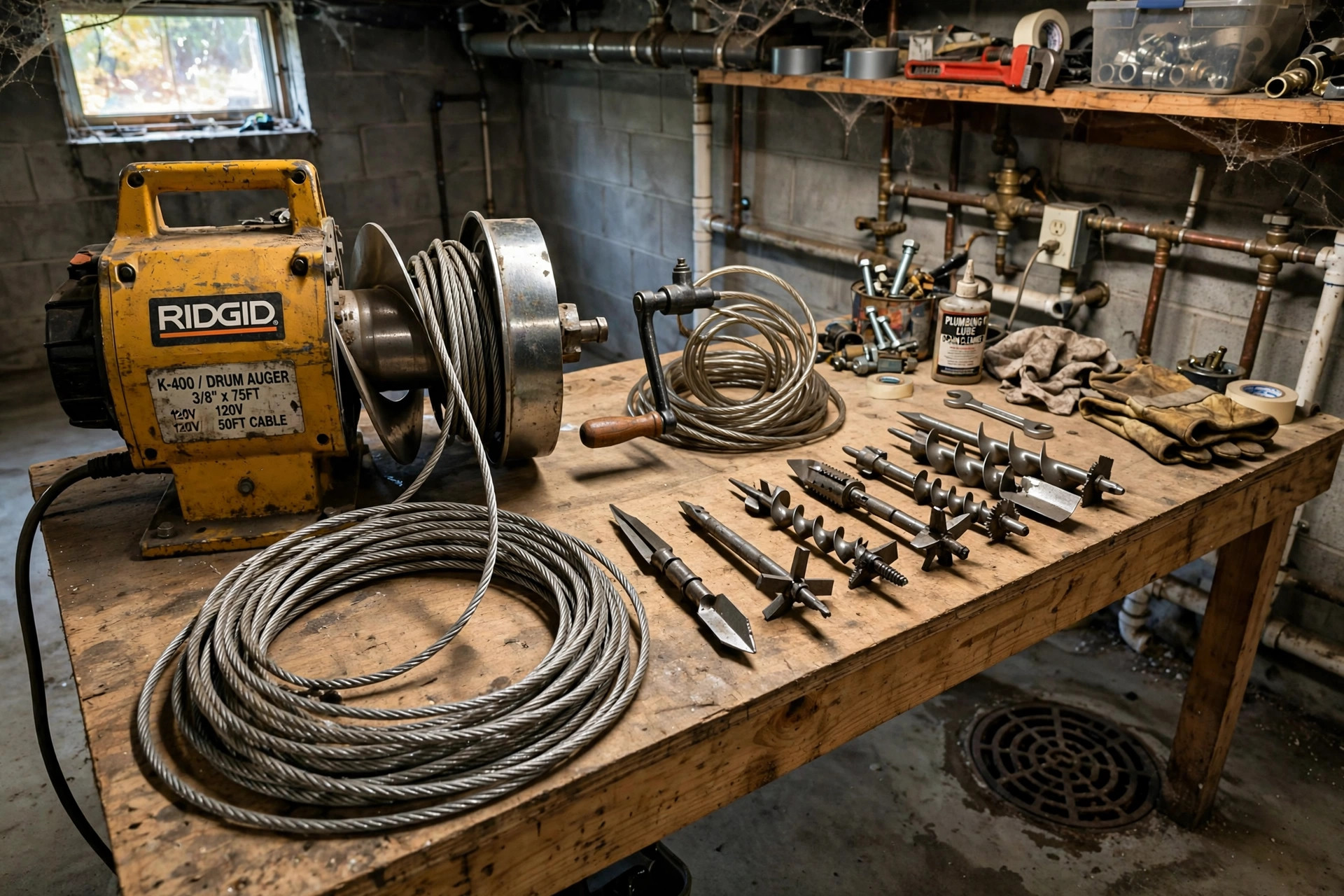

A slow drain is a small problem until it is not. Hair, grease, and soap gather inside a pipe month after month. One morning the tub will not empty, or the kitchen sink fills while the washer runs. At that point a store plunger may do nothing. Many home owners then find that commercial grade drain clog remover tools for sale can clear what a simple plunger cannot. These tools are stronger than the light kits sold for one sink. They reach deeper, grip harder, and break up the thick mass that blocks a line.
The market offers a wide range of machines and hand tools. Some run by hand. Some run on a small motor. Some use high pressure water. Prices run from under fifty dollars to several hundred. This guide explains the types, what to check before you buy, what they cost, and how to use them without harm to yourself or your pipes. It draws on guidance from seasoned home repair publications and trusted product testers, including This Old House, Family Handyman, and The Spruce.
Why a Strong Drain Tool Matters
A blocked drain is more than an annoyance. Standing water breeds germs and odor. A blocked sewer line can push waste water back into a home, and that kind of damage costs thousands to repair. The U.S. Environmental Protection Agency warns that water damage in homes invites mold growth and can harm indoor air, a point explained on the EPA site. Clearing a line early is the cheaper path.
Chemical cleaners promise a quick fix. In practice they often fail on a full blockage. Strong acids and lyes can eat at older pipes, harm septic systems, and burn skin and eyes. Mechanical tools avoid these risks. A cable or auger breaks the clog apart or pulls it out, leaving the pipe clear and the water safe. For rental owners and landlords, a good tool pays for itself the first time it saves a service call. For a home owner with big trees near the sewer line, root growth returns year after year, and a drain clog remover tools reviews and buying guide can help you pick a tool you will use more than once.
Commercial grade tools differ from light homeowner kits in a few plain ways. Their cables are longer and thicker. Their motors and drums are built for repeated use. Their heads come in shapes meant for roots, grease, and paper. A cheap twenty-five foot snake may bend or kink on a stubborn blockage. A heavier cable keeps pushing and keeps its shape.
What to Look for When You Buy: Commercial Grade Drain Clog Remover Tools for Sale
Before you spend money, think about the drains you will serve. A bath tub and a bathroom sink need only a short cable, often fifteen to twenty-five feet. A main sewer line may run one hundred feet from the house to the street. Measure the longest run you expect to clear, then buy a cable a little longer. Consumer Reports has long advised buyers to size a tool to the job rather than the shelf price, and the habit pays off here too.
Cable thickness matters as much as length. Thin cables, about a quarter inch, suit sink and tub traps. Half inch cables handle floor drains and branch lines. Three-quarter inch cables are the workhorses for main lines. Thicker cable costs more but resists kinking and drives through roots. Manual crank tools are cheap and need no power, good for short runs. Motorized drum machines feed the cable for you and suit long lines.
Check the heads that come in the box. A simple bulb or drop head opens most lines. A cutter head with blades chews through roots. A retrieving head grabs lost objects like a ring or a toy. Buying extra heads at the start is wise, since shops like The Home Depot and Lowe’s stock common sizes.
Weight and storage count more than people expect. A one-hundred foot drum machine can weigh over one hundred pounds. If you must carry it down stairs to a basement cleanout, think about a unit with wheels and a handle, or a sectional machine whose cables snap together in shorter lengths. Sectional machines cost more but one person can move them.
Also look at the warranty and the brand’s record for parts. A drain tool is a long-term buy. Firms reviewed by Bob Vila and Good Housekeeping are often chosen because spare cables, heads, and switches stay on the market for years. A tool you cannot repair is a tool you throw away.
The Main Types on the Market
Hand Augers and Toilet Augers
The hand auger is the simplest commercial grade tool. A coiled cable sits in a canister. You turn a crank by hand while pushing the cable into the drain. Three and six foot toilet augers have a curved guide that protects the bowl from scratches. Longer hand augers run twenty-five to fifty feet and suit sinks, tubs, and shower traps. They cost little and store in a bucket. Their limit is reach and power.
Motorized Drum Machines
The drum machine is the standard tool of the trade. A metal drum holds fifty to one hundred feet of cable. A motor spins the drum while you feed the cable into the pipe with a lever or by hand. The spinning head bores into the clog. Many models include an auto feed that moves the cable in and out without gloves on the cable itself, which is cleaner and safer. Drum machines range from compact units for indoor drains to large rolling units for sewer mains. If you own several rental homes, this is the class to study first.
Sectional Drain Machines
Sectional machines skip the drum. Instead, short lengths of cable connect end to end, and the machine spins them from a fixed frame. You add sections as the cable travels down the line. The parts weigh less than a full drum, so one worker can carry the kit down a hill to a septic cleanout. The trade-off is time. Connecting and splitting sections slows the job. Still, for long outdoor runs, the lighter load wins.
High Pressure Water Jetters
A jetter uses a pump and a special nozzle to blast water backward along the pipe wall. The jets scrub grease and sludge off the pipe and push debris downstream. Jetters shine in kitchen lines and grease traps, where cable heads tend to poke a hole through the mass and leave the rest. Electric jetters for home use run up to about fifteen hundred pounds per square inch. Larger gas units go higher and serve main lines. Note that old clay or orangeburg pipe can be harmed by too much pressure, so know your pipe before you blast.
Specialty Heads and Accessories
Whatever machine you choose, the head does the real work. Keep a small set on hand. A spear head starts a blocked line. A U-cutter scrapes the pipe wall clean. A saw blade head cuts roots. A funnel or retrieving auger fishes out solid objects. Changing a head takes a minute and often turns a failed job into a win. Many buyers pair these with commercial grade gutter cleaning tools with free shipping when they maintain a whole property, inside and out.
What These Tools Cost
Prices for commercial grade drain clog remover tools for sale vary widely with size and power. A heavy-duty hand auger costs twenty to sixty dollars. A toilet auger of good build runs thirty to eighty dollars. Compact electric drum machines for indoor drains start around two hundred dollars and climb to five hundred for stronger motors and longer cables.
Full-size drum machines with seventy-five to one hundred feet of half or three-quarter inch cable run five hundred to twelve hundred dollars. Sectional machines sit in the same band, sometimes higher because of the extra cable sections. Electric jetters for home use cost two hundred fifty to six hundred dollars. Professional gas jetters pass one thousand dollars and rise with pressure and flow.
A set of four common heads costs forty to ninety dollars. A replacement fifty-foot cable runs fifty to one hundred twenty dollars, depending on thickness.
Weigh this against a plumber’s visit. A simple drain call often costs one hundred fifty to three hundred dollars in most American cities. A main line clearing can cost three hundred to six hundred. If your home clogs twice a year, a mid-range machine can pay for itself in two or three uses. That math is why landlords and house flippers keep one in the truck.
Care and Upkeep
A drain cable is bare steel, and steel rusts. After each use, pull the cable out, wipe it down with a rag, and oil it lightly before winding it back. Many owners flush the cable with a hose and let it dry in the sun. Store the machine in a dry spot. A rusted cable weakens and can snap inside a pipe, leaving you with a worse problem than the clog.
Check the head before every job. Bent or broken cutters dig into the pipe wall instead of the blockage. Replace worn heads at once. Inspect the cable for kinks, flat spots, and frayed strands. A damaged section should be cut out and replaced, not bent back into shape.
For motors, follow the maker sheet. Keep vents free of lint. Check cords for nicks. For jetters, flush the pump with clean water after use and drain the hoses before winter storage so ice does not crack them. A few minutes of care after each job adds years to the tool’s life.
Safety Rules
Drain work mixes spinning steel, dirty water, and tight spaces. Take it seriously. The U.S. Consumer Product Safety Commission publishes general guidance on power tool safety that applies here; its resources are on the CPSC site. Wear heavy leather gloves, not cloth, since a spinning cable can grab loose fabric in an instant. Wear eye protection. Drain water carries germs, so wash hands and tools after the job, and keep cuts covered.
Never run a cable without knowing what lies below. Ask the home owner or check old plans for the pipe path. Do not force a cable through a toilet or a trap it cannot bend through. If the cable binds hard, stop, reverse, and pull back a little before trying again. Forcing it risks kinking the cable or cracking a pipe.
Keep the work area clear. A drum machine can shift as the cable spins. Set it on firm ground and keep children and pets away. With chemical cleaners, never mix products, and never use a machine right after pouring a strong chemical into the drain. The cable can splash the chemical back at you.
For jetters, never point the nozzle at skin. High pressure water cuts flesh like a knife. Keep the nozzle inside the pipe once the pump runs. Check that hose couplings are tight before you start.
If a line will not clear after two honest tries, stop and call a plumber. A camera inspection may show a collapsed pipe or a major root mass that no hand tool will fix. Knowing when to quit is part of the trade.
Frequently Asked Questions
How long a cable do I need for a home sewer line?
Measure from the cleanout to the street or septic tank, then add twenty-five feet. Most American homes need seventy-five to one hundred feet. Shorter runs serve fine with fifty feet. Buying too short a cable is the most common first-buyer mistake.
Can these tools damage my pipes?
They can if misused. A spinning cutter head can scar soft pipe or crack brittle clay. Use the right head for the pipe type, keep the speed moderate, and never force a stuck cable. PVC and cast iron stand up well to normal auger work. Very old or thin pipe calls for a gentler touch or a professional.
Do I need a motorized machine, or is a hand crank enough?
For sinks, tubs, and short traps, a hand crank does the job. For lines longer than fifty feet, a motor saves real labor and keeps the cable spinning at steady speed, which clears faster. If you clear drains more than a few times a year, the motor is worth the cost.
Are water jetters better than cable snakes?
They serve different clogs. Cables bore through roots and solid blockages. Jetters wash grease, soap, and soft sludge off pipe walls. Kitchen lines respond well to jetters. Root-filled sewer lines need a cable cutter. Some owners keep both and choose by the symptom.
How do I keep a cleared drain from clogging again?
Catch hair with a drain strainer. Never pour grease down the sink; wipe pans with a paper towel first. Run hot water after dishwashing. Have trees near the line trimmed, and ask a plumber about root treatment if roots return each year. Small habits keep the big tool on the shelf.
Is it worth buying, or should I just call a plumber?
If you face clogs once in a blue moon, call a plumber. If you own rentals, manage a large home, or fight roots every spring, buying pays off. Add up two years of service calls and compare with the machine price. Most frequent users come out ahead.
A Final Word
Commercial grade drain clog remover tools for sale give the home owner the same muscle the trades use. Choose by cable length, thickness, and drive type. Buy heads for the clogs you meet. Care for the steel and respect the spin. With the right tool and a steady hand, most clogs yield in an afternoon, and the line runs free for months to come.
References
Bob Vila. (n.d.). Home improvement advice. https://www.bobvila.com Consumer Reports. (n.d.). Product reviews and ratings. https://www.consumerreports.org Family Handyman. (n.d.). DIY home repair and maintenance. https://www.familyhandyman.com Good Housekeeping. (n.d.). Product reviews and home advice. https://www.goodhousekeeping.com Lowe’s. (n.d.). Home improvement products. https://www.lowes.com The Home Depot. (n.d.). Home improvement products. https://www.homedepot.com The Spruce. (n.d.). Home and garden advice. https://www.thespruce.com This Old House. (n.d.). Home renovation guidance. https://www.thisoldhouse.com U.S. Consumer Product Safety Commission. (n.d.). Product safety information. https://www.cpsc.gov U.S. Environmental Protection Agency. (n.d.). Protecting human health and the environment. https://www.epa.gov
Was this guide helpful?

About James Carter
The My Garden US editorial team writes practical, in-depth home and garden guides for American homeowners — tested advice, no fluff.
You May Also Like

Powerful Pest Control Service Plans Near Me: How to Choose the Right One
January 25, 2026 0 views
Top Rated Pressure Washing Service Companies for Homeowners: A Complete Guide
July 10, 2026 0 views
Buy Cordless Electric Scrubbers Online in Arizona
February 21, 2026 0 views