Why Cats Need a Place to Climb
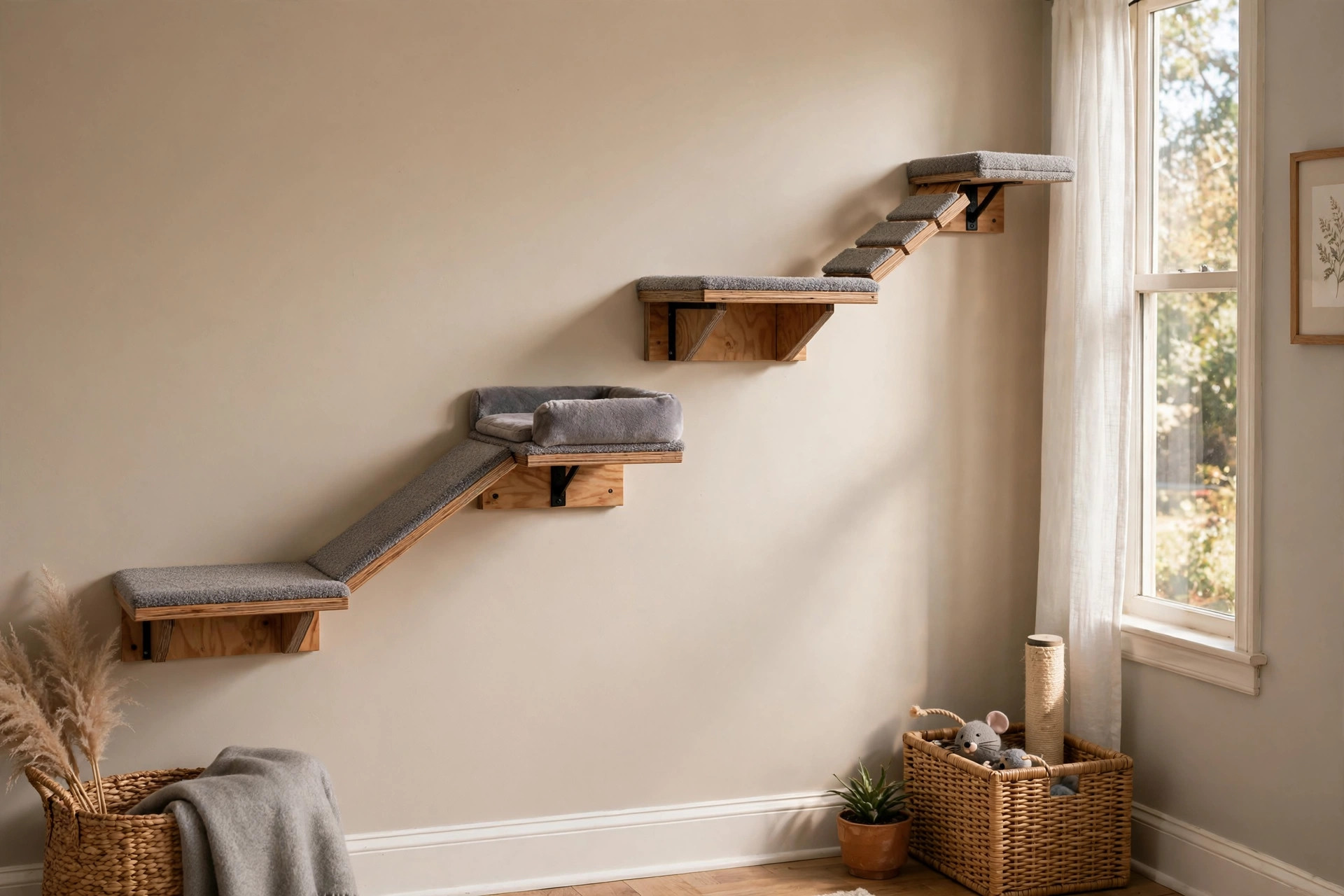
A cat that lives indoors still carries the habits of its wild kin. In nature, a cat climbs trees to rest, to watch for danger, and to spot prey. A house with only floor space leaves out that part of the cat. Many owners find that cat climbing wall shelves for vertical space fill this gap. The shelves give the cat a high road through the room, and the cat gains exercise, rest, and a sense of command over its home.
This guide explains why wall shelves help, what to look for when you buy them, and how to mount them safely. If you have a small flat or a busy house, these shelves add living space for your cat without taking floor space from you.
Why Vertical Space Matters for Indoor Cats: Cat Climbing Wall Shelves for Vertical Space
Cats feel safer when they can sit up high. From a high perch, a cat can see the whole room and stay clear of feet, dogs, and noise. This sense of safety lowers stress. The ASPCA advises owners to give indoor cats daily play and climbing space, since a cat that cannot climb may grow bored or restless.
Boredom often shows up as trouble. A cat may scratch the sofa, knock items off tables, or pester people at night. Climbing shelves give the cat a proper outlet for that energy. Jumping from shelf to shelf is good exercise for the legs and back. It helps the cat keep a healthy weight, which matters for indoor animals that may eat more than they move.
Vertical space also helps in homes with more than one cat. Cats share space by rank, and high spots serve as prizes. When each cat can claim its own perch, fights grow less common. PetMD describes how climbing routes reduce tension among cats that live under one roof. The cat on the high shelf feels secure, and the cat below feels less crowded.
Age matters too. Wall shelves let you set the height for the cat you have. You can start low and raise the route as a kitten grows, or keep it low for a senior cat with stiff joints.
What to Look for When You Choose
A good set of wall shelves must hold the cat without wobble. Start with the weight rating. An average house cat weighs ten pounds, but it lands hard when it jumps. A shelf rated for at least thirty pounds gives a safe margin. For a large cat, look for fifty pounds or more. Shelves that feel light and thin may crack under a fast landing.
The surface matters as much as the strength. Cats need grip. Smooth wood or slick plastic can send a paw sliding. Carpet-covered tops, sisal pads, or rough unfinished wood give the cat steady footing. Some shelves come with raised rims. A rim of one or two inches helps a sleeping cat feel enclosed and keeps it from rolling off.
Shape and size count too. A perch should be wide enough for the cat to turn around. For most cats, a shelf ten inches deep and eighteen inches wide works well. Larger breeds need bigger platforms. Cover any sharp corners, since the cat will rub its face on edges.
Mounting hardware is the part owners overlook most. The bracket must reach into a wall stud, which is the solid wood frame inside the wall. Hollow wall anchors can work, but they are less strong. Family Handyman explains how to find studs and set anchors for heavy wall loads. If you rent, look for systems that use fewer holes, or ask your landlord before you drill.
Think about the finish. Shelves that match your room look better and are more likely to stay up for years. Solid wood, stained plywood, and quality laminate all look fine in a living room. Cheap particle board swells if it gets wet and may sag, so choose sealed wood or metal near water bowls or humid rooms.
Types of Wall Shelves and Climbing Options
Wall shelves for cats come in several forms. Many owners mix two or three kinds to build a route.
Flat Solid Shelves
Flat shelves are simple boards fixed to the wall. They form the base of most climbing walls. You can buy ready-made cat shelves from pet stores, or you can build your own from lumber. Chewy carries many kinds of cat wall furniture in wood, carpet, and mixed styles. Stores such as Home Depot sell wood boards and mounting brackets if you prefer to build the shelves yourself.
Place flat shelves in a stair-step pattern. Each shelf should sit twelve to eighteen inches above and to the side of the one below. That gap suits a normal jump. For kittens or older cats, shrink the gap to eight or ten inches.
Perches with Rims or Beds
A perch is a shelf with raised edges or a soft pad. It serves as a lookout post or a nap spot. Many perches have a small lip around three sides. The cat can lie with its back against the lip and feel safe. Some perches add a cushion; washable covers are best, since pads collect fur.
Put at least one perch near a window. Cats love to watch birds and people from a warm spot. A perch by the window can serve the same role as a cat window perch for sunny window lounging. If you mount the shelf high enough, the cat gains sun, view, and safety in one place.
Step Shelves and Ladders
Step shelves are smaller boards set in a tight zigzag. They help cats reach high places in short hops. Ladders with carpet rungs serve the same job. These work well in narrow halls where big shelves would block the way.
Bridges and Tunnels
A bridge is a narrow span that links two shelves across a gap. A tunnel is a short tube the cat can walk through. Both add play value to the wall. The Spruce Pets offers guides on cat enrichment that show how bridges and tunnels keep indoor cats active. Add one bridge or tunnel per wall to keep the route fun without making it crowded.
Full Climbing Wall Sets
Some makers sell full sets in one box. A set may hold five or six shelves, a perch, and a bridge, with all hardware included. These sets save time, since the layout is planned for you. Some use a floor-to-ceiling tension pole instead of wall screws, which leaves no holes.
If you want a floor-based option as well, a best cat tree for large cats sturdy tall can stand at the base of the wall and give the cat a scratching post for the climb.
Cost and Price
Prices vary with material and brand. Simple carpet-covered wall steps cost ten to twenty dollars each. Solid wood shelves run twenty to forty dollars each. A padded window perch or a large corner platform may cost forty to seventy dollars.
A full five-piece set usually costs between eighty and one hundred fifty dollars. High-end sets in real hardwood with brass brackets can reach two hundred dollars or more. Do-it-yourself builders spend less. A pine board, two brackets, and screws from a hardware store may cost under fifteen dollars per shelf.
Shipping adds to the cost of large sets. Check the total before you order. If you build your own, plan for a drill, a level, a stud finder, and sandpaper.
How to Install Wall Shelves Safely
Good placement starts with a plan. Mark the wall with painter tape where each shelf will go. The route should flow in steps, without wide gaps.
Find the studs first. A stud finder beeps over solid wood. Mark each stud with a pencil. Set the brackets so that at least two screws bite into a stud. On walls without studs in the right spots, use heavy-duty toggle bolts rated for the load. Bob Vila covers basic home repair skills that help with this kind of mounting job.
Level every shelf and tighten all screws, then test each shelf with your own weight. Press down hard. If the shelf moves, add another bracket or move it to a stud.
Keep the route away from danger. Do not place shelves above a hot stove, a deep sink, or a sharp table corner. Leave clear landing room at the top and bottom of the route. A shelf that ends above a doorway should have a soft rug below in case of a slip.
Start the cat low. Let the cat learn the first two shelves before you add higher ones. Rub a little catnip on the new shelf, or place a treat there. Most cats test a new shelf within a day. A shy cat may need a week. Do not lift the cat onto a high shelf and leave it there. Let the cat choose its own pace.
Care and Upkeep
Wall shelves need little care, but a quick check keeps them safe. Once a month, grip each shelf and try to rock it. Tighten any loose screw at once. A shelf that worked loose can fail without warning.
Vacuum carpet-covered shelves every week or two. Fur builds up fast, and a thick mat of fur makes the surface slick. Wash removable pads in the machine on a gentle cycle. For wood shelves, wipe with a damp cloth. Avoid strong cleaners with harsh fumes, since cats are sensitive to smells.
Check sisal wraps for fraying, and rewrap worn boards with new sisal rope from a pet store. A best cat scratching post tall for large cats nearby can also draw scratching away from the shelves.
Look at the wall around the brackets once or twice a year. Damp spots or cracks in the drywall mean the mount is under stress. Move the shelf to a firmer spot if you see damage. Sunlight can fade stains and finishes over time, so rotate padded covers to keep wear even.
Safety Notes
Safety starts with solid mounting, as noted above. A few more points deserve care.
Weight limits are real. Do not let two large cats crowd onto a shelf rated for one. Spread the load across many brackets, since overloaded shelves pull out of the wall slowly, then all at once.
The CPSC warns about falling furniture hazards in the home, and wall shelves count as furniture. Keep small children from pulling on low shelves. Teach children to let the cat use its shelves in peace. A startled cat may scratch if grabbed on a perch.
Check for sharp edges after any home repair. A bent bracket or a raised screw head can cut a paw. Run your hand along each shelf edge now and then. File down any rough spot you find.
Keep cords and strings away from the climbing route. A dangling blind cord near a shelf is a hazard. Tie cords up high, and use short, sturdy toys fixed to the shelf instead of long strings.
If your cat is old, ill, or blind, keep the route low and simple. Wide shelves with high rims work best. Ask your vet about the right activity level for the cat. Some cats with joint pain do better with ramps than with jumps.
FAQ
How many shelves does my cat need?
Three to five shelves make a good starter route. That is enough for the cat to climb, rest, and move across the wall. You can add more later. Watch how the cat uses the first shelves. If the cat naps on the highest perch each day, the route is a success.
Will wall shelves damage my walls?
Each bracket needs screws in the wall. When you move the shelves, small holes remain. You can fill them with spackle and paint over them in minutes.
Can a large or heavy cat use wall shelves?
Yes, if the shelves are built for the load. Choose shelves rated for at least fifty pounds. Mount every bracket into a stud. Wide platforms suit big cats better than narrow steps. Many makers now sell lines for large breeds, so read the weight rating before you buy.
What if my cat ignores the new shelves?
Give it time. Most cats explore new heights within a few days. Place treats or a favorite toy on the lowest shelf. A sprinkle of catnip helps too. Make sure the shelves are easy to reach. If the first jump looks too far, add a step in between.
Are wall shelves better than a cat tree?
Both work well, and many homes use both. A cat tree needs floor space and can tip if it is cheap or tall. Wall shelves use no floor space and cannot tip when mounted well. Trees offer enclosed hideouts that shelves lack.
How high can the shelves go?
Most indoor routes top out at six or seven feet. That height gives the cat a fine view without a risky fall. Very high shelves near the ceiling look fun, but a slip from nine feet can hurt. Keep the route at a height where a fall onto a rug would not harm the cat.
A Final Word
Wall shelves turn empty wall space into a playground for your cat. They cost less than many think, they fit small homes, and they answer a deep need in the animal. Plan the route, mount it with care, and let the cat set the pace. The Spruce has ideas for arranging cat shelves with home decor if you want the route to blend with your rooms. Consumer Reports tests product stability and build quality for many home goods, which can help you compare brands before you buy. With a little effort, your cat gains a high road, and you gain a happier, calmer pet.
References
ASPCA. (n.d.). Pet care and animal welfare resources. https://www.aspca.org Bob Vila. (n.d.). Home improvement advice. https://www.bobvila.com Chewy. (n.d.). Pet supplies. https://www.chewy.com Consumer Reports. (n.d.). Product reviews and ratings. https://www.consumerreports.org Family Handyman. (n.d.). DIY home repair and maintenance. https://www.familyhandyman.com PetMD. (n.d.). Pet health information. https://www.petmd.com The Home Depot. (n.d.). Home improvement products. https://www.homedepot.com The Spruce. (n.d.). Home and garden advice. https://www.thespruce.com The Spruce Pets. (n.d.). Pet care guides and product reviews. https://www.thesprucepets.com U.S. Consumer Product Safety Commission. (n.d.). Product safety information. https://www.cpsc.gov
Was this guide helpful?

About David Wilson
The My Garden US editorial team writes practical, in-depth home and garden guides for American homeowners — tested advice, no fluff.