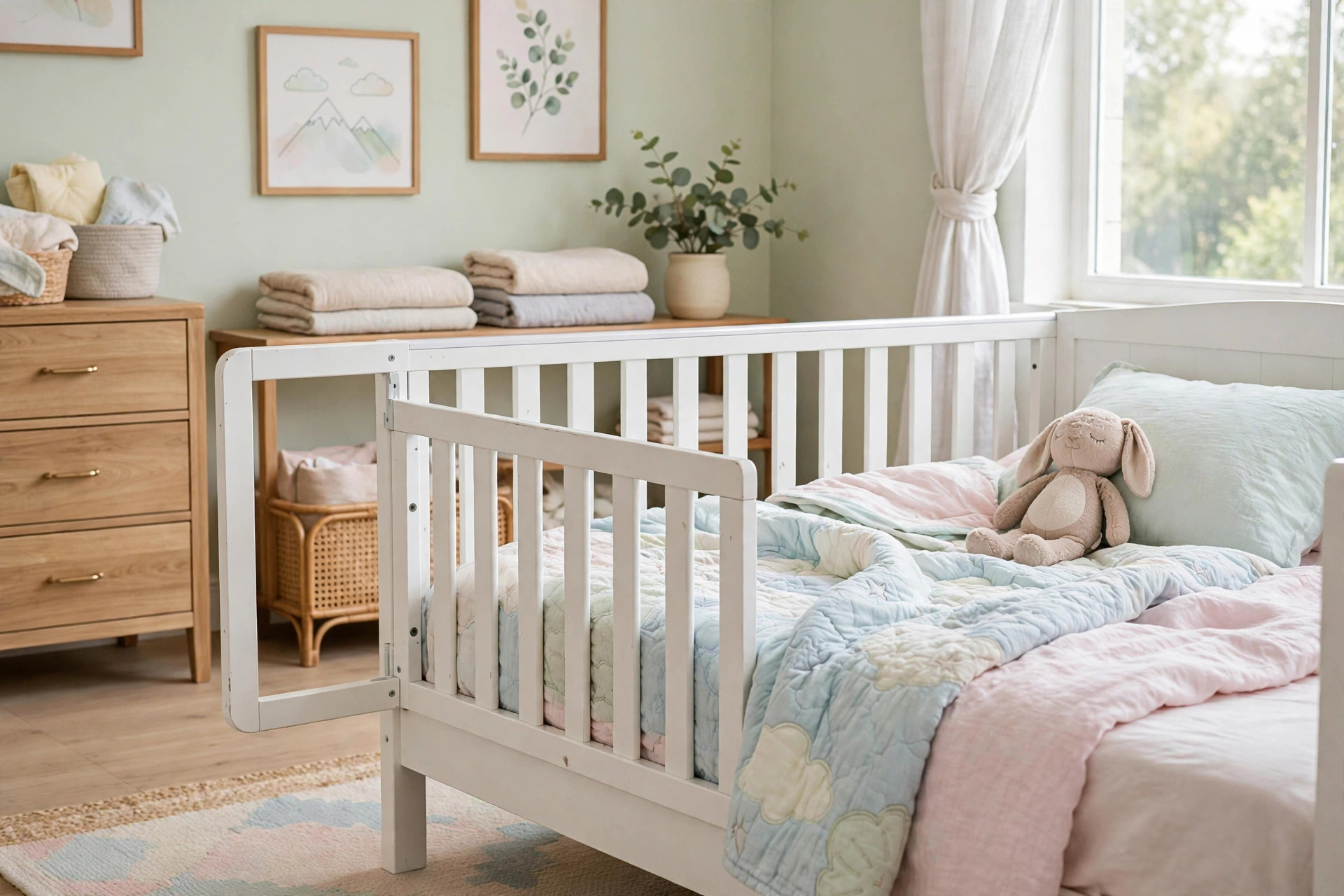

A toddler bed rail for convertible crib safety is one of the simplest tools a parent can buy when a child outgrows the crib. The rail attaches to the open side of a converted crib and keeps a restless sleeper from rolling onto the floor. It costs little, installs in minutes, and it can spare your child a hard fall in the middle of the night.
The move from crib to toddler bed is a milestone. Most children make the switch between eighteen months and three years of age. Some climb out of the crib early and force the issue. Others are content to stay put until a new sibling arrives. Whenever the time comes, safety is the first concern. The toddler bed sits lower than the crib, but a fall from it can still hurt a small child. A guard rail closes that gap.
This guide explains why toddler bed rails matter, how convertible cribs change into toddler beds, what to look for when you choose a rail, what kinds are sold, what they cost, and how to keep the rail safe and clean through years of use. Parents who are shopping for a best convertible crib for small nursery room will find the information here pairs well with that choice, since the crib and the rail must fit together.
Why a Toddler Bed Rail Matters
A child who has slept in a crib since birth has never faced an open bed edge. The crib rails were always there. When the crib converts to a toddler bed, one or both long sides open up. The child gains freedom to climb in and out. The child also gains the chance to roll out while asleep.
Young sleepers move a great deal. They turn, kick, and slide in their sleep. Adults have learned to sense the edge of the mattress. Toddlers have not. A bed rail acts as a quiet reminder and a physical barrier. The child rolls against it and stops. Many children never fall once the rail is in place.
There is a second reason. The rail helps the child feel safe. An open bed can feel large and strange to a two-year-old. The rail marks the edge of the sleep space. It tells the child where the bed ends and the room begins. Children who feel secure tend to settle faster at bedtime. The rail can make the first weeks in the new bed calmer for the whole household.
How Convertible Cribs Become Toddler Beds: Toddler Bed Rail for Convertible Crib Safety
A convertible crib is built to change as the child grows. Most models pass through three or four stages. They start as a full crib with all four sides. They then convert to a toddler bed. Later they may become a daybed and then a full-size bed. The conversion kit usually ships with the crib or sells as a separate kit.
For the toddler stage, the parent removes the front rail and the drop side, if the crib has one. The mattress support drops to its lowest setting. A toddler guard rail then bolts to the open side where the front rail used to sit. Some kits include the rail. Others sell it on its own, and the parent buys it later.
Not every rail fits every crib. Cribs differ in length, side height, and hole spacing. Before you buy, check your crib brand and model. Look at the toddler bed with guard rails for first bed options as well, since some families move straight to a standalone toddler bed instead of converting. The measurements below will help you match a rail to your crib.
Standard Sizes
Most full-size convertible cribs take a standard crib mattress, which measures about 52 inches long and 28 inches wide. The guard rail for this size is often 30 to 35 inches long. Mini cribs need shorter rails. Measure the open side of your converted bed and write the number down before you shop.
What to Look for When You Choose a Rail
A Snug Fit With No Gaps
The rail must sit flush against the mattress. Any gap between the rail and the mattress can trap a small arm or leg. When you shop, look for rails with adjustable width or multiple mounting positions. After you install the rail, press your hand along the seam. If you can slide more than two fingers into a gap, adjust the rail until the gap closes.
Bar Spacing
If the rail has vertical bars, the space between them should be narrow. Wide gaps can trap a head or a limb. A good rule is the same one used for crib slats: no more than two and three-eighths inches apart. Mesh-sided rails avoid this problem entirely. The fabric leaves no gaps for small fingers to enter.
Rail Height
The rail should rise at least five inches above the top of the mattress. Taller rails work better for active sleepers. A low rail may not stop a child who rolls with force. Measure from the mattress surface, not from the bed frame, since mattress thickness varies.
Solid Attachment
The rail must lock to the bed frame, not merely rest against it. Look for rails that bolt through pre-drilled holes or clamp firmly to the mattress platform. After you install it, push the rail hard from several angles. It should not shift, tilt, or lift. A rail that moves is a rail that can fail.
Materials
Wood rails match wooden cribs and look fine in the nursery. Metal rails are strong and easy to wipe clean. Mesh rails are light and have no pinch points. Whatever material you choose, the finish should be smooth and free of splinters, sharp edges, and peeling paint. If you prefer wooden furniture throughout the nursery, sources like IKEA carry matching nursery pieces worth a look while you plan the room.
Easy Access for Parents
You will lift your child into bed and take your child out many times a day. Some rails fold down or swing down for easy access. This feature is worth having. A rail that is hard to lower will tempt you to leave it down, and a rail left down protects no one.
Types of Toddler Bed Rails
Fixed Guard Rails
Fixed rails bolt to the bed frame and stay up at all times. They are the simplest kind and often the sturdiest. They suit families who want the rail in place for the whole toddler stage. The trade-off is access. You must lift the child over the rail or reach across it at bedtime.
Swing-Down Rails
These rails pivot down along the side of the bed. You lower the rail to tuck the child in, then swing it back up and lock it. They cost a bit more than fixed rails. They are a good choice for grandparents and caregivers who may struggle to lift over a fixed rail.
Fold-Down Rails
Fold-down rails drop straight down against the bed frame. They work much like swing-down rails. Some models fold flat enough that the child can climb into bed alone, which helps build independence.
Mesh Bed Rails
Mesh rails stretch fabric over a frame. They are light, and their soft sides reduce bumps. They often strap under the mattress rather than bolt to the frame. This makes them easy to move between beds, which is handy for travel or for a child who sleeps in two homes. Check the strap system often. Straps can loosen with use.
Foam Bumpers
Foam bumpers are not true rails. They sit under the fitted sheet near the mattress edge and form a low ridge. They suit older toddlers who need only a gentle reminder of the edge. They will not stop a child who rolls hard. For a young or active sleeper, a real rail is the safer pick.
Families comparing full setups can read about the best convertible toddler bed with safety rail to see how rails and beds are matched at the factory.
Cost and Price
Toddler bed rails are modest in price. A simple fixed rail often costs between twenty and forty dollars. Swing-down and fold-down rails run from thirty to sixty dollars. Mesh rails fall in the middle, usually thirty to fifty dollars. Foam bumpers are the cheapest at ten to twenty dollars.
The conversion kit for your crib is a separate cost. Some cribs include it. Others sell it for forty to one hundred dollars. Check what came in your crib box before you buy anything. You may already own the rail.
Price is not the best guide to safety. An inexpensive rail that fits well and locks tight is safer than a costly rail that wobbles. Spend your effort on fit and attachment rather than on features you will not use. Retailers such as Wayfair and The Home Depot list many rails side by side, which makes price comparison easy.
Installing the Rail the Right Way
Read the manual that came with your crib and your rail. The steps below cover the common pattern.
1. Set the mattress support to its lowest position. 2. Remove the front crib rail according to the crib manual. Keep all bolts in a labeled bag. 3. Hold the guard rail in place and line up the bolt holes. 4. Insert the bolts and tighten them by hand first, then with a tool. Do not overtighten. 5. Lay the mattress back in the bed. 6. Test the rail. Push it, pull it, and lean on it. It should not move. 7. Check the gap between rail and mattress along the full length.
Keep the manual and the spare parts. When the toddler stage ends, you will need them for the next conversion. The Family Handyman site is not in our linked list for this category, but general assembly advice of this kind is widely available in parenting guides like What to Expect, which covers nursery setup step by step.
Safety Rules to Follow
Safety does not end at installation. These rules protect your child for the full toddler stage.
Check the bolts monthly. Wood shrinks and swells with the seasons. Bolts loosen. A quick check with a wrench once a month takes two minutes.
Keep the gap closed. Each time you change the sheets, run your hand along the rail-to-mattress seam. Adjust at once if a gap has opened.
Mind the other side. If the bed sits against a wall, the gap between the mattress and the wall can trap a child. Push the bed tight to the wall or fill the space. The Consumer Product Safety Commission publishes crib and bed safety guidance at CPSC, and their entrapment warnings apply to toddler beds as well.
Teach safe climbing. Show your child how to climb in and out at the foot of the bed or where the rail ends. Praise the child for doing it right. Children learn fast when the lesson is calm and repeated.
Do not add pillows as rails. Pillows shift in the night and can cover a small face. A real guard rail is the only barrier you should trust.
Watch for recalls. Before you buy, and once a year after, check the model against recall lists. Independent testers such as Consumer Reports and the buying guides at Wirecutter review nursery products and flag safety problems.
Follow weight and age limits. Most toddler rails are rated for children up to about fifty pounds. When your child outgrows the limit, move to the next bed stage.
Health guidance for safe sleep carries over into the toddler years. The pediatric resources at HealthyChildren.org and the American Academy of Pediatrics explain sleep safety in plain terms for each age.
Care and Upkeep
A bed rail needs little care. Wipe wood and metal rails with a damp cloth and mild soap. Rinse the cloth and wipe again so no soap film remains. Dry the rail at once to protect the finish. Mesh rails often have removable covers. Wash the cover in cold water and let it air dry.
Check the finish each season. Look for chips, cracks, and rough spots. Sand a rough spot smooth with fine sandpaper and touch it up with child-safe paint if needed. Replace the rail if a bar bends or a joint cracks. A damaged rail is not worth repairing beyond simple touch-ups.
When the toddler stage ends, remove the rail, clean it, and store it with its bolts in a dry place. Label the bag with the crib model. A well-kept rail can serve a younger sibling years later. Design ideas for the changing nursery can be found at The Spruce, which covers each stage of the child’s room.
Frequently Asked Questions
At what age should I add a toddler bed rail?
Most children move to a toddler bed between eighteen months and three years. Add the rail at the same time you convert the crib. If your child climbs out of the crib earlier, convert the bed and add the rail at once. Do not wait for a fall to prompt the change.
Can I use a universal rail with any convertible crib?
Some rails claim to fit most cribs, and many do. Still, measure your bed and compare it to the rail specs before you buy. Check hole spacing as well as length. A rail that almost fits is not good enough. The safest choice is the rail made for your crib brand, or one whose specs match your measurements exactly.
Is one rail enough, or do I need two?
One rail on the open side is enough if the other side sits against a wall with no gap. If the bed stands away from the wall on both sides, use a rail on each open side. Never leave a side open toward the middle of the room.
How long will my child need the rail?
Most children need the rail for one to two years. When your child can get in and out of bed calmly, stays in bed through the night, and no longer rolls near the edge, you can try a few nights without it. Keep the rail stored nearby in case you need it again.
Are mesh rails as safe as wood or metal rails?
A well-made mesh rail that straps tight under the mattress is safe for most toddlers. It has no bars to trap limbs and no hard edges to bump. The weak point is the strap system. Check the straps often and tighten them as needed. For a very active sleeper, a bolted wood or metal rail gives the firmest barrier.
What should I do with the crib rails I removed?
Store them with their hardware in a dry place. Label every bag. You will need the parts if the crib converts again to a daybed or full-size bed, and you will need them if you sell or hand down the crib. Missing parts are the most common reason a used crib cannot be rebuilt safely.
A Short Final Word
A toddler bed rail for convertible crib safety is a small purchase with a large job. It guards the open side of the bed while your child learns the new freedom of a big-kid bed. Choose a rail that fits your crib with no gaps, install it tight, check it often, and follow the basic safety rules. The toddler years pass fast. A few careful steps now will keep them safe and let the whole house sleep well.
References
American Academy of Pediatrics. (n.d.). HealthyChildren.org. https://www.healthychildren.org American Academy of Pediatrics. (n.d.). Child health resources. https://www.aap.org Consumer Reports. (n.d.). Product reviews and ratings. https://www.consumerreports.org Family Handyman. (n.d.). DIY home repair and maintenance. https://www.familyhandyman.com IKEA. (n.d.). Home furnishings. https://www.ikea.com The Home Depot. (n.d.). Home improvement products. https://www.homedepot.com The Spruce. (n.d.). Home and garden advice. https://www.thespruce.com U.S. Consumer Product Safety Commission. (n.d.). Product safety information. https://www.cpsc.gov Wayfair. (n.d.). Furniture and home goods. https://www.wayfair.com What to Expect. (n.d.). Pregnancy and parenting guidance. https://www.whattoexpect.com Wirecutter. (n.d.). Product reviews from The New York Times. https://www.nytimes.com/wirecutter
Was this guide helpful?

About James Carter
The My Garden US editorial team writes practical, in-depth home and garden guides for American homeowners — tested advice, no fluff.
You May Also Like

Kids Room Rug for Boys Sports Theme
September 16, 2026 0 views
Nursery Rocker With Lumbar Support Pillow: A Parent’s Complete Guide
April 25, 2026 0 views
Toddler Chair With Cup Holder for Snacks: A Parent’s Complete Guide
September 5, 2026 0 views