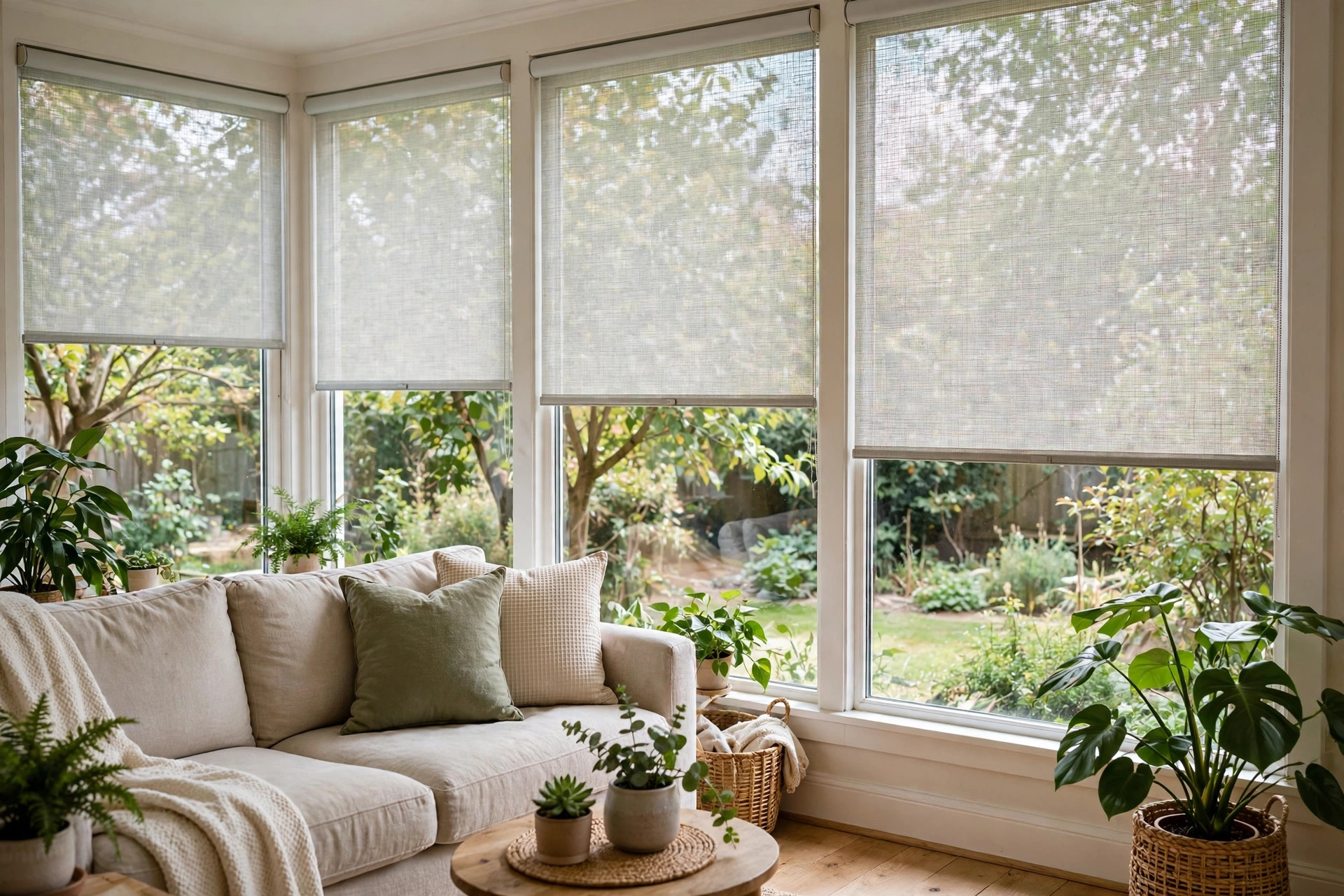

A sunroom is a happy room. It brings the garden indoors. But on a hot summer day it can turn into a furnace. The best solar shades for sunrooms buying guide starts with one simple truth: glass lets in light and heat at the same time. Solar shades let you keep the light and cut the heat. This guide shows you how to choose them, what they cost, and how to care for them.
Why Solar Shades Matter in a Sunroom
A sunroom is mostly glass. Walls of glass. Often a glass roof. That glass traps heat. Temperatures can climb twenty or thirty degrees above the rest of the house. Furniture fades. Plants wilt. People leave the room by noon.
Solar shades are made for this problem. They are woven screens, not solid fabric. Tiny holes in the weave let you see the yard outside. At the same time the weave blocks most of the sun’s heat. A room can drop several degrees with shades drawn. Energy bills fall because the air conditioner works less.
They also cut glare. A sunroom at midday can be too bright to read a book or play cards. Solar shades soften the light. The view stays. The harsh white glare goes away.
Sunrooms also face a second problem in winter. Glass loses heat fast. Solar shades will not insulate like heavy drapes. They are a summer tool first. Know this before you buy. If you want winter warmth, you may need a second layer, like cellular shades or heavy curtains. For top rated pinch pleat drapes for small apartments, a different guide will serve you better.
How to Choose Solar Shades for a Sunroom: Best Solar Shades for Sunrooms Buying Guide
Start with the openness factor. This is the most important number. Openness means how much of the fabric is open space. A 1 percent openness blocks 99 percent of light and heat but you can barely see through it. A 10 percent openness gives a clear view but lets in more heat.
For most sunrooms, 3 to 5 percent openness is the sweet spot. You can see the garden. The heat drops. The glare fades. Choose 1 percent only if the room faces harsh western sun and gets unbearable in the afternoon.
Next, look at the color. Light colors reflect heat. Dark colors absorb it but give a sharper view with less glare. A white or cream shade keeps a room coolest. A dark bronze or charcoal shade gives the clearest view of the yard. Gray sits in the middle and works well in most rooms.
Measure each window carefully. Sunroom windows come in odd sizes. Tall narrow panels. Angled tops under a glass roof. Measure width and height at three spots. Use the smallest number. Inside-mount shades need the window frame to be deep enough. Most sunroom frames are fine for an inside mount, which looks cleaner.
Think about how you will lift them. Cordless shades are the modern standard. You push up or pull down by hand. They are safer for children and pets. Corded shades cost less but have cords that can tangle. Motorized shades are the luxury choice. You press a button or use a phone app. For tall sunroom windows, motorized shades save you from climbing on chairs. Brands like Lutron and retailers such as Blinds.com sell both manual and motorized options, and IKEA carries simple cordless styles at low prices.
Types and Options
Solar shades come in a few main forms. Each suits a different sunroom.
Roller solar shades are the most common. A single sheet of screen fabric rolls around a tube at the top. You pull it down when the sun is strong. They are simple, cheap, and easy to clean. Most sunrooms do fine with plain roller shades.
Dual or layered shades pair a solar screen with a second fabric. Day and night in one shade. The solar layer handles the afternoon sun. The second layer, often a soft fabric, gives privacy at night. If your sunroom faces a neighbor, this is worth the extra money.
Exterior solar shades mount outside the glass. They stop heat before it enters. They work better than any indoor shade. But they cost more, need a sturdy mount, and face weather. Rain and wind wear them down. For most homeowners, interior shades are enough.
Sloped or skylight shades fit angled glass roofs. A standard roller shade cannot hang straight on a slope. Skylight shades use side rails to hold the fabric flat. If your sunroom has a glass roof, ask for shades made for sloped glass. Hunter Douglas is one well-known maker of skylight-ready shades, and big stores like Home Depot and Lowe’s stock roller and skylight models you can see in person.
Cost and Price
Solar shades are among the cheapest window treatments per window. A basic roller solar shade for a standard window runs about twenty to fifty dollars. Wide or custom sizes run fifty to one hundred fifty dollars. A large sunroom may have ten or fifteen windows. The total adds up fast.
Cordless shades cost a little more than corded ones. The difference is small and worth it for safety. Motorized shades are the big jump. Expect one hundred fifty to four hundred dollars per window with a motor. A full motorized sunroom can run into the thousands.
Custom sizing raises the price. Sunrooms often need it. Standard store shades come in fixed widths. If your windows are odd, order custom. It costs more but fits right. Poor fit lets light leak around the edges and looks sloppy.
Watch for free shipping deals. Online shade sellers often ship free, which matters when you order fifteen shades. Guides on best bamboo roman shades with free shipping cover similar shipping tips for other shade types. For a full sunroom, a single order from Wayfair or a specialty seller can save a real sum on freight.
Labor is another cost. You can hang roller shades yourself with a drill and a level. A whole sunroom takes an afternoon. Motorized shades may need an electrician if they are hardwired. Battery-powered motors avoid that cost. The batteries need charging or replacing every year or so.
Care and Upkeep
Solar shades are easy to keep. Dust them once a month with a dry cloth or a soft brush attachment on a vacuum. The open weave catches dust. A quick pass keeps it from building up.
For spots, use a damp cloth with mild soap. Blot, do not scrub. Hard scrubbing can stretch the weave. Let the shade dry fully before rolling it up. A damp shade rolled tight can grow mildew.
Keep shades away from sharp objects. The screen fabric can snag. Pets with claws are the main risk. If a cat climbs the shade, you will see pulls in the weave. Train pets early or choose a tighter weave.
Check the roll mechanism once a year. A roller shade should roll up smooth and even. If it telescopes to one side, the fabric is off track. Unroll it fully and roll it back slowly, guiding it straight. Cordless spring mechanisms sometimes lose tension. Most have a small adjustment you can turn with a screwdriver.
Fabric may fade over years of strong sun. Light colors fade less. If a shade looks chalky or brittle, replace it. A good solar shade lasts five to ten years in a sunroom. Cheap ones last less. Spending a bit more up front often costs less over a decade.
Safety
Window cords kill children and pets every year. This is a serious matter. The Consumer Product Safety Commission has warned about corded window coverings for decades. Choose cordless or motorized shades for any home with small children or pets. If you already own corded shades, cut looped cords or fit them with tension devices that hold cords tight to the wall.
Heat is a second safety point. A sunroom without shades can reach dangerous temperatures. Elderly people and small children overheat fast. Shades are not just comfort. They are protection on the hottest days.
Fire safety matters too. Keep shades away from space heaters and candles. Screen fabric is not fireproof. Most solar shade fabrics meet basic flame standards, but keep open flames far from any window treatment.
Installation safety is simple. Use a stable ladder or step stool. Have someone hold it. Do not lean out of high windows to mount exterior shades. Call a professional for second-story exterior work.
FAQ
Do solar shades block the view of the garden? No. That is their main advantage. The woven screen lets you see out during the day. You keep your view of the yard, the birds, and the trees. At night the effect reverses. People outside can see in when your lights are on. Lower a second layer or close doors to the house for night privacy.
What openness factor is best for a sunroom? Three to five percent suits most sunrooms. It cuts heat and glare while keeping a clear view. Pick one percent for brutal western sun. Pick seven to ten percent if heat is mild and you prize the clearest view.
Can I install solar shades myself? Yes. Most roller solar shades mount with two brackets, a drill, and a level. Measure twice and drill once. A single shade takes about fifteen minutes. A full sunroom takes an afternoon. Motorized hardwired models are the exception. Hire an electrician for those.
Will solar shades lower my cooling bills? Yes, by a useful amount. They cut the solar heat that enters through glass. A sunroom can run several degrees cooler with shades drawn. Your air conditioner runs less. Exact savings depend on your climate, your glass, and how often you draw the shades. Energy Star and guides at The Spruce offer more background on how window coverings affect home energy use.
Do solar shades work on skylights and sloped glass? Standard roller shades do not. They hang straight down and will swing loose on a slope. You need shades made for skylights with side rails or tension wires. Order them to the exact size of the sloped panel. They cost more than flat-window shades but solve the glass-roof problem.
Are motorized solar shades worth the money? For a sunroom with many tall windows, yes. You raise and lower a dozen shades with one button. No cords, no climbing. Battery motors keep the cost down since no wiring is needed. If your sunroom has only a few low windows, manual cordless shades do the same job for far less money.
How do solar shades compare to real wood blinds? Solar shades give a clearer view and cut more heat with less bulk. Wood blinds give more privacy control and a classic look. Wood blinds cost more and need more cleaning. For a sunroom, solar shades usually win. For a formal room, wood may suit better. Our guide to affordable real wood blinds walks through the wood option in detail.
Do solar shades fade furniture less than bare glass? Yes. They block most ultraviolet rays. Ultraviolet light is what fades fabric, wood, and rugs. Your sunroom furniture, cushions, and floors will keep their color much longer with shades in place. This alone can pay for the shades if you have good furniture in the room.
A Short Final Word
The best solar shades for sunrooms buying guide comes down to three choices. Pick three to five percent openness. Pick a light color for heat or a dark color for view. Pick cordless or motorized for safety. Measure well, hang them straight, and dust them now and then. Your sunroom will stay bright, cool, and pleasant all summer long. For more ideas on dressing the rest of your home, HGTV has broad design inspiration worth a look.
References
Blinds.com. (n.d.). Window blinds, shades, and shutters. https://www.blinds.com ENERGY STAR. (n.d.). Energy efficient products. https://www.energystar.gov HGTV. (n.d.). Home and garden ideas. https://www.hgtv.com Hunter Douglas. (n.d.). Custom window treatments. https://www.hunterdouglas.com IKEA. (n.d.). Home furnishings. https://www.ikea.com Lowe’s. (n.d.). Home improvement products. https://www.lowes.com Lutron. (n.d.). Lighting and automated shade controls. https://www.lutron.com The Home Depot. (n.d.). Home improvement products. https://www.homedepot.com The Spruce. (n.d.). Home and garden advice. https://www.thespruce.com U.S. Consumer Product Safety Commission. (n.d.). Product safety information. https://www.cpsc.gov Wayfair. (n.d.). Furniture and home goods. https://www.wayfair.com
Was this guide helpful?

About Jennifer Lee
The My Garden US editorial team writes practical, in-depth home and garden guides for American homeowners — tested advice, no fluff.
You May Also Like
Energy Efficient Decorative Window Film Buying Guide
August 26, 2026 0 views
Where to Buy Sheer Voile Panels in Arizona
January 3, 2026 0 views
Top Rated Modern Geometric Curtains for Small Apartments
June 27, 2026 0 views