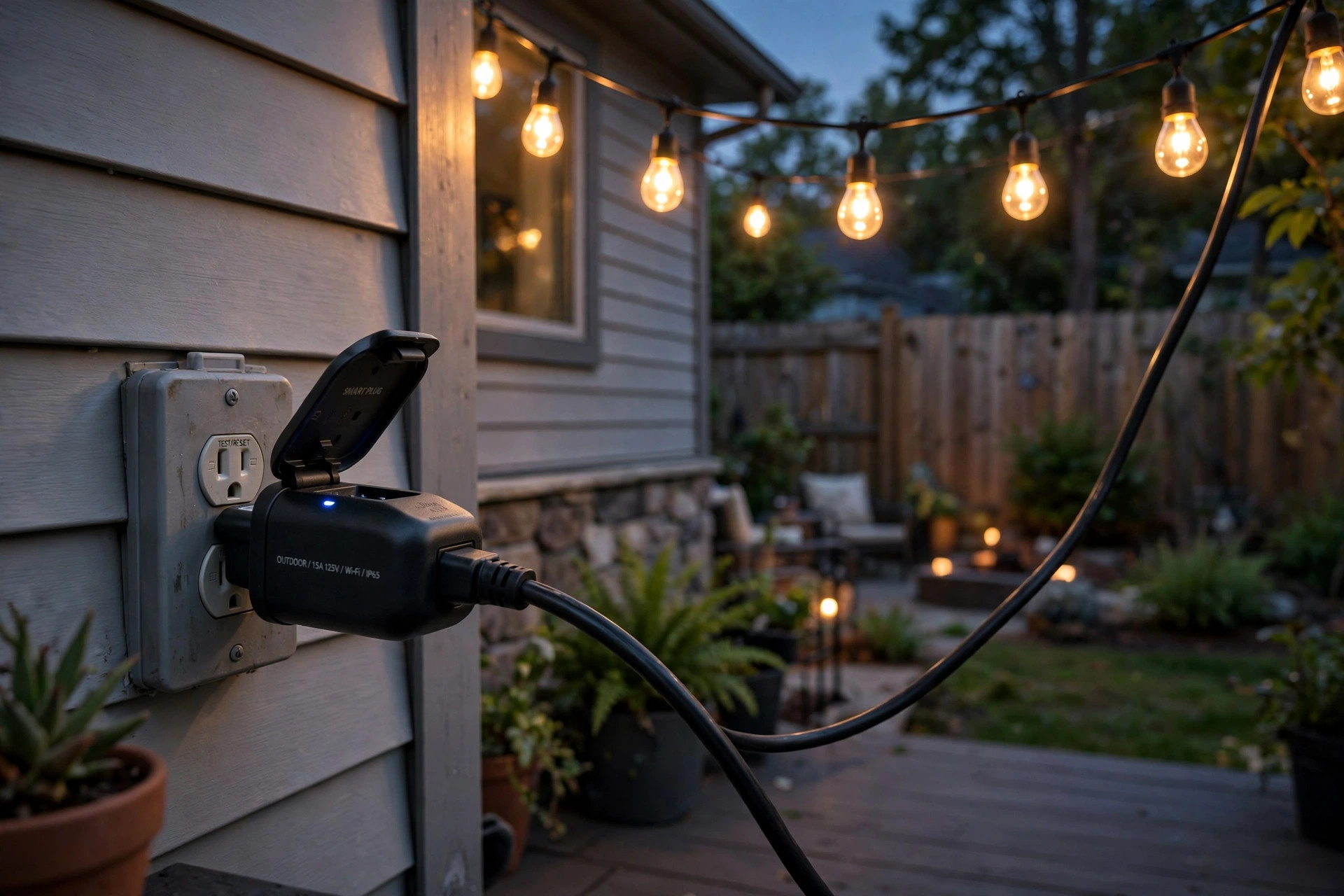

The best outdoor smart plug reviews 2026 usa look at one simple goal. You want to turn things on and off outside your home from your phone or your voice. It may be the porch light. It may be the string of lights over the patio. It may be the fountain in the garden or the decorations at the end of the year. An outdoor smart plug makes it easy. You plug it into an outside outlet. You plug your light or pump into it. Then you control it with an app, a schedule, or a voice command. This guide reads the reviews for you. It tells you what matters, what to look for, and what to avoid before you buy.
Why an Outdoor Smart Plug Matters
An ordinary outlet is always on. If you want the patio lights on at dusk and off at midnight, you must walk outside and flip a switch. In bad weather this is a bother. A smart plug does the job for you. You set a timer in the app. The lights follow the sun. Some plugs sense dusk and dawn on their own. Others link to your other smart home gear, so one command can light the yard and start the music.
Money matters too. A plug that turns the fountain pump off at night saves power. A plug that turns the heater for the dog house on only in the cold hours of winter saves more. Reviews show that people use outdoor smart plugs most for three things: lights, pumps and fountains, and holiday decorations. The right plug is one that stands up to rain and heat, holds a strong Wi-Fi signal through the walls of the house, and does not fail when the weather turns cold.
Security is another use. Lights that turn on and off on a schedule make a house look lived in when you are away. Reviewers pair plugs with doorbell cameras and outdoor cameras for a simple plan. The camera watches the drive. The plug lights the walk. Together they make the home safer. You can read more about outdoor cameras in our piece on best outdoor security camera without wifi subscription.
What to Look for When You Choose: Best Outdoor Smart Plug Reviews 2026 Usa
Reviews in 2026 agree on a short list of points. Work through them before you press the buy button.
Weatherproof Rating
This is the first thing to check. The rating looks like IP44, IP65, or IP66. The first number is dust. The second number is water. IP44 means the plug resists splashes. IP65 means it stands up to jets of water from any side. IP66 goes further still. For a plug under an eave, IP44 may be enough. For a plug out in the open yard, IP65 is the safer pick. Check the safety notes at cpsc.gov for guidance on safe outdoor electrical use.
Number of Outlets
Many outdoor smart plugs give you two outlets in one unit. This is a good deal for the price. You can run the patio lights from one side and the fountain from the other. Each side often has its own timer. Some models give you one outlet only, but with a smaller body that fits in tight outlet boxes. Think about what you will plug in before you buy.
Wi-Fi Range and Band
Outdoor plugs live far from the router. The signal must pass through walls. Most plugs use 2.4 GHz Wi-Fi, which travels farther than 5 GHz. Reviews warn that some plugs set up only on 2.4 GHz, so you may need to switch your phone to that band during setup. A plug with a good antenna holds the signal at the far end of the yard. If your yard is large, a plug placed close to the house is wiser than one at the fence.
Power Rating
Every plug has a limit, often 15 amps or about 1,800 watts for a standard model. Holiday light strings draw little. A space heater or a large pump draws more. Add up the watts of what you will plug in. Stay well under the limit. Reviews tell of plugs that failed because the user ran two heaters from one outlet pair. The Consumer Reports buying guides stress matching the load to the rating.
App Quality and Voice Control
The best hardware can be spoiled by a bad app. Look for reviews that praise a stable app. Check that the plug works with the voice system you already use. Many plugs work with Alexa and Google Home. Some also work with Apple HomeKit. The Google Store lists devices that work with Google Home. Keep your current system in mind so all your devices answer to one command.
Timer and Schedule Options
Look for countdown timers, daily schedules, and dusk-to-dawn control. The better plugs let you set random times, which is useful when you travel. The lights do not follow the same pattern every night, and that is the point.
Types of Outdoor Smart Plugs
Single-Outlet Plugs
These are the small ones. One outlet, one device. They are cheap and simple. Good for a single string of lights or one decoration. They fit where space is tight.
Dual-Outlet Plugs
The most common type in the reviews. Two outlets, often with separate control for each. The body is larger and weather sealed with rubber flaps over each socket. This is the best pick for most buyers.
Plugs With Energy Monitoring
Some models report how much power flows through them. You can see in the app what the fountain costs to run each month. This is a nice extra. It is not needed for basic use.
Hub-Free vs Hub-Based
Most modern plugs connect straight to Wi-Fi. No hub needed. A few work through a smart home hub. If you already own a hub for lights and sensors, a hub-based plug may fit your system better. For most homes, hub-free is simpler.
Cost and Price
Prices for outdoor smart plugs in the United States are fair. Basic single-outlet models run about ten to fifteen dollars. Good dual-outlet weatherproof models run about twenty to thirty dollars. Models with energy monitoring or HomeKit support can run thirty to forty dollars. Packs of two often cut the price per plug.
Reviews make one point clear. The cheapest plug is rarely the best deal. Buyers of very cheap plugs report weak seals, poor apps, and outlets that die after one season in the rain. A mid-price plug from a known brand lasts longer. That is the better use of your money. Check current prices at CNET and PCMag roundups, which track deals across the year.
Care and Upkeep
An outdoor smart plug needs little care, but a few habits keep it safe.
Keep the socket covers closed when outlets are not in use. This keeps rain and insects out. Wipe the body now and then to clear dust and spider webs. In winter, check that ice has not formed around the seals. If the plug stops responding, unplug it, wait a minute, and plug it in again. Most reviews say this simple restart fixes the problem.
Update the app when it asks. Makers send out fixes that keep the plug stable. If the plug is far from the house and the signal is weak, move the router nearer to that side of the house or add a Wi-Fi extender. Do not wrap the plug in a plastic bag to keep it dry. This traps heat and can cause damage. Buy a plug with the right weather rating instead.
Safety
Outdoor plugs mix power and water, so safety is not a small thing. Only buy plugs listed by a known testing body such as UL or ETL. The mark is printed on the body. Check your home outlet too. It should have a GFCI, the kind with the test and reset buttons. This is the outlet that cuts power in a fault and keeps you safe.
Do not plug a smart plug into an extension cord and run it across the yard if you can avoid it. Long cords in the grass are a trip hazard and a fire risk. If you must use a cord, use one rated for outdoor use and keep the connections off the ground. In a storm with lightning, unplug sensitive gear. The safety pages at cpsc.gov explain outdoor electrical safety in full.
Read the Verge smart home coverage for news on standards such as Matter, which now lets plugs from different makers work in one system. This is good for safety in another sense. A plug that follows an open standard is less likely to be left behind by its maker.
How to Set One Up
Setup is the same for most models. It takes about ten minutes.
1. Plug the smart plug into the outside outlet. Keep the covers closed. 2. Download the maker app and create an account. 3. Put your phone on the 2.4 GHz Wi-Fi band if the app asks. 4. Follow the app to add the plug. It will find the plug and link it to your Wi-Fi. 5. Name the plug, such as “Patio Lights.” 6. Set a schedule or timer. Test it by turning the outlet on and off in the app. 7. Link the app to your voice system if you want voice control.
If the plug will not connect, move it closer to the house for setup, then move it back. Many users report that setup works near the router and the plug stays linked once placed outside.
FAQ
Can outdoor smart plugs stay outside all year?
Most are made to stay out in rain and snow. Check the rating and the temperature range on the box. In very cold areas, some plugs lose Wi-Fi range in winter. A plug rated for cold weather holds up better.
Do I need a hub?
Most new models need no hub. They connect straight to your Wi-Fi. If your system is built on a hub, check that the plug works with it before you buy.
Will they work with Alexa and Google Home?
Most do. Check the product page for the voice systems you use. Some also work with Apple HomeKit, but fewer outdoor models do. The Google Store and Ring pages show which devices join each system.
How far can the plug be from the router?
It depends on your walls and yard. Most reviews report a good link up to about fifty to one hundred feet. Thick brick or concrete walls cut the range. A plug on the far side of a large house may need a Wi-Fi extender.
Are they safe in the rain?
A listed plug with the right IP rating is made for rain. Make sure the outlet covers are closed and the plug is mounted with the outlets facing down where possible. Never open the seals while it rains.
Can I use one for a space heater?
Check the watt rating first. Many space heaters draw 1,500 watts, which is close to the limit of a 15-amp plug. Reviews advise against running a heater through a smart plug unless the plug is clearly rated for it. A heater with its own thermostat is the safer choice.
A Short Final Word
The best outdoor smart plug is not the one with the most features. It is the one with a true weather seal, a strong Wi-Fi link, and an app that works every time. Dual-outlet models give the most use for the money. Buy a known brand, match the power rating to your load, and set your schedules. Then the patio lights will be waiting when you come home.
If you are building a fuller outdoor system, look at our wireless outdoor security camera reviews 2026 for cameras that pair well with timed lighting, and our ring vs nest doorbell comparison 2026 usa if the front door is next on your list. For whole-home security plans, SimpliSafe and ADT both offer systems that sit well beside simple smart plugs.
References
ADT. (n.d.). Home security and automation. https://www.adt.com CNET. (n.d.). Technology news and reviews. https://www.cnet.com Consumer Reports. (n.d.). Product reviews and ratings. https://www.consumerreports.org Google Store. (n.d.). Smart home devices. https://store.google.com PCMag. (n.d.). Technology product reviews. https://www.pcmag.com Ring. (n.d.). Smart home security devices. https://www.ring.com SimpliSafe. (n.d.). Home security systems. https://www.simplisafe.com The Verge. (n.d.). Technology news and reviews. https://www.theverge.com U.S. Consumer Product Safety Commission. (n.d.). Product safety information. https://www.cpsc.gov
Was this guide helpful?

About James Carter
The My Garden US editorial team writes practical, in-depth home and garden guides for American homeowners — tested advice, no fluff.
You May Also Like
Generator Interlock Kit Installation Cost USA
March 31, 2026 0 views
Smart Home Setup Service Cost USA 2026: A Practical Price Guide
June 19, 2026 0 views
Interconnected Smoke Alarms Code Requirements USA
March 10, 2026 0 views