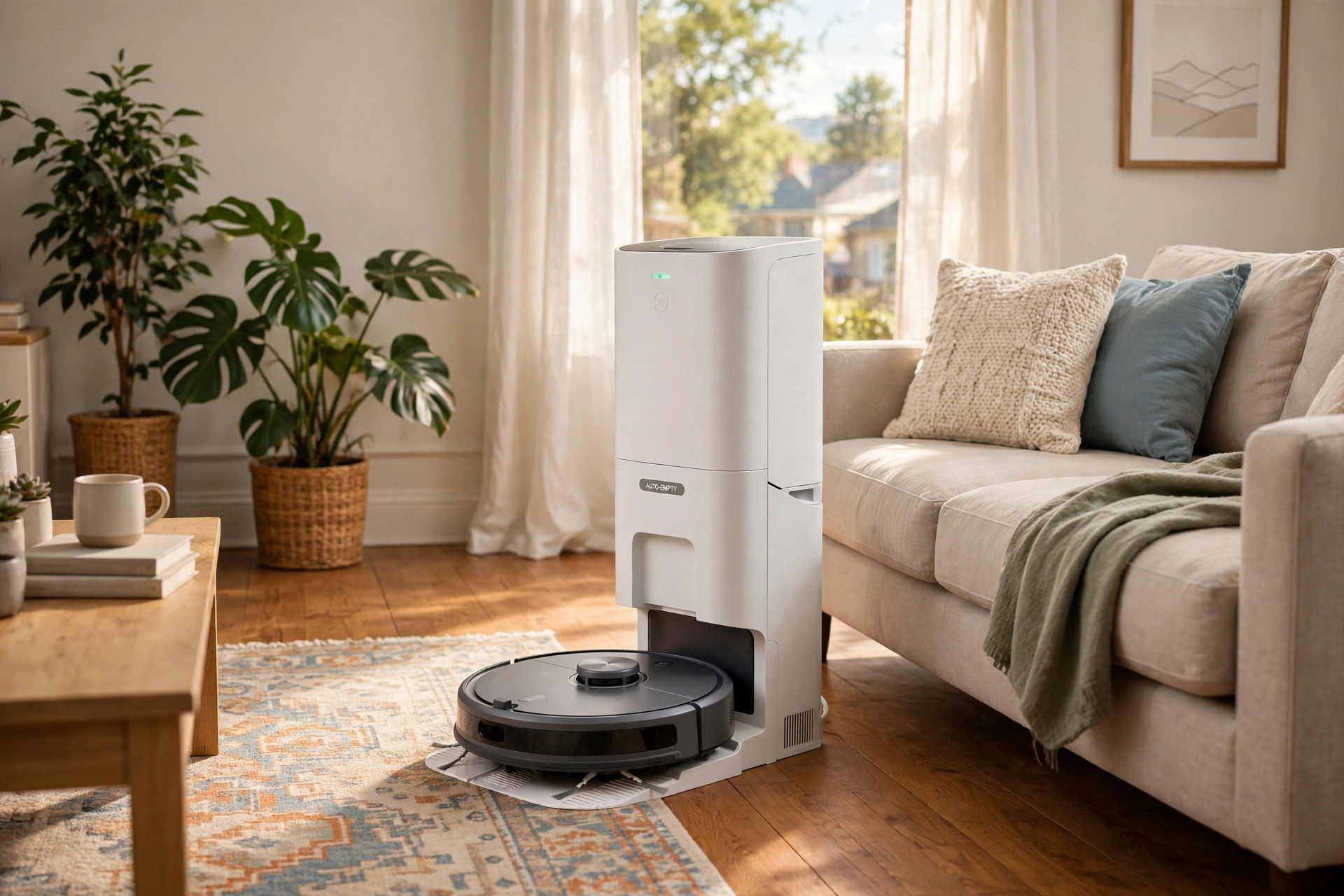

A house stays clean only when someone cleans it. That is the plain truth. The best self emptying robot vacuum reviews USA shoppers read each year all point to the same wish. People want clean floors without daily work. A self emptying robot vacuum offers that promise. It sweeps the floor by itself. Then it returns to a base station. The base station pulls the dirt out of the robot and stores it in a sealed bag. You throw the bag away once every month or two. This article explains what these machines do, what to look for, what they cost, and how to keep one running well.
Why a Self Emptying Robot Vacuum Matters
Time is the reason. A standard upright vacuum asks for your time every week. A robot vacuum asks for it only now and then. The self emptying base makes the difference even larger. With a normal robot vacuum, you must empty a small dust bin after every run or two. Many owners forget. A full bin means weak suction and poor cleaning. A self emptying base solves this problem. The base has a large bag or bin that holds weeks of dirt. The robot empties itself each time it docks.
Homes with pets gain the most. Dogs and cats shed hair every day. A robot vacuum that handles pet hair well keeps that hair off rugs and floors. When the base empties the robot on its own, the owner does not touch pet hair for weeks. Allergy sufferers also gain. Sealed bags trap dust, pollen, and dander. You do not breathe in a cloud of dust when you empty a small bin over a trash can. Consumer advocates who test home products have noted that sealed disposal systems lower the dust that returns to the air during emptying. You can read general testing methods at Consumer Reports.
Busy families gain too. A parent with small children has little time for daily sweeping. A retired couple may find that bending over a dust bin is hard work. A self emptying robot vacuum fits both lives. You set a schedule in the phone app. The machine cleans while you are at work or while you rest. It is not a full replacement for a deep cleaning, but it keeps daily dirt under control. Reviews in tech publications such as PCMag often stress that these machines are best seen as helpers, not replacements, for a full size vacuum.
What to Look for When You Choose: Best Self Emptying Robot Vacuum Reviews Usa
Reviews of self emptying robot vacuums in the United States tend to test the same points. These are the ones that matter most in daily use.
Suction power comes first. Suction is measured in pascals. Higher numbers mean stronger pickup on carpet. For hard floors, even modest suction does the job. For medium pile carpet, look for stronger numbers. Reviewers at CNET have shown that brush design matters as much as raw suction. A good rubber brush roller pulls hair off carpet without tangling.
Navigation comes second. Older machines bounce around at random. Newer machines build a map of your home. They clean in straight lines and remember where they have been. Some use laser towers. Others use cameras. Laser models work well in the dark. Camera models can struggle in a dark room. A mapped machine also lets you draw no go zones in the app. You can keep it out of the dog bowl area or away from a fragile rug.
The base station comes third. Check how long the bag or bin holds dirt. Most hold thirty to sixty days of debris. Bagged bases seal dirt better. Bagless bases save the cost of bags but can puff dust when you empty them. Also check the size of the base. Some base stations are tall and wide. Measure the spot where you plan to put it. A tall base will not fit under a low table.
Battery life and coverage come fourth. Most machines run for ninety to one hundred eighty minutes per charge. That is enough for a medium size home. If your home is large, the robot should return to charge and then continue where it left off. Almost all mapped models do this.
Noise comes fifth. Emptying cycles are loud. The base runs a strong motor for ten to fifteen seconds to pull dirt from the robot. This sound can startle a pet. If your dog fears loud sounds, schedule emptying for times when you are home to calm the animal, or check whether the app lets you pick a quieter empty mode.
Types and Options You Will Find
Not all self emptying robot vacuums are built the same. The main groups are described below.
Standard Self Emptying Models
These are the most common. The robot vacuums and mops lightly, or vacuums only, and empties into the base. They suit apartments and small houses. They cost less than the larger models. They handle hard floors and low pile rugs with ease.
Robot Vacuum and Mop Combos
Many newer machines mop as well as vacuum. They drag a damp pad or spin two mop pads over hard floors. The better base stations wash and dry the mop pads too. These are useful in homes with tile or wood floors. A review of robot mop combos can help you see how the mopping feature performs in real kitchens. Keep in mind that robot mopping is light work. It handles daily footprints, not stuck on stains.
High End Mapping Models
Top models build precise maps and recognize objects. They can steer around shoes, cords, and pet accidents. Some raise their mop pads when they sense carpet. These features cost more. They pay off in homes with many rooms or many obstacles on the floor.
Brand Ecosystems
Two brand names appear in nearly every comparison. A comparison of the two leading brands shows how their maps, apps, and base stations differ. Some buyers prefer to stay in one brand family so that one app controls many devices. Smart home platforms also matter. A vacuum that answers to voice commands through a smart speaker fits well in a connected home. The Google Store lists devices that work with its voice assistant, and Ring shows how home devices can share one app.
Cost and Price
Prices in the United States fall into three rough bands. Entry level self emptying models sell for about two hundred fifty to four hundred dollars. They vacuum well but mop poorly or not at all. Their maps are simple. Mid range models sell for about four hundred to seven hundred dollars. They map well, mop decently, and often have object avoidance. High end models sell for seven hundred to over one thousand dollars. They wash their own mop pads, dry them with hot air, and steer with great care.
Do not judge by price alone. Read reviews that test cleaning on both carpet and hard floor. A cheap model with a good brush can beat a costly model with a weak one. Watch for sales. Prices drop sharply around major shopping holidays. Replacement bags cost about fifteen to twenty five dollars for a pack of three or six. One bag lasts a month or more in most homes. Add this cost to your yearly budget. Filters and brushes also wear out. A yearly parts cost of forty to eighty dollars is normal.
Care and Upkeep
A self emptying robot vacuum needs little care, but it needs some. The base bag must be changed when full. The app will tell you. Do not wait too long. An overfull bag strains the base motor.
Clean the brush roller once a week. Hair wraps around it. Most rollers pop out without tools. Cut away hair with the small tool that comes in the box. Wipe the sensors with a dry cloth. Dirty sensors make the robot bump into walls. Empty and rinse the mop water tanks if your model has them. Change the water after each mopping run so it does not sour.
Reviews of robot vacuums that also mop show that the mopping bar can smear dirty water if the pad is not changed. Rinse or swap pads often. A clean pad gives a clean floor. If your model has a dirty water tank, pour it out after each run and let it air dry with the lid open. Check the wheels for tangled thread. Keep cords and small toys off the floor before a run. The robot will last longer and clean better. Most machines run well for three to five years with this basic care.
Safety
Robot vacuums are safe when used with care. The United States Consumer Product Safety Commission tracks injuries from home products and posts recalls. You can check its site at CPSC before you buy. Register your product with the maker so you hear about recalls.
Keep the charging base against a wall on a level floor. Do not place it where it can get wet. Do not let children ride on the robot. The machine is not a toy. Keep pets in mind during the loud emptying cycle. Some animals panic at the sound. Run the first few cycles while you are home to watch how your pet reacts.
The sealed bags help people with dust allergies, but they do not remove all risk. Wear a simple dust mask when you change a bag if you are sensitive. Wash your hands after handling a full bag. Unplug the base before you clean inside it.
Home security devices share the same network as many robot vacuums. A safe home network protects all of them. Use a strong WiFi password. Keep the robot app updated. Makers of home security systems, such as SimpliSafe and ADT, give the same advice for cameras and alarms. Tech news sites like The Verge also remind readers to update smart home apps on time.
Frequently Asked Questions
How long does the dust bag in the base last?
In most homes, one bag lasts thirty to sixty days. Homes with several shedding pets may fill a bag in three weeks. The app tracks fullness and sends an alert.
Do self emptying robot vacuums work on carpet?
Yes. They work best on low and medium pile carpet. On thick, shaggy rugs they can struggle. Strong suction and a rubber brush roller give the best results on carpet.
Are they much louder than regular robot vacuums?
The vacuuming sound is about the same. The emptying cycle is louder. It lasts ten to fifteen seconds. You can schedule cleaning and emptying for times when the noise will not bother you.
Can a robot vacuum replace my full size vacuum?
Not fully. It handles daily dirt and keeps floors neat between deep cleanings. For stairs, car seats, and heavy messes you still need a full size machine.
Do I need WiFi to use one?
You need WiFi for the app, maps, and schedules. Some models have a basic clean button that works without WiFi. Without the app you lose maps and no go zones.
A Short Final Word
The best self emptying robot vacuum reviews USA buyers can find all end in the same place. Match the machine to your home. Small apartment with hard floors needs little. Large house with pets and carpet needs more. Read tests from trusted reviewers. Check the cost of bags and parts. Then set a schedule and let the machine do the daily work. Your floors will stay cleaner, and your hands will stay free.
References
ADT. (n.d.). Home security and automation. https://www.adt.com CNET. (n.d.). Technology news and reviews. https://www.cnet.com Consumer Reports. (n.d.). Product reviews and ratings. https://www.consumerreports.org Google Store. (n.d.). Smart home devices. https://store.google.com PCMag. (n.d.). Technology product reviews. https://www.pcmag.com Ring. (n.d.). Smart home security devices. https://www.ring.com SimpliSafe. (n.d.). Home security systems. https://www.simplisafe.com The Verge. (n.d.). Technology news and reviews. https://www.theverge.com U.S. Consumer Product Safety Commission. (n.d.). Product safety information. https://www.cpsc.gov
Was this guide helpful?

About Emily Rodriguez
The My Garden US editorial team writes practical, in-depth home and garden guides for American homeowners — tested advice, no fluff.
You May Also Like
Best Video Doorbell Without Subscription USA: A Practical Guide
August 3, 2026 0 views
Smart Under Cabinet Lighting Reviews 2026 USA
July 23, 2026 0 views
Robot Lawn Mower Reviews for USA Yards
April 19, 2026 0 views