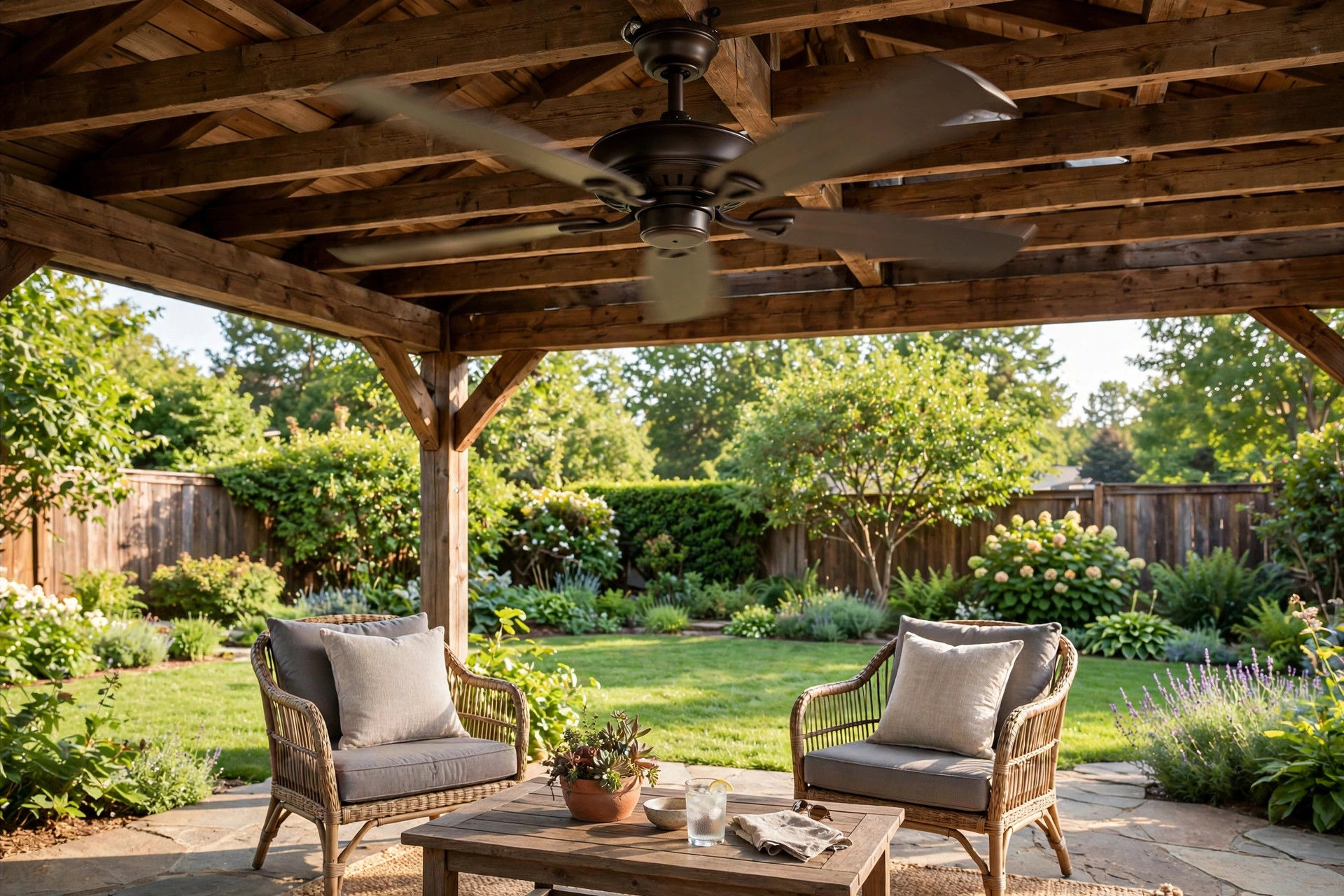

A search for the best outdoor ceiling fan for patio usa buyers usually starts on a hot July evening. The grill is cooling. The air on the porch does not move. A fan on the ceiling would make the whole space usable. The good news is that makers now build fans just for the outdoors. The right model will stand up to rain, wind, and salt air for many years.
This guide walks through the whole purchase in plain terms. It covers wet and damp ratings, blade size, motor types, light kits, and price. It also covers care and safety. By the end, a buyer will know what to look for and what to skip.
Why It Matters
Heat keeps many patios empty in summer. A ceiling fan does not cool the air. It cools the people under it. Moving air takes heat from the skin. The body feels cooler. The effect is real and fast. A Www.familyhandyman.com notes that good air movement can make an 85-degree porch feel like a 78-degree room.
Shade plus a fan is the best mix. The fan moves air across a shaded seating area. Mosquitoes dislike moving air. Guests stay longer. The patio becomes a second living room. Without a fan, the same patio may sit unused from June to September.
Indoor fans do not belong outside. Rain ruins indoor motors. The blades warp. The wiring corrodes. A fan that lacks the right rating can become a hazard. Outdoor-rated models seal the motor and use rust-proof hardware. That is the core difference. Shoppers should compare The Home Depot to see which models carry wet and damp ratings before they decide.
What to Look For: Best Outdoor Ceiling Fan for Patio Usa
Damp Rating vs. Wet Rating
This is the most important detail. Outdoor fans carry one of two labels. A damp-rated fan is built for covered patios. It can handle humidity and mist but not direct rain. A wet-rated fan can stand direct rain and even a garden hose. Underwriters Laboratories tests these ratings. The label is usually on the box and on the fan housing.
A covered porch with a full roof can use a damp-rated fan. An open pergola or a lanai with no roof needs a wet-rated fan. When in doubt, buy wet-rated. The price gap is small. The peace of mind is large.
Blade Size and Span
Blade span is measured in inches across the full circle. Most outdoor fans come in 44, 52, or 60 inches. The size should match the space. A small porch of about 75 square feet suits a 44-inch fan. A medium patio up to 175 square feet suits a 52-inch fan. A large open lanai suits a 60-inch fan or even two fans.
Blades on outdoor fans use treated wood, molded plastic, or coated metal. Real wood must be sealed for outdoor use. Cheap blades warp in the first season. Look for blades marked for exterior use.
Motor Type
The motor is the heart of the fan. Most outdoor fans use AC induction motors. They cost less. They run at three or four fixed speeds. Better models use DC motors. A DC motor uses less power. It offers more speeds, often six or more. It runs quieter. DC motors cost more up front but save money on power over the years.
Look for a sealed, corrosion-resistant motor. Stainless steel or powder-coated parts last longer near pools and coasts. The Www.energystar.gov lists ceiling fans that meet strict efficiency rules. An ENERGY STAR model moves more air per watt.
Mounting and Downrod Length
Patio ceilings vary. Porches may have a flat roof. Pergolas may have open beams. The fan needs the right mount. Most outdoor fans ship with a short downrod for flat ceilings. A sloped ceiling needs an angled mount adapter.
Blades should hang at least seven feet above the floor. Most codes require this clearance. An eight-foot ceiling takes a short downrod. A tall pergola may need a downrod of two feet or more. Measure first. Buy the rod that fits.
Controls and Light Kits
A remote control is worth the price outdoors. Wall switches may sit far from the seating area. Many outdoor fans include a handheld remote. Some offer a wall remote. A light kit helps when the patio stays in use after dark. Look for enclosed light kits that keep water out.
Shoppers who like bundled controls may also want to read about a Ceiling fan with light and remote reviews usa for indoor-outdoor use cases. The same remote technology now ships on most quality outdoor models.
Types and Options
Outdoor ceiling fans come in a few broad styles. Each suits a different setting.
Traditional five-blade fans are the common choice. They move a lot of air. They fit classic porches and farmhouse patios. They come in bronze, white, black, and nickel finishes.
Contemporary three-blade fans move air faster per blade. They suit modern patios with clean lines. They often use DC motors and quiet settings.
Caged fans have a metal cage around the motor and blades. The cage keeps hands and pool toys away from the blades. They suit homes with small children. They also suit low ceilings near play areas.
Windmill-style fans use wide wooden blades. They look like old farm windmills. They move large volumes of air slowly. They suit barns, large lanais, and rustic porches.
Some brands sell the same model in indoor and outdoor versions. The outdoor version costs a bit more. The difference is in the seals and hardware. Never buy the indoor version to save money for a patio. A Consumer Reports warns that indoor fans used outdoors fail early and can void the warranty.
Cost and Price
Prices for outdoor ceiling fans in the United States cover a wide range. Basic damp-rated models start near forty dollars at discount stores. Mid-range wet-rated models run from one hundred to two hundred fifty dollars. Premium DC-motor models with remote and light kits run from three hundred to six hundred dollars.
Installation adds cost. A simple swap on an existing ceiling box may cost one hundred to two hundred dollars from a local electrician. A new installation that needs fresh wiring may cost three hundred to five hundred dollars. Buyers comparing big-box pricing can check Lowe’s and big-box competitors for current deals before they hire an installer.
Running costs are low. A standard AC fan uses about sixty to seventy-five watts on high. A DC fan uses about thirty watts. At average power rates, running a fan all evening costs a few cents. Fans also let a home cut air conditioning use in nearby rooms. That is where the real savings hide.
Warranty terms matter. Good brands offer ten-year or lifetime motor warranties. Cheap models may offer only one year. A long warranty signals that the maker trusts the seals and the motor. Keep the receipt. Register the product online.
Care and Upkeep
Outdoor fans need a small amount of care each year. The care takes less than an hour.
Dust and pollen build up on blades. Wipe the blades with a damp cloth each spring. Dry them after. A blade balance kit costs a few dollars. It fixes most wobble. Tighten all screws once a year. Outdoor vibration loosens hardware over time.
Check the downrod and mounting bracket each spring. Look for rust on the screws. Stainless steel hardware shows little rust. Cheap steel screws rust fast. Replace rusted screws at once. A loose mount is the main cause of fan noise.
Wash wet-rated fans with a garden hose at low pressure. Keep water away from the motor housing when possible. Damp-rated fans should be wiped by hand, not hosed. Never spray water into the light kit. Let the fan dry fully before turning it on.
Winter care depends on the region. In the Gulf Coast and Florida, fans run all year. In the North, cover the fan or let it sit idle. A breathable cover keeps dust off. Remove the cover in spring. Run the fan on high for an hour to blow out dust. Guidance from Www.thisoldhouse.com backs this seasonal routine.
Major HVAC makers also stress routine checks. Advice from Www.carrier.com and Www.lennox.com repeats the same point: small yearly maintenance stops big repair bills. The same holds true for a patio fan.
Safety
Safety with an outdoor fan starts at the ceiling box. The box must be rated for fan support. A standard light box is not enough. A fan-rated box carries the extra weight and the motion. An electrician can swap a box in under an hour.
Turn off the breaker before any work. Use a voltage tester. Do not trust the wall switch alone. Outdoor circuits may feed several outlets. The breaker is the only safe shutoff.
Keep blades clear of railings and beams. Seven feet of clearance above the floor is the rule. Eight inches of clearance between blades and ceiling is the norm. Both rules appear in most local codes.
Wet-rated fans are safe in rain. Damp-rated fans are not safe in direct rain. The rating label decides. If the label has worn off, assume damp and keep it dry. The U.S. Department of Energy publishes general guidance on efficient cooling that notes fans work best with shades and cross-ventilation, which also lowers electrical load.
Near salt water, rinse the fan with fresh water every few months. Salt corrodes metal fast. Stainless hardware helps but is not immune. Coastal homes should pick fans rated for marine use when they can.
Frequently Asked Questions
Can I use an indoor ceiling fan on a covered patio?
No. A covered patio still gets humid. Morning mist reaches the motor. Corrosion starts inside. The fan may run for a season and then fail. Worse, the wiring may corrode and create a shock risk. Buy a fan with at least a damp rating.
What size outdoor ceiling fan do I need for a 12 by 12 patio?
A 12-by-12 patio is about 144 square feet. A 52-inch fan suits this size. Place it at the center of the seating area. A very tall ceiling may call for two smaller fans instead of one large one.
Do outdoor ceiling fans keep bugs away?
Fans help. Mosquitoes are weak fliers. Moving air makes it hard for them to land. A fan will not remove every bug. It works best with screens and citronella candles. Many patio owners report far fewer bites with a fan running.
Can an outdoor ceiling fan run in the rain?
Only a wet-rated fan should run in rain. Wet-rated models seal the motor and wiring. Damp-rated fans should stay dry. Running a damp-rated fan in rain voids the warranty. It may also trip the breaker.
How long does an outdoor ceiling fan last?
A good outdoor fan lasts ten to fifteen years with basic care. Cheap models may last three to five years. The motor usually outlasts the blades. Salt air and harsh sun shorten the life. A long motor warranty is a good sign.
Should I choose a fan with a light?
A light kit helps for evening use. Enclosed LED kits use little power and stay cool. LED bulbs last for years. If the patio already has good lighting, skip the kit. The fan will cost less and look cleaner.
Homeowners planning wider outdoor comfort projects can also look at a Best fire pit for backyard reviews usa for warmth on cool nights, or Solar pool heater reviews for usa homes for pool owners who want longer swim seasons. A Www.trane.com and a Www.goodmanmfg.com both publish seasonal buying guides that place patio fans inside the broader home comfort picture.
A Final Word
The best outdoor ceiling fan for patio usa buyers is the one that fits the space, carries the right rating, and runs quiet. Start with the rating. Match the blade size to the patio. Pick a DC motor for quiet nights. Add a remote and a light kit for ease. With a small yearly cleaning, the fan will serve for a decade or more.
Related guides on this site include energy efficient mini split for 1500 sq ft, ductless mini split installation cost per zone, and best mini split for cold climates reviews usa.
References
Best fire pit for backyard reviews usa. (n.d.). Home and garden information. https://best-fire-pit-for-backyard-reviews-usa/ Carrier. (n.d.). Heating and cooling systems. https://www.carrier.com Ceiling fan with light and remote reviews usa. (n.d.). Home and garden information. https://ceiling-fan-with-light-and-remote-reviews-usa/ Consumer Reports. (n.d.). Product reviews and ratings. https://www.consumerreports.org ENERGY STAR. (n.d.). Energy efficient products. https://www.energystar.gov Family Handyman. (n.d.). DIY home repair and maintenance. https://www.familyhandyman.com Lennox. (n.d.). Heating and cooling systems. https://www.lennox.com Lowe’s. (n.d.). Home improvement products. https://www.lowes.com The Home Depot. (n.d.). Home improvement products. https://www.homedepot.com This Old House. (n.d.). Home renovation guidance. https://www.thisoldhouse.com U.S. Department of Energy. (n.d.). Energy efficiency and renewable energy. https://www.energy.gov Www. (n.d.). Home and garden information. https://www
Was this guide helpful?

About Emily Rodriguez
The My Garden US editorial team writes practical, in-depth home and garden guides for American homeowners — tested advice, no fluff.
You May Also Like
Garage Insulation Kit for Metal Doors USA: A Plain Guide for Homeowners
January 3, 2026 0 views
The Best Dehumidifier for Basement Use in the USA in 2026
January 16, 2026 0 views
Are HVAC Maintenance Plans Worth It? A USA Homeowner Guide
January 20, 2026 0 views