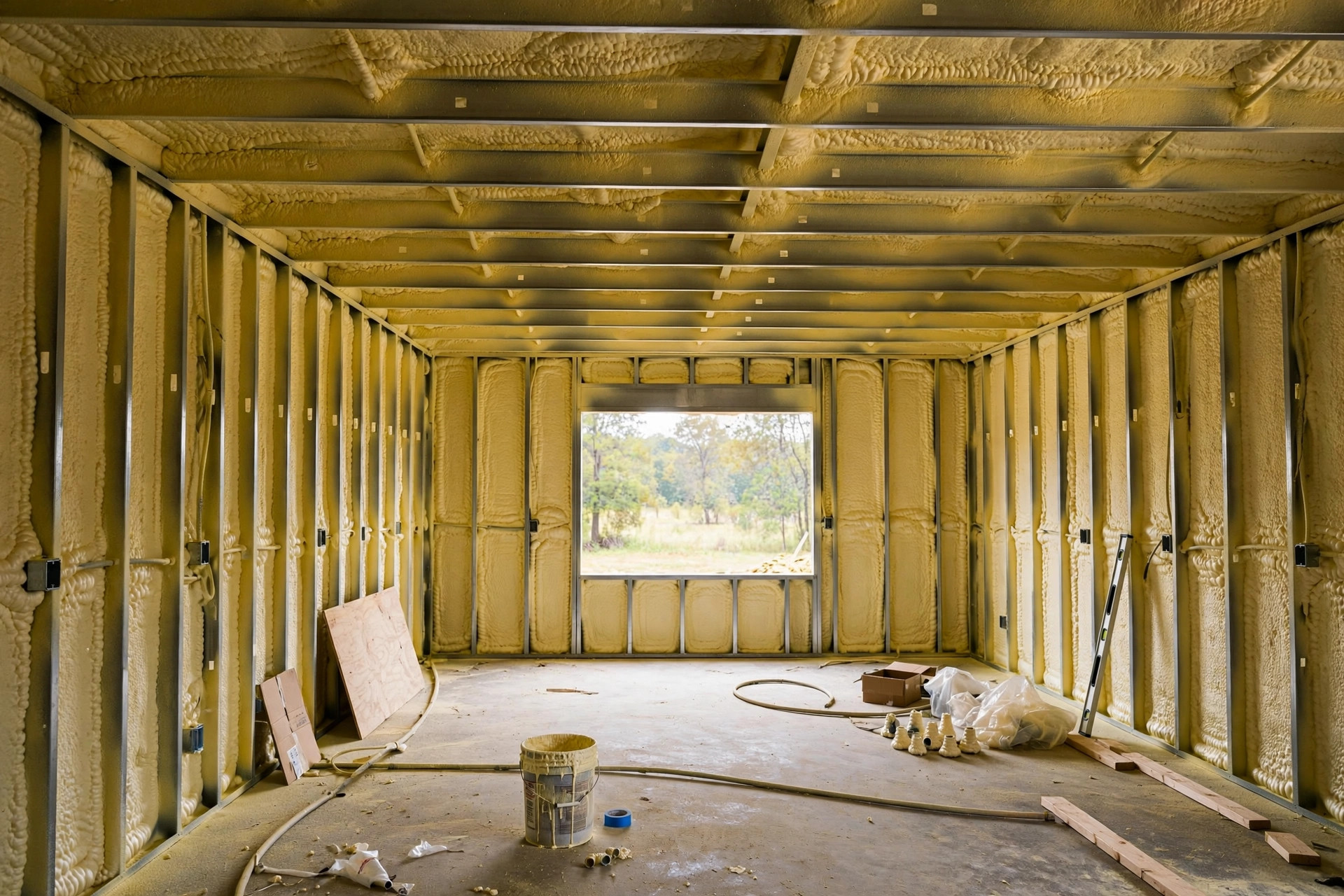

More Americans now live in metal building homes. Farmers turn barns into houses. Families build barndominiums on open land. Retirees choose steel shells because they go up fast and cost less than wood frames. Yet one problem follows nearly every metal home: the search for the best insulation for metal building homes usa owners can trust. Steel moves heat with great speed. In winter, walls turn cold and rooms lose warmth. In summer, the sun bakes the roof and heat pours inside. Warm moist air meets cold steel, and water beads form on walls and ceilings. This sweating can drip onto floors, feed mold, and rust the frame. Good insulation stops this chain of trouble. This guide explains the main types, the right R-values, the costs, and the safety rules, in plain words.
Why Metal Building Homes Need Special Insulation
A metal building home is not a wood frame house. Wood slows heat a little on its own. Steel conducts heat about 400 times faster than wood. Heat races through steel purlins and girts and slips past thin insulation in a process called thermal bridging. Wherever bare metal touches the inside air, that spot becomes a cold point, and moisture in the air condenses on it.
Condensation is the true enemy. A metal home in a humid state can sweat like a cold glass on a hot day. The water runs down walls, soaks drywall, and stains ceilings. Over time it can rust the steel skin and frame, and feed mold inside wall cavities, which harms indoor air.
Insulation does three jobs in a metal home. It slows heat flow so rooms stay warm in winter and cool in summer. It keeps interior surfaces warm enough that moisture does not condense on them. It also cuts noise, because rain on a steel roof sounds like drums without a sound barrier. Choosing the best insulation for metal building homes usa builders recommend means meeting all three needs at once.
Energy use matters too. An uninsulated metal building can cost twice as much to heat and cool as a well insulated one. The U.S. Department of Energy notes that proper insulation is one of the cheapest ways to cut home energy bills. A metal home owner who skips insulation pays for it every month.
What to Look For When You Choose Insulation: Best Insulation for Metal Building Homes Usa
R-Value That Fits Your Climate
R-value measures how well insulation resists heat flow. A higher number means better resistance. The right R-value depends on the climate zone. The Department of Energy publishes R-value guides for attics, walls, and floors by zone. A home in Minnesota needs far more insulation than one in Florida. For metal building homes, many builders aim for R-30 to R-49 in the roof and R-13 to R-21 in the walls, then adjust for local code.
Vapor and Condensation Control
R-value alone does not stop sweating. Moisture control matters just as much. The best insulation for metal building homes usa owners install in damp climates always includes a plan for vapor. A vapor retarder on the warm side of the insulation slows moisture from reaching cold steel. Some types, such as closed cell spray foam, act as their own vapor barrier. Others, such as fiberglass batts, need a separate facing or plastic sheet.
Fire Rating and Code Rules
Most local codes require insulation and its facings to meet fire standards. Spray foams must be covered by an approved thermal barrier such as drywall in living spaces. Fiberglass and mineral wool are naturally noncombustible, which is a plus. Before buying, check the local building code. Advice from seasoned remodelers, such as the editors at This Old House, often stresses pulling a permit and following code from the start.
Types of Insulation for Metal Building Homes
Spray Foam Insulation
Spray foam is the most common answer to the best insulation for metal building homes usa contractors suggest. Two kinds exist. Open cell foam is soft and light, with an R-value near R-3.7 per inch. Closed cell foam is dense and rigid, with an R-value near R-6.5 per inch, and it blocks water vapor on its own.
Foam sprays on as a liquid and grows to fill every gap. It sticks straight to the steel panels, which kills air leaks and stops thermal bridging across the purlins. Closed cell foam also stiffens the wall and adds racking strength. The downsides are cost and the need for a trained crew. The chemicals must be mixed and sprayed with care, and the crew must wear full protective gear. To learn more about pricing, see our guide on spray foam insulation cost per square foot.
Fiberglass Batt and Blanket Insulation
Fiberglass batts are the pink or yellow rolls seen in most American attics. They are cheap, easy to find, and simple to install between girts and purlins. Standard batts give about R-3.2 per inch. Metal building makers sell wide blanket systems with a white vinyl facing that stretches across the purlins before the roof panels go on.
Fiberglass works only when it stays dry and fills the space with no gaps. It does not stop air leaks or vapor without a facing. If condensation reaches it, it can sag and lose R-value. Still, for owners on a tight budget in dry climates, faced fiberglass blankets remain a fair choice. Makers such as Owens Corning publish R-value and install guides for their batts and blankets. Our guide on how much attic insulation do i need usa explains how to size the depth for your zone.
Rigid Foam Board Insulation
Rigid boards of polyisocyanurate, extruded polystyrene, or expanded polystyrene give R-4 to R-6.5 per inch. Builders fasten them to the outside of the steel frame or layer them inside, then tape the seams to form a continuous blanket. Because the boards run across the steel members, they break thermal bridging better than batts tucked between them.
Every seam must be taped or sealed, or air will slip through. The boards must be covered where code requires, since most foam plastics burn when exposed to flame. Many crews pair rigid boards with fiberglass to reach high R-values at lower cost.
Reflective and Radiant Barrier Insulation
Reflective insulation looks like bubble wrap coated in foil. It does not work by R-value. It works by reflecting radiant heat. In a hot attic under a steel roof, a radiant barrier facing an air gap can cut heat gain in a real way. It shines most in southern states where cooling bills dominate.
It needs an air gap of at least three quarters of an inch on the shiny side. Pressed tight against steel with no gap, the effect nearly vanishes. Radiant barriers serve best as a helper layer with foam or fiberglass in hot climates.
Loose-Fill and Blown-In Insulation
Loose-fill fiberglass or cellulose blows into attics and flat ceilings with a machine. It fills odd corners and works around pipes and wires. Cellulose gives about R-3.5 per inch, and blown fiberglass gives about R-2.5 per inch. In a metal home with a low slope ceiling, blown insulation on top of the ceiling deck is a cheap way to reach high R-values.
Loose-fill settles over the years, so installers add extra depth. It must never sit against a sweating steel surface with no vapor plan, or it will mat down and mold. A sealed ceiling with a vapor retarder below the fill keeps it dry.
Cost and Price Guide
Cost decides many insulation jobs. Prices below are rough 2026 figures for installed work in the United States, and they move with region and job size.
Spray foam costs the most. Open cell foam runs about $1.50 to $3.50 per square foot for a typical wall depth. Closed cell foam runs about $3.50 to $7.00 per square foot. A 2,000 square foot barndominium can cost $8,000 to $20,000 to foam fully, depending on depth and region.
Fiberglass blanket systems for metal buildings cost far less, often $1.00 to $2.50 per square foot installed. Standard batts for interior framed walls run $1.50 to $3.00 per square foot installed. Rigid foam boards run $2.00 to $4.50 per square foot installed, with thicker boards at the high end. Blown-in attic insulation is among the cheapest upgrades, often $1.50 to $3.50 per square foot for a deep fill.
Do not judge cost by price per square foot alone. Cheap insulation that leaves air leaks and condensation can rot a steel home from the inside. Many owners find that closed cell foam pays back through lower energy bills, fewer moisture repairs, and a quieter house. The Family Handyman site offers cost breakdowns and step guides that help owners compare bids.
Labor and prep add to the bill. Steel surfaces must be clean and dry before foam goes on. Always get three written bids, and ask each bidder how the system handles condensation, not just what R-value it reaches.
A tight, well insulated steel home can use a smaller heating and cooling system than a leaky one. Makers such as Carrier, Trane, Lennox, Rheem, and Goodman publish sizing guides that show how a tight envelope cuts equipment size. Owners who pair good insulation with right-sized equipment, such as a mini split for garage heating and cooling in a shop wing, often see the best total savings.
Care and Upkeep
Good insulation needs little care, but it is not fit and forget. Walk the home once a year and look for water stains on ceilings and walls. Stains point to a leak or a condensation failure. Check the roof from outside for loose fasteners and failed sealant, since a roof leak can soak insulation from above.
Keep gutters clear so water moves away from the slab and walls. Make sure bathroom and kitchen exhaust fans vent straight outside, not into the attic or wall cavity. Dumping moist air into the building shell feeds the very condensation the insulation was meant to stop.
Do not crush insulation. In attics, lay boards over joists before storing boxes, so the blown fill keeps its full depth. If a section of fiberglass gets wet, find and fix the water source first, then replace the wet batt.
Pest checks help too. Seal pipe and wire holes with caulk or foam, and keep grass trimmed back from the base of the steel walls. A dry, sealed shell stays a healthy shell.
Safety
Insulation work carries real hazards, and metal building homes add their own. Fiberglass fibers itch skin and irritate lungs, so wear long sleeves, gloves, goggles, and a dust mask rated for fine particles. Cellulose dust calls for the same gear plus good ventilation.
Spray foam is strictly pro work. The two liquid parts react with heat and give off fumes during spraying. Crews wear respirators with supplied air, full suits, and eye protection. Homeowners and pets must stay out of the building during spraying and for the reentry time the maker states.
Steel work adds fall and cut risks. Roof purlins are slick, and panel edges cut like knives. Anyone working above the ground needs fall protection and a steady lift or scaffold. Shut off circuits before drilling or fastening near wires, since steel conducts current.
Fire safety rounds out the list. Keep all foam plastics covered with the thermal barrier the code demands. Never leave exposed foam where sparks fly. When in doubt, ask the local building inspector before the job starts.
FAQ
What is the best insulation for a metal building home in a cold climate?
Closed cell spray foam leads in cold zones. It gives high R-value per inch, seals air leaks, and acts as its own vapor retarder, which stops condensation on cold steel. Pair it with enough depth to meet the local code R-value, and cover it with drywall for fire safety.
Can I use fiberglass batts in a metal building home?
Yes, but only with a strict moisture plan. Use faced batts or blankets with the facing toward the warm side, seal every air leak, and keep the steel ventilated where the design calls for it. In humid climates, foam or rigid board usually performs better and lasts longer.
How do I stop condensation in my metal building home?
Control moisture at the source and at the steel. Vent baths and kitchens outside, run a dehumidifier in damp months, and choose insulation that keeps interior steel surfaces above the dew point. Closed cell foam sprayed straight to the panels is the most sure method. Fix roof leaks fast, since liquid water beats any insulation.
Is spray foam worth the cost for a barndominium?
For most owners, yes. The upfront price runs two to four times the cost of fiberglass, but foam cuts energy bills, ends condensation, and quiets rain noise. Many owners recover the extra cost in five to ten years.
Do I need a vapor barrier with metal building insulation?
Most assemblies need one. Closed cell spray foam forms its own vapor retarder at common depths. Fiberglass and open cell foam need a separate vapor retarder on the warm side in cold climates. In hot humid climates the placement changes, so follow the Department of Energy zone guidance.
Can I insulate a metal building home myself?
A handy owner can install fiberglass batts, rigid boards, and reflective barriers with care. Blown-in attic fill rents by the day at many stores. Spray foam is not a DIY job. The chemicals, heat, and fumes demand trained crews with the right rigs and suits.
A Short Final Word
The best insulation for metal building homes usa owners choose is the one that beats condensation, meets the local code R-value, and fits the budget without cutting corners on air sealing. Closed cell spray foam wins on performance. Fiberglass and rigid boards win on price. Many fine homes use a mix: foam on the roof deck where sweating starts, and batts or boards on the walls. The Energy Star site offers free guides on sealing and insulating any American home.
References
Carrier. (n.d.). Heating and cooling systems. https://www.carrier.com ENERGY STAR. (n.d.). Energy efficient products. https://www.energystar.gov Family Handyman. (n.d.). DIY home repair and maintenance. https://www.familyhandyman.com Goodman. (n.d.). Heating and cooling equipment. https://www.goodmanmfg.com Lennox. (n.d.). Heating and cooling systems. https://www.lennox.com Owens Corning. (n.d.). Roofing and insulation products. https://www.owenscorning.com Rheem. (n.d.). Heating, cooling, and water heating. https://www.rheem.com This Old House. (n.d.). Home renovation guidance. https://www.thisoldhouse.com Trane. (n.d.). Heating and air conditioning. https://www.trane.com U.S. Department of Energy. (n.d.). Energy efficiency and renewable energy. https://www.energy.gov
Was this guide helpful?

About Jennifer Lee
The My Garden US editorial team writes practical, in-depth home and garden guides for American homeowners — tested advice, no fluff.
You May Also Like

The Best Dehumidifier for Basement Use in the USA in 2026
January 16, 2026 0 views
Barndominium Insulation Options and Costs USA
March 9, 2026 0 views
Floor Mounted Mini Split Reviews USA: A Plain Guide for 2026
September 14, 2026 0 views