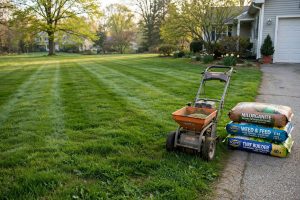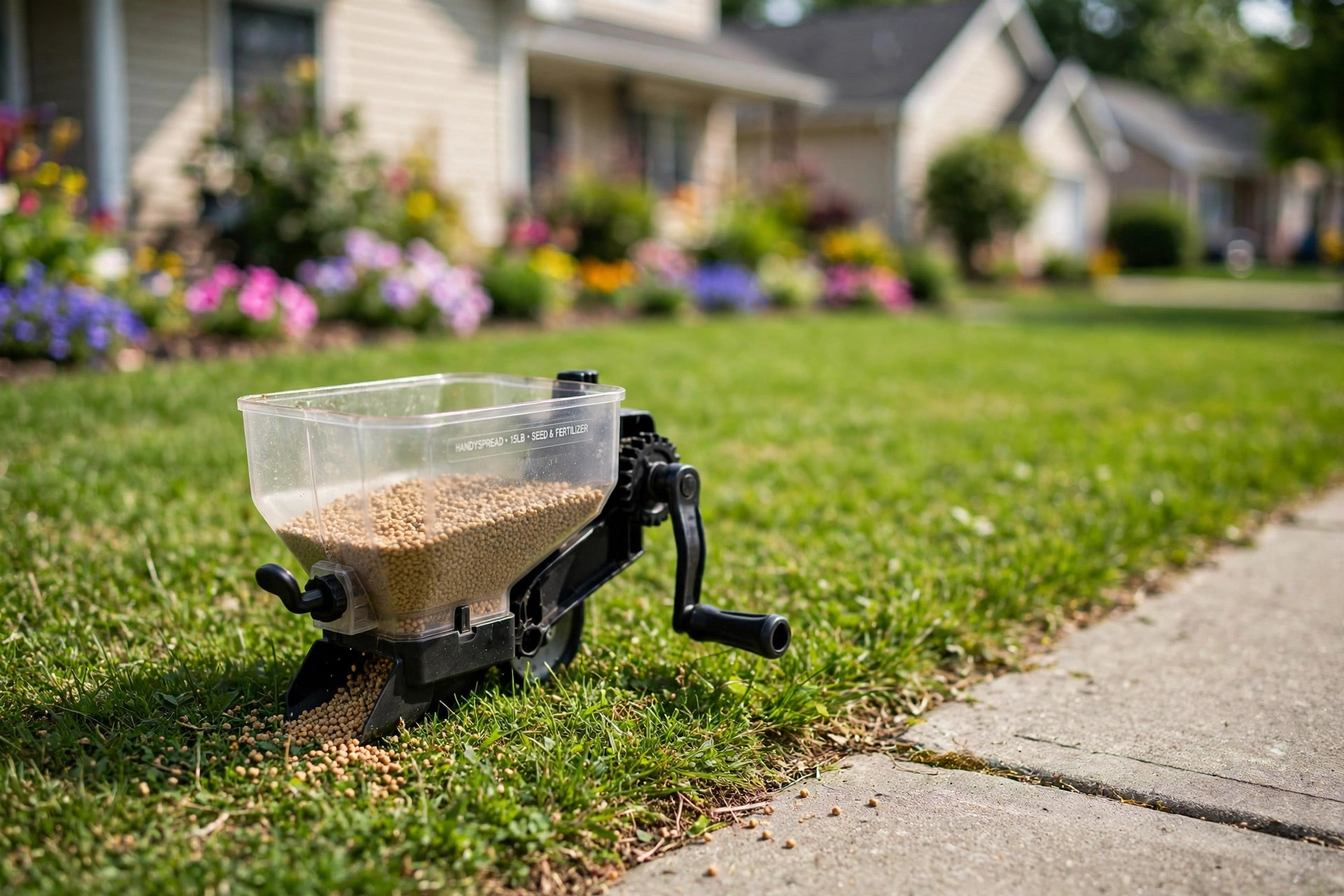

A small lawn does not need big tools. A full-size push spreader is heavy, hard to turn, and too wide for narrow side yards and small plots. The best handheld spreader for small lawns solves this problem. It is light, cheap, and easy to use. It fits in one hand, and it spreads seed, fertilizer, or ice melt evenly across a small area.
Many homeowners buy a large spreader and then leave it in the garage because it is too much work to push across a lawn that is only a few hundred square feet. A handheld model takes up almost no storage space. It also gives you better control around flower beds, sidewalks, and patios. If your lawn is under 5,000 square feet, a handheld spreader is often the smarter buy.
This guide explains what to look for, the main types, fair prices, and how to get even coverage. It also covers care and safety so your spreader lasts for many seasons.
Why a Handheld Spreader Matters for Small Lawns
Small lawns have their own needs. A strip of grass between two houses may be only five feet wide. A front yard in a town lot may be 1,000 square feet. A big push spreader throws material ten feet or more. That is too wide. Granules land on the sidewalk, the driveway, and the flower beds.
The best handheld spreader for small lawns throws material a short, controlled distance. You can walk the edge of the lawn and keep the product on the grass. You save money because you waste less fertilizer. You also protect nearby plants from burn, since fertilizer on leaves can damage them.
Handheld spreaders are also kinder to your back. A push spreader with a full bag of fertilizer can weigh forty pounds or more. A handheld unit holds only a few pounds of material. You carry it in one hand and turn a crank or press a trigger with the other. The job is quick and easy.
Many people use a handheld spreader for patch repair. When a pet leaves a bare spot or a dry summer kills a patch of grass, you do not want to roll out the big spreader. A handheld seed spreader for patch repair lets you drop seed exactly where you need it. The same tool works for spot feeding, winter ice melt on small paths, and even salt for a short driveway.
What to Look for When You Choose One: Best Handheld Spreader for Small Lawns
Not all handheld spreaders are the same. Here are the key points to check before you buy.
Hopper capacity. Most handheld spreaders hold two to five pounds of material. A larger hopper means fewer refills, but it also means more weight in your hand. For a very small lawn, two or three pounds is enough. If your lawn is closer to 5,000 square feet, look for a larger hopper or plan on one refill.
Adjustable flow settings. Good spreaders have a dial or lever that controls how fast material flows out. This matters because seed, fertilizer, and salt have different sizes and weights. Check the product label for the correct setting. Handheld spreader settings for fertilizer usually come from the fertilizer bag itself, which lists the setting number for common spreader brands.
Spread pattern control. Some models throw material in a wide arc. Others have a deflector or a narrow opening that drops material straight down. For small lawns with tight edges, a model with edge control is worth the extra cost. It keeps granules off the sidewalk.
Build quality. Look for a sturdy plastic hopper that does not crack in cold weather. The crank or motor mechanism should feel smooth. Metal gears last longer than cheap plastic ones, but they cost more. Read the warranty. A one- or two-year warranty is a good sign.
Ease of cleaning. Fertilizer is corrosive. If you cannot empty and rinse the spreader, it will rust or clog. Choose a model with a wide opening at the top and a simple design with few hidden corners.
Power source. Manual crank models never need batteries. Battery-powered models spread faster and more evenly, but they cost more and you must keep them charged. For a small lawn, a manual crank is usually enough.
Types of Handheld Spreaders
There are three main types. Each works best for a different job.
Handheld Broadcast Spreaders
A handheld broadcast spreader spins a small disc that throws granules in a circle or arc. It covers ground quickly. It is the best choice when you want to feed a whole small lawn with fertilizer or seed. The best handheld spreader for small lawns is often a broadcast model because it is fast and even.
The trade-off is control. Broadcast spreaders can throw material onto walkways and beds if you are not careful. Walk slowly, keep the spreader level, and close the gate when you turn around at the end of a pass.
Handheld Drop Spreaders
A drop spreader lets material fall straight down in a narrow band. It is slower than a broadcast model, but it is very exact. It is ideal for narrow strips between houses, small sections, and edges. If your lawn is long and thin, a drop spreader may serve you better than a broadcast model.
Shaker Jugs and Scoop Spreaders
The simplest option is a jug with holes in the cap or a scoop you swing by hand. These cost only a few dollars. They work for tiny jobs, like reseeding a few bare spots or salting a short step. They do not spread as evenly as crank models, so they are not the best choice for a whole lawn.
Larger yards have different needs. If you ever move to a bigger home, you may want to read about broadcast spreaders for large lawns to compare the two sizes.
Cost and Price
Handheld spreaders are among the cheapest lawn tools you can buy. Basic shaker jugs cost under ten dollars. Manual crank models usually sell for fifteen to forty dollars. Battery-powered handheld spreaders cost forty to eighty dollars.
For most small lawns, a manual crank model in the twenty-to-thirty-dollar range is the sweet spot. It spreads evenly, lasts for years, and needs no batteries.
Compare prices at the start of spring, when garden centers stock up. End-of-season sales in fall can save you ten to twenty percent. Online reviews can help too. Sites like Consumer Reports test lawn and garden tools and publish ratings that show which models hold up over time.
Do not forget the cost of the material itself. A bag of fertilizer that covers 5,000 square feet may cost twenty to forty dollars. Grass seed costs more per pound. A handheld spreader pays for itself quickly if it stops you from wasting half a bag on the sidewalk.
How to Use Your Spreader for Even Coverage
Even coverage is the whole point of a spreader. Too much fertilizer in one spot burns the grass. Too little leaves weak, thin areas. Follow these steps.
Read the bag first. Every fertilizer and seed bag lists the setting for common spreader types. Set your dial to the number shown. If your brand is not listed, start with a low setting and make a test pass on a small area.
Fill on a hard surface. Always fill the hopper on the driveway or patio, never on the lawn. Spills on grass can burn it. Sweep up any spills before you start.
Walk at a steady pace. Speed affects how much material lands on each square foot. Walk at a normal, even pace. Do not rush or stop mid-pass with the gate open.
Overlap your passes slightly. On each pass, walk so that the edge of your spread pattern just touches the edge of the last pass. A small overlap is better than a gap. Gaps show up as stripes in the lawn.
Close the gate on turns. When you reach the end of a row, close the flow gate before you turn around. Open it again when you start the next pass. This takes practice but prevents heavy piles at the ends of rows.
Apply in two directions for best results. For fertilizer, spread half the bag walking north to south and the other half walking east to west. This cross pattern evens out any light or heavy spots.
Spring is the busiest season for lawn work. If you plan to reseed, it helps to learn how to plant grass seed in spring before you start, so your timing and soil preparation are right.
Care and Upkeep
A handheld spreader is simple, but it still needs basic care. Fertilizer and salt are corrosive. If you put the spreader away dirty, the moving parts will seize up by next season.
Empty it after every use. Pour leftover material back into its bag. Do not store fertilizer in the hopper. Moisture in the air will cake it into a hard lump.
Rinse and dry it. Wash the hopper and the spreader mechanism with a hose. Let it dry fully in the sun before you store it. A quick spray of light oil on metal parts helps prevent rust, but keep oil away from areas that touch the lawn.
Check the gate and crank. Once a year, check that the flow gate opens and closes fully and that the crank turns smoothly. Tighten any loose screws. If the gate sticks, a small amount of dry graphite powder can free it.
Store it indoors. A garage or shed is fine. Do not leave the spreader outside all winter. Freezing rain cracks cheap plastic, and UV sun weakens it over time. Hanging it on a hook keeps it off the damp floor.
With this simple care, a good handheld spreader lasts five to ten years. That is many seasons of even, healthy lawns for a small investment.
Safety Tips
Lawn products are safe when used as directed, but they deserve respect.
Wear gloves and eye protection. Fertilizer dust can irritate skin and eyes. A simple pair of garden gloves and safety glasses is enough.
Keep children and pets off the lawn until the product is watered in. Most fertilizer bags give a re-entry time. Follow it. If you use a drought tolerant grass seed or any seed, keep pets from digging up the fresh seedbed.
Store products in their original bags. Never pour fertilizer or weed killer into unmarked containers. Keep them locked away from children.
Sweep granules off hard surfaces. Fertilizer that lands on the driveway or sidewalk should be swept back onto the lawn. Rain can wash it into storm drains, which harms streams and lakes. Edge control on your spreader helps, but a broom finishes the job.
Follow local rules. Some towns limit when you can apply fertilizer, especially near water. Check your local rules before a big spring application.
Big equipment makers like Toro, John Deere, and Briggs & Stratton publish safety guides for lawn tools. Their advice is worth reading even if you only own a small handheld model.
Frequently Asked Questions
How big a lawn can a handheld spreader handle? Most handheld spreaders work well on lawns up to about 5,000 square feet. Above that, refilling the small hopper gets tiresome and a walk-behind model is faster. For lawns under 2,000 square feet, a handheld model is the ideal tool.
Can I use a handheld spreader for grass seed? Yes. Handheld spreaders work well for grass seed, and they are excellent for overseeding thin areas. Set the flow gate low, since seed is light and flows fast. Make two light passes in different directions rather than one heavy pass.
What is the difference between a handheld broadcast spreader and a small lawn broadcast spreader for fertilizer? The terms often describe the same thing. A small lawn broadcast spreader for fertilizer is usually a handheld or very small push unit meant for compact yards. Both throw granules in an arc. The handheld version is lighter and cheaper, while a small push version covers ground faster on medium lawns.
Do I need a battery-powered model? Not for a small lawn. A manual crank gives even results on a few thousand square feet, and it never runs out of charge. Battery models are worth it if you have trouble turning a crank or you spread material often.
Why is my lawn striped after spreading? Stripes come from gaps between passes or from walking at uneven speeds. Overlap each pass slightly and keep a steady pace. A cross pattern, half the material one way and half the other, hides most errors.
Can I use one spreader for fertilizer, seed, and ice melt? Yes, as long as you clean it between uses. Rinse and dry it fully before switching materials. Never mix leftover fertilizer with seed in the hopper.
A Final Word
The best handheld spreader for small lawns is the one you will actually use. It should feel light in your hand, spread evenly, and store in a small space. A basic crank model at a fair price does the job for most homeowners.
Buy it before the spring rush. Learn the settings on your fertilizer bag. Walk slow, overlap your passes, and clean the spreader when you finish. Do these simple things and your small lawn will stay thick, green, and even all season long.
References
Toro. (n.d.). Lawn care equipment and outdoor power products. https://www.toro.com Deere & Company. (n.d.). Lawn and garden equipment. https://www.deere.com Briggs & Stratton. (n.d.). Engines and outdoor power equipment. https://www.briggsandstratton.com Consumer Reports. (n.d.). Product reviews and ratings. https://www.consumerreports.org
Was this guide helpful?

About Michael Thompson
The My Garden US editorial team writes practical, in-depth home and garden guides for American homeowners — tested advice, no fluff.
You May Also Like
How to Maintain Zoysia Grass Lawn: A Complete Care Guide
January 13, 2026 0 views
How to Install French Drain Around House: A Step-by-Step Guide
April 5, 2026 0 views
How Much Does an Artificial Turf Backyard Putting Green Cost?
September 25, 2026 0 views