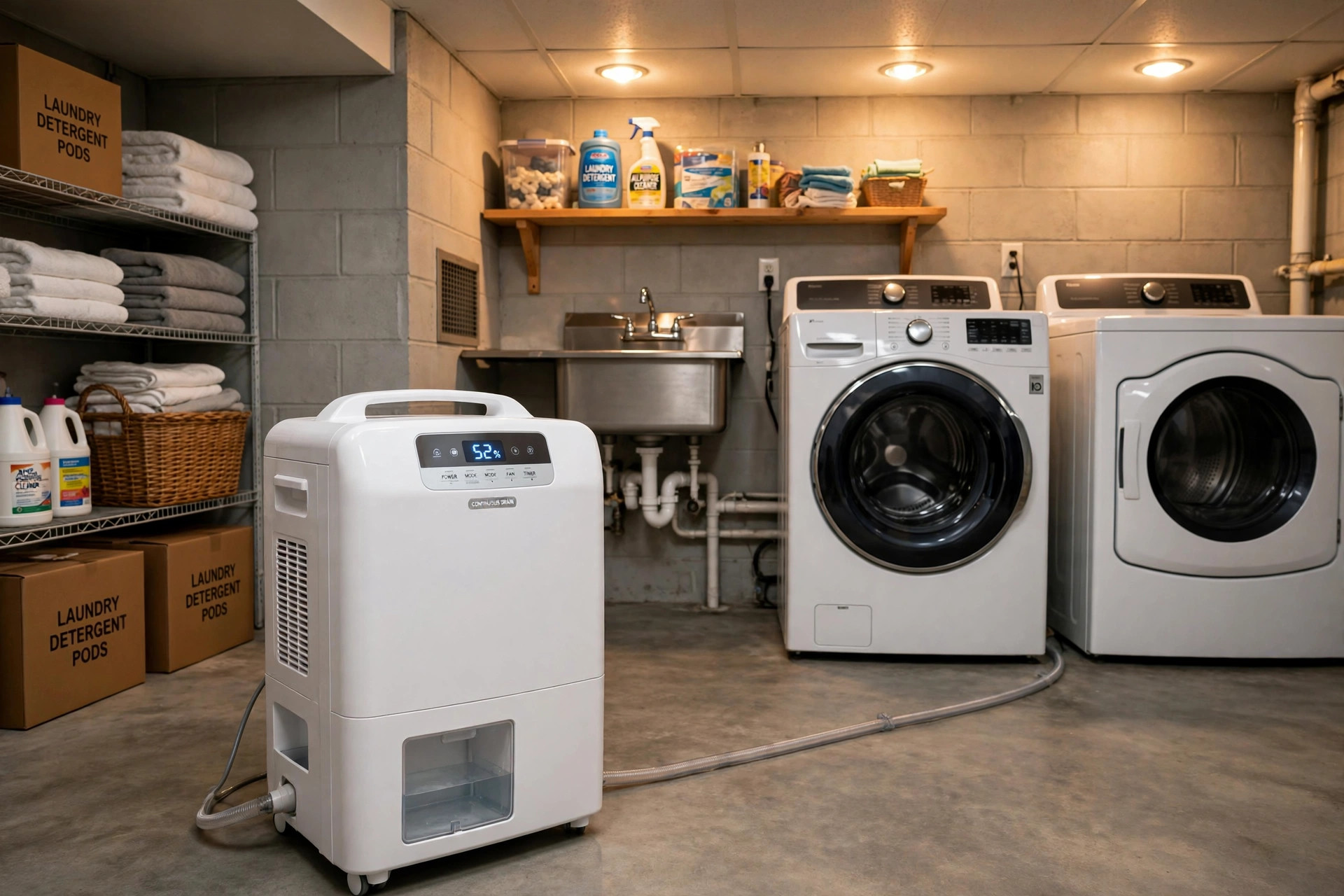

Basements are damp by nature. Concrete pulls water from the soil. Warm air meets cool walls. The result is moisture, and moisture brings mold, mildew, and musty smells. The best dehumidifier for basement 2026 usa shoppers can buy is the one that fits the size of the room, runs with little noise, and drains water with no daily trips to empty a bucket. This guide explains how basement dehumidifiers work, what to look for when you shop, what they cost, and how to keep one running for years.
Why a Basement Needs a Dehumidifier
A basement lives below ground. Water pushes against the walls from outside. Warm air from upstairs carries water vapor down the stairs. When that vapor touches a cold wall or floor, it turns to liquid. This is why paint peels and cardboard boxes turn soft.
High humidity feeds mold. Mold can grow on drywall, wood, cloth, and paper. It stains the walls. It harms the air you breathe. A musty smell in the lower part of a home is often the first sign. A dehumidifier pulls water from the air and holds the humidity at a safe level.
The federal energy office suggests that most homes stay comfortable and healthy when indoor humidity sits between 30 and 50 percent. Below 30 percent the air feels too dry. Above 60 percent mold grows fast. A small gauge called a hygrometer tells you where your basement stands. If the reading sits near 70 percent, a dehumidifier is due.
A dry basement also protects what is stored there. Furniture lasts longer. Tools stay free of rust. Clothes kept in boxes do not smell old. Floor finishes do not buckle. The cost of one machine is small next to the cost of ripping out moldy drywall.
How to Choose a Basement Dehumidifier: Best Dehumidifier for Basement 2026 Usa
Pint Capacity
Dehumidifiers are sold by pint capacity. The number tells how many pints of water the machine can pull from the air in one day. A small basement of 500 square feet with mild dampness may do well with a 30-pint unit. A large basement of 2,000 square feet that smells musty may need a 70-pint unit.
Buyers should match the machine to both size and dampness. A unit that is too small will run all day and never reach the set level. A unit that is too large costs more to buy and uses more power than needed. For most American basements that feel wet in summer, 70 pint dehumidifier reviews for basements show that the 70-pint size is the common choice.
Check how the maker measured the pints. Old ratings used 80 degrees and 60 percent humidity. New ratings use 65 degrees and 60 percent humidity. The new numbers look smaller for the same machine. When you compare two models, make sure both use the new test or both use the old test.
Drain Options
A dehumidifier fills a bucket with water. A 70-pint machine can fill its bucket in a single day in a wet basement. Emptying the bucket by hand gets old fast. Many models also offer a gravity drain. A short hose runs from the machine to a floor drain or a utility sink. Water flows out on its own.
The third choice is a built-in pump. A pump pushes water up and out through a long thin hose. This helps when the nearest drain sits across the room or above the floor. Pumps add to the price, but they save daily work. For a finished basement that doubles as a living room, a pump or gravity hose keeps the floor clear of buckets.
Noise and Energy Use
Dehumidifiers hum. The sound comes from the fan and the compressor. Noise matters when the basement holds a home office, a guest room, or a play area. Look for a listed sound level under 50 decibels for quiet rooms. Read reviews that speak of real homes, not just the test lab.
Energy use matters too. A machine that runs eight hours a day can add a clear line to the power bill. Models that carry the ENERGY STAR label use about 20 percent less power than standard models. The label also sets a mark for water removal per unit of power. Sites like the Carrier learning center explain how efficient equipment pays back its cost over the years. A slightly higher price at the store can mean lower bills for years.
Cool Basements Need Defrost
Basements stay cool. A dehumidifier can freeze up when the room drops below 65 degrees. Ice forms on the coils. The machine stops pulling water. Good basement models include an auto-defrost cycle. The machine melts the ice and starts again on its own. If your basement runs cold in spring and fall, do not skip this feature.
Ease of Use
A clear display helps. A humidistat lets you set a target, often 45 or 50 percent, and the machine holds it. A timer lets the unit run only at night. Wheels and handles help you move it. A washable filter saves the cost of new filters. These small features do not make headlines, but they decide whether you like the machine after a year.
Types of Basement Dehumidifiers
Portable Freestanding Units
Most shoppers buy portable units. They stand on the floor. They plug into a normal outlet. They roll from room to room. They cost the least. A portable unit suits most basements, and it can move upstairs in a flood emergency. The trade is noise and the need to drain water.
Basement and Crawl Space Units
Some units are built for low, tight spaces. They sit low to the ground. They handle cool air well. They often cost more, but they run for years in hard spots. If your basement is more of a crawl space, the best crawl space dehumidifier 2026 usa options are worth a look before you buy a standard tall unit.
Whole-House Units
A whole-house dehumidifier ties into the ductwork of the home. It dries every room at once, basement included. It costs far more and needs a trained installer. For homes with wide mold trouble or very wet ground, it may be the right call. Homeowners often compare this path with whole house dehumidifier installation cost usa before they decide.
Cost and Price
Prices in 2026 run in clear bands. A basic 30-pint portable unit costs around 200 to 280 dollars. A 50-pint unit costs around 280 to 380 dollars. A 70-pint unit with a pump costs around 380 to 550 dollars. Low-profile crawl space units run 900 to 1,600 dollars. A whole-house unit, with install, runs 1,500 to 3,000 dollars or more.
Running cost is separate from the sticker price. A 70-pint unit may draw about 700 watts. At 15 cents per kilowatt hour, eight hours of run time costs about 84 cents a day, or about 25 dollars a month. An ENERGY STAR model cuts that by a fifth. Over five years the savings can cover the price gap between a cheap unit and a good one.
Watch the warranty. Most portable units carry one year of full coverage and up to five years on the sealed system. Brands with long service histories, such as Trane and Lennox, publish clear warranty terms that show what is covered and for how long. Keep the receipt and register the product online.
Buy from stores that take returns with no fuss. A machine may seem fine in the store and loud at home. Major retailers such as Home Depot sell the full range of sizes and let you compare models side by side.
Care and Upkeep
A dehumidifier asks for little care, but it asks often. The main job is the filter. Dust and lint coat the filter in a few weeks. A dirty filter chokes the air flow. The machine works harder and pulls less water. Wash or vacuum the filter once a month in heavy use.
The water bucket needs a wash too. Warm water and mild soap keep slime from growing. If you use a drain hose, check it each season. A kink in the hose backs water up into the bucket. A clogged hose can spill water on the floor.
Wipe the coils once a year. Dust on the coils acts like a blanket. It slows the cold transfer that pulls water from the air. Unplug the machine first. A soft brush or a vacuum with a brush tool does the job.
Store the unit with care if you run it only in summer. Drain all water. Clean the filter. Wrap the cord. Keep it upright in a dry spot. Do not lay it on its side for long, as oil in the compressor can shift.
Guides from This Old House and the Family Handyman walk through these small tasks with photos. A half hour of care each season keeps the machine strong for five to ten years.
Safety
Dehumidifiers are safe when used with care. A few rules keep them that way. Plug the unit straight into a wall outlet. Do not run it through a long thin extension cord, which can heat up. Keep the machine three feet from walls and furniture so air can move. Never set drinks or wet items on top of it.
Empty or drain the bucket on time. Standing water breeds germs. If the machine has sat unused for months, wash the bucket before the first run. Watch the cord for frays. If the unit smells hot or makes a new grinding sound, unplug it and call the maker. A working smoke alarm on each level of the home is a wise backstop, as with any large appliance.
Frequently Asked Questions
What humidity level should I set for my basement?
Set the humidistat to 45 or 50 percent. This level stops mold but does not dry the air so much that wood cracks. Makers like Rheem and Goodman note in their home comfort guides that 30 to 50 percent is the healthy band for most homes. If the machine never reaches 50 percent, the unit may be too small for the space.
Can a dehumidifier fix a flooded basement?
No. A dehumidifier pulls water from the air. It does not pump out standing water. After a flood, first remove the water with a wet vacuum or a pump. Dry the walls and floor. Then run the dehumidifier to pull out the deep dampness trapped in wood and concrete.
Should the dehumidifier run all year?
It depends on your climate. In the South and along the coasts, summer humidity calls for daily use. In the North, many owners run the unit from April to October and store it in winter. Watch the hygrometer. If the reading holds under 50 percent on its own, give the machine a rest.
How long does a basement dehumidifier last?
A good portable unit lasts five to ten years. Heavy use shortens the life. Clean filters and yearly coil care stretch it. When repairs cost more than half the price of a new unit, replace it. New models use less power, so the upgrade can pay for itself.
Does a dehumidifier help with allergies?
It can. Dust mites and mold both love damp air. Holding humidity near 45 percent slows them down. The machine is not a medical device, and it does not replace an air cleaner for pollen. But many allergy sufferers find the basement smells cleaner and the air feels lighter.
Where is the best spot to place the unit?
Set it in the center of the damp area, away from walls. Keep it near a drain if you use a hose. Do not trap it in a closet. Air must flow in and out freely. If one corner stays wet while the rest dries, move the unit closer to that corner.
A Short Final Word
The best dehumidifier for basement 2026 usa homes is not a mystery. Measure your space. Match the pint size to the dampness. Pick a gravity hose or a pump so you never haul a bucket. Choose an ENERGY STAR model with auto-defrost for cool rooms. Keep the filter clean. A small machine, well chosen and well kept, turns a damp lower floor into a dry room you can trust with storage, guests, and peace of mind.
References
Carrier. (n.d.). Heating and cooling systems. https://www.carrier.com ENERGY STAR. (n.d.). Energy efficient products. https://www.energystar.gov Family Handyman. (n.d.). DIY home repair and maintenance. https://www.familyhandyman.com Goodman. (n.d.). Heating and cooling equipment. https://www.goodmanmfg.com Lennox. (n.d.). Heating and cooling systems. https://www.lennox.com Rheem. (n.d.). Heating, cooling, and water heating. https://www.rheem.com The Home Depot. (n.d.). Home improvement products. https://www.homedepot.com This Old House. (n.d.). Home renovation guidance. https://www.thisoldhouse.com Trane. (n.d.). Heating and air conditioning. https://www.trane.com U.S. Department of Energy. (n.d.). Energy efficiency and renewable energy. https://www.energy.gov
Was this guide helpful?

About James Carter
The My Garden US editorial team writes practical, in-depth home and garden guides for American homeowners — tested advice, no fluff.
You May Also Like
What Is the AC Tune Up Cost Near Me for Spring 2026?
April 19, 2026 0 views
Wood Stove Installation Cost Near Me: What to Expect
February 2, 2026 0 views
Electric Fireplace Insert Reviews 2026 USA: A Plain Buyer’s Guide
January 24, 2026 0 views