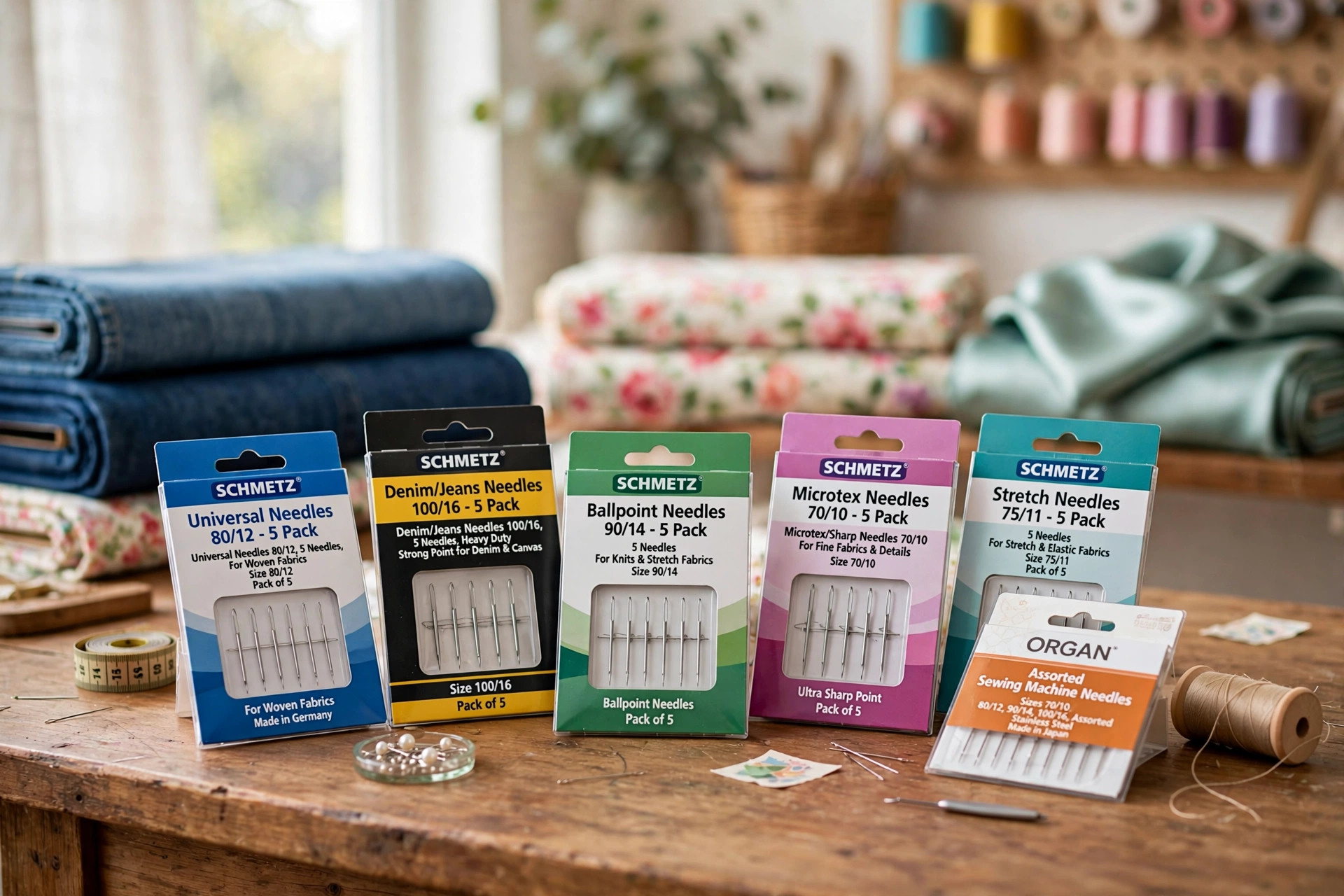
Every sewing machine needle looks small and plain. But the wrong needle can break your thread, skip stitches, or punch holes in good fabric. The right needle makes the machine run smooth and the seam look neat. A sewing machine needles assortment for fabrics gives you many needle types in one pack. You open the box and find the needle that fits the cloth in front of you. It is a simple idea, and it saves time and money.
Sewers across the United States keep an assortment pack near the machine for this reason. Denim, quilting cotton, stretch knits, and silk all need a different point and a different size. This guide explains what an assortment pack holds, how to read needle labels, what to look for when you buy, and how to keep your needles sharp and safe.
Why the Right Needle Matters
A needle does more than push thread through cloth. It opens a clean hole, carries the thread down through the fabric, and helps form each stitch. When the needle is wrong for the fabric, the whole job suffers. A needle made for thin cotton can bend or snap on heavy denim. A sharp denim needle can cut the fine loops of a knit and leave runs in the fabric. A dull needle makes a dull thud with every stitch and leaves weak seams.
An assortment pack solves this problem before it starts. Instead of buying one needle type at a time, you buy a set with several types and sizes. Most packs hold between ten and one hundred needles. The cost per needle is low. You always have a fresh needle on hand, and a fresh needle is one of the best secrets of good sewing.
Craft supply guides at places like Michaels note that beginners often blame the machine when the real fault is a dull or wrong needle. Changing the needle is the fastest fix on any machine. If you are new to sewing, start with the right machine too. A good best beginner sewing machine for home crafts paired with a fresh needle will sew better than a costly machine with a dull one.
What to Look For When You Choose: Sewing Machine Needles Assortment for Fabrics Usa
Not all assortment packs are the same. Some are wide but shallow. They hold many needle types but few sizes. Others are narrow but deep. They hold one type in many sizes. Read the pack before you buy. A good sewing machine needles assortment for fabrics should list the needle type, the size range, and the fabric each needle suits.
Needle Types
Needles differ by the shape of the point. Universal needles have a slightly rounded point and sew most woven and knit fabrics. Ballpoint needles have a fully round point that pushes between knit fibers instead of cutting them. Stretch needles have a special eye and scarf that stop skipped stitches on elastic knits and spandex. Denim needles, also called jeans needles, have a strong sharp point that pierces heavy twill. Microtex or sharp needles have a very fine sharp point for silk, microfiber, and tightly woven fabrics. Leather needles have a cutting edge that slices a hole in leather and vinyl. Quilting needles have a tapered point that passes through many layers with ease.
A mixed assortment usually holds universal, ballpoint, stretch, denim, and sharp needles. That mix covers most home sewing. Specialty packs exist for embroidery, topstitching, and metallic thread. Sewing references published by This Old House and Family Handyman remind readers that the needle system must fit the machine as well. Most home machines take 130/705 H needles, the standard flat-shank system. Check your manual before you buy.
Needle Sizes
Needle size is shown in two numbers, such as 80/12. The first number is the European size. The second is the American size. Smaller numbers mean finer needles. Larger numbers mean heavier needles. Size 60/8 is very fine and suits silk and chiffon. Size 70/10 suits light cotton and voile. Size 80/12 is the middle size and suits quilting cotton and linen. Size 90/14 suits denim and light canvas. Size 100/16 suits heavy denim, canvas, and upholstery cloth.
An assortment pack should span at least 70/10 to 90/14. That range covers light, medium, and medium-heavy fabrics. The needle maker Schmetz prints size charts on most packs, so you can match the number to the fabric weight at a glance.
The Main Needle Types in an Assortment
Let us look at each common needle in a sewing machine needles assortment for fabrics and learn when to use it.
Universal needles. The general worker of the set. Use them for quilting cotton, linen, flannel, and light wool. If you sew only now and then, universal needles in sizes 80/12 and 90/14 will carry you far. They are forgiving and easy to find.
Ballpoint needles. The knit specialist. The round point slides between the loops of jersey, interlock, and rib knit. Use them for T-shirts, knit dresses, and sweatshirts. A sharp point on these fabrics cuts the loops and causes runs. Ballpoints stop that damage.
Stretch needles. The elastic expert. Stretch needles have a slightly shorter eye and a deeper scarf, which is the groove above the eye. This shape keeps the thread loop open long enough for the hook to catch it. Use them for spandex, swimwear, and very stretchy knits. When a ballpoint needle skips stitches on stretch fabric, a stretch needle often fixes it.
Denim or jeans needles. The heavy worker. The reinforced shaft resists bending. The sharp point pierces dense twill. Use them for jeans, canvas bags, and work clothes. They also sew through many layers at seams and hems. Pair them with a sturdy machine like those reviewed at Brother, which are built for home sewing and quilting.
Sharp or Microtex needles. The fine specialist. The slim sharp point pierces tightly woven fabric with a tiny clean hole. Use them for silk, satin, microfiber, and fine shirting. They also work well for topstitching, where the stitches show and must be even.
Leather needles. The cutter. The wedge-shaped point cuts a neat slit in leather, vinyl, and faux leather. Never use a leather needle on woven fabric. The cutting edge will damage the weave. Never use a regular sharp needle on leather either. The point will dull fast and the stitches will be uneven.
Quilting needles. The layer worker. The tapered point moves through a quilt top, batting, and backing with less drag. Quilters who piece and quilt on the same machine keep these in the assortment at all times.
Embroidery needles. The thread friend. They have a larger eye and a deeper groove so embroidery thread and metallic thread pass through without fraying. If your machine has an embroidery unit, add these to your kit.
How to Match Needle, Fabric, and Thread
The needle, the fabric, and the thread work as a team. Match all three and the machine sings. Fine fabric wants a fine needle and fine thread. Heavy fabric wants a heavy needle and heavy thread. A heavy needle with a fine thread makes large holes and weak seams. A fine needle with heavy thread bends or breaks.
with a little room to spare. If it drags, use a larger needle or a larger eye. If it falls through with wide gaps, use a smaller needle. Thread guides at JOANN stock charts that pair common thread weights with needle sizes.
Pair your cutting tools with the same care. Clean cuts make clean seams. A best rotary cutter for quilting fabric crafts and a sharp pair of shears cut fabric edges that feed evenly under the presser foot. Art supply shops like Blick carry rulers and mats that help you cut straight lines for quilt blocks and garment pieces.
Test on a scrap before you sew the real piece. Sew a short line of stitches on two layers of the same fabric. Check the top and the bottom. The stitches should look even. The fabric should lie flat. If you see puckers, loops, or skipped stitches, change the needle type or size first. That one change fixes most problems.
Cost and Price in the USA
A sewing machine needles assortment for fabrics is one of the cheapest upgrades in the craft room. Small packs of ten to twenty needles sell for about two to four dollars at craft stores and big-box retailers. Mid-size packs of fifty needles sell for about five to eight dollars. Large bulk packs of one hundred needles, often one type in many sizes, sell for about ten to fifteen dollars.
Brand name packs from Schmetz and Organ cost a little more than store brands. Many sewers say the brand packs hold their sharpness longer. Store brands work well for practice sewing and for crafts where the seam does not carry weight. Price checkers at Home Depot and Bob Vila show that online prices run close to store prices, with bulk packs offering the best cost per needle.
Needles are a wear item. They dull with use. A common rule is to change the needle after every eight hours of sewing or at the start of each new project. At these prices, a fresh needle costs less than a cup of coffee. Do not wait for skipped stitches to tell you the needle is dull. Change it on schedule.
Care and Upkeep
Needles need little care, but they need order. Keep the pack in its case so the types do not mix.
Store needles in a dry place. A damp basement or garage can spot them with rust. A rusted needle stains fabric and drags through cloth. Toss rusted or bent needles at once. Keep a small used-needle box, an old film canister or a mint tin, so loose needles never roll free on the table.
Machine makers like Singer advise cleaning the needle plate and bobbin area when you change the needle. Lint packs around the feed dogs and dulls the machine’s work. A small brush and a drop of oil, used as the manual directs, keep the machine ready for the next project.
A basic best sewing kit for beginners adults crafts should hold an assortment pack, spare bobbins, a seam ripper, pins, and a tape measure. With those tools in one box, you can fix a seam or start a project without hunting through drawers.
Safety at the Sewing Table
Needles are small and sharp. Treat them with respect. Insert the needle with the flat side of the shank facing the right way, as the manual shows. Tighten the needle clamp screw firmly. A loose needle can fall into the bobbin area and jam the machine.
Keep fingers clear of the needle path while the machine runs. Never push fabric with your fingers close to the needle. Use a stiletto tool or a pair of tweezers to guide small pieces. Unplug the machine or switch it off when you change the needle, the presser foot, or the needle plate.
Dispose of used needles with care. Do not toss them in the trash loose. Slide them into a sealed tin or a purpose-made needle disposal box. Keep the box away from children and pets. A needle on the floor can end up in a foot or a paw.
Frequently Asked Questions
How often should I change my sewing machine needle? Change it at the start of each new project or after about eight hours of sewing. Heavy fabrics and many layers dull needles faster. A fresh needle costs little and prevents most stitch problems.
Can I use one needle type for everything? A universal needle in size 80/12 will sew many common fabrics. But it is not the best choice for knits, denim, leather, or silk. An assortment pack lets you pick the right needle for each fabric, which gives stronger seams and cleaner stitches.
What does 80/12 mean on a needle pack? It is the needle size. The first number, 80, is the European size. The second number, 12, is the American size. Lower numbers are finer needles for light fabric. Higher numbers are heavier needles for thick fabric.
Do needles fit all sewing machine brands? Most modern home machines take the 130/705 H flat-shank needle system. This includes most Brother, Singer, Janome, and Bernette machines. Some older or industrial machines take other systems. Check your manual before you buy an assortment pack.
Why do my stitches skip on stretch fabric? The needle is likely the wrong type. Switch to a stretch needle or a ballpoint needle in the right size. The round point and special eye of these needles stop the thread loop from slipping. Test on a scrap of the same fabric before you sew the garment.
Are expensive brand needles worth it? Brand packs cost a bit more, but many sewers find they stay sharp longer and sew more evenly. For daily sewing, the difference is worth the small extra cost. For simple crafts and practice, store brand needles work fine.
A Final Word
A sewing machine needles assortment for fabrics is a small box with a large effect. It puts the right needle within reach for every cloth you sew. Learn the point shapes, learn the sizes, and change the needle on schedule. Your machine will run quieter, your stitches will look neater, and your projects will last longer. Keep the pack by the machine, and you will reach for it more than any other tool in the craft room.
References
Blick Art Materials. (n.d.). Art and craft supplies. https://www.dickblick.com Bob Vila. (n.d.). Home improvement advice. https://www.bobvila.com Brother. (n.d.). Sewing and embroidery machines. https://www.brother-usa.com Family Handyman. (n.d.). DIY home repair and maintenance. https://www.familyhandyman.com JOANN. (n.d.). Fabric and craft supplies. https://www.joann.com Michaels. (n.d.). Arts and crafts supplies. https://www.michaels.com Schmetz. (n.d.). Sewing machine needles. https://www.schmetzneedles.com Singer. (n.d.). Sewing machines and accessories. https://www.singer.com The Home Depot. (n.d.). Home improvement products. https://www.homedepot.com This Old House. (n.d.). Home renovation guidance. https://www.thisoldhouse.com
Was this guide helpful?

About Robert Taylor
The My Garden US editorial team writes practical, in-depth home and garden guides for American homeowners — tested advice, no fluff.