
Drawing begins with a pencil. Before paint, before ink, before the computer, the hand learns to see through a simple stick of graphite and wood. The search for the best sketching pencils set for drawing art is therefore a search for a basic and lasting tool. A good set costs little, lasts long, and rewards years of practice. A poor set breaks in the sharpener, scratches the paper, and teaches nothing. This guide explains how to choose well. It covers why sketching pencils matter, what to look for, the main types, the price you may pay, how to care for them, and the questions most often asked.
Why a Good Sketching Pencil Set Matters
Every drawing starts as a line. A line drawn with a soft, even core teaches the hand control. A line drawn with a gritty or scratchy core teaches only frustration. Beginners often blame their own lack of talent when the fault lies in the tool. A set of even, smooth graphite pencils removes this problem at the start.
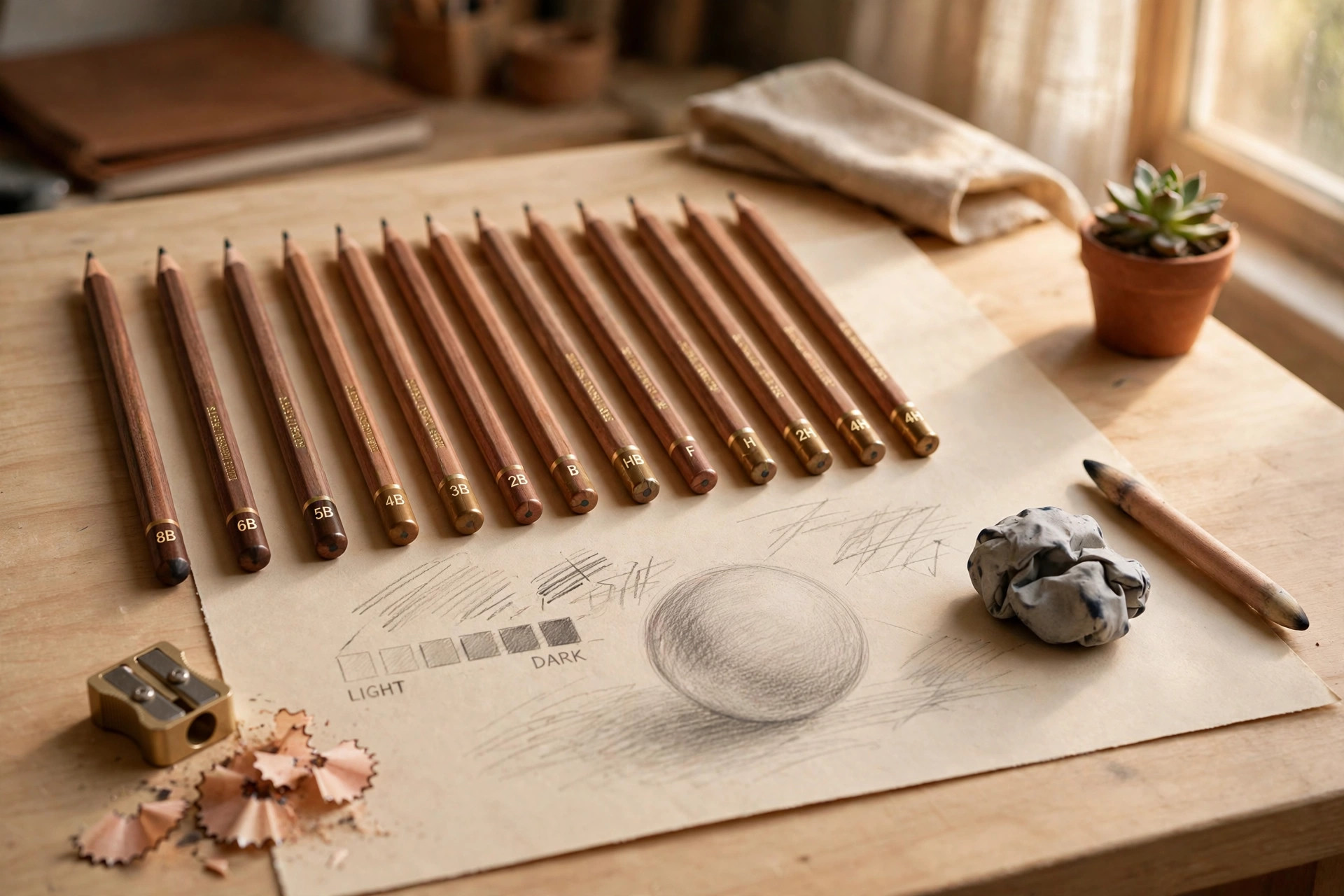
A full set also gives range. A single office pencil can only make one tone. It is either pressed hard and dark, or held light and gray. An artist with a graded set can draw the palest hairline and the deepest shadow with the same relaxed grip. The range comes from the grade scale, which runs from hard to soft. With that range, shading becomes smooth and natural. The beginner learns tone, and tone is what turns a flat outline into a drawing with depth.
There is also the matter of comfort. Sketching sessions last an hour or more. A pencil with a round, even wood barrel and a centered core will not cramp the hand. Cheap pencils often have off-center cores. They break when sharpened, and the wood splinters. The artist then holds the stub tighter to keep control, and the hand tires. Quality is not a luxury here. It is what makes long practice possible.
Many art teachers report the same small miracle. A student who has struggled for months with a handful of loose pencils tries a real artist set for the first time and suddenly draws better. The talent was always there. The tool finally let it show.
How to Choose: What to Look For: Best Sketching Pencils Set for Drawing Art
Choosing the best sketching pencils set for drawing art is not difficult once you know the signs of quality. The list below covers the main points.
Graphite Quality and Smoothness
The core of the pencil is graphite mixed with clay. More clay makes a harder, paler line. More graphite makes a softer, darker line. In a good pencil the mixture is even from end to end. The line lays down without grit or skips. Test a new pencil on cheap copy paper first. The soft grades should leave a rich dark tone with little pressure. The hard grades should leave a clean light gray line without digging into the paper.
Grade Range in the Set
A beginner set should span from at least 2H to 6B. Many fine sets run from 4H to 8B. Do not buy a set that contains only one or two grades. The whole point of a set is the scale. For learning, the middle grades (HB, B, 2B) do most of the work. The hard grades are for light construction lines. The soft grades are for deep shadows.
Wood and Barrel Construction
Cedar is the best wood for sketching pencils. It sharpens cleanly and does not split. Basswood is also common and fair. Avoid pencils whose wood smells sharp or chemical, which can signal cheap glued stock. Hold the pencil up to the light and roll it. A good barrel is straight, with paint that does not flake.
Extras in the Box
Many sets include more than pencils. Blending stumps, a kneaded eraser, a white charcoal pencil, and a small sharpener are all useful. These extras save a separate trip to the store. They also teach the beginner the full routine of drawing: lay down tone, blend it, lift it back out with the eraser. Beginners learning lettering can also explore a fine calligraphy pen set for beginners lettering once their hand control grows.
Brand Reputation and Reviews
Stick with makers who sell to artists as their main trade. Art supply houses such as Dick Blick, Michaels, and JOANN stock sets from makers with long records. Read a few reviews before you buy. Look for praise of smooth cores and complaints about breakage. One complaint means little. Ten complaints mean much.
Types of Sketching Pencils and Sets
Not all sketching tools are the same wood pencil. The main types are described here.
Standard Wooden Graphite Sets
This is the classic form and the best choice for most beginners. The sets come in tins or boxes of 6, 12, 24, or 36 pencils, each marked with its grade. Twelve pencils are enough for a beginner. Twenty-four or more suit an artist who wants every fine step between grades.
Sketching and Drawing Kits
A full kit adds erasers, sharpeners, blending tools, and sometimes charcoal. These kits cost a little more than pencil-only sets but give the beginner everything at once. Many art stores such as Michaels carry these kits in the student section.
Charcoal Pencils
Charcoal pencils are wood pencils with a compressed charcoal core instead of graphite. They make richer blacks than graphite can reach. They are also messier and harder to erase. They suit bold work and quick gesture drawings. Most drawing artists keep both graphite and charcoal sets on the desk.
Mechanical Sketching Pencils
A mechanical pencil holds a thin lead that never needs sharpening. Leads come in grades like a wood pencil. They give a very fine, even line, which suits technical drawing and fine detail. They are less suited to broad shading, where a wood pencil’s side works better.
Woodless Graphite Pencils
These are solid sticks of graphite with a thin lacquer coat. They cover large areas fast and are good for backgrounds and big tonal washes. They wear down quickly and are best as a second tool, not the main one.
Carbon Sketch Pencils
Carbon pencils mix charcoal and graphite. They give dark lines that stay put and do not smear as easily as charcoal. They are a middle ground for artists who want depth without the mess.
Cost and Price: What You Should Expect to Pay
The best sketching pencils set for drawing art need not cost much. Student sets of 12 pencils run from about 8 to 15 dollars at large retailers such as Amazon or Walmart. These are fine for a beginner and will last several months of daily practice.
Artist-grade sets of 12 to 24 pencils run from about 15 to 35 dollars. The graphite is smoother and more even. The wood is better. For anyone past the first year of drawing, this step up is worth the money.
Professional sets with 36 or more pieces, fine cases, and full extras can run from 35 to 75 dollars. Specialty sets, such as those for portrait work or for plein air drawing, may cost more.
Price per pencil is the honest way to compare. A 24-pencil set at 24 dollars costs one dollar a pencil. Compare like with like: grade range, brand, and count. Avoid sets that charge a high price but give few pencils and no extras. Also avoid the very cheapest sets, whose cores break in every sharpener and whose lines are uneven. Between the two extremes lies the best value.
For home studios, it is wise to keep one good set for finished work and one cheaper set for daily practice. This keeps the fine tools in good shape while the hand does its drills. Office supply stores such as Staples often carry the cheaper practice sets.
Care and Upkeep
Pencils are simple tools, but a little care keeps them drawing well for a long time.
Store pencils flat or upright in a case, points up. Do not toss them loose in a drawer. The cores are brittle. A drop on a hard floor can crack the core inside the wood. The pencil will then break at the same spot every time it is sharpened, and the wood looks fine from the outside. Many artists learn this lesson only after blaming the sharpener.
Sharpen with care. A hand sharpener with a sharp blade works well for daily use. For a long, exposed point, many artists use a knife or a sandpaper block. A long point gives more graphite to work with for shading with the side of the tip. Sharpen away from finished drawings so that dust and shavings do not smudge the paper.
Keep erasers clean. A kneaded eraser picks up graphite and can be stretched and folded to expose a clean face. A white plastic eraser should be wiped on scrap paper when it grows dark. Dirty erasers smear instead of lift.
Watch the heat. Do not leave a pencil set on a car dashboard in summer. Heat softens the bonding wax in some cores and can make them crumble. Room temperature and low humidity suit all art supplies, from pencils to a watercolor paint set for professional artists at home.
Use a small brush or cloth to clear graphite dust from your work area. Fine dust settles on paper and can gray a clean drawing. A tidy desk protects the work.
Safety Notes
Graphite sketching pencils are among the safest art supplies. Still, a few cautions apply.
Keep pencils and sharpeners away from small children. A sharp point can prick, and small shavings can be a choking hazard. Many makers mark their sets for ages three and up or for older children. Read the package.
Graphite is not lead. Modern pencil cores contain no lead at all. The word “lead” is only an old habit of speech. There is no lead poisoning risk from drawing pencils.
Charcoal pencils create more dust than graphite. If you draw with charcoal often, keep the room aired and avoid breathing the dust. This is simple care, not danger.
Some very old or imported pencils have paint with heavy metals. Buy from known brands sold by known stores such as The Home Depot craft aisles or dedicated art suppliers, and this concern goes away. If a pencil’s paint flakes heavily or smells strongly of chemicals, set it aside and replace it.
Frequently Asked Questions
What grade should a beginner start with?
Start with HB, B, and 2B. HB is the middle of the scale and close to an ordinary writing pencil. B is a step softer and darker. 2B is softer still and good for shading. Once these feel natural, try the harder and softer ends of the set.
How many pencils does a beginner need?
Twelve is enough. A 12-pencil set with grades from 2H to 6B covers every job a beginner will meet. More pencils add fine steps between grades, which is nice but not needed at the start.
What is the difference between H and B pencils?
H stands for hard. Hard pencils make light, thin lines and keep a sharp point. B stands for black. Soft B pencils make dark, wide lines and wear down fast. HB sits in the middle: hard and black in balance. Think of the scale as a ruler, with H on one end and B on the other.
Are expensive sketching pencils worth it?
Up to a point, yes. The jump from a very cheap set to a mid-priced artist set brings smoother cores and better wood. The jump from mid-priced to the most costly sets brings smaller gains. A serious beginner should buy the best mid-priced set the budget allows and spend the rest on paper.
Can I use sketching pencils for writing or school?
You can, but an HB sketching pencil wears faster than a school pencil. For notes and tests, a standard number two pencil is cheaper and keeps its point longer. Keep the art set for art.
How long does a sketching pencil last?
A pencil used for daily practice can last a few weeks to a couple of months. Harder grades last longer because less graphite wears away. Softer grades wear fast. Buying a set rather than single pencils keeps all grades on hand when one runs short.
A Short Final Word
The best sketching pencils set for drawing art is the one that feels right in your hand and lays down a clean, honest line. You do not need the largest set or the highest price. You need even cores, a true range of grades, and wood that sharpens cleanly. Buy from a trusted art supplier, try each grade on scrap paper, and store the set with care.
Drawing is a slow art. The hand learns in months, not days. A good pencil set is a quiet partner in that long work. It never rushes you. It never judges the line. It only answers the pressure of your hand, line after line, until the eye and the hand agree. Artists who pair their pencil practice with other mediums, such as a craft paint brush set for acrylics, often find their drawing grows stronger for the contrast. Begin with one good set, draw every day, and let the pencil teach you.
See Bob Vila for more detail.
References
Amazon. (n.d.). Online shopping. https://www.amazon.com Blick Art Materials. (n.d.). Art and craft supplies. https://www.dickblick.com Bob Vila. (n.d.). Home improvement advice. https://www.bobvila.com JOANN. (n.d.). Fabric and craft supplies. https://www.joann.com Michaels. (n.d.). Arts and crafts supplies. https://www.michaels.com Staples. (n.d.). Office supplies and furniture. https://www.staples.com The Home Depot. (n.d.). Home improvement products. https://www.homedepot.com Walmart. (n.d.). Everyday low prices. https://www.walmart.com
Was this guide helpful?

About James Carter
The My Garden US editorial team writes practical, in-depth home and garden guides for American homeowners — tested advice, no fluff.
You May Also Like
Best Watercolor Brushes Set for Beginners Art: A Plain Guide
August 7, 2026 0 views
Best Wood Stain for DIY Furniture Refinishing
July 10, 2026 0 views
Best Silicone Molds for Resin Crafts Jewelry: A Plain Guide
June 2, 2026 0 views