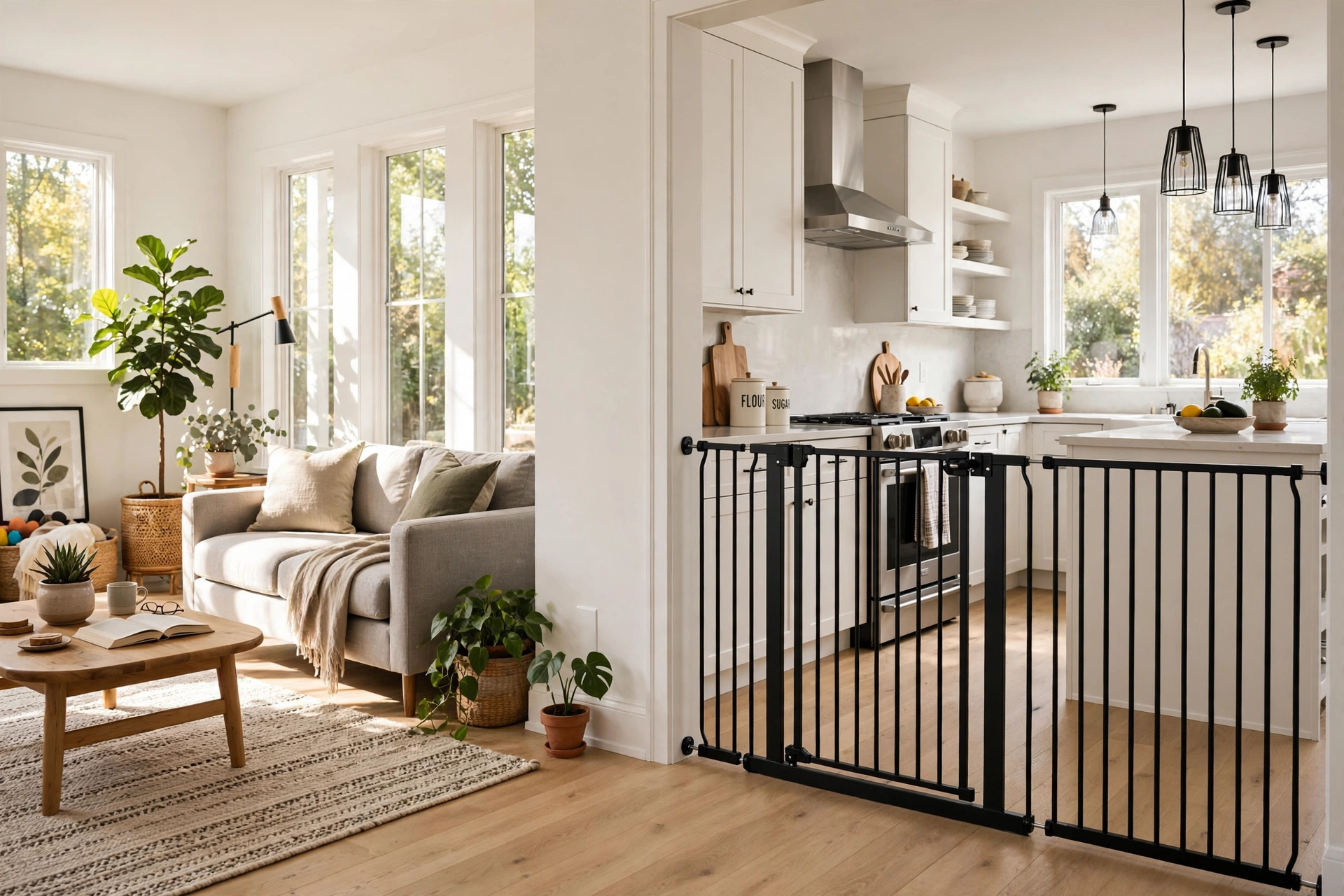
Many homes built in the last thirty years have an open floor plan. The kitchen flows into the living room. The dining room has no walls. The hall is wide and bare. This style of house looks beautiful and feels roomy, but it can cause real problems for pet owners. A dog can run from the kitchen to the living room in seconds. A puppy can slip past the dining table and chew a shoe before anyone notices. A cat can wander into a room that holds a new kitten or a sleeping baby. For these reasons, a pet gate extra wide for open floor plans is one of the most useful tools a pet owner can buy. It keeps animals out of rooms where they do not belong, yet it lets light and air move freely through the house.
This guide explains what an extra wide pet gate is, why it matters in an open home, how to choose the right one, what kinds are sold, what they cost, and how to keep them clean and safe. The aim is to give you plain facts so you can buy with confidence.
Why an Extra Wide Pet Gate Matters in an Open Home
In a traditional home with narrow doorways, a standard pet gate does the job. Most doorways measure about 30 to 36 inches across. A normal gate fits that space with ease. But an open floor plan has few real doorways. The gaps between rooms can be 48, 60, or even 72 inches wide. Some openings between a living room and a hallway are wider still. A standard gate cannot cover that distance. A pet gate extra wide for open floor plans is made for exactly this problem. It spans the broad gaps that modern homes are full of.
Safety is the first reason to use one. Kitchens hold hot stoves, sharp knives, and food that can harm a dog. A gate keeps a curious puppy out of those rooms while you cook or do chores. It also protects cats. A new cat may need a quiet room of her own while she settles in. A gate lets her see and hear the family without being chased by the resident dog.
Training is the second reason. A gate creates a smaller, safe zone for a puppy to rest in during house training. The dog can watch family life from behind the gate. This reduces whining and stress. It also keeps a senior dog safe. Older dogs with weak hips should not climb stairs. A gate at the stairway keeps them on the safe floor.
A third reason is simple peace of mind. When guests come to the door, a gate keeps a big dog from rushing at them. When the front door must stand open for a delivery, a gate keeps a cat from slipping outside. These small moments are when most accidents happen.
What to Look For When You Choose: Pet Gate Extra Wide for Open Floor Plans
Choosing a pet gate extra wide for open floor plans takes a little care. The right gate depends on the width of your opening, the size of your pet, and the way you live. The list below covers the points that matter most.
Measure First
Measure the opening before you shop. Use a tape measure and write down the exact width in inches. Measure at the top, the middle, and the bottom. Walls are not always straight. Baseboards can make the bottom wider or narrower. Write down all three numbers. A pet gate extra wide for open floor plans should fit the widest of the three, or at least have room to adjust. Most wide gates adjust from about 38 inches up to 71 or 76 inches. Some go wider with extra panels. Never guess the width. A gate that is too short leaves a gap. A gate that is too wide will not fit at all.
Match the Gate to Your Pet
A gate for a Chihuahua is not the same as a gate for a Labrador. Check the height of the gate. For small dogs and cats, a gate of 24 to 30 inches is often enough. For medium and large dogs, look for 30 to 36 inches or more. Athletic dogs can jump high. A tall gate stops that. Also check the bar spacing. A puppy or kitten can squeeze through wide bars. Bars spaced two inches apart or less keep small pets in. Some gates made for cats have a small pet door built in. A related option is a pet gate with cat door for stairway safety, which lets the cat pass while the dog stays put. You can read more in our article on pet gate with cat door for stairway safety.
Mounting Style
Pet gates mount in two main ways. Pressure-mounted gates push against the walls with rubber pads. They need no screws and cause no marks. They are easy to move. But they can shift if a strong dog leans on them. Hardware-mounted gates screw into the wall. They are much stronger. They stay put when a big dog pushes against them. For very wide openings, hardware mounting is the safer choice. The wider the gate, the more leverage a dog has against it. Some gates combine both styles. They mount with hardware but can be removed from the brackets for storage.
Walk-Through Door
A walk-through gate has a door for humans. You unlatch it and step through. Without one, you must step over the gate many times a day. That is annoying, and risky for older adults. Look for a door that opens both ways and locks shut with one hand. The latch should be strong enough that a clever dog cannot learn to open it.
Material and Build
Extra wide gates are made from wood, metal, or plastic. Metal gates are the strongest and the most common choice for large dogs. They last for years. Wooden gates look warm and suit homes with wood trim. They fit well in living rooms where looks matter. Plastic gates are light and cheap, but they suit small pets only. Check the finish. It should be smooth, with no sharp edges or peeling paint. A gate that stays in place for months should also be easy to wipe clean.
Types of Extra Wide Pet Gates
Stores sell several kinds of wide gates. Each kind suits a different home and a different need.
Freestanding gates. These stand on their own with side panels for support. They need no wall contact. You can set one up in seconds and fold it flat for storage. They work best for calm, small to medium dogs. A strong dog can push a freestanding gate over, so they are not for determined jumpers.
Pressure-mounted wide gates. These press against the walls with adjustable pads. They need no screws. They are popular in rented homes where the owner does not want holes in the walls. They work well for medium pets and calm large dogs.
Hardware-mounted wide gates. These screw into the wall or door frame. They are the strongest option and suit large dogs and wide openings. The screws leave small holes when removed, which can be filled with putty.
Retractable gates. These use a mesh screen that rolls up like a window shade. When you do not need the gate, it disappears into its housing. They suit small pets and calm dogs but are not as strong as metal gates.
Convertible playpen gates. Some wide gates can be shaped into a playpen or used as a room divider. They have hinged panels that bend around corners. These are useful in a truly open plan where no wall is handy. A related product is a best dog playpen for puppies indoor outdoor setup, which gives a puppy a safe zone inside or outside the house.
Cost and Price
A pet gate extra wide for open floor plans costs more than a standard gate. The extra panels and stronger frame add to the price. Here is a plain look at what you can expect to pay in the United States.
Basic pressure-mounted wide gates often sell for 40 to 70 dollars. Mid-range gates with a walk-through door and metal frames often run 70 to 120 dollars. These are the most popular choice. High-end hardware-mounted gates in hardwood or heavy steel can cost 120 to 200 dollars or more.
Price is not the only cost. If you rent your home, check your lease before you drill. Some owners forbid screws in the walls. In that case, a pressure-mounted gate is the better choice even if it costs a little more to find one strong enough.
A good gate lasts for years. Think of it as a one-time buy. Cheaper gates may bend or rust. A well-made metal gate can serve through several pets. Paying a little more at the start often saves money over time.
Care and Upkeep
A pet gate needs little care, but a few simple habits will keep it safe and clean.
Wipe the gate down once a week with a damp cloth and mild soap. Dry metal gates after. Water left on metal can cause rust. Dust wooden gates and wipe with a barely damp cloth. Never soak a wooden gate.
Check the hardware every month. Pressure-mounted gates can loosen as the house settles or as a dog bumps them. Tighten the pads. Check that the latch still closes with a firm click. For hardware-mounted gates, check the screws. They can work loose over months of use. Tighten them with a screwdriver.
Look for damage. Check for bent bars, cracked welds, or peeling paint. A bent bar can trap a paw. Peeling paint can be chewed off and swallowed. Replace a gate that shows real damage. Do not try to fix a broken weld at home.
If the gate has a walk-through door, oil the hinges once or twice a year with a drop of household oil. This keeps the door from squeaking. A squeaky gate can startle a nervous pet.
Store spare panels flat in a closet or garage if your gate comes apart. Keep them dry. Metal panels stored in damp places can rust.
Safety
Safety is the whole point of a pet gate. Use it well and it protects your pet. Use it badly and it can cause harm. Keep these rules in mind.
Never use a pet gate as a crib substitute for a small child. Pet gates are made for pets, not babies. Baby gates meet different safety rules. Keep that line clear.
Do not leave a puppy alone behind a gate for long hours without water and a comfortable spot to rest. A gate is a management tool, not a place of punishment. The pet should feel calm behind it. Give the pet a bed, water, and a toy.
Watch for climbing. Some cats climb gates with ease. A gate will not stop a determined climber. If your cat climbs, a taller gate or a different plan may be needed. For dogs that jump, a short gate is an invitation, not a barrier. Match height to the animal.
Keep cords and drapes away from the gate. A retractable mesh gate near a cord can tangle. A curious kitten can pull a drape down through the bars.
Check that the gate cannot tip. A freestanding gate can fall if a dog leans on it hard. Place it away from stairs. If a gate tips at the top of a stairway, a dog can fall down the stairs. Hardware-mounted gates are the only safe choice at the top of stairs.
Teach children how to open and close the gate. A gate left open is no gate at all. Show older children how the latch works and remind younger ones to call an adult.
For homes with both dogs and cats, think about how each animal moves. A best dog door for sliding glass door installation lets a dog go outside on his own, while a gate inside keeps rooms divided. Plan the two together for best results.
Frequently Asked Questions
How wide is an extra wide pet gate? An extra wide pet gate usually covers openings from about 38 inches up to 71 or 76 inches. Some models stretch past 100 inches with extension panels. Standard gates cover only 28 to 42 inches. Always measure your opening first and compare it to the gate’s stated range.
Can an extra wide pet gate work without screws? Yes. Many extra wide gates are pressure-mounted and need no screws. They press against the walls with rubber pads. But for very wide openings or strong dogs, a hardware-mounted gate is safer. The wider the opening, the more force a dog can put on the gate.
Will a pet gate damage my walls? Pressure-mounted gates can leave small marks from the rubber pads. These usually wipe off. Hardware-mounted gates leave small screw holes. These can be filled with putty when you move out. If you rent, ask your landlord before you drill.
Can a pet gate replace a crate for puppy training? A gate and a crate serve different ends. A crate gives a puppy a small den for sleep. A gate gives the puppy a larger safe zone for play. Many owners use both together.
Is a walk-through door worth the extra cost? For most homes, yes. You will pass through the gate many times a day. Stepping over a gate gets old fast, and it can be unsafe for older adults. A walk-through door with a one-hand latch makes daily life much easier.
How long will a good pet gate last? A well-made metal gate can last five to ten years or more with simple care. Wooden gates last nearly as long if kept dry. Cheap plastic gates wear out faster. The latch is often the first part to fail, so test it before you buy and keep it clean.
A Final Word
An open floor plan is a joy to live in, but it asks pet owners to plan a little. A pet gate extra wide for open floor plans fills the wide gaps that standard gates cannot reach. It keeps the kitchen safe while you cook. It gives a puppy a calm zone while he learns the rules. It lets light move through the house while keeping animals where they belong.
Take time to measure. Match the gate to your pet’s size and strength. Choose hardware mounting for wide openings and strong dogs. Keep the gate clean and check it often. Do those simple things and the gate will serve you well for years. Your pet stays safe, your home stays open, and everyone lives easier.
For more background, see ASPCA, PetMD, and American Kennel Club. For more background, see The Spruce Pets, The Home Depot, and Chewy. See also Petco and PetSmart for further detail.
References
American Kennel Club. (n.d.). Dog care and training resources. https://www.akc.org ASPCA. (n.d.). Pet care and animal welfare resources. https://www.aspca.org Chewy. (n.d.). Pet supplies. https://www.chewy.com Petco. (n.d.). Pet supplies and services. https://www.petco.com PetMD. (n.d.). Pet health information. https://www.petmd.com PetSmart. (n.d.). Pet supplies and services. https://www.petsmart.com The Home Depot. (n.d.). Home improvement products. https://www.homedepot.com The Spruce Pets. (n.d.). Pet care guides and product reviews. https://www.thesprucepets.com
Was this guide helpful?

About Robert Taylor
The My Garden US editorial team writes practical, in-depth home and garden guides for American homeowners — tested advice, no fluff.