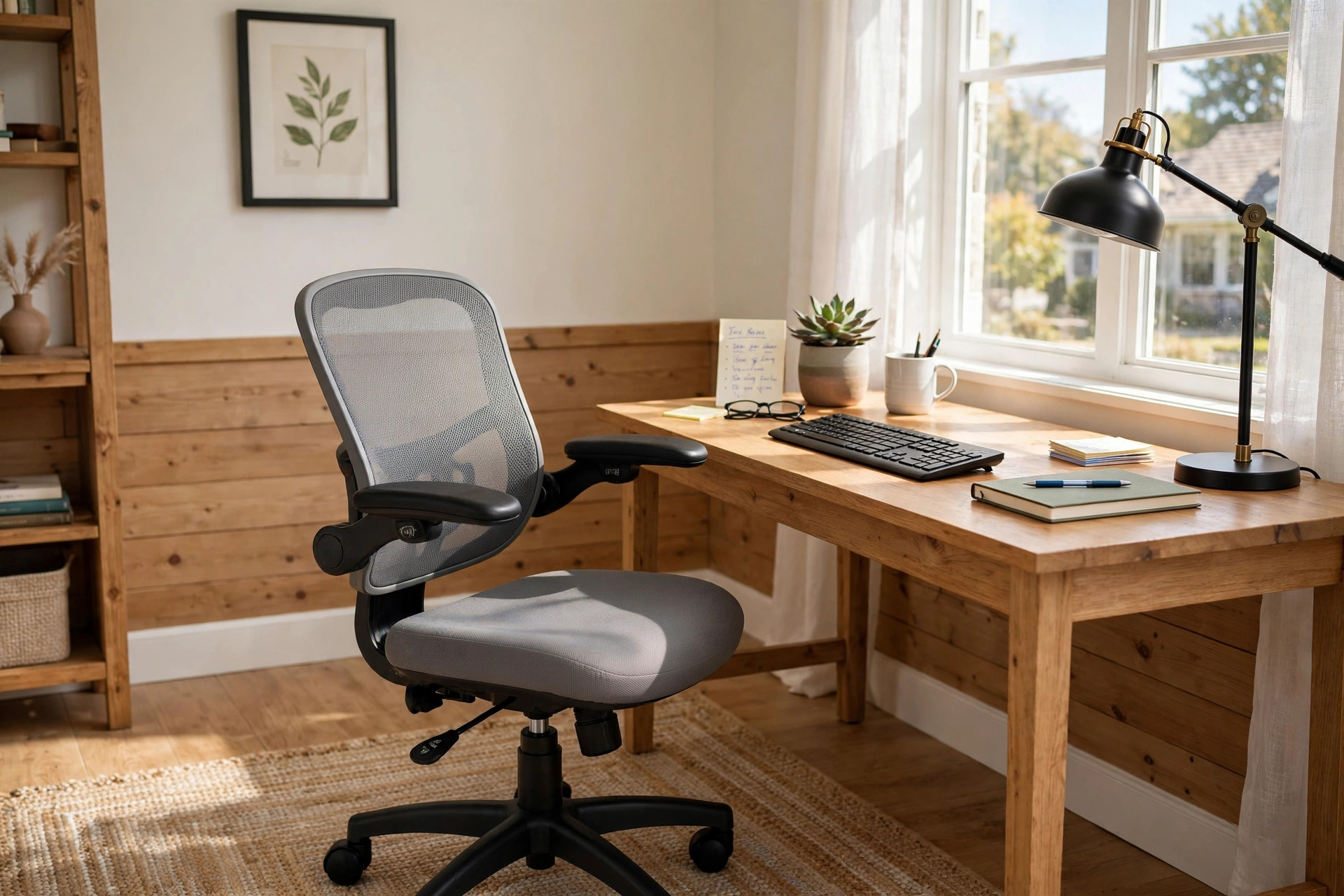

Most office chairs are built for an average frame. A person who stands five feet two inches tall or less finds that the seat edge presses into the backs of the thighs. The feet do not reach the floor. The lumbar pad strikes the mid-back instead of the lower back. An adjustable office chair for short person petite frames solves these faults. It drops the seat low enough for the feet to rest flat. It shortens the seat depth so the back can reach the backrest. This article explains what to measure, what to test, and what to pay.
Why Chair Fit Matters for Petite Workers
A chair that is too tall forces the body to adapt. The worker perches on the edge of the seat. The lower back loses contact with the backrest. The neck tips forward to see the screen. Hours pass in this pose. The shoulders stiffen. The lower back aches. The legs tingle where the seat edge cuts across the thighs.
These effects are not a matter of comfort alone. A seat pan that is too deep blocks blood flow behind the knees. Feet that dangle force the spine into a rounded curve. A petite worker who sits eight hours a day in a standard chair builds strain into every week of the year.
The fix is simple geometry. A chair seat should lower to about fifteen inches from the floor. The seat pan should measure no more than sixteen inches front to back. The backrest should adjust low enough to meet the lumbar curve of a short torso. When those numbers are right, the feet sit flat, the knees rest at a right angle, and the back meets the chair in the right place. Retailers such as IKEA and Wayfair list seat height ranges on most chair pages, and those numbers are the first thing to check.
What to Look For Before You Buy: Adjustable Office Chair for Short Person Petite
Low Minimum Seat Height
Seat height is the single most important measure. A petite adult needs a seat that drops to about fifteen or sixteen inches. Many standard task chairs stop at eighteen or nineteen inches. That gap is enough to leave short legs dangling.
Look for a gas cylinder rated for a low range. Chairs marketed to children and teenagers often reach down to fourteen inches, though they may lack adult back support. A well-made chair with a low-range cylinder gives the best of both worlds. Test the lowest setting before anything else. Sit down, place both feet flat on the floor, and check that your thighs rest level without pressure behind the knees.
Shallow Seat Depth
Seat depth matters almost as much as seat height. A standard seat pan runs nineteen to twenty inches deep. A petite frame needs sixteen inches or less. With the right depth, you can sit back fully and still have two fingers of space between the seat edge and the back of the knee.
Sliding seat pans help. A seat that glides forward and back lets you tune the depth to your legs. Look for a range of at least two inches. If the chair lacks this feature, the shell size must be right from the start.
Lumbar Support That Sits Low
On a short torso, a fixed lumbar pad often lands too high. It pushes the mid-back and leaves the lower back unsupported. Choose a backrest whose lumbar support adjusts up and down over a wide range. A flexible mesh back can also work, because it bends to meet the curve of the spine rather than forcing one.
Headrests follow the same rule. A headrest that starts too high does nothing. If the chair has one, it should drop low enough to cradle the base of the skull. If it cannot, skip the headrest entirely.
Armrests That Drop and Narrow
Armrest height should let the shoulders hang loose. Many chairs set their lowest armrest at seven inches above the seat, which forces short arms to hunch. Look for armrests that drop lower or that swing out of the way. Width adjustment matters too, since petite shoulders are narrower. Adjustable arms reviewed by Wirecutter often score well on these ranges.
Types and Options
Petite and Small Task Chairs
Several makers build task chairs sized for smaller frames. These chairs use shorter cylinders, shallower pans, and smaller backrests. They look like ordinary office chairs but scaled down. For a home desk, a compact task chair pairs well with a tidy cable setup; see our guide to a desk grommet for cable pass through to keep cords out of the way.
Ergonomic High-End Chairs
Premium makers such as Herman Miller and Steelcase offer smaller shell sizes in their classic lines. These chairs cost more, but they give deep adjustment ranges and long service life. A smaller shell from a premium line often fits a petite frame better than a one-size chair at half the price. PCMag covers these models in its office chair roundups, with attention to adjustment ranges.
Adjustable Desk Chair Combos
Some buyers pair a height-adjustable desk with their chair. A desk that drops to twenty-four inches or less lets a short person keep the chair low and the work surface near the elbows. Standing desk makers like Uplift Desk publish full height ranges, which makes matching simple. For small rooms, a corner desk with hutch for a small home office can hold the same low work height in less space.
Stool and Footrest Add-Ons
When the chair cannot drop low enough, a footrest closes the gap. A flat, sturdy footrest under the desk lets the feet rest level even when the seat sits high. It is a stopgap, not a cure, but it costs little and helps right away. Shared spaces benefit too; a partition divider for a shared room can carve out a corner where the footrest and chair stay set for one person.
Cost and Price
Prices run wide. Basic petite-size task chairs start near one hundred dollars. They give low seat height and shallow pans but limited adjustment. Mid-range chairs run from two hundred to five hundred dollars. They add sliding seats, adjustable lumbar support, and better armrests.
Premium ergonomic chairs run from six hundred to more than one thousand dollars. The price buys finer adjustment, longer warranties, and parts that last a decade. For someone who works from home full time, the cost spread over ten years can be lower than replacing a cheap chair every two years.
Watch for shipping and return costs. A chair that does not fit must go back. Retailers with free returns remove the risk of buying unseen. Reviews from The Spruce often note assembly time and return terms, which helps when comparing two models at similar prices.
Used chairs deserve a look. Office liquidators sell premium chairs at a fraction of new price. Measure the cylinder travel and seat depth before you commit. A used chair with a worn cylinder may no longer reach its lowest setting.
Care and Upkeep
A chair keeps its fit only if its parts keep moving. Wipe the cylinder and base clean of dust so the height lever works smoothly. Tighten bolts twice a year. Check the casters for hair and thread, which make the chair roll hard and strain the back when you pull in to the desk. A chair mat under the casters protects both the floor and the wheels, and it makes small position shifts smoother through the day.
Fabric seats need vacuuming to keep dust from grinding into the weave. Mesh backs can be wiped with a damp cloth. Leather or vinyl seats benefit from a conditioner made for the material. Keep the chair out of direct sun, which fades fabric and dries out plastic parts.
If the gas cylinder starts to sink under weight, it is worn. A replacement cylinder costs little and restores the low seat height that makes the chair fit. Replacing it is a simple job with basic tools.
Safety
A chair that rolls away or tips adds risk. Keep all five casters on the floor when you sit down. Lean the back only within the tilt range, and set the tilt lock if you tend to lean hard. A chair on a smooth floor may need a mat to keep it from sliding as you shift.
Check the weight rating. Most task chairs carry up to two hundred fifty pounds. Heavier ratings use sturdier cylinders, which also hold height settings longer. Never stand on the chair or use it as a step stool.
Small parts can loosen over time. A wobbling armrest or a seat that rocks side to side should be tightened before it fails. If a weld cracks or the cylinder sticks, retire the chair.
Frequently Asked Questions
What seat height does a short person need?
Most petite adults sit best with a seat between fifteen and seventeen inches high. Measure your lower leg from the floor to the back of the knee while wearing your usual shoes. That number is your target seat height. Choose a chair whose lowest setting matches it.
Is a petite chair strong enough for daily work?
Yes, if it carries a proper rating. Size and strength are different things. A well-built petite chair uses the same class of cylinder and base as a standard chair. Check the weight rating and the warranty length rather than judging by size.
Can I use a regular chair with a footrest instead?
A footrest helps, but it does not fix seat depth or lumbar height. If the seat pan is too deep, your back still cannot reach the backrest. Use a footrest as a short-term fix while you shop for a chair with the right seat depth.
Do I need armrests on a petite chair?
Armrests help when they adjust low and narrow. Fixed high armrests do more harm than good for short arms, because they push the shoulders up. If the chair’s arms cannot drop low enough, choose a model with removable arms or none at all.
How long should an office chair last?
A mid-range chair lasts five to eight years with daily use. Premium chairs often last ten to twelve years, and their parts are replaceable. The gas cylinder usually wears first. When it starts to sink, replace it rather than buying a whole new chair.
Where can I try petite chairs before buying?
Office furniture showrooms and some large retailers keep floor models. Sit in each candidate at its lowest setting with your feet flat. If no showroom is near, order from a seller with free returns and test the chair at your desk for a week.
Should I also buy a footrest with a petite chair?
It is good to have one on hand. Even a well-fitted chair feels better with a footrest on long days, because it lets you shift your leg angle. A simple flat footrest costs little. Keep it under the desk and use it when your legs grow restless, then push it aside when you want full floor contact.
A Final Word
The right chair disappears under you. Feet flat, knees easy, back held where it curves. Getting there takes three numbers: a seat that drops near fifteen inches, a pan no deeper than sixteen, and a lumbar pad that reaches a short back. Measure twice, test once, and buy the chair that meets all three. The premium lines from Herman Miller and Steelcase fit many petite frames, and budget options from IKEA and Wayfair cover the basics. Your back will feel the difference by the end of the first week.
References
Herman Miller. (n.d.). Office furniture and ergonomic seating. https://www.hermanmiller.com IKEA. (n.d.). Home furnishings. https://www.ikea.com PCMag. (n.d.). Technology product reviews. https://www.pcmag.com Steelcase. (n.d.). Office furniture and workplace research. https://www.steelcase.com The Spruce. (n.d.). Home and garden advice. https://www.thespruce.com UPLIFT Desk. (n.d.). Standing desks and ergonomic office furniture. https://www.uplift-desk.com Wayfair. (n.d.). Furniture and home goods. https://www.wayfair.com Wirecutter. (n.d.). Product reviews from The New York Times. https://www.nytimes.com/wirecutter
Was this guide helpful?

About Emily Rodriguez
The My Garden US editorial team writes practical, in-depth home and garden guides for American homeowners — tested advice, no fluff.
You May Also Like

Best Web Camera for Home Office Zoom Meetings: A Simple Buying Guide
April 10, 2026 0 views
Home Office Desk Grommet for Cable Pass Through: A Simple Guide
January 25, 2026 0 views
The Best Desk Organizer Set for a Small Office Desk: A Practical Guide
September 28, 2026 0 views