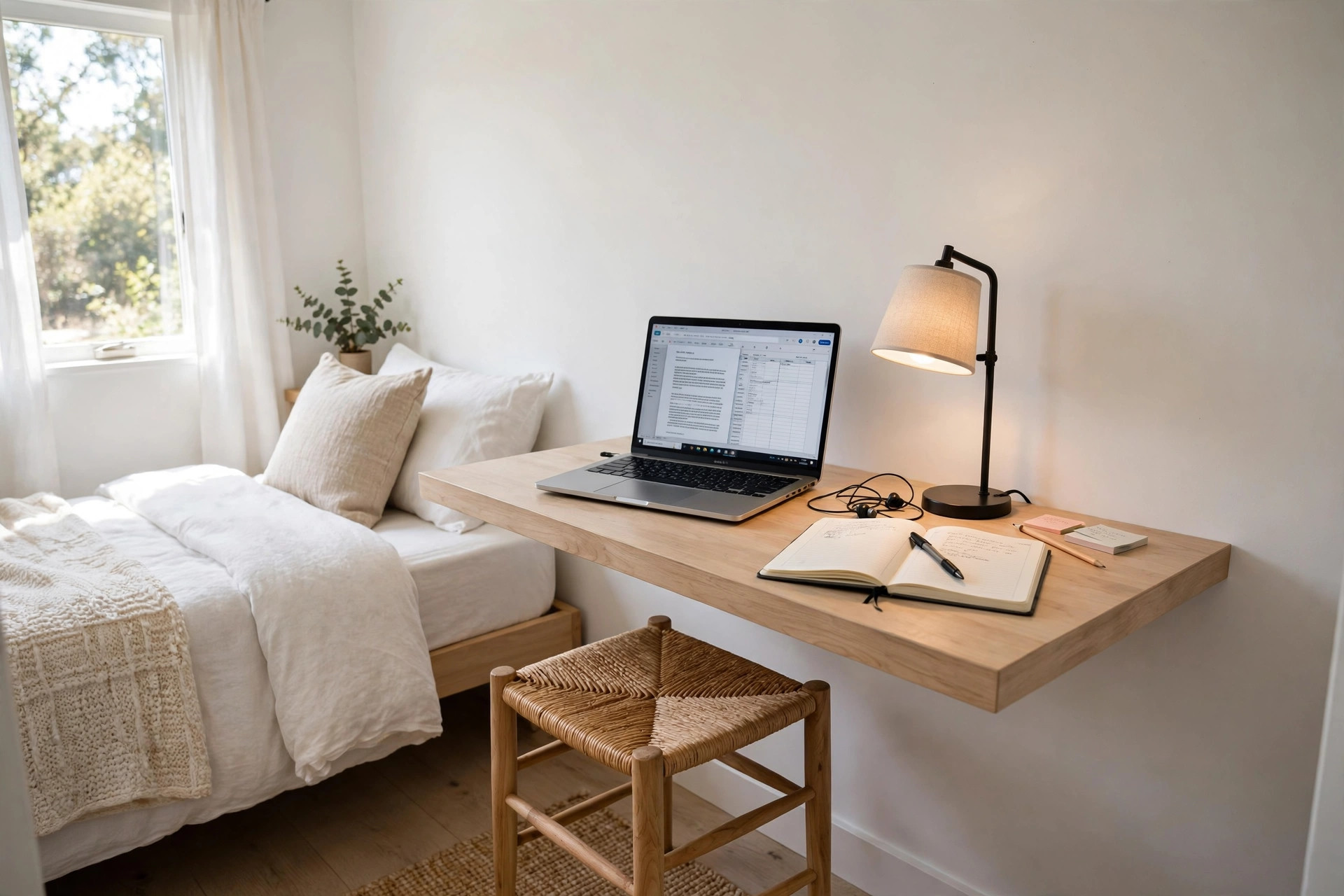

A floating shelf desk for tiny bedroom office use is a simple answer to a common problem. Many people now work from home. Their bedrooms are small. A full desk will not fit. A table takes up too much floor room. A wall-mounted shelf desk gives a work surface with no legs. It folds flat against the wall in some models. It frees the floor under it. This guide will help you understand why this desk works, what to look for, and how to keep it in good shape.
Why a Floating Shelf Desk Makes Sense for a Tiny Bedroom
A small bedroom must do two jobs at once. It is a place to sleep. It is also a place to work. These two jobs fight for space. A bed takes most of the room. A dresser takes the rest. There is often no spot left for a normal desk.
A floating shelf desk for tiny bedroom office needs solves this. It mounts to the wall. It needs no floor space of its own. You can place it over a bed or in a corner. The room feels bigger.
A small room should have furniture that does more than one job. A wall desk is a shelf when you rest and a desk when you work.
What a Floating Shelf Desk Is: Floating Shelf Desk for Tiny Bedroom Office
A floating shelf desk is a flat board fixed to the wall. It has no legs. Hidden brackets or strong anchors hold it up. Some models have a hinge. The top folds down for work. It folds up against the wall when you finish. Others stay fixed in place at all times.
The desk is different from a normal table. A table stands on the floor. It takes room even when no one uses it. A wall desk leaves the floor free. You can roll a chair under it or push a storage box under it.
The floating shelf desk for tiny bedroom office buyers often choose is shallow. It may be only twelve to twenty inches deep. This is enough for a laptop, a notebook, and a lamp. It will not hold a large desktop computer. Know this before you buy.
What to Look for When You Choose One
Weight Capacity
This is the first thing to check. The desk must hold your laptop, books, and lamp. Read the weight limit on the package. Do not guess.
Size and Depth
Measure your wall before you shop. Note how much width you have. Note the height you want. A desk for laptop work needs a top at least twenty-four inches wide. For a mouse and papers, go wider. Depth of sixteen inches works for most laptops. If you need two monitors, a floating desk is likely too small.
Wall Type
The wall you mount to matters a lot. A desk fixed into wall studs is very strong. Drywall alone is weak. You will need special anchors for drywall. Brick and concrete walls need masonry screws. If you rent your home, check your lease. Some landlords do not allow wall holes. Ask first.
Fold-Down or Fixed
Fold-down desks save the most space. They close flat when not in use. Fixed desks are stronger. They hold more weight. Think about your day. If you work each day at the same spot, a fixed desk is fine. If you need the wall clear at night, choose a fold-down model.
Material and Finish
Wood desks look warm and last long. Solid wood is best but costs more. Engineered wood is cheaper. It can still serve well for light work. Metal desks are strong and plain. A light finish makes a small room feel larger.
Types of Floating Shelf Desks
Simple Shelf Board with Brackets
This is the most basic type. It is a flat board held by metal brackets. It costs the least. It is easy to install. It does not fold. It suits people who need a desk that is always ready. Pair it with a small standing desk for laptop only use if you want a standing option for short tasks.
Fold-Down Wall Table
This desk hangs on hinges. You pull it down to work. You push it up to close it. Many models have a storage box behind the top. Pens and papers stay inside. This type is a favorite for very small rooms. It hides the work space at night.
Desk with Built-In Shelves
Some wall desks come with shelves above or beside the work top. These shelves hold books, plants, and files. They keep the desk top clear. The whole unit looks like one piece of furniture. It costs more than a plain board. It saves you from buying extra shelves.
Corner Floating Desk
A corner desk uses two walls. It gives more top space in a tight corner. Many small bedrooms have an empty corner. This desk fills it well. It is harder to install because both sides must be level. A friend can help hold it during mounting.
Drawer Desk
This type has one or two small drawers under the top. Drawers hold pens, chargers, and paper. They keep small things off the top. The desk is heavier because of the drawer box. Check the weight limit with care.
Cost and Price
A floating shelf desk for tiny bedroom office buyers can find is not costly. Prices run from low to high based on size and material.
A plain board with brackets costs about twenty to sixty dollars. It is the cheapest path. You can buy the board and brackets at many home stores. The Home Depot carries a wide range of boards and mounting hardware for such projects.
A fold-down desk from a known maker costs sixty to two hundred dollars. IKEA sells wall-mounted desks that fit small rooms and small budgets. Wayfair lists many styles in this price range as well.
A solid wood wall desk with shelves can cost two hundred to five hundred dollars. These are made to last. They look like real furniture. Herman Miller and Steelcase focus on work furniture with strong build quality, though their prices sit at the high end. Uplift Desk offers wall and small-space work options too.
Add the cost of tools if you do not own them. You may need a drill, a level, a stud finder, and wall anchors. These tools cost about thirty to eighty dollars if bought new. Many people borrow them from a friend.
If you hire help to install the desk, add fifty to one hundred dollars for the labor. Mounting into studs is a simple job for a handyman. It takes under an hour in most cases.
How to Install Your Floating Shelf Desk
Step One: Pick the Spot
Choose a wall with an outlet near it. You will need power for your laptop and lamp. Avoid walls with pipes behind them. The side of the room near a window gives good light. Make sure a chair can fit under the desk. Leave room to push the chair in.
Step Two: Find the Studs
Use a stud finder to find the wood studs behind the drywall. Mark them with a pencil. Fix the desk into studs when you can. This is the strongest way. If no stud is in the right spot, use strong toggle bolts made for drywall.
Step Three: Mark the Height
The top of the desk should sit at the same height as a normal desk. This is about twenty-eight to thirty inches from the floor. Sit in your chair and rest your arms. Your elbows should bend at a right angle. Mark this height on the wall.
Step Four: Level and Drill
Hold the desk or a level at your mark. Draw a straight line. Drill pilot holes into the studs. Have a friend hold the desk while you drive the screws. Check the level again before you finish.
Step Five: Test the Weight
Press down on the desk with both hands. It should not move. Set a few books on it and leave them for an hour. Only then set up your laptop and lamp.
Detailed guides on mounting wall furniture appear on The Spruce, which covers home projects in plain steps. Consumer Reports tests home goods and can help you compare build quality before you buy.
Setting Up a Work Spot in a Tiny Bedroom
A desk is only part of the work spot. Light matters. A small lamp on the desk keeps your eyes from strain. Place the lamp on the left if you write with your right hand. This keeps your shadow off the page.
A chair matters too. A small chair with no arms fits under a wall desk. It pushes in flat. If your chair is too tall, you will hit your knees. Measure the space under the desk before you buy a chair.
Cords are a common mess. Use a small power strip behind the desk. Tie loose cords with simple ties. A clean cord path keeps the small room from looking busy.
A rug under your chair cuts noise and makes the room feel warmer.
For ideas on small-space work setups, Wirecutter reviews desks and chairs with care. PCMag covers work-from-home gear as well.
Care and Upkeep
A floating shelf desk needs little care. Wipe the top each week with a damp cloth. Dry it after. This keeps dust from building up. Do not use strong cleaners on wood. They can dull the finish.
Check the screws twice a year. Wood walls and heavy use can loosen them. Tighten any screw that has play. If an anchor pulls loose from drywall, replace it with a larger toggle bolt. Do not keep using a loose mount.
Use a coaster under drinks. A spilled cup can stain wood, so wipe spills at once.
Sunlight can fade the finish over time. Close the blind in the strong afternoon sun if the desk sits by a window.
Safety
Safety starts with mounting. A desk that falls can hurt a person and break a laptop. Always mount into studs when you can. Respect the weight limit. Do not let children hang from the desk.
Fold-down desks have pinch points at the hinge. Keep fingers clear when you open or close them. Teach children not to play with the moving top.
Check that no cords run across the floor where you walk. A cord in the path can trip you in a small room. Run cords along the wall with clips.
If you use a lamp with a hot bulb, keep paper away from it. Better still, use an LED bulb. It stays cool and uses less power.
Common Mistakes to Avoid
The first mistake is skipping the studs. Drywall alone will not hold a loaded desk for long. It may hold at first. It will sag or pull out over time. Find the studs or use the right anchors.
The second mistake is buying too small. A board that fits only the laptop leaves no room for a mouse or notes. Measure your gear first. Add a few inches on each side.
The third mistake is mounting too high or too low. A desk at the wrong height hurts your neck and back. Use the elbow test described above. Take time to get it right.
The fourth mistake is overloading the desk. A wall desk is not a bookshelf. Heavy books and printers can push past the limit. Store heavy items on the floor.
FAQ
How much weight can a floating shelf desk hold?
Most hold thirty to fifty pounds when fixed into studs. Light models hold less. Heavy-duty models hold more. Always read the limit printed by the maker. Stay well under it for safety.
Can I install a floating desk in a rental apartment?
It depends on your lease. Many landlords allow small holes that you fill before you move out. Some do not allow any wall mounting. Read your lease or ask your landlord in writing. There are also no-drill options with strong adhesive strips, but they hold far less weight.
Is a floating shelf desk good for two monitors?
No, not in most cases. A floating shelf desk for tiny bedroom office use is made for a laptop. Two monitors need a wide, deep, strong desk. A wall shelf is too small and may not hold the weight. One laptop, or one small monitor, is the safe limit.
What is the best height for a wall-mounted desk?
About twenty-eight to thirty inches from the floor suits most adults. The right height lets your elbows bend at ninety degrees while you type. Taller people may need thirty-one inches. Shorter people may need twenty-seven. Test with your own chair before you drill.
Can a floating desk damage my wall?
It makes holes like any wall-mounted item. Small screw holes can be filled with spackle when you move. Large toggle bolt holes need a bit more patch work. The wall itself is not harmed if you mount with care and keep within the weight limit.
How do I hide cords on a wall desk?
Use adhesive cord clips along the wall under the desk. Run all cords to one power strip. A cord cover that matches your wall paint hides the rest. Keep the strip off the floor so it is easy to reach.
A Short Final Word
A floating shelf desk for tiny bedroom office rooms is a quiet, honest piece of furniture. It does not try to be more than it is. It gives you a flat place to work. It leaves your floor free. It costs less than a full desk.
Take your time when you choose. Measure twice. Mount into studs. Keep the top clear of clutter. With these simple steps, a small bedroom can hold a real work spot. The room stays a bedroom at night. By day, it earns its keep as an office.
For more on small work spaces, see our notes on an adjustable laptop table for recliner chair use and the best standing desk mat for concrete floors.
References
Consumer Reports. (n.d.). Product reviews and ratings. https://www.consumerreports.org Herman Miller. (n.d.). Office furniture and ergonomic seating. https://www.hermanmiller.com IKEA. (n.d.). Home furnishings. https://www.ikea.com PCMag. (n.d.). Technology product reviews. https://www.pcmag.com Steelcase. (n.d.). Office furniture and workplace research. https://www.steelcase.com The Home Depot. (n.d.). Home improvement products. https://www.homedepot.com The Spruce. (n.d.). Home and garden advice. https://www.thespruce.com UPLIFT Desk. (n.d.). Standing desks and ergonomic office furniture. https://www.uplift-desk.com Wayfair. (n.d.). Furniture and home goods. https://www.wayfair.com Wirecutter. (n.d.). Product reviews from The New York Times. https://www.nytimes.com/wirecutter
Was this guide helpful?

About Lisa Anderson
The My Garden US editorial team writes practical, in-depth home and garden guides for American homeowners — tested advice, no fluff.
You May Also Like

Home Office Desk Organizer for Mail and Bills: A Simple Guide
June 7, 2026 0 views
Small Rolling Desk for Laptop in Living Room: A Practical Buying Guide
January 7, 2026 0 views
Adjustable Footstool for Under Desk Leg Support
May 28, 2026 0 views