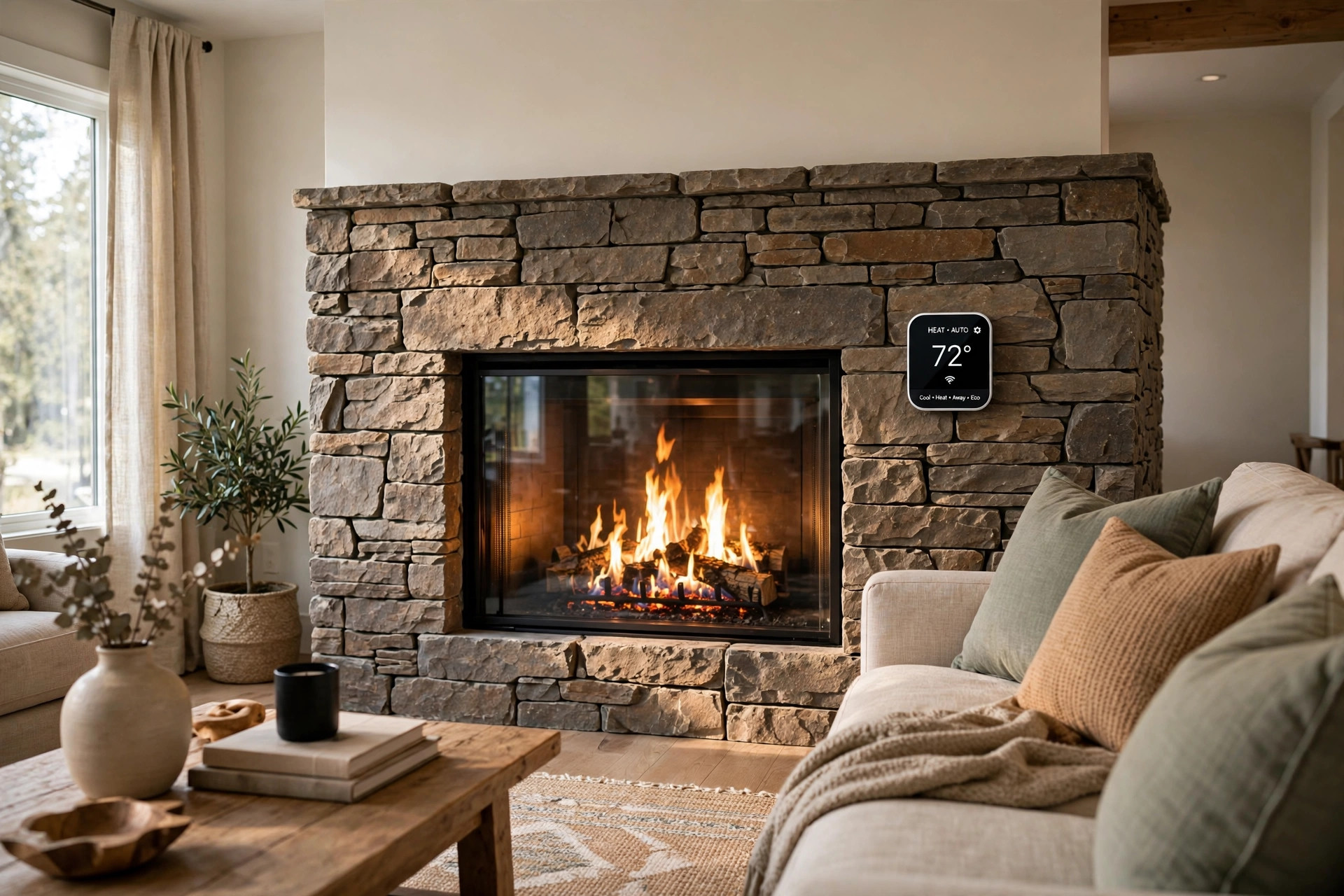

Shoppers who search for smart thermostat controlled gas fireplaces for sale want two things at once: the warm glow of a real flame and the easy control of a modern heater. A gas fireplace with a smart thermostat gives both. You set a room temperature. The fireplace lights itself. It adjusts the flame up and down. When the room is warm enough, it turns itself down or off. You never have to tend wood. You never have to walk across a cold room to turn a dial. This guide explains how these units work, what to look for, what they cost, and how to buy with care.
Why a Thermostat Controlled Gas Fireplace Matters
A plain gas fireplace looks fine, but its heat is hard to manage. You turn it on and the room gets warmer and warmer. You turn it off and the room cools. A smart thermostat breaks this cycle. It reads the room temperature through a sensor. It sends signals to the gas valve. The flame grows when the room is cool and shrinks when the room is warm. The result is steady comfort instead of hot and cold swings.
This matters for several reasons. First, comfort improves. The room stays close to the temperature you chose, often within one or two degrees. Second, fuel use drops. The unit burns less gas because it stops heating once the target is reached. Third, safety improves. Many models shut down on their own if the room gets too hot or if the flame goes out. Fourth, daily life gets easier. You can warm the living room before you come downstairs in the morning. You can lower the heat from the couch at night.
These units also work well as zone heaters. Instead of heating the whole house with the main furnace, you heat the one room where people sit. This can cut the load on the main system during mild cold spells. For shoppers in small homes, a premium thermostat controlled gas fireplace for a small apartment may heat the main living space with little waste.
How the Smart Thermostat Works: Smart Thermostat Controlled Gas Fireplaces for Sale
The term “smart” covers a range. At the simple end, a wall thermostat with a temperature dial wires to the fireplace. You set a number, and the unit holds it. In the middle are programmable thermostats. You set a schedule, such as 70 degrees in the evening and 64 overnight. At the high end are smart thermostats with remote control. You change settings from a phone app. Some link to home systems and respond to voice commands.
Most gas fireplaces use one of two control styles. Millivolt systems run on a tiny electric current made by the pilot light. They need no house power and keep working during a power outage. Many millivolt units accept a thermostat, a remote, or both. Electronic ignition systems use house power and light the pilot only when heat is called for. These often pair with the most advanced smart controls.
When you shop, ask how the thermostat talks to the unit. Some use wires. Some use radio signals from a remote handset that also holds the temperature sensor. A handset with a built-in sensor is handy, because you can place it where you sit. The fireplace then heats to the temperature at your chair, not at the wall.
What to Look for in the Thermostat Itself
A good control has a clear display that shows the room temperature and the set point. It should hold the set point within a tight band. Look for a child lock if young children live in the home. A timer or schedule feature adds real value. Battery backup matters for models that must keep settings during an outage. Finally, check the range of any wireless remote so the signal reaches from your usual seat.
Types and Options
Gas fireplaces come in three main vent types. Direct vent units pull fresh air from outside and send exhaust back out through a sealed pipe. They are the most common choice for living rooms and bedrooms. They keep room air clean and work with glass fronts that stay sealed.
Vent free units burn room air and release exhaust into the room. They are efficient because no heat escapes up a pipe. However, they face strict rules in some states and cities. A few states limit or ban them. Check local codes before you buy. B-vent or natural vent units use a traditional chimney style pipe. They are simple but less efficient, since warm air rises out the vent.
Style choices matter too. Insert models slide into an old wood fireplace opening. They are popular in older homes. Freestanding stoves stand on the floor and suit rooms with no fireplace. Built-in linear units sit in a wall and give a long ribbon of flame. Corner units fit rooms where wall space is tight. For the front of the unit, many buyers add luxury fireplace screens with doors for an extra layer of safety and style.
Fuel is another choice. Natural gas connects to a home gas line and costs less per unit of heat in most areas. Propane works where no gas line reaches. It needs a tank outside the home. Make sure the model you buy is set up for your fuel, or can be converted by a licensed tech.
Sizing the Unit
Size is measured in BTUs, or British thermal units. A small unit may give 20,000 BTUs. A large one may give 40,000 or more. A room of 400 square feet in a cold climate may need 20,000 to 25,000 BTUs. Poor insulation or tall ceilings raise the need. Oversizing wastes money and causes short cycling, where the unit turns on and off too often. A dealer can run a simple heat load check for your room.
Cost and Price
Prices for smart thermostat controlled gas fireplaces for sale span a wide range. Small vent free models with basic thermostat controls start near 800 to 1,200 dollars for the unit alone. Mid range direct vent inserts with programmable controls run 1,500 to 3,000 dollars. Large built-in linear units with full smart home links can reach 4,000 to 7,000 dollars.
The unit price is only part of the cost. Professional installation often adds 1,000 to 3,000 dollars. Direct vent models need vent pipe work through a wall or roof. Gas line work needs a licensed plumber or gas fitter. Permits and inspections add a few hundred dollars in many towns. A stone or tile surround adds more. If you like a stone look, read about ventless stone fireplace surrounds before you plan the finish work.
Running costs are modest. Natural gas heat from a fireplace often costs less per hour than electric space heat. A 25,000 BTU unit at full flame may use about a quarter of a therm of gas per hour. Because the thermostat cuts the flame back, real use is lower. Yearly service adds 100 to 200 dollars.
Where the Smart Features Add Cost
A basic thermostat add-on may cost 100 to 250 dollars. A smart Wi-Fi control with an app may add 200 to 400 dollars. Full home system links can add more. Weigh this against fuel savings. A good thermostat can cut gas use by 10 to 20 percent over a plain on-off model. Over years, the control pays for itself.
Care and Upkeep
Gas fireplaces need less care than wood units, but they are not care free. Book a yearly service visit before the heating season. A technician cleans the burner, checks the gas lines, tests the ignition, and inspects the vent. This visit catches small problems before winter.
Between visits, you can do simple tasks. Keep the glass front clean with a cleaner made for fireplace glass. Vacuum dust from around the unit. Keep the area near the vents clear of boxes and drapes. Check that the remote or thermostat has fresh batteries each fall. If the flame looks weak or yellow on a unit that should burn blue, call for service. Do not try to fix gas parts yourself.
The thermostat needs care too. Keep its sensor away from direct sun, drafts, and other heat sources. A sensor near a sunny window reads too warm. The fireplace then underheats the room. Wipe dust from the display and vents on the control. If a wireless remote loses its link, check the pairing steps in the manual before you call for help.
Safety
Gas fireplaces are safe when installed and used with care. Still, respect the fuel. Hire a licensed installer and pull permits where required. The federal Consumer Product Safety Commission tracks home heating incidents and offers safety guidance for fuel burning appliances. Read it before your first winter.
Place a working carbon monoxide detector in the room and one on each floor of the home. Test them each month. Never run a vent free unit in a small closed room without the fresh air the manual calls for. Keep children and pets away from hot glass. Glass fronts can reach high temperatures even after the flame is low. A screen or barrier helps.
Follow the manual on clearances. Keep furniture, paper, and cloth at the distances the maker states. Never hang stockings or garlands on a hot unit. If you smell gas, leave the home and call the gas company from outside. Do not light matches or flip switches.
Smart controls add a safety layer but do not replace common sense. Use the high temperature shutoff if your model has one. Set sane schedules so the unit does not heat an empty home all day. Lock the controls if children can reach the remote.
Buying Tips
Start with your room and your fuel. Measure the space. Note your fuel type. Check local codes for vent free rules. This narrows the field fast.
Shop from sellers who know hearth products. Large home stores such as Home Depot carry many models and parts. Maker sites like Heatilator show full product lines with specs. Review sites like Consumer Reports test heating products and rate reliability.
Compare control features side by side. Write down which models include a true thermostat and which only include a simple remote. Ask whether the thermostat sensor sits in the handset or on the wall. Ask about power outage behavior. A millivolt unit keeps heating when the lights go out. An electronic unit may not.
Get installation quotes in writing. Ask each bidder to list vent work, gas work, permits, and finish work. A low unit price means little if the install bid is high. Check that the installer is licensed and insured. Ask for references from past fireplace jobs.
Read the warranty. Good makers cover the firebox for many years and parts for one to five. Ask what service support looks like in your town. A fine unit with no local service is a poor buy.
Look up efficiency and safety data. The EPA publishes guidance on home heating choices and air quality. The Department of Energy offers plain guides on heating options and controls. Home advice sites such as This Old House, Family Handyman, Bob Vila, and The Spruce publish buying guides and install stories that show what to expect.
FAQ
Do smart thermostat gas fireplaces need electricity?
It depends on the ignition type. Millivolt systems make their own small current from the pilot light. They run the thermostat and gas valve with no house power. Electronic ignition systems need house power to light. Many smart Wi-Fi controls need power too. Ask the dealer which parts keep working in an outage.
Can I add a smart thermostat to a gas fireplace I already own?
Often yes. Many millivolt gas fireplaces accept a thermostat or remote add-on. A technician wires it to the valve or pairs a wireless control. Some older units lack the right valve. Have a hearth professional check your model before you buy parts.
Are thermostat controlled gas fireplaces safe in bedrooms?
Direct vent models are the usual pick for bedrooms. They seal combustion from room air. Many codes allow them with the right size and controls. Vent free models face tighter bedroom rules in many places. Check local code and the manual.
How much can a thermostat save on gas?
Savings vary, but a good thermostat often cuts use by 10 to 20 percent against a plain on-off fireplace. The unit burns less because it throttles back at the set point. Zone heating adds more savings if you turn down the main furnace.
Do these fireplaces work during a power outage?
Millivolt models do. They need no house power for the burner or basic thermostat. Electronic ignition models usually do not light without power unless they have battery backup. Smart Wi-Fi features stop working without power and internet in all cases.
What maintenance does the thermostat need?
Very little. Change batteries each year. Keep the sensor clean and away from sun and drafts. If readings seem wrong, compare with a simple room thermometer. A gap of more than a few degrees means the sensor spot is poor or the unit needs service.
Final Word
Smart thermostat controlled gas fireplaces for sale give you the best of two worlds: living flame and steady, hands-off heat. Pick the right vent type for your home and local code. Size the unit to the room. Choose a thermostat with the features you will truly use. Pay for licensed installation and yearly service. Do these things and the fireplace will warm your home with little fuss for many years.
References
Bob Vila. (n.d.). Home improvement advice. https://www.bobvila.com Consumer Reports. (n.d.). Product reviews and ratings. https://www.consumerreports.org Family Handyman. (n.d.). DIY home repair and maintenance. https://www.familyhandyman.com Heatilator. (n.d.). Fireplaces and fireplace products. https://www.heatilator.com The Home Depot. (n.d.). Home improvement products. https://www.homedepot.com The Spruce. (n.d.). Home and garden advice. https://www.thespruce.com This Old House. (n.d.). Home renovation guidance. https://www.thisoldhouse.com U.S. Consumer Product Safety Commission. (n.d.). Product safety information. https://www.cpsc.gov U.S. Department of Energy. (n.d.). Energy efficiency and renewable energy. https://www.energy.gov U.S. Environmental Protection Agency. (n.d.). Protecting human health and the environment. https://www.epa.gov
Was this guide helpful?

About Robert Taylor
The My Garden US editorial team writes practical, in-depth home and garden guides for American homeowners — tested advice, no fluff.
You May Also Like
How to Find Top Rated Chimney Inspection Services Near Me
April 20, 2026 0 views
Buy Fireplace Glass Doors Online in Arizona: A Simple Buying Guide
March 16, 2026 0 views
Tile Fireplace Surrounds: Reviews and Buying Guide
March 29, 2026 0 views