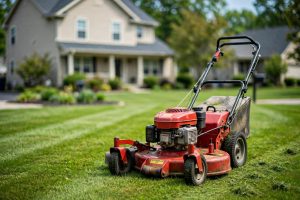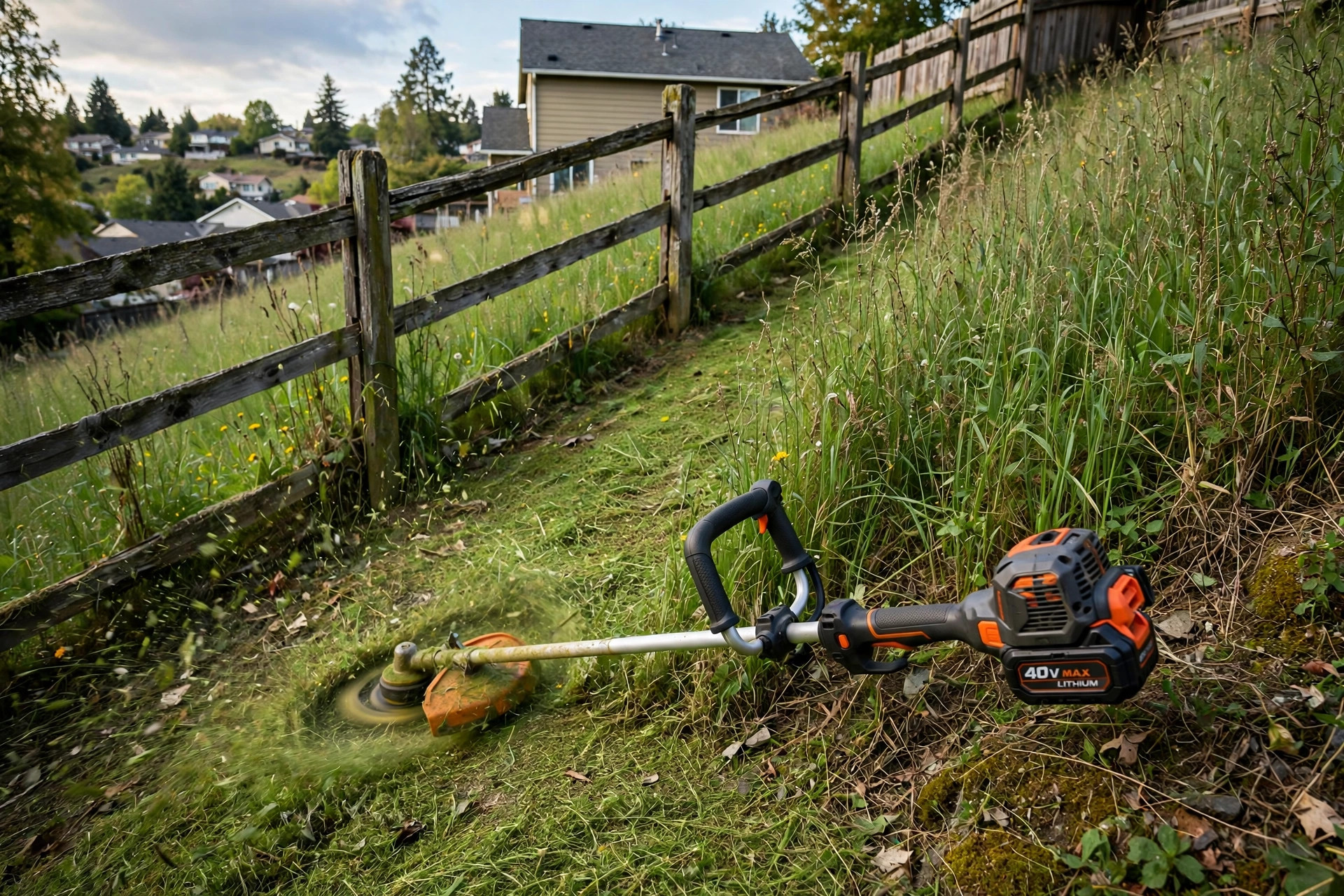

A fence line trimmer for steep slopes is the tool that finishes what a mower cannot. Grass grows tall along every fence post and under every rail, and on a hill a riding mower or even a walk-behind mower is either unsafe or useless there. A hand-held string trimmer lets you walk the fence line on your own two feet and cut that strip clean without pushing a heavy machine sideways on a grade.
Trimming along a fence on flat ground is easy work. On a steep slope the job gets harder. The footing is poor, the angle is strange, and a trimmer that is too heavy will wear you out fast.
Why a Fence Line Trimmer Matters on Steep Slopes
Mowers have strict slope limits. OSHA guidance used in the landscaping trade says never to mow slopes greater than 15 degrees, and on grades above 5 degrees you should only mow straight up and down. Many fence lines sit on banks and drainage swales that are steeper than that. A mower simply does not belong there.
A string trimmer is built for exactly these spots. You carry it in your hands, you control the cutting head, and you walk across the slope at a steady pace. Along a fence, the line of the trimmer reaches under rails and around posts where mower wheels and decks cannot go. It also stops grass and weeds from pressing against wooden fence boards, where trapped moisture can rot the wood and rust the fasteners.
On steep ground, weeds grow thick because the strip is hard to reach and often skipped. A neglected fence line on a slope turns into a fire hazard in dry months, a hiding place for ticks and rodents, and an eyesore that drags down the whole yard. A trimmer you can handle on a grade keeps that strip under control. Bare spots left by hard trimming can wash out in heavy rain, so seed them with hardy grass seed from companies like Pennington and feed the strip with products from Scotts to keep the bank green and stable.
What to Look for in a Fence Line Trimmer for Steep Slopes
Working on a hill punishes your body, so the ergonomics of the machine matter as much as its power.
Weight. This is the first thing to check. On flat ground, a 12-pound trimmer feels fine. On a 20-degree slope, every pound pulls at your arms and shoulders. Look for a trimmer under 10 pounds before battery or fuel is added. Battery models in the 40-volt class often weigh 7 to 9 pounds with the battery installed, which is why they are popular for slope work.
Shaft style. Straight-shaft trimmers reach farther under a fence and along a bank. They also accept more attachments, like edger heads. Curved-shaft trimmers are lighter and shorter, and some people find them easier to swing close to their feet on a slope. For fence lines on hills, a straight shaft is usually the better pick because it keeps your hands higher and your back straighter.
Harness. A shoulder strap or a full harness changes everything on a slope. It takes the weight off your arms, steadies the machine, and leaves both hands free to guide the head. Trimmers meant for heavier work, like the ECHO SRM series, come with or accept a shoulder harness. If you plan to trim a long fence line on a hill more than a few times a year, buy a harness with the tool.
Power head design. On slopes you want a trimmer that starts easy and runs smooth. Modern battery trimmers start with the press of a button, which is a real advantage when you are standing on uneven ground and do not want to yank a pull cord. Gas trimmers with easy-start systems, like ECHO’s i-30 or STIHL’s Easy2Start, reduce the same problem.
Line feed. Bump-feed heads let you tap the head on the ground to advance line. That works fine on flat lawns. On a steep fence line, tapping the head on a rock-strewn bank is awkward. Auto-feed heads advance line on their own and save you the trouble.
Types of Trimmers for Slope and Fence Work
Battery-Powered Electric Trimmers
Battery trimmers are the most common choice for homeowners today. They are light, quiet, and start with a button. Most 40-volt models sell for $90 to $280 depending on the battery size and the kit. In 2026, Greenworks has listed a 40-volt 12-inch trimmer at a low of about $90, and RYOBI 40-volt Expand-It kits at Home Depot run from about $159 to $249. These prices make battery power hard to beat for a homeowner who trims once a week.
The catch is runtime. A small 2.0 Ah battery may last 20 to 30 minutes of real cutting, which is enough for a normal fence line but short for a very long one. Buy a kit with a larger battery or a second pack if your slope is long. Battery trimmers are also gentler on thick weeds than gas models, so match the machine to your weeds.
For a related comparison of electric options, see our battery-powered hedge trimmer reviews.
Gas-Powered Trimmers
Gas trimmers still rule where weeds are thick and the fence line is long. Entry-level gas models start around $150, solid homeowner models land in the $200 to $300 range, and professional units run past $400. ECHO and STIHL both offer several homeowner models under $200, with the ECHO SRM-225 and the STIHL FS 38 being common picks. These machines cut 15- to 17-inch swaths and handle brush that would stall a small battery trimmer.
Gas has downsides on a slope. The machines are heavier, they vibrate more, and mixing fuel is a chore. Many gas trimmers run on small engines from Briggs & Stratton, which powers much of the outdoor equipment sold in the United States. But if your fence line sits in a field edge with heavy weeds, gas is worth it. A two-stroke engine is lighter and cheaper but needs mixed fuel; a four-stroke runs on straight gasoline and is quieter, though it weighs more.
If you need a trimmer that can chew through the toughest growth, read our guide to the top rated string trimmer for thick weeds.
Wheeled Trimmers and Attachment Systems
Wheeled string trimmers, sometimes called walk-behind trimmers, have big wheels and a heavy-duty line head. Makers like Toro and John Deere sell walk-behind models for long fence runs, but they are a poor choice for steep slopes. They are heavy to push sideways across a grade and can slip. Leave them for flat fence runs.
Attachment systems, like RYOBI’s Expand-It line, are worth a look. One battery powerhead drives trimmer, edger, and pole-saw attachments. On a sloped fence line, being able to swap to an edger head for the bottom of the slope or a pole saw for overhanging branches adds real value. Check our cordless edger vs gas edger comparison if you plan to edge the base of the hill too.
Cost and Price: What to Budget in 2026
Here is what current prices look like for a fence line trimmer for steep slopes, based on 2026 retail figures:
– Budget battery trimmer: $90 to $150. Covers short fence lines and light grass. Good as a starter. – Mid-range battery trimmer (40V class, larger battery): $150 to $280. The sweet spot for most homeowners on slopes. Light, quiet, strong enough for weekly fence work. – Homeowner gas trimmer: $150 to $300. Better for long fence lines and thick weeds. Heavier to carry on a hill. – Pro-grade gas trimmer: $300 to $450 plus. For very long slopes, acreage, or brush. Overkill for most yards.
Add $20 to $40 for a good shoulder harness if the trimmer does not include one, and about $10 a year for replacement trimmer line. A spool of round .095 line, the most common size for homeowner trimmers, costs under $10 and lasts most of a season.
Buy from a dealer that honors the warranty, which is typically two to five years. Consumer Reports tests trimmers for reliability and noise, and its ratings are a solid second opinion before you buy. ECHO’s own site lists its full SRM lineup with specs and dealer locations. The Spruce publishes plain buying guides for trimmers, and LawnStarter connects homeowners with local landscaping pros if you would rather hire the job out.
How to Trim a Fence Line on a Steep Slope
Work across the slope, not up and down it. Walk a steady horizontal path along the fence and swing the head in a smooth arc. Let the line do the cutting; pressing the head into the grass only wastes line and strains the motor.
Start at the top of the slope and work your way down in passes. Cut a strip about as wide as the trimmer’s swath, then step down and cut the next strip. Keep the cutting head tilted slightly so debris flies away from you, not into your legs. When trimming along the fence itself, hold the head parallel to the ground and run the line just under the bottom rail.
Trim when the grass is dry. Wet grass clumps, sticks to the fence boards, and turns a slope into a skating rink. Morning dew on a steep bank is a real fall risk, so wait until the sun has dried the ground. Landscaping pros who work slopes for a living plan their day so hilly areas get done after they dry out.
Wear boots with real tread, long pants, eye protection, and ear protection if you run a gas model. Gloves help too, since vibration on a long slope adds up.
Care and Upkeep
A trimmer that lives near a slope takes a beating, so basic upkeep pays off.
Line. Check the head before every use. Soak new trimmer line in water for a day before loading it; wet line cuts better and lasts longer. Keep a spare spool in the garage.
Battery models. Store batteries indoors, out of the heat. Do not leave them on the charger for days. A battery that is kept cool and charged to about half for winter storage will last more seasons.
Gas models. Use fresh fuel mixed at the ratio in the manual, and run the carburetor dry before long storage. Clean the air filter a few times a season. Spark plugs last a long time, but keep a spare on hand.
The fence line itself. After trimming, pull grass clippings away from the base of wooden posts so they do not hold moisture. Once a year, walk the fence on the slope and check for loose posts, leaning rails, and wire ties that grass has grown over. It is easier to fix a fence before weeds hide the damage.
Safety on Slopes
This part matters more than the tool. Falls on slopes cause real injuries, and trimmer line moves fast enough to throw stones and sticks at high speed.
– Walk across the slope in slow, deliberate steps. Never run. – Do not trim on slopes so steep you cannot stand steady. If your footing fails on the dry ground, it is too steep for the tool. – Keep the trimmer guard in place. It blocks most thrown debris. – Watch for rocks, stumps, and buried fence wire that can snag the head or snap line. – Keep children and pets at least 50 feet away while you work. – Stop if you feel tired. Fatigue causes slips, and slips on slopes cause falls.
OSHA’s slope-safety material for landscape workers recommends weed-edging equipment rather than mowers in hazard zones near edges and drop-offs, and notes that slopes above 15 degrees should not be mowed at all. The same respect for the slope applies when you are on foot with a trimmer.
Frequently Asked Questions
Can I use a regular string trimmer on a steep slope? Yes. A hand-held string trimmer is one of the safest tools for a slope because you walk on your own feet instead of riding or pushing a machine across the grade. Choose a light model with a harness, and never work on ground too steep to stand on.
What is the best type of trimmer for a long fence line on a hill? For most homeowners, a 40-volt battery trimmer with a straight shaft and a shoulder harness is the best mix of weight, power, and ease of use. If the weeds are very thick or the fence line is very long, step up to a homeowner-grade gas trimmer.
How much does a good slope trimmer cost in 2026? Expect $150 to $280 for a quality battery trimmer kit, or $200 to $300 for a solid gas trimmer. Budget models start near $90. A shoulder harness adds about $20 to $40 if it is not included.
Should I trim up and down the slope or across it? Trim across the slope in horizontal passes, starting at the top. This keeps your footing steady and keeps debris flying away from you. Only walk up and down when moving between passes.
How often should I trim the fence line? During the growing season, every one to two weeks keeps the strip clean and stops weeds from seeding. A clean fence line also protects wooden posts from rot by keeping grass off the boards.
Is it safe to trim when the grass is wet? No. Wet grass on a slope is slippery, clumps up, and sticks to the fence. Wait until the ground is dry, ideally after the morning dew has burned off.
Final Word
A fence line trimmer for steep slopes is a simple tool for a hard job. Buy light, buy comfortable, and spend the extra few dollars on a harness. Walk the slope with care, trim it dry, and keep up with the strip before the weeds win. The fence, and your footing, will thank you.
References
ECHO Incorporated. (n.d.). String trimmers and outdoor power equipment. https://www.echo-usa.com Consumer Reports. (n.d.). String trimmer ratings and buying guide. https://www.consumerreports.org The Spruce. (n.d.). Lawn and garden care guides. https://www.thespruce.com Greenworks Tools. (n.d.). Battery-powered outdoor power equipment. https://www.greenworkstools.com Ryobi Tools. (n.d.). Outdoor power tools. https://www.ryobitools.com The Home Depot. (n.d.). Home improvement products. https://www.homedepot.com Toro. (n.d.). Lawn mowers and yard tools. https://www.toro.com Deere & Company. (n.d.). Lawn care and grounds equipment. https://www.deere.com Briggs & Stratton. (n.d.). Small engines and outdoor power. https://www.briggsandstratton.com LawnStarter. (n.d.). Lawn care services and advice. https://www.lawnstarter.com Pennington. (n.d.). Grass seed and lawn products. https://www.pennington.com Scotts. (n.d.). Lawn care products. https://www.scotts.com
Was this guide helpful?

About Lisa Anderson
The My Garden US editorial team writes practical, in-depth home and garden guides for American homeowners — tested advice, no fluff.
You May Also Like
The Best Backpack Sprayer for Weed Killer: A Plain Guide
May 13, 2026 0 views
Dwarf Mondo Grass Ground Cover Reviews: A Plain Guide for Shady Yards
February 24, 2026 0 views
Affordable Landscape Lighting Installation Near Me: A Plain Guide
July 8, 2026 0 views