
Window fan for whole house cooling reviews matter because a simple fan can change the way a home feels in summer. Many homes in the United States get hot in July and August. The air sits still. The rooms feel heavy. A good window fan moves that hot air out and pulls cooler air in. This guide looks at how window fans work, what makes one better than another, and what American buyers report after a full season of use. It is written in plain language. It sticks to facts that homeowners can check on their own.
Why It Matters
Cooling a whole house with air conditioning is costly. The U.S. Department of Energy notes that fans use far less power than compressors, and that a well placed fan can make a room feel several degrees cooler even when the thermometer does not move (https://www.energy.gov). A window fan does two jobs at once. It pushes hot indoor air out through one window. It draws cooler outdoor air in through another. When the outside air is cooler than the inside air, this trade lowers the temperature of the whole house. Many buyers in window fan for whole house cooling reviews say the fan paid for itself in a single summer through lower electric bills.
There is also the question of comfort. Air conditioning dries the air and closes the house tight. A window fan lets fresh air move through the rooms. People who sleep with a window fan often report better sleep. The steady hum covers street noise. The moving air keeps sheets from sticking. In mild climates, a window fan can replace air conditioning on many nights of the year. In hot climates, it can still help. It takes the load off the air conditioner, so the compressor runs less and the house feels even. Buyers who pair a window fan with an attic fan, covered in this guide to whole house fan vs attic fan comparison, often report the best results.
What to Look For When You Choose a Window Fan: Window Fan for Whole House Cooling Reviews
Reviews show that three features decide whether a buyer is happy: air power, noise, and fit. Get these three right and the rest is detail.
Air Power and Room Size
Window fans are rated in CFM, which stands for cubic feet per minute. The number tells you how much air the fan moves each minute. For one room, 500 to 1,000 CFM is often enough. For whole house cooling, look for 1,500 CFM or more. Many units sold for this purpose move 2,000 to 3,500 CFM on the high setting. Check the fan against the size of your home. A small fan in a large two story house will work hard and cool little. Measure your floor area first. The ENERGY STAR program offers plain guidance on matching cooling equipment to home size, and the same habit of sizing right applies to fans (https://www.energystar.gov).
Noise Levels
A window fan sits close to the bed and the couch. Loud fans ruin sleep. Look for models with more than one speed. Low speed is often quiet enough for a bedroom. High speed moves the most air and fits daytime use. Reviews often warn that cheap fans rattle in the window frame. A snug fit and foam sealing strips cut the rattle down. Some newer models use DC motors, which tend to run quieter than old AC motors. This Old House has covered how proper mounting and sealing cut fan noise in real homes (https://www.thisoldhouse.com).
Reversible Airflow
A good window fan blows both ways. The exhaust setting pushes hot air out. The intake setting pulls fresh air in. Many whole house setups use both. One fan exhausts from an upstairs window, where hot air collects. Another fan intakes from a shaded downstairs window, where the air is cooler. Some fans split the job on their own. They have two or three blades side by side, and each can blow in or out. This design lets one window do the work of two. Buyers rate reversible models higher in long term reviews.
Controls and Convenience
A remote control sounds like a luxury. In practice it matters, because window fans are often out of reach. Timers matter too. Many buyers run the fan for an hour before bed, then let it switch off. Thermostats on fancier models do the same job on their own. They turn the fan on when the room is warm and off when it cools. Carrier, a major maker of home cooling equipment, has long advised homeowners to combine fans with sensible control of temperature setpoints for the lowest bills (https://www.carrier.com).
Types and Options
Single Blade Window Fans
The simplest design is one big blade in a box that fills the window opening. These units are cheap and light. They move less air than twin designs but fit windows that are small or oddly sized. Buyers use them for single rooms rather than whole houses. They are easy to carry and easy to store in winter.
Twin Window Fans
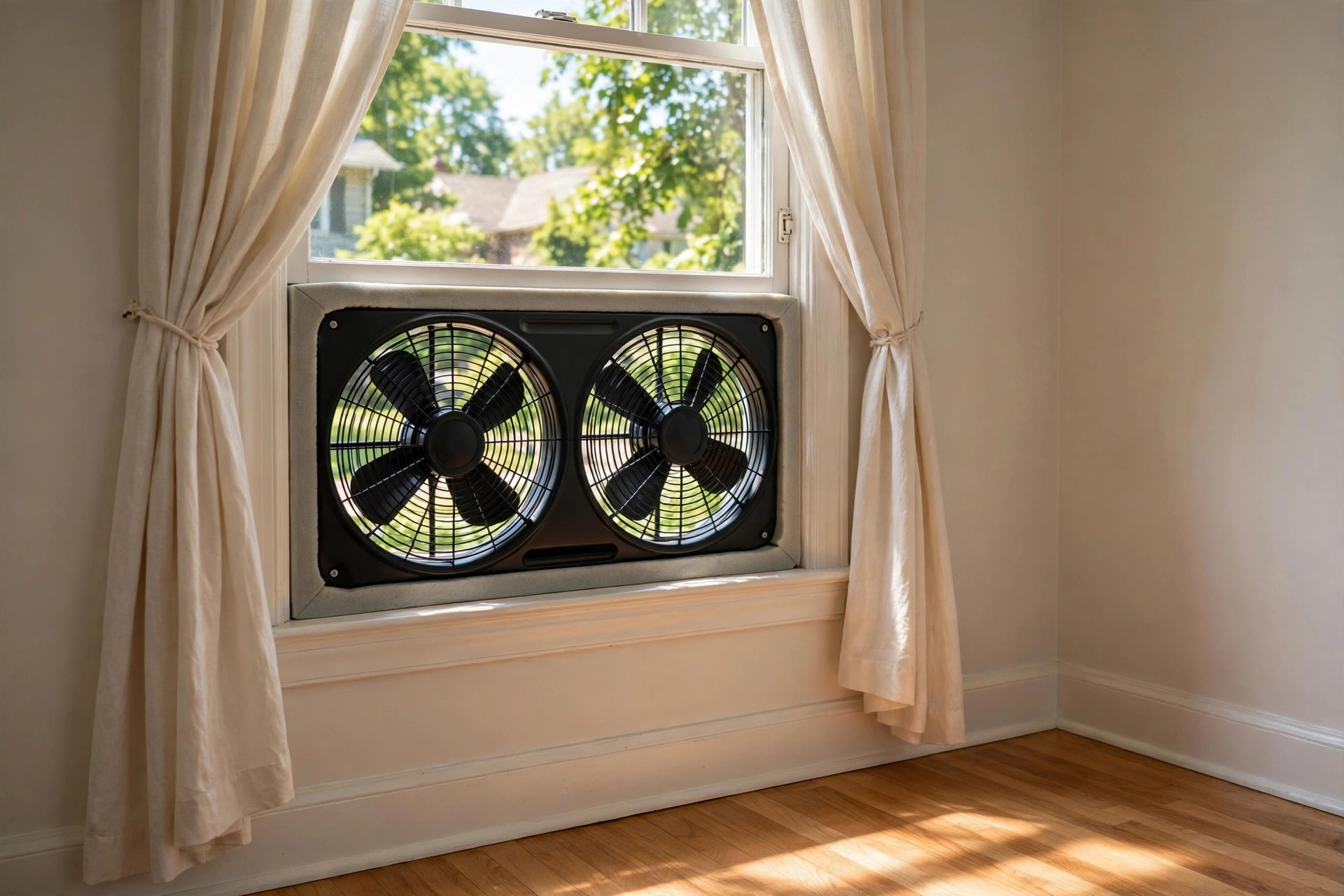
Two blades side by side are the classic window fan. Each blade often reverses on its own. This gives the exhaust in and exhaust out setup in one window. Twin fans are the most common choice in window fan for whole house cooling reviews. They balance air power, noise, and price. Most move 1,200 to 2,500 CFM across two blades. They suit double hung windows best.
High Velocity Window Fans
Some models use a wide blade and a strong motor to move a large volume of air. These look like floor fans sized to sit in a window. They are louder than twin fans on high speed. Buyers use them when the goal is maximum air change per hour. They suit open floor plans and homes with big rooms. Rheem, another well known name in home comfort, notes that strong air circulation can let homeowners raise the thermostat setting without losing comfort (https://www.rheem.com).
Whole House Window Units
A few makers sell window fans built for full house air exchange. These are wide units with three or four blades. They can move 3,000 CFM or more. They are heavier and cost more. Buyers who live in dry climates with cool nights rate them best, because the cool night air can drop the whole house temperature by the morning. Trane advises that night ventilation works best when the outdoor air is at least several degrees cooler than indoors (https://www.trane.com).
Cost and Price
Window fans are among the cheapest cooling tools a homeowner can buy. Single blade models often cost between 30 and 60 dollars. Twin reversible models run from 50 to 120 dollars. High power whole house units cost 120 to 250 dollars. These are one time costs. Running costs are small. A typical window fan draws 50 to 100 watts. At average United States power rates, that is a few cents an hour. Lennox points out that small cooling costs add up over a summer, which is why low wattage fans are such a good value (https://www.lennox.com).
Compare this to air conditioning. A central air conditioner draws 3,000 to 5,000 watts. The seasonal cost difference can reach hundreds of dollars. That is why many buyers use the window fan first and the air conditioner second. Installation cost is near zero for a window fan. The owner sets it in the window and plugs it in. This stands in sharp contrast to built in whole house fans, which need an electrician and a cut in the ceiling. Buyers comparing the two often read the guide to whole house fan installation cost usa before they decide.
Care and Upkeep
A window fan asks little. Keep it clean and it will run for years. Dust gathers on the blades and the grill. Wipe them with a damp cloth once a month in the cooling season. Dust on blades makes the fan noisier and weaker. Check the power cord each spring. Frayed cords are a fire risk and should be replaced with the whole unit if the cord is not detachable. Oil the motor if the maker calls for it. Many modern motors are sealed and need no oil. Read the manual once and follow it. The Family Handyman site offers seasonal checklists that include fan and window unit upkeep for homeowners (https://www.familyhandyman.com).
Store the fan well in winter. Take it out of the window before the first frost. Cold air leaks around a fan left in place all winter. Clean it, wrap the cord, and store it upright in a dry closet or garage. Cover it with a cloth to keep dust off. In spring, seat it back in the window with fresh foam strips. Check that the window screen is in good shape. A good screen keeps bugs out while the fan pulls air in. Goodman Manufacturing reminds homeowners that seasonal care of all cooling equipment is the best way to keep warranties valid and machines safe (https://www.goodmanmfg.com).
Safety
Window fans are simple machines, but a few safety rules matter. Never leave a running fan in a window with no screen when small children or pets can reach it. Keep the fan cord away from curtains and bedding. Plug the fan straight into a wall outlet. Extension cords can overheat under steady load. Turn the fan off before you clean the blades. Unplug it first for full safety. Do not run a window fan in the rain unless the maker rates it for wet use. Most indoor window fans are not built for rain. If your climate has hot, humid nights, know that a window fan adds moisture to the house along with the cool air. In very humid regions, air conditioning still has a job to do.
Frequently Asked Questions
Can one window fan really cool a whole house?
Yes, in the right conditions. The fan must move enough air, and the outdoor air must be cooler than the indoor air. Homes with open doors between rooms cool best. Buyers in dry climates report the strongest results. Buyers in humid climates report that the fan helps most at night.
Which setting works best for whole house cooling?
Most buyers use exhaust mode on an upstairs window in the evening. Hot air rises, so the top floor is where heat collects. A second fan on intake mode in a shaded ground floor window feeds cool air in. This push pull setup is the most praised pattern in reviews.
How does a window fan compare to a whole house attic fan?
A window fan costs less, installs in minutes, and can be moved from room to room. An attic fan moves more air and mounts out of sight, but it costs more and needs wiring. Many homes use both. For a head to head view, see the whole house fan vs attic fan comparison guide.
Are window fans safe to run all night?
Yes, if the unit is in good shape and fits the window firmly. Use the timer or thermostat so it does not run longer than needed. Keep bedding and curtains clear of the grill. Buyers who want brand level detail often check the quietcool whole house fan reviews usa page for quieter whole house options as well.
Will a window fan raise my electric bill?
Very little. A fan drawing 75 watts costs only a few cents per hour to run. Many buyers find their total summer bill falls, because they run the air conditioner less. The fan replaces some compressor hours, and the compressor is the costly part.
What size window fan do I need for a two story home?
Look for a unit rated at 2,000 CFM or more for the main exhaust window. Add a second smaller fan on the intake side if the house is large. Seal the gaps around the fan with foam strips so air goes through the blades, not around them.
A Short Final Word
Window fan for whole house cooling reviews point to one clear lesson. The fan is a small buy with a large payoff when the home and the climate suit it. Size it right, seal it in the window, and use exhaust mode at night. Keep it clean and store it well. For a few dozen dollars and a few cents an hour, many American families get cooler nights, fresher air, and lower summer bills.
References
Carrier. (n.d.). Heating and cooling systems. https://www.carrier.com ENERGY STAR. (n.d.). Energy efficient products. https://www.energystar.gov Family Handyman. (n.d.). DIY home repair and maintenance. https://www.familyhandyman.com Lennox. (n.d.). Heating and cooling systems. https://www.lennox.com Rheem. (n.d.). Heating, cooling, and water heating. https://www.rheem.com This Old House. (n.d.). Home renovation guidance. https://www.thisoldhouse.com Trane. (n.d.). Heating and air conditioning. https://www.trane.com U.S. Department of Energy. (n.d.). Energy efficiency and renewable energy. https://www.energy.gov
Was this guide helpful?

About James Carter
The My Garden US editorial team writes practical, in-depth home and garden guides for American homeowners — tested advice, no fluff.
You May Also Like

Ceiling Fan Installation Cost Near Me: What You Should Expect to Pay
July 25, 2026 0 views
Mini Split for Garage Heating and Cooling: A Practical Guide for Homeowners
July 29, 2026 0 views
Best DIY Mini Split Systems Reviews USA: What Homeowners Should Know
September 17, 2026 0 views