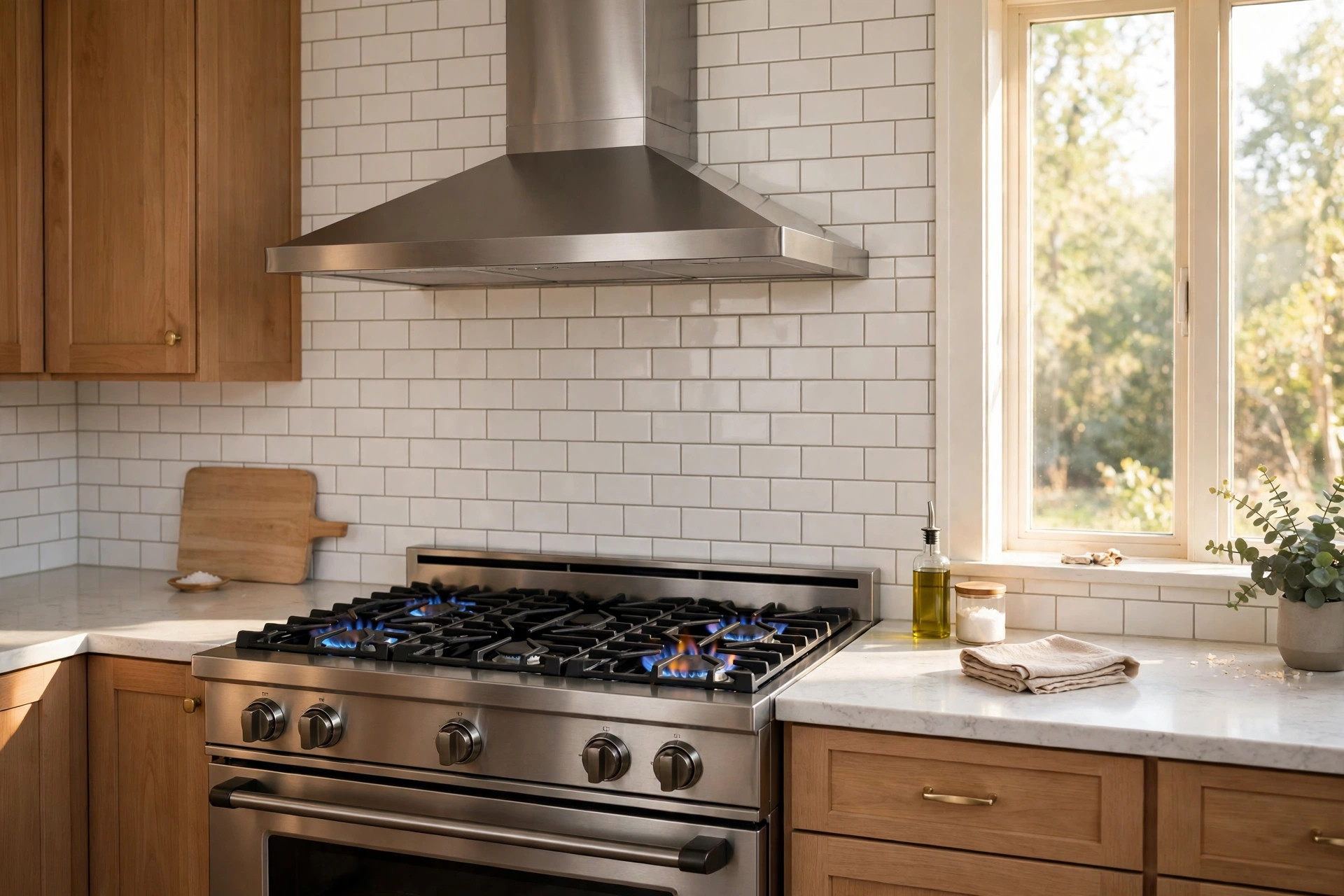

What a Range Hood CFM Calculator for Gas Stove Does
A range hood cfm calculator for gas stove use takes the size and power of your cooktop and tells you how much air your hood must move. CFM stands for cubic feet per minute. It is the measure of airflow. A gas stove puts out more heat and more fumes than an electric stove. That is why it needs more CFM. A calculator saves you from guessing. It turns your burner ratings and kitchen size into one clear number. With that number you can shop with confidence. You can pick a hood that keeps your kitchen air clean.
Why the Right CFM Matters So Much: Range Hood Cfm Calculator for Gas Stove
Cooking on a gas stove creates heat, smoke, grease, steam, and fumes. Gas burners also give off carbon monoxide and nitrogen dioxide. A weak hood cannot carry these away fast enough. Grease then coats your cabinets and walls. Smoke sets off alarms and stains paint. Cooking odors linger for hours. Over time, poor ventilation can hurt indoor air quality. A strong hood pulls the fumes up and pushes them outside. That keeps your air safe and your kitchen clean.
Too much CFM is not ideal either. An oversized hood costs more to buy and more to run. It can be loud. In tight, modern homes, a very powerful hood can pull too much air out. That creates a vacuum in the house. It may pull air down the chimney or out of the furnace flue. So the goal is the right CFM. Not too little, and not too much. A range hood cfm calculator for gas stove sizing gets you to that sweet spot.
Method 1: The BTU Rule
This is the most common method. It ties the hood power to the power of the stove.
First, find the BTU rating of every burner on your gas stove. The manual or the stove label lists these. Add them all together. Then divide the total by 100. The result is the minimum CFM you need.
For example, a 30-inch stove with four burners might have a total of 40,000 BTU. Divide by 100 and you get 400 CFM. A 36-inch pro-style range might total 70,000 BTU. Divide by 100 and you need 700 CFM. A 48-inch range with six burners and a griddle might total 110,000 BTU. That calls for at least 1,100 CFM.
This rule is simple and widely used. Home appliance reviewers and many hood makers point to it as a starting point. It works best for standard cooking. If you sear meat often or use a wok, go higher.
Method 2: The Width Rule
This method uses the width of your stove. It is quick and easy.
Take the width of your cooktop in feet. For a gas stove, plan on 150 CFM per linear foot if you cook at high heat often. Plan on 100 CFM per foot for lighter cooking. A 30-inch stove is 2.5 feet wide. At 150 CFM per foot, that is 375 CFM. A 36-inch range is 3 feet wide. That gives 450 CFM. A 48-inch range is 4 feet wide. That gives 600 CFM.
Some guides use only 100 CFM per foot for all gas stoves. That tends to under-size the hood for serious cooks. A full guide at This Old House notes that gas cooking needs more pull than electric cooking. The width rule is a good cross-check. Run both the BTU rule and the width rule. Then use the larger of the two numbers. That way you stay on the safe side.
Method 3: The Room Volume Rule
This method looks at your kitchen instead of your stove. It is useful for open-plan kitchens where cooking fumes can drift far.
Measure your kitchen in feet: length times width times height. That gives the cubic feet of air in the room. Multiply by 15. That is the number of full air changes per hour a good hood should provide. Then divide by 60 to get CFM.
For example, a kitchen that is 12 feet by 14 feet with an 8-foot ceiling has 1,344 cubic feet. Times 15 is 20,160. Divide by 60 and you get 336 CFM. In a large open kitchen of 2,500 cubic feet, the same math gives 625 CFM.
This method guards against an undersized hood in a big room. The U.S. Department of Energy has long warned that tight, well-sealed homes need careful ventilation planning. Use this method along with the BTU rule for the most honest answer.
What to Look For When You Choose a Hood
Ducted beats ductless. A ducted hood vents air outside through a duct. A ductless hood pushes air through a filter and back into the room. Ductless is better than nothing, but it cannot remove heat or fumes. If you can run a duct, do it.
Hood size matters. Your hood should be at least as wide as your stove. Many pros say go three inches wider on each side. A 30-inch stove pairs well with a 36-inch hood. That extra capture area catches rising smoke before it escapes.
Mounting height. For a gas stove, mount the hood 24 to 30 inches above the cooktop. Too high and the smoke spreads before it reaches the hood. Too low and you may hit your head or fail local codes.
Duct size and run. A strong hood needs a fat duct. Most hoods over 400 CFM need a 6-inch or 8-inch round duct. Keep the run short and straight. Every elbow adds resistance. As a rough rule, each 90-degree bend acts like 25 extra feet of straight duct. The Family Handyman guide shows how poor duct runs starve even strong hoods of airflow.
Filters. Baffle filters are best for gas cooking. They trap grease and wash in the dishwasher. Mesh filters clog faster and need more cleaning.
Noise. Hoods are rated in sones. A quiet hood runs near 1 to 3 sones on low speed. A powerful hood may hit 7 to 9 sones on high. Look for a hood that is quiet at the speed you will use most. Variable speed controls help a lot.
Style. An under-cabinet hood fits under existing cabinets and saves money. An island hood hangs over a cooktop in the middle of the kitchen and needs ductwork through the ceiling. A wall-mount chimney hood is a common choice for a range against the wall. Kitchen design editors compare these styles in depth.
Types of Range Hoods for Gas Stoves
Under-cabinet hoods mount beneath a wall cabinet. They cost less and install fast. They suit standard 30-inch stoves. Their capture area is small, so they work best with moderate CFM.
Wall-mount chimney hoods attach to the wall and run a chimney to the ceiling. They handle higher CFM well. They are a popular pick for 36-inch gas ranges.
Island hoods hang from the ceiling over an island cooktop. They need to be wider than the stove because smoke can drift from every side. They often need 500 CFM or more.
Range hood inserts and liners fit inside a custom wood hood. They give a built-in look with pro-level power. Many carry ratings of 600 to 1,200 CFM.
Downdraft vents rise up from behind the cooktop. They are weak against the natural rise of hot air. They are a poor match for high-BTU gas stoves.
Cost and Price Ranges
A basic under-cabinet hood with 300 to 400 CFM costs about 150 to 400 dollars. A mid-range wall-mount chimney hood with 400 to 600 CFM runs 400 to 1,200 dollars. A pro-style insert or island hood with 900 CFM or more can cost 1,200 to 3,000 dollars and up.
Installation adds to the bill. A simple swap may cost 200 to 400 dollars in labor. Running new ductwork can add 500 to 1,500 dollars. High-CFM hoods may also need a makeup air unit. That can add 500 to 2,000 dollars. Check prices at Home Depot to see current models.
Makeup Air: The Rule Many People Miss
This is the part most buyers skip, and it is the most important safety topic.
A hood over 400 CFM pulls a lot of air out of your house. Fresh air must come in to replace it. In an older, drafty house, air leaks in through cracks. In a newer, tight house, it does not. Without makeup air, the house goes into negative pressure. That can pull carbon monoxide back down the flue of a gas water heater or furnace. That is called backdrafting, and it is dangerous.
Many building codes now require makeup air for hoods rated above 400 CFM. ENERGY STAR ventilation guidance and state codes often point to this threshold. A makeup air unit opens a damper and brings in fresh outside air when the hood runs. Some units also heat the incoming air in winter.
If your range hood cfm calculator for gas stove result is above 400 CFM, talk to your contractor or local building office about makeup air. Do not skip this step. It is a safety issue, not just a comfort issue.
Care and Upkeep
A hood only works as well as its filters. Wash metal baffle or mesh filters every month if you cook daily. Greasy filters choke airflow and can be a fire risk. Wipe the inside of the hood with a degreaser each month. Check the duct once a year for grease buildup or bird nests at the outside cap. If your hood vents through a charcoal filter, replace the filter as the manual directs. A well-kept hood holds its CFM for many years. A neglected one loses power fast.
Safety Tips
– Never leave a gas burner on high with the hood off. Turn the hood on before you light the burner. – Keep paper towels, curtains, and wood utensils away from open flames. – Clean grease filters often. Built-up grease can catch fire. – If you smell gas and the burners are off, do not flip switches. Leave the house and call your gas company. – Make sure the hood exhausts outside, not into the attic or wall cavity. – Install a carbon monoxide detector in or near the kitchen. – The Consumer Product Safety Commission offers free home safety guides worth a read.
Frequently Asked Questions
How many CFM do I need for a 30-inch gas stove? Add up your burner BTUs and divide by 100. Most 30-inch gas stoves total 35,000 to 45,000 BTU, so plan on 350 to 450 CFM. A range hood cfm calculator for gas stove sizing often lands near 400 CFM for this size.
Is 400 CFM enough for a gas range? For a standard 30-inch stove with normal cooking, 400 CFM is usually enough. For a 36-inch or larger range, or for heavy frying and wok cooking, you likely need 600 CFM or more.
What CFM do I need for a 48-inch gas range? A 48-inch pro-style range can total 100,000 BTU or more. The BTU rule gives 1,000 CFM or higher. Plan on a pro-style insert or liner with makeup air.
Do I need makeup air for a 600 CFM hood? In most cases, yes. Codes in many states require makeup air above 400 CFM. Check with your local building department before you buy.
Can I use a ductless hood with a gas stove? You can, but it is not ideal. Ductless hoods filter grease and odors but do not remove heat, steam, or gas fumes. A ducted hood is far better for gas cooking.
How high should a range hood be over a gas stove? Mount it 24 to 30 inches above the cooktop. Check your local code and the hood manual, since some high-CFM models ask for more clearance.
A Short Final Word
A range hood cfm calculator for gas stove sizing takes the guesswork out of a big purchase. Add up your BTUs, check the width and the room size, and use the largest number. Match the hood to that number, run proper ductwork, and plan for makeup air above 400 CFM. Do these things and your kitchen will stay clean, safe, and pleasant for years. Carrier, Trane, and Goodman all publish ventilation guidance that points to the same basic rules.
References
Carrier. (n.d.). Heating and cooling systems. https://www.carrier.com Consumer Reports. (n.d.). Product reviews and ratings. https://www.consumerreports.org ENERGY STAR. (n.d.). Energy efficient products. https://www.energystar.gov Family Handyman. (n.d.). DIY home repair and maintenance. https://www.familyhandyman.com Goodman. (n.d.). Heating and cooling equipment. https://www.goodmanmfg.com The Home Depot. (n.d.). Home improvement products. https://www.homedepot.com This Old House. (n.d.). Home renovation guidance. https://www.thisoldhouse.com Trane. (n.d.). Heating and air conditioning. https://www.trane.com U.S. Consumer Product Safety Commission. (n.d.). Product safety information. https://www.cpsc.gov U.S. Department of Energy. (n.d.). Energy efficiency and renewable energy. https://www.energy.gov
Was this guide helpful?

About Jennifer Lee
The My Garden US editorial team writes practical, in-depth home and garden guides for American homeowners — tested advice, no fluff.
You May Also Like

Under Cabinet Range Hood Reviews 2026 USA: A Practical Buying Guide
July 26, 2026 0 views
Geothermal Heat Pump Cost Per Ton USA: A Plain Guide for Homeowners
May 6, 2026 0 views
Wood Stove Installation Cost Near Me: What to Expect
February 2, 2026 0 views