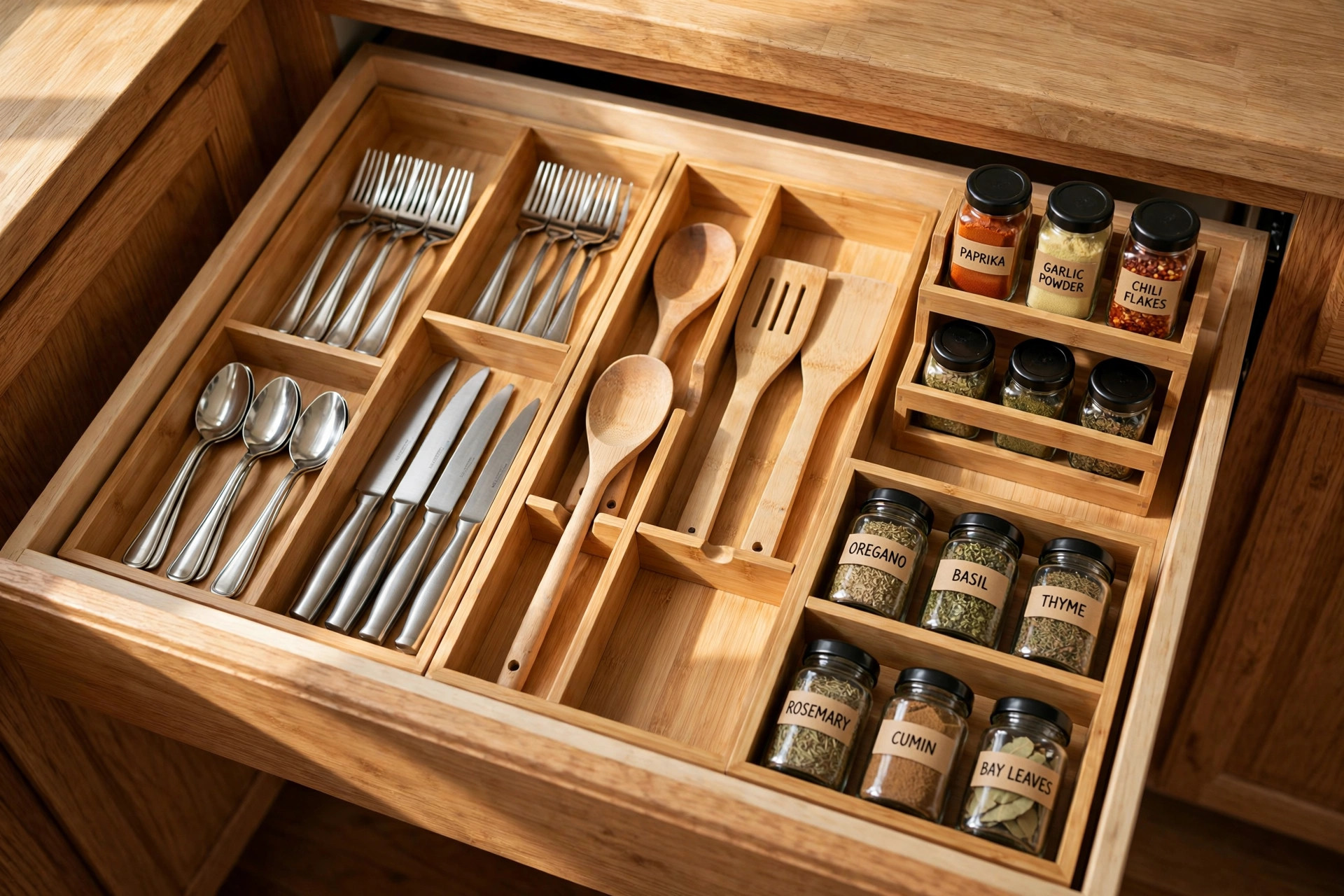

Kitchen drawers take more daily use than almost any other storage space in an American home. Forks, knives, spatulas, whisks, and measuring cups all land in the same few drawers. Without some order, they turn into a noisy tangle within weeks. This kitchen drawer organizers price comparison usa guide is written to help you compare the main types, materials, and prices before you spend a dollar. It shows what each style costs, which homes each style suits, and how to get the best value for your money.
Prices for kitchen drawer organizers in the United States run from a few dollars for a simple plastic tray to well over a hundred dollars for a fitted hardwood system. The gap is not only about looks. Material, size, adjustability, and brand all move the price. A careful comparison saves real money, because the cheapest tray is not always the best deal, and the dearest insert is not always the finest one.
Why Kitchen Drawer Organizers Matter
A kitchen runs on small tools. The cook reaches into a drawer dozens of times a day. When the drawer is a mess, cooking takes longer and nerves fray. An organizer changes this at once. Each item gets a slot. You open the drawer and see what you need. Meal preparation becomes calmer and quicker.
There is also a safety angle. Loose knives and sharp graters slide around in a crowded drawer. A hand that reaches in blind can find the blade instead of the handle. A divider or slot keeps sharp tools fixed in place. Families with children gain peace of mind from this simple habit.
Cleanliness improves too. Crumbs and dust gather in empty corners of bare drawers. A tray with smooth walls lifts out for washing. The drawer beneath it stays far cleaner. For people who take food safety seriously, this matters.
Money is the last reason. Organizers protect your tools. Wooden spoons do not get scratched by metal tongs when each has its own bay. Good knives keep their edges when they rest in slots instead of banging together. Over a year or two, an organizer can pay for itself by cutting down on broken and dulled tools.
What to Look For When You Buy: Kitchen Drawer Organizers Price Comparison Usa
Before you compare prices, know what to judge. Five points matter most.
Measure Your Drawers First
No organizer works if it does not fit. Pull out a tape measure. Write down the inside width, depth, and height of each drawer you plan to outfit. Note the height carefully. Deep drawers can hold tiered trays. Shallow drawers need flat trays. Many returns happen because buyers skip this step. Five minutes with a tape measure prevents the whole problem.
Material
Plastic organizers are the cheapest and the lightest. They wash easily in the sink. Cheap plastic can warp in a hot dishwasher, so check the label. Bamboo organizers cost more but look warm and natural. Bamboo resists moisture better than most soft woods. Hardwood trays, often oak or walnut, cost the most. They feel solid and last for years. Stainless steel inserts suit modern kitchens and clean up fast. Each material has a fair place; the choice is about budget and taste.
Adjustability
Fixed trays have set slots. They work well for standard silverware. Adjustable dividers, usually spring-loaded rods or sliding panels, let you build custom bays. They fit odd tools like rolling pins and long tongs. For deep drawers, an adjustable system is often the wiser buy even at a higher price, because one set can serve several drawers.
Ease of Cleaning
Kitchens are messy places. Look for trays that lift out in one piece. Smooth surfaces wipe down in seconds. Avoid inserts with sharp inside corners that trap dried food. If you plan to wash a tray in the dishwasher, confirm that the maker allows it.
Drawer Depth
Shallow top drawers need low-profile trays, often under two inches tall. Deeper drawers can take two-tier systems, where a sliding top tray covers a lower level. Measure the clear space under the drawer above before you order a tall insert.
Shoppers who want a broader view of kitchen storage can also read our guide to the best kitchen cabinet organizers for American homes, which covers shelves, racks, and pull-out systems beyond the drawer.
Types of Kitchen Drawer Organizers and What They Cost
The market falls into a few clear groups. Here is what each group offers and what it usually costs in the United States.
Cutlery and Silverware Trays
The basic tray. It holds forks, knives, and spoons in long slots. Plastic versions sell for three to ten dollars. Bamboo versions run twelve to twenty-five dollars. Hardwood trays start around twenty dollars and climb past forty for larger sizes. For most homes, this is the first organizer to buy, and a mid-range bamboo tray is the sweet spot of price and life.
Utensil Trays and Dividers
These handle the bigger tools: spatulas, ladles, whisks, tongs. Some are wide trays with square bays. Others are sets of individual dividers you place yourself. Expect five to fifteen dollars for plastic and fifteen to thirty-five dollars for bamboo or wood. Expandable trays, which stretch to fit wider drawers, sit at the top of this range.
Knife Inserts and Docking Blocks
Knife blocks that sit inside a drawer keep blades safe and edges sharp. In-drawer knife docks, usually wooden blocks with slots, cost fifteen to forty dollars. Cheaper universal blocks use bristles or foam to grip blades. They cost less but wear out sooner. For a home with good knives, a proper slotted wood dock is worth the money.
Spice Drawer Inserts
Tiered spice racks that lie flat in a drawer let you read every label at a glance. Plastic and metal versions cost eight to twenty dollars. Bamboo tiered inserts cost fifteen to thirty dollars. Measure the drawer depth before you buy, because these inserts need room for jars to stand at an angle.
Two-Tier and Stacking Systems
For deep drawers, a sliding top tray doubles the storage. The top layer holds small items. Slide it aside and the lower layer holds larger tools. These systems cost twenty to fifty dollars. They are a strong value for homes with a few deep drawers and many small tools.
Custom and Cut-to-Fit Solutions
Some makers sell sheets and rails that you trim to your exact drawer size. These cost more, often thirty to eighty dollars per drawer, but they waste no space. They suit odd or extra-large drawers where standard trays leave gaps. Rental homes and older houses with unusual drawer sizes benefit most from this option.
Readers outfitting small kitchens may also like our roundup of top rated rolling storage carts for small apartments, which adds mobile storage where drawers run short.
Kitchen Drawer Organizers Price Comparison USA: Typical Price Ranges
Here is a plain table-style summary of what American shoppers usually pay today.
– Basic plastic cutlery tray: 3 to 10 dollars – Bamboo cutlery tray: 12 to 25 dollars – Hardwood cutlery tray: 20 to 45 dollars – Expandable utensil tray: 10 to 25 dollars – Adjustable drawer dividers, set of four: 8 to 20 dollars – In-drawer knife dock: 15 to 40 dollars – Tiered spice insert: 8 to 30 dollars – Two-tier sliding system: 20 to 50 dollars – Cut-to-fit custom system: 30 to 80 dollars per drawer
Prices shift with brand, store, and sales seasons. Big-box stores like Home Depot and Lowe’s often price standard trays a few dollars below specialty shops. Discount giants such as Walmart and Amazon run wide selections with frequent price drops, which makes them handy for a straight kitchen drawer organizers price comparison usa shoppers can trust. Specialty organizers from The Container Store tend to cost more but offer cleaner design and better sizing charts.
For the natural-wood look, IKEA sells simple bamboo drawer inserts at gentle prices, and Wayfair lists hundreds of wood and metal options across the whole price range. Review sites like The Spruce test popular trays head to head, while Apartment Therapy shows real kitchens where readers explain what worked in tight spaces. Hands-on guides at Family Handyman walk through measuring drawers and fitting dividers step by step.
How to Compare Prices the Smart Way
A low sticker price can mislead. Compare the full picture.
First, compare cost per drawer, not per piece. A fifteen-dollar expandable tray that fits a wide drawer may cost less per drawer than two eight-dollar fixed trays. Second, check what the price includes. Some sets bundle dividers, a knife dock, and a spice insert. A bundle often beats buying each part alone. Third, read the sizing before you cheer a bargain. A tray that is two inches too wide is money wasted.
Watch for sales cycles. January brings organization sales at many American retailers. Late summer back-to-college season also discounts small storage goods. Buying off-season can cut twenty to thirty percent from the price of wood trays.
Do not forget shipping. A nine-dollar tray with an eight-dollar shipping fee is a seventeen-dollar tray. Free-shipping thresholds at large stores can make a slightly dearer tray the cheaper total buy. Local pickup, where offered, removes the question entirely.
Where to Buy in the USA
You have four main routes. Big-box home stores give you the chance to hold a tray and check its weight and finish before you pay. Online marketplaces give you the widest choice and the easiest price comparison. Specialty organization shops give you expert sizing help and cleaner designs at higher prices. Dollar stores and discount chains give you the lowest prices, with thinner plastic and shorter life.
For most buyers, the best plan mixes routes. Buy standard trays online after a careful price comparison. Buy the pieces you must feel and size, like knife docks, in a store. Readers comparing spin-style corner storage can see our best rotating lazy susan turntables for Texas homes for another angle on cabinet storage value.
Care and Upkeep
Good care stretches the life of any organizer. Empty the tray once a month and shake out crumbs. Wipe plastic trays with warm soapy water and let them dry fully before they go back. Bamboo and wood trays do best with a damp cloth and quick drying; long soaks can swell the joints. A thin coat of food-safe mineral oil once or twice a year keeps bamboo from drying and cracking.
Check spring-loaded dividers now and then. The springs can weaken over years of use. A weak divider slides and defeats its purpose. Replacement divider sets cost little and install in seconds.
Keep the drawer slides clean too. Dust in the slide tracks makes drawers stick, which tempts people to yank them. A yanked drawer throws every tool out of its slot. A quick vacuum of the tracks twice a year keeps the motion smooth.
Safety Notes
Keep knives in slots or docks, never loose. Teach children that the knife drawer is not a play space. If a tray cracks, replace it; a cracked tray has sharp edges that can cut a reaching hand.
Heavy tools belong near the bottom of deep drawers. Top-heavy drawers can tip forward when pulled hard, especially in light furniture. Do not overload a single drawer beyond what its slides can carry. If the drawer sags, spread the load across two drawers.
Some cheap plastic trays give off a strong smell when new. Air them out for a day before use. If the smell persists, return the tray. You should not store food-contact tools in plastic that smells strongly of chemicals.
Frequently Asked Questions
What size drawer organizer should I buy?
Measure the inside of your drawer: width, depth, and height. Buy a tray at least half an inch smaller in width and depth than the inside measurement so it drops in without forcing. For height, leave room for the drawer above to close. When in doubt between two sizes, choose the smaller one and add a divider to fill the gap.
Are bamboo organizers worth the extra cost over plastic?
For most homes, yes. A bamboo tray costs roughly twice a basic plastic one but lasts several times longer. Bamboo resists warping, looks better with age, and wipes clean. Plastic still wins for tight budgets and for drawers that hold wet items, since plastic does not mind standing water.
Can I use one organizer set for all my kitchen drawers?
You can, but it is rarely the best plan. Top drawers need shallow cutlery trays. Deep drawers need tall dividers or two-tier systems. A mixed set, chosen drawer by drawer after measuring, gives a tidier result than one identical tray in every drawer.
How do I stop organizers from sliding around?
Most trays have small rubber feet or a non-slip base. If yours slides, lay a sheet of non-slip drawer liner under the tray. Cut the liner to size with scissors. This simple fix costs a few dollars and solves the problem at once.
Should I buy a matching set or mix and match brands?
Matching sets look neat and often cost less as a bundle. Mixing brands lets you pick the best tray for each drawer. There is no rule. If looks matter to you, buy a set for the drawers guests see. If function comes first, mix freely and choose each piece on merit.
A Final Word
A kitchen drawer organizer is one of the smallest buys a home can make and one of the most felt. For the price of a takeout dinner, you can turn a tangled drawer into a calm tool chest. Use this kitchen drawer organizers price comparison usa guide as your starting point. Measure first. Compare cost per drawer. Weigh material against how long you plan to keep it. Buy the right piece for each drawer, not the flashiest set on the shelf. Do that, and every meal you cook will start a little smoother.
References
Amazon. (n.d.). Online shopping. https://www.amazon.com Apartment Therapy. (n.d.). Home design ideas and inspiration. https://www.apartmenttherapy.com Family Handyman. (n.d.). DIY home repair and maintenance. https://www.familyhandyman.com IKEA. (n.d.). Home furnishings. https://www.ikea.com Lowe’s. (n.d.). Home improvement products. https://www.lowes.com The Container Store. (n.d.). Storage and organization products. https://www.containerstore.com The Home Depot. (n.d.). Home improvement products. https://www.homedepot.com The Spruce. (n.d.). Home and garden advice. https://www.thespruce.com Walmart. (n.d.). Everyday low prices. https://www.walmart.com Wayfair. (n.d.). Furniture and home goods. https://www.wayfair.com
Was this guide helpful?

About Emily Rodriguez
The My Garden US editorial team writes practical, in-depth home and garden guides for American homeowners — tested advice, no fluff.
You May Also Like

Where to Buy Entryway Coat Racks in Texas: A Complete Buying Guide
March 11, 2026 0 views
Premium Pantry Food Storage Containers Buying Guide
April 23, 2026 0 views
Pantry Shelving Units Price Comparison USA
February 13, 2026 0 views