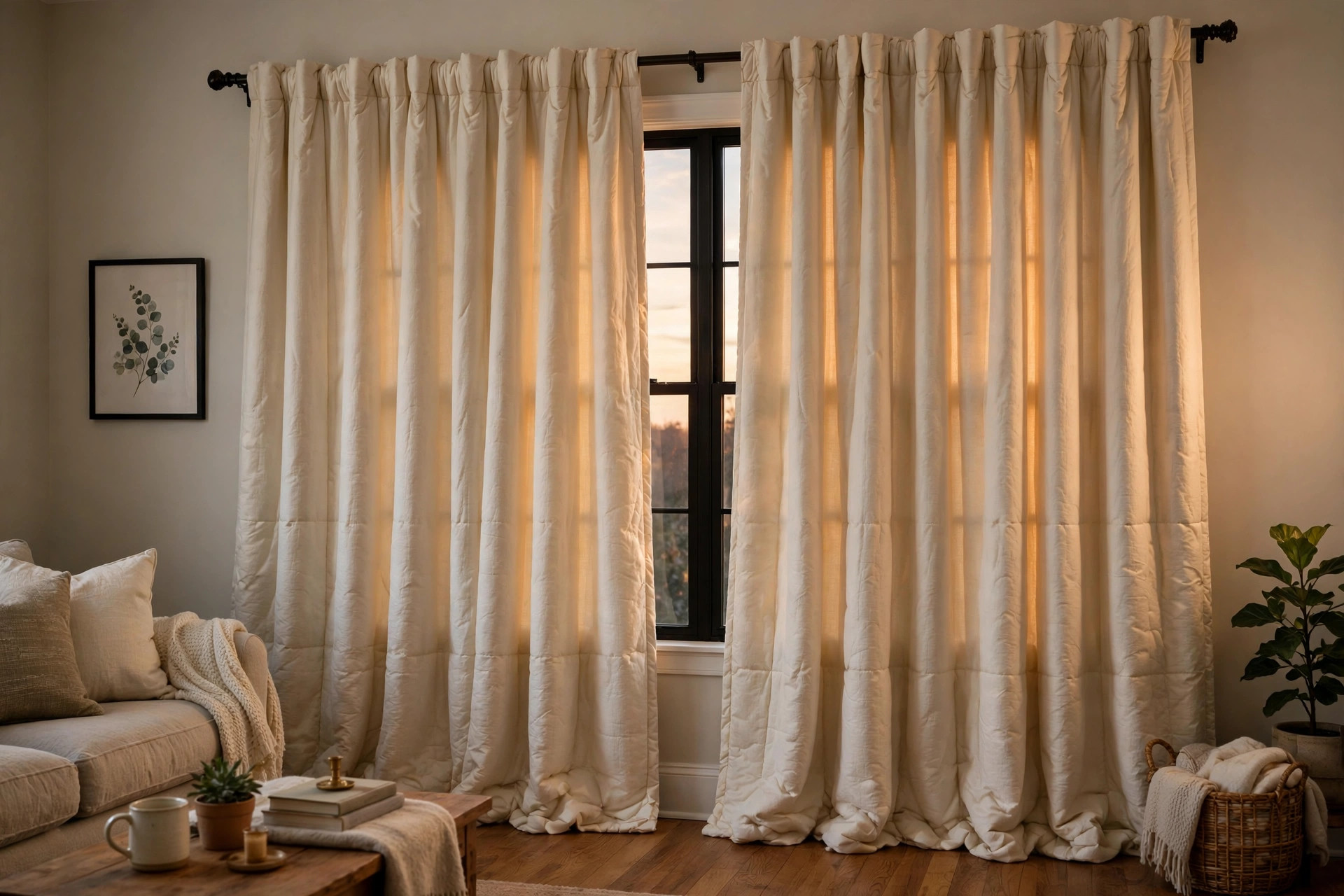

This thermal insulated curtains reviews and buying guide is for the homeowner who wants lower heat bills and a more restful house. Drafty windows can waste a great deal of energy. A thick curtain with an insulating layer will not fix a bad window, but it will slow the loss of heat in winter and block the hot sun in summer. Read this guide before you spend your money. It will show you how these curtains work, what to look for in a review, which types suit which room, what they cost, how to care for them, and how to use them with safety in mind.
Why Thermal Insulated Curtains Matter
A window is the weakest point in most walls. Glass passes heat far faster than drywall and insulation. In winter, warm room air cools against the glass and falls to the floor. In summer, sun pours through the same glass and heats the room like a greenhouse. Energy advisors have long pointed out that window coverings can cut this flow. A well-fitted insulating curtain adds a layer of still air between the room and the glass. Still air is a poor conductor of heat, and that is exactly what you want.
The gain is real but modest. Do not believe a maker who claims a curtain will cut your heat bill in half. A sensible view is this: the curtain reduces drafts near the window, makes the room feel warmer at the same thermostat setting, and trims a few percent from your bill. Comfort is often the larger reward. Chairs by the window feel warmer. The room holds its heat longer after the furnace shuts off. In summer, closed insulating curtains keep the worst of the afternoon sun off the floor and the furniture.
Home improvement editors note that curtains work best as part of a plan. Weatherstrip the window frame first. Seal gaps with caulk. Then hang the curtain close to the wall, wide enough to cover the frame on all sides. Product guides on The Spruce explain that a curtain that hangs inches away from the wall lets warm air slip behind it and rise past the glass, which defeats the purpose.
What to Look For in Reviews: Thermal Insulated Curtains Reviews and Buying Guide
Most reviews of thermal curtains test three things: heat control, light blocking, and looks. Read reviews with care. A five-star review that praises only the color tells you nothing about insulation. A good review says how the curtain felt on a cold night, whether cold air still poured down behind it, and whether it hung straight.
When you read this thermal insulated curtains reviews and buying guide, keep these points in mind.
Fabric weight. Heavier fabric blocks more air movement. Thick cotton blends, velvet, and triple-weave fabrics do better than thin polyester. Velvet drapes have a long record in cold climates for this reason. If you like the look of velvet, our companion piece on navy blue velvet curtains covers their reviews and buying tips.
Insulating layer. True thermal curtains have a middle layer. Some use foam or acrylic bonded to the back. Others use a woven interlining sewn between the face and the lining. The interlining style hangs better and lasts longer. The bonded style is cheaper and common in ready-made panels.
Weave and lining color. A tight weave blocks air. A white or cream lining reflects summer heat back out the window. In winter, the lining side faces the room or the glass depending on the maker, so follow the maker’s directions.
Size. Buy wide and long. The panel should cover the whole frame and reach the floor or the sill. Gaps at the edges leak heat. Oversized panels that overlap at the center are better than two panels that just meet.
Header style. Grommets and back tabs let the panel hang flat against the wall. Pinch pleats look rich but can leave gaps at the folds. Rod pocket tops are simple and cheap but gather the fabric, which opens small channels for air.
Reviewers at Wirecutter and Bob Vila often test curtains in real bedrooms over weeks, which is more useful than a first-day impression. Look for reviews that mention washing, fading, and whether the insulating layer held up.
Types of Thermal Insulated Curtains
Triple-weave panels. Three layers woven as one cloth. The middle layer is usually dark yarn that blocks light. They hang well, need no separate lining, and often come as blackout curtains. They suit bedrooms and media rooms.
Foam-backed panels. A layer of acrylic foam coats the back of a decorative face. They insulate well and block light fully. They are the cheapest option. The foam can crack after years of sun, so they suit rooms where the sun is not brutal.
Interlined drapes. A thick flannel-like layer is sewn between face and lining. These are the most traditional and often the best insulators. They hang in deep folds and look high end. They are common in custom work and cost more.
Two-layer sets. A sheer or light curtain for daytime and a thermal panel for night. This gives the most control. Close both at night for full insulation. Open the thermal panel by day for light and a view.
Cordless and motorized options. For homes that want cellular shades instead of curtains, see our guide to cordless cellular shades for American homes. Cellular shades trap air in honeycomb pockets and rival curtains for insulation.
Home style writers at Apartment Therapy point out that heavy drapes also change the sound of a room. Thick thermal panels soften echoes and muffle street noise. If you live near a busy road, that bonus may matter as much as the heat savings.
How to Choose for Your Room
Bedrooms. Choose blackout thermal panels. Dark rooms help sleep. Measure so the panel covers three to four inches past the frame on each side and falls to the floor. A wide overlap at the center keeps the morning sun out.
Living rooms. You may want light in the day. Use a two-layer set. Keep the look soft. Velvets and heavy cottons suit this room. Check that the fabric tone works with the wall color in daylight.
Nurseries and kids rooms. Cord safety matters most here. Choose panels with no long cords, or use cordless shades. The U.S. Consumer Product Safety Commission guidance on window covering safety is worth reading before you buy for a child’s room. Note that window treatment safety rules apply to blinds and shades as well as curtains.
Small apartments. Ready-made panels save money. One wide panel can cover a sliding door. Renter-friendly tension rods work if the panel is not too heavy. Our page on thermal energy efficient window treatments lists more options for small spaces.
Drafty old windows. No curtain replaces a storm window. If the sash rattles, seal it first. Then hang the curtain on a wrap-around rod so the ends curve back to the wall. This traps a pocket of air over the glass. Editors at This Old House describe this old trick in their window guides.
Cost and Price
Prices vary widely. Ready-made foam-backed panels sell for about twenty to sixty dollars a pair at large retailers. Triple-weave blackout panels run about thirty to eighty dollars a pair. Custom interlined drapes can cost two hundred dollars or more per panel.
What drives the price up: natural fibers like linen and velvet, hand sewing, custom width, deep pleats, and brand names. What keeps it down: polyester face, foam backing, standard sizes, grommet tops.
Check what the pair covers. Some listings show one panel in the photo but sell one panel per pack. Others sell pairs. Read the listing line that says “set of” before you compare prices. Return policies matter too. Hang one panel for a night and check for drafts before you cut tags.
Major home stores carry wide selections. Home Depot and Lowe’s both stock thermal panels in store and online, so you can touch the fabric before you buy. Specialty shops like Blinds.com focus on window coverings and offer many sizes and free samples.
Installation Tips
Measure twice. Measure the frame width and add eight to twelve inches. Measure from the rod to where you want the hem to fall. Write both numbers down and take them to the store.
Mount the rod wide and high. Set brackets four to six inches past the frame on each side and four to six inches above it. This lets the open panel stack off the glass so daylight still enters.
Close them at the right time. In winter, close thermal curtains at dusk and open them on sunny mornings to let free heat in. In summer, close them before the sun hits the window and open them after sunset. This habit matters more than the brand you buy.
Seal the edges. A valance or cornice at the top stops warm air from rising behind the curtain and spilling into the room. Magnetic strips or velcro tape at the sides can close small gaps. Do-it-yourself guides at Family Handyman show simple ways to fit these.
Use with other treatments. A thermal curtain over a cellular shade is one of the best setups for an old, cold window. Two layers beat one thick layer.
Care and Upkeep
Most thermal curtains need gentle care. Read the tag. Many can be machine washed in cold water on a gentle cycle. Foam-backed panels do not like hot water or the dryer. Heat can soften or crack the coating. Hang them to dry or tumble on no heat.
Vacuum the panels with a soft brush now and then. Dust builds up on heavy fabric. Sun fades one side over time. Turn or rotate panels once a year if they take direct sun. Check the backing each year. If the foam flakes or the interlining sags, the curtain has lost much of its value. Replace it.
Velvet and linen panels may need dry cleaning. Factor that cost in before you buy. A thirty-dollar panel that needs forty dollars of cleaning each year is not a bargain.
Storage matters. If you swap curtains by season, fold them loosely in a breathable bag. Do not crush foam-backed panels under heavy boxes. Creases in foam may not come out.
Safety
Curtains hang near heat sources in many homes. Keep fabric at least three feet from space heaters and open fireplaces. Never drape a curtain over a radiator to “help” it. The fabric can overheat and scorch.
Cord safety is the main risk with window coverings. Long pull cords can strangle small children and pets. Choose cordless curtains or keep cords short, high, and out of reach. Tie-downs and cleats help. If you have old corded blinds elsewhere, replace them or fit them with cord shorteners.
Fire safety counts too. Some thermal fabrics are treated to resist flame. Check the label. Keep curtains away from candles. The U.S. Department of Energy notes that window coverings are part of a home’s energy plan, and safe use is part of that plan.
FAQ
Do thermal insulated curtains really work? Yes, within limits. They slow heat flow through the window and cut drafts. They will not fix a broken seal or replace storm windows. Expect more comfort and a small cut in bills, not a miracle.
What is the difference between thermal and blackout curtains? Blackout curtains block light. Thermal curtains block heat flow. Many panels do both, since the layers that block light also slow air movement. Check the label. A blackout curtain with a thin face may not insulate well.
Should the white lining face the room or the window? Follow the maker. Many makers put the reflective lining toward the window to bounce summer heat back out. Others design it the other way. The care tag or package usually says.
Can I wash thermal curtains? Often yes, but gently. Cold water, gentle cycle, no hot dryer for foam-backed panels. Interlined drapes often need dry cleaning. Always read the tag first.
How many panels do I need per window? Two for most windows, wide enough to overlap at the center. One very wide panel works for a narrow window or a door. Measure the covered width, not the window width. The stack should cover the frame plus several inches on each side.
Are expensive thermal curtains worth it? For bedrooms and very drafty windows, yes. Better fabric hangs straighter, seals edges better, and lasts longer. For a mild climate or a spare room, a mid-price panel does the job.
A Final Word
This thermal insulated curtains reviews and buying guide comes down to a few plain rules. Seal the window first. Buy wide and long. Close the curtains at dusk in winter and before the sun in summer. Read reviews for real-world notes on drafts, washing, and wear, not just star counts. A good thermal curtain is a quiet worker. It asks little, costs little to run, and makes the house feel calmer in every season.
References
Apartment Therapy. (n.d.). Home design ideas and inspiration. https://www.apartmenttherapy.com Blinds.com. (n.d.). Window blinds, shades, and shutters. https://www.blinds.com Bob Vila. (n.d.). Home improvement advice. https://www.bobvila.com Family Handyman. (n.d.). DIY home repair and maintenance. https://www.familyhandyman.com Lowe’s. (n.d.). Home improvement products. https://www.lowes.com The Home Depot. (n.d.). Home improvement products. https://www.homedepot.com The Spruce. (n.d.). Home and garden advice. https://www.thespruce.com This Old House. (n.d.). Home renovation guidance. https://www.thisoldhouse.com U.S. Consumer Product Safety Commission. (n.d.). Product safety information. https://www.cpsc.gov U.S. Department of Energy. (n.d.). Energy efficiency and renewable energy. https://www.energy.gov Wirecutter. (n.d.). Product reviews from The New York Times. https://www.nytimes.com/wirecutter
Was this guide helpful?

About Lisa Anderson
The My Garden US editorial team writes practical, in-depth home and garden guides for American homeowners — tested advice, no fluff.
You May Also Like

Top Rated Cordless Cellular Shades for American Homes
March 16, 2026 0 views
Custom Skylight Blackout Blinds With Free Shipping: A Simple Buying Guide
March 24, 2026 0 views
Cafe Curtains for Kitchens Reviews and Buying Guide
February 5, 2026 0 views